

President Hakainde Hichilema has begun a second term in Zambia after an election victory that has been overshadowed by allegations of irregularities, an opposition challenge and the detention of his main rival on treason charges.
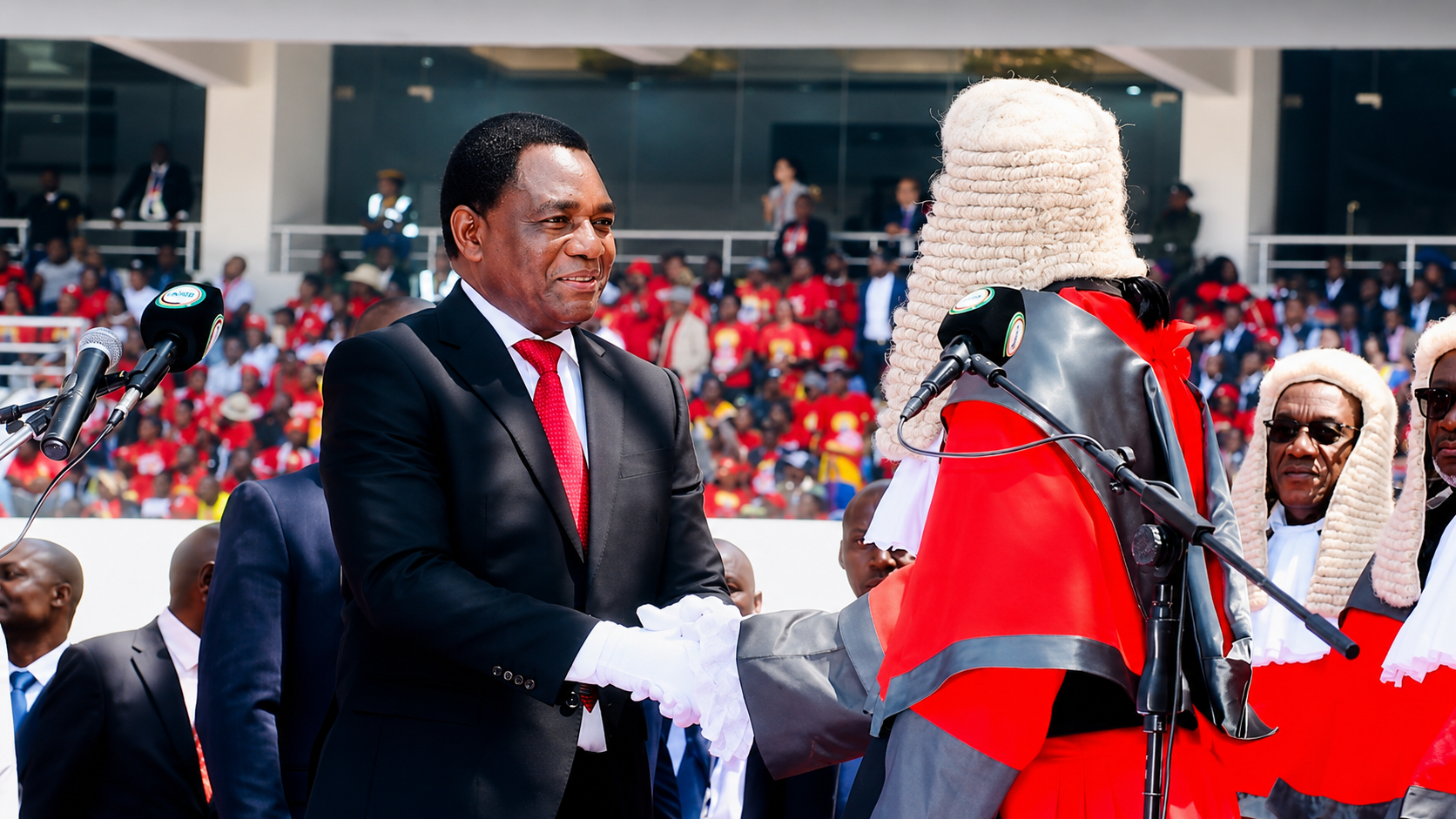
Hichilema was sworn in on Sept. 1 at National Heroes Stadium in Lusaka, pledging to continue his economic programme and serve all Zambians. But the ceremony came at a politically sensitive moment, with opposition leader Brian Mundubile in detention and international observers questioning aspects of the electoral process.
A victory under scrutiny
The Electoral Commission of Zambia declared Hichilema the winner of the Aug. 13 presidential election, giving him about 60% of the vote, according to official results. Mundubile, the National Reconciliation Party for Unity and Prosperity candidate, finished second with about 38%. Mundubile rejected the outcome and said his campaign had documented serious irregularities involving the conduct of voting, counting, transmission and declaration of results. Hichilema has rejected claims that the election was fraudulent.
The dispute has acquired greater significance because Zambia has long been regarded as one of the more stable multiparty democracies in southern Africa. Hichilema himself built much of his political identity around opposition to the previous administration, accusing it of undermining democratic institutions and restricting political opponents. His election in 2021 was widely seen as a peaceful transfer of power and an important moment for Zambia’s democratic system.
The events surrounding the 2026 election have therefore created an uncomfortable contrast. A president who came to office promising democratic renewal is now beginning another term while his principal electoral challenger faces a serious criminal prosecution.
Observers raise concerns
The concerns over the election did not come solely from the opposition. The European Union Election Observation Mission said voting on election day was generally calm and voters were offered a competitive choice, but it also found that advantages associated with incumbency and restrictions on campaigning contributed to an uneven playing field.
The more serious concerns emerged during the counting and tabulation of results.
The EU mission said the Electoral Commission suspended nationwide counting and announcement of results for several hours on Aug. 14 following violent incidents involving polling staff and allegations of ballot box theft. After the process resumed, observers reported a significant deterioration in the transparency of tabulation.
In some counting centres, officials failed to record results on tally sheets immediately after they were announced, contrary to electoral regulations. Observers also reported extended breaks in almost half of the centres they monitored, with returning officers apparently waiting for instructions from the electoral commission headquarters before announcing results.
The EU mission also reported that a heavier military presence at counting centres appeared intimidating to many people and was associated with lower participation by party agents and citizen observers. In Lusaka, an armed group attacked a counting centre in Makeni and took most polling-station result forms, while observers received credible reports of political cadres disrupting counting centres in Kabwe.
The mission has stressed that these findings do not amount to a final assessment of the entire election. Its final report is expected to provide a more comprehensive evaluation after the electoral process and related legal proceedings are complete.
The opposition challenge
Mundubile had said his campaign would challenge Hichilema’s victory in court, arguing that the election was affected by serious irregularities. His ability to pursue that challenge became increasingly uncertain as political tensions escalated after the vote.
On Aug. 27, police said Mundubile and his running mate, Makebi Zulu, had been taken into custody in connection with an alleged offence of treason. Police initially did not provide details of the allegations. Reuters later reported that both men had been formally charged with treason, according to their lawyer.
The case has become one of the defining features of Zambia’s post-election period. Treason is an exceptionally serious charge, and its use against a leading opposition politician inevitably carries political implications, particularly when it follows a disputed national election.
Mundubile has previously described the allegations against him as fabricated. The authorities, however, have presented the matter as a national security case rather than an electoral dispute. The legal process will therefore be closely watched both inside Zambia and abroad.
The timing has intensified concerns among opposition supporters and civil society groups that political competition could become increasingly difficult during Hichilema’s second term.
A difficult contrast
There is an irony in the circumstances surrounding Hichilema’s return to office.
In 2017, Hichilema himself was arrested and detained on treason charges during his time as opposition leader under then-President Edgar Lungu. He spent several months in detention before being released following international pressure and mediation. That experience became part of the political history that shaped Hichilema’s rise to power.
Nearly a decade later, his principal opponent is facing the same type of charge.
That does not establish that the cases are equivalent, nor does it determine whether the allegations against Mundubile have merit. But it creates an unavoidable test for Hichilema’s administration. How the government allows the courts, police and electoral institutions to handle the dispute will influence perceptions of Zambia’s democratic direction.
For Hichilema, the challenge is not simply to defend his electoral mandate. He must also persuade sceptical Zambians and international partners that the institutions surrounding that mandate remain independent and credible.
Economic stakes remain high
The political controversy comes as Hichilema enters a second term with significant economic expectations.
During his first term, his government made debt restructuring and economic stabilisation central priorities. The administration also sought to attract investment and strengthen Zambia’s position as a major copper producer. Hichilema highlighted those achievements during his inauguration and pledged to continue improving the economy.
Investors have so far appeared less alarmed by the political dispute than might have been expected. Reuters reported that allegations surrounding the election had not deterred investors, while Zambia’s debt restructuring remains an important part of the government’s economic agenda.
Copper will remain particularly important. Zambia is one of Africa’s major copper producers, and the global push for electric vehicles, renewable energy infrastructure and other technologies requiring critical minerals has increased attention on African copper resources.
But economic confidence is closely linked to political stability. A prolonged dispute over the election, continued arrests of opposition figures or perceptions of weakening institutions could eventually become more consequential for investors than the immediate market reaction suggests.
Zambia’s democratic test
The African Union and COMESA also deployed observers to the election. Their joint mission involved 93 short-term observers drawn from 27 African countries and monitored voting in hundreds of polling stations across eight provinces. The mission said its preliminary assessment was not a final judgement and that it would continue observing the results-management process and any electoral disputes.
That distinction matters. Election observation missions generally do not determine who legally won an election. Their role is to assess whether procedures were conducted in accordance with national law and recognised democratic standards.
For Zambia, the credibility of the next stage will depend heavily on whether complaints are handled transparently and through established legal mechanisms.
The EU has explicitly urged Zambian authorities and political actors to address grievances peacefully and constructively. It has also called for reported violence to be investigated and for accountability where wrongdoing is established.
That puts responsibility on both sides. The government must allow legitimate opposition activity and ensure institutions operate without political interference. Opposition leaders, meanwhile, must pursue challenges through lawful channels and avoid rhetoric or actions that could contribute to violence.
A second term with a heavy burden
Hichilema now has five years to deliver on his economic promises, strengthen institutions and demonstrate that Zambia’s democratic system remains resilient.
His inauguration itself was orderly, with regional and international dignitaries attending the ceremony in Lusaka. Vice-President Mutale Nalumango was also sworn in, while Hichilema promised to govern with equality and continue his economic programme.
Yet the political backdrop is impossible to ignore.
A second-term president normally begins with an opportunity to consolidate his mandate. Hichilema instead begins with an unresolved debate over the credibility of the election that returned him to power and an opposition leader behind bars on a treason charge.
The immediate question is whether Zambia can move beyond the disputed election without deepening political divisions. The longer-term question is whether Hichilema can ensure that the institutions of state remain stronger than the political interests of any individual government.
For a country that has often been cited as an example of peaceful political transitions in Africa, that will be one of the most important tests of Hichilema’s second presidency.
The result of the election may already have been declared, but the political transition is far from settled. How Zambia handles the dispute, the treason case and the concerns raised by observers could ultimately define Hichilema’s second term as much as his economic record.

More from Elections
Libya’s 24-month election deal: Who really stands to own the country?
Libya’s election roadmap promises political unity, but control of guns, oil, money and foreign alliances may decide who holds power.
Zambia’s Hichilema wins a second term: What it means for Africa’s copper economy
Zambia’s copper boom is entering a critical phase as President Hakainde Hichilema begins a second term focused on investment, production and local value.