

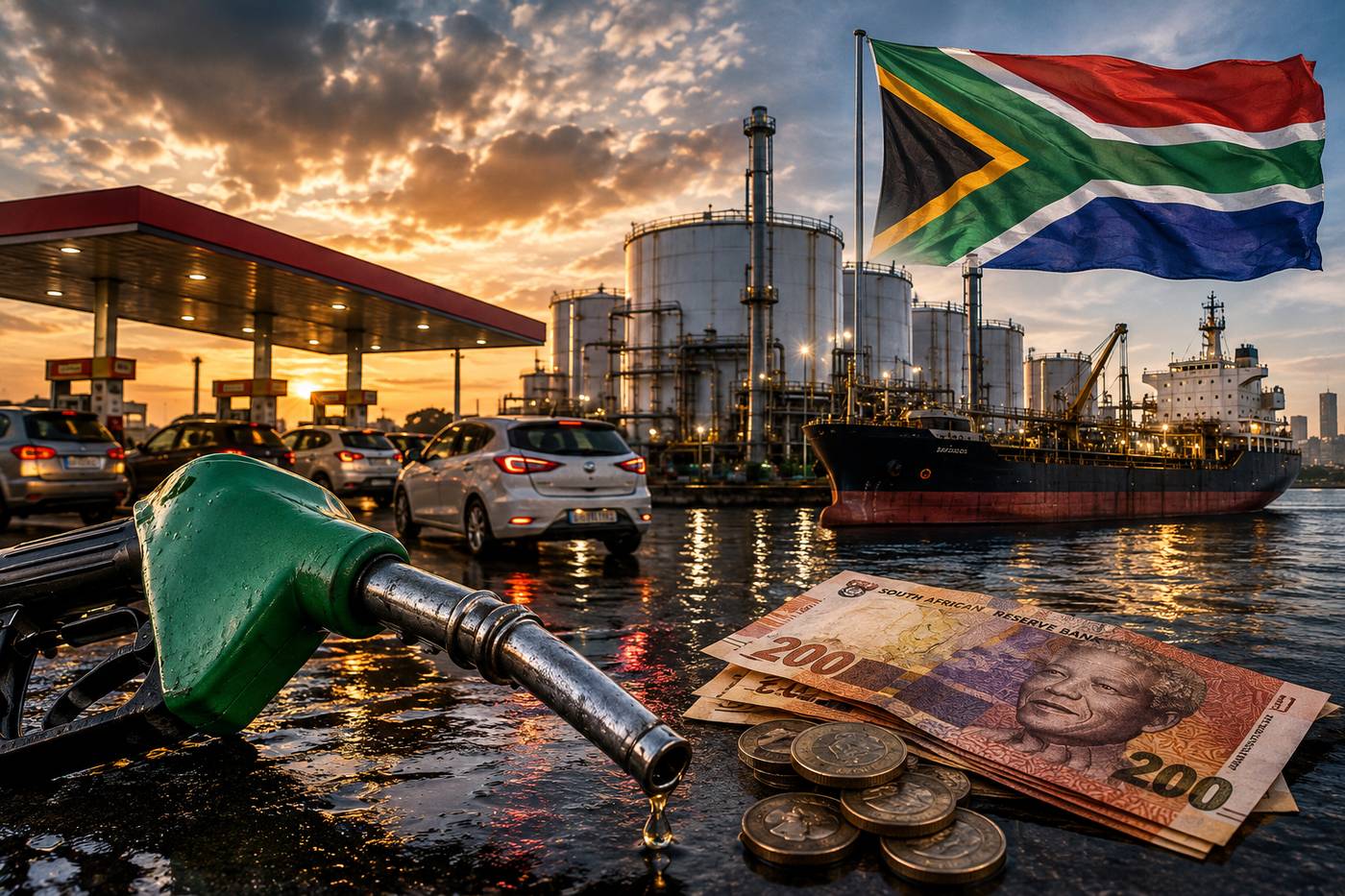
South African motorists are paying sharply more for fuel from September 2, but the bigger story is not only what consumers pay at the pump. It is who controls the infrastructure, refining capacity, imports and supply chains behind every litre.
Petrol prices rose by R1.34 a litre, while wholesale diesel increased by about R2.94 to R3.15 a litre, depending on the grade. The increases reflect higher international petroleum prices, shipping risks, global supply constraints and South Africa’s exposure to movements in the rand against the U.S. dollar. The latest increase therefore offers a window into a much larger African economic question: when energy prices rise, where does the money actually go?
A global shock reaches South Africa
The immediate trigger is largely external. South Africa does not set the international price of crude oil or refined petroleum products, and its regulated fuel-pricing system is designed around an import-parity model. The government’s Basic Fuel Price mechanism effectively calculates what it would cost to source refined products from international markets, bring them into South Africa and then add domestic costs, taxes, levies and regulated margins.
That means a country can have domestic refineries and still remain highly exposed to international energy markets. The Department of Mineral and Petroleum Resources says the Basic Fuel Price is influenced by international crude and petroleum-product prices as well as the rand-dollar exchange rate. During the latest review period, the average Brent crude price rose from $82.37 to $87.88 a barrel. The department also pointed to uncertainty around oil flows through the Strait of Hormuz, higher shipping costs and shortages of refined products. (DMRE)
The result is a familiar pattern across Africa. A geopolitical crisis thousands of kilometres away can quickly become a transport bill, a food bill or a higher electricity and manufacturing cost at home.
Who controls South Africa’s fuel supply?
South Africa’s fuel industry is not controlled by a single company. It is a network of refiners, importers, storage operators, wholesalers, retailers, pipeline and port infrastructure providers and government institutions.
The structure has changed significantly over the past decade. Several major refineries have closed or remained offline, increasing the country’s reliance on imported refined products. South Africa currently has two operational crude-oil refineries, Astron Energy’s refinery in Cape Town and the Natref refinery in Sasolburg, alongside Sasol’s major coal-to-liquids operation at Secunda. The government has acknowledged that refinery closures have altered the country’s fuel-security position.
Natref is particularly important because it supplies the inland market. Sasol is the majority shareholder, while the refinery’s minority ownership has been associated with the Prax Group following TotalEnergies’ agreement to sell its 36.36% stake. Natref has a nameplate capacity of roughly 108,500 barrels per day.
Astron Energy, meanwhile, operates the Cape Town refinery, one of the country’s remaining conventional crude-processing facilities.
Other infrastructure is equally strategic. Durban’s Island View Precinct, for example, is a major liquid-bulk and petroleum storage hub used by several companies. Parliament has described it as strategically important to the fuel industry, with infrastructure connected to import, storage and distribution operations involving companies including Sasol, Engen, TotalEnergies and Astron Energy.
The ownership question is therefore bigger than the petrol station on the corner. Control over storage tanks, ports, pipelines, refineries and import terminals can be just as economically important as ownership of the fuel brand consumers see.
Who benefits when prices rise?
It would be misleading to say that oil companies simply pocket the entire increase. South Africa’s fuel price includes several components, including the international product cost, transport and storage costs, taxes, levies and regulated margins.
The government’s pricing structure specifically provides for wholesale and retail margins. The wholesale margin is intended to provide marketers with a benchmark return on their depreciated assets, while the retail margin reflects costs incurred by service-station operators. Government also collects fuel-related taxes and levies.
But higher international prices can still create opportunities for parts of the energy value chain.
Refiners can benefit when the margin between crude input costs and refined-product prices widens. Recent Reuters reporting illustrates how powerful this effect can be globally. European gasoline refining margins rose above $62 a barrel in early September as fuel supplies tightened, while diesel margins also remained elevated.
Sasol provides an important South African example. The company reported a 9% increase in annual profit for the year ended June 30, 2026, helped by higher oil prices and increased fuel sales volumes. Sasol also operates one of Africa’s most important integrated energy and chemicals businesses.
For investors, the lesson is important. Rising pump prices do not automatically mean every energy company becomes more profitable. The winners depend on where a company sits in the value chain, how much product it owns, its exposure to crude and refined-product prices, its debt burden and whether it can pass higher costs to customers.
Diesel is the bigger economic problem
Petrol affects households directly, but diesel can be more consequential for the wider economy.
Trucks, tractors, mining equipment, generators, construction machinery and many industrial operations depend heavily on diesel. When diesel rises by roughly R3 a litre, the effect moves far beyond filling stations.
Agriculture provides one of the clearest examples. Farmers use diesel to operate tractors, harvesters, irrigation equipment and other machinery. Reuters reported earlier this year that South African farmers were already struggling with sharply higher diesel costs during the harvest season, with the agricultural industry warning that fuel represents a significant share of farming costs.
The impact then travels through the supply chain.
A farmer pays more to plant and harvest crops. A transport company pays more to move those crops. A processor pays more to operate machinery and transport finished products. A retailer faces higher distribution costs. Eventually, some of that cost reaches consumers.
This is why diesel inflation can be more dangerous than a simple increase in the cost of driving a private car. It can become embedded across the economy.
Africa’s import problem
South Africa’s vulnerability is part of a wider continental problem.
Africa produces substantial quantities of crude oil, yet many African countries remain dependent on imported refined petroleum products because they lack sufficient modern refining capacity. The result is an uncomfortable paradox: countries can export crude while importing the petrol and diesel their own economies consume.
Recent disruption has exposed that vulnerability. Reuters reported that Asian diesel exports to Africa surged to between 1.8 million and 2 million metric tons in August, reaching a 4.5-year high as Middle Eastern supplies fell sharply. The report said roughly half of Africa’s diesel imports last year came from the Middle East, with Saudi Arabia alone accounting for about 40%.
This is not simply a fuel issue. It is a sovereignty issue.
Every tanker of imported refined fuel represents exposure to international prices, shipping costs, currency movements, geopolitical tensions and maritime chokepoints.
Can Africa refine its own fuel?
The answer is yes, but building refineries is expensive and complicated.
Nigeria’s Dangote refinery has become the most visible example of Africa’s attempt to expand domestic refining. The facility has a capacity of around 700,000 barrels per day and is designed to transform Nigeria from a major crude producer and fuel importer into a significant refined-product supplier.
Yet even Dangote demonstrates that refining alone does not solve every problem. Reuters reported in July that the refinery began pricing fuel products in dollars after difficulties securing enough domestic crude through Nigeria’s naira-for-crude programme. The refinery needs more crude cargoes than it has been receiving domestically and has had to source additional supplies at international prices.
That experience carries an important lesson for Africa. Energy independence requires more than constructing a refinery. Countries need reliable crude supply, ports, pipelines, storage, electricity, skilled workers, financing and stable regulation.
East Africa is now considering the same strategy. Kenya, Tanzania, Uganda, South Sudan and the Democratic Republic of Congo have discussed a regional refinery initiative, with Tanzania’s Tanga port considered as a possible location. At the same time, Dangote has proposed a large refinery project in Kenya’s Lamu region.
Where are the investment opportunities?
The opportunity extends beyond traditional oil production.
Africa’s growing energy demand creates potential investment opportunities in refining, fuel storage, pipelines, ports, natural gas, renewable power, electricity transmission, battery storage and energy-efficient transport.
For traditional investors, companies with strong refining, distribution or storage assets may gain from higher utilisation and regional demand. Infrastructure investors may find opportunities in terminals, pipelines and logistics networks that connect energy producers with consumers.
There is also a longer-term opportunity in renewable energy. Africa has enormous solar resources, while many countries remain heavily dependent on imported petroleum for transport and electricity generation. Expanding solar, wind, battery storage and electric mobility could gradually reduce exposure to imported oil.
But the transition will not happen overnight. Trucks, mining equipment, agricultural machinery, aviation and shipping will continue to require liquid fuels for years. This means Africa’s energy strategy is likely to be a combination of conventional fuels and new energy technologies rather than an immediate switch from one system to another.
The real ownership question
The September fuel increase ultimately raises a bigger question than why motorists are paying more.
It asks who owns the infrastructure that determines whether Africa is merely a consumer of global energy or becomes a producer, processor and distributor of its own energy.
For South Africa, the priority is not simply keeping petrol prices low. It is rebuilding resilience across refining, storage, ports and supply chains while maintaining competition and attracting investment.
For the wider continent, the opportunity is even larger. Africa has crude oil, natural gas, sunlight, minerals and enormous potential for renewable energy. What it has lacked is enough infrastructure and capital to convert those resources into reliable, affordable energy for its own economies.
The companies that control that infrastructure could become some of the most strategically important businesses on the continent.
The fuel shock therefore offers a warning, but also an investment signal. Africa’s next energy story may not be about who owns the oil. It may be about who owns the refineries, pipelines, storage terminals, electricity networks and technologies that turn energy into economic power.

More from Energy
Somalia oil and gas: Why global energy companies are watching the Horn of Africa
Turkish drillship Çağrı Bey pushes deep offshore Somalia as global energy companies watch Mogadishu's oil exploration bets to revive its fragile economy.
Nigeria wants to become Africa’s energy powerhouse — Can the IEA partnership deliver?
Nigeria’s IEA partnership could unlock investment, strengthen energy security and support ambitions to become a leading African energy powerhouse.
Africa has the sun. Who owns the solar boom?
Africa’s solar boom is reshaping energy markets as investors, governments and African businesses compete for ownership, profits and influence continentwide.