

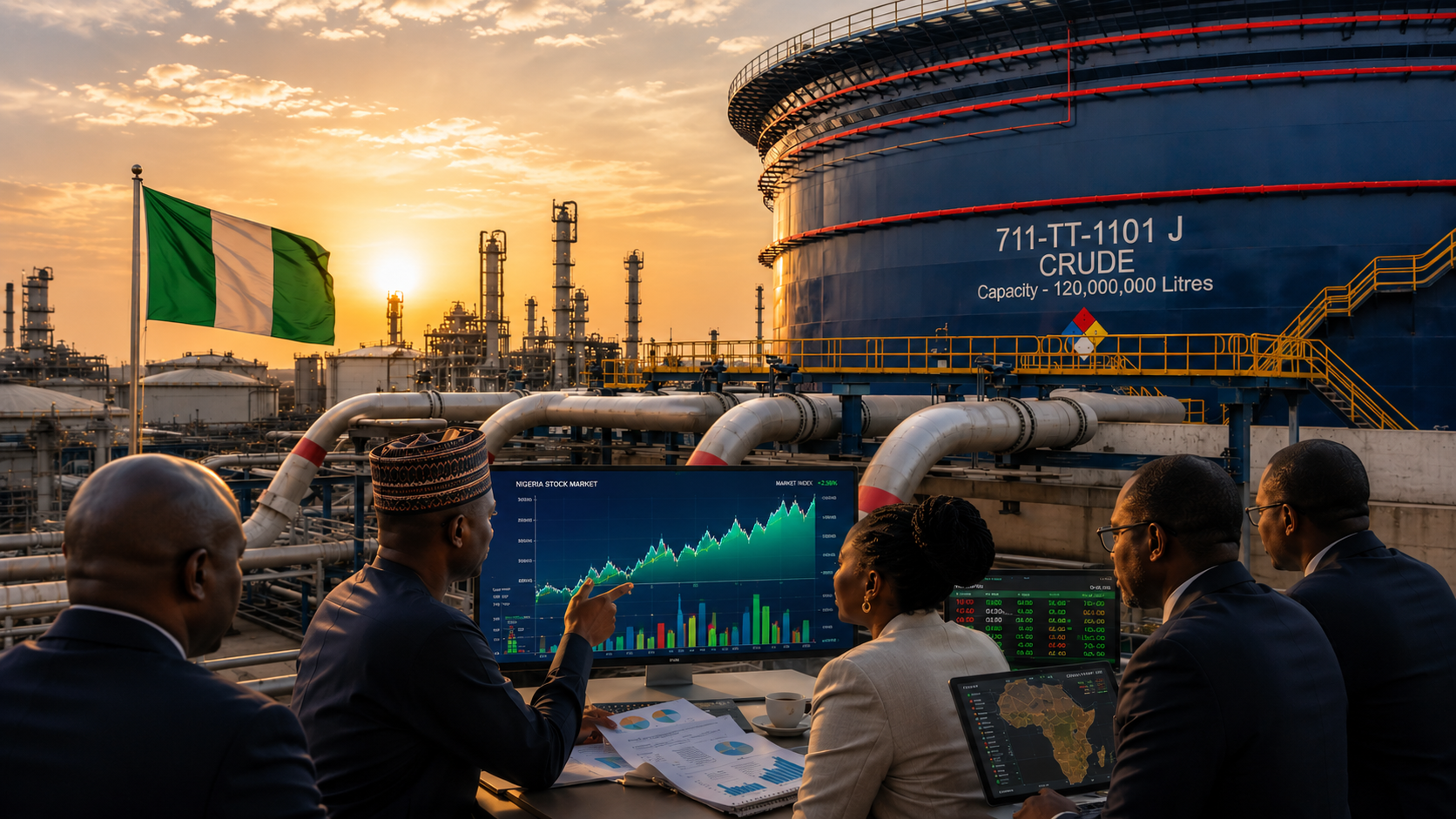
The Dangote Petroleum Refinery is moving closer to what could become one of Africa’s biggest stock market listings, and the significance goes beyond the billions of dollars that could be raised. The proposed IPO could mark a rare opportunity for African pension funds, sovereign investors, institutions and ordinary Nigerians to take direct ownership of a strategically important energy asset that has traditionally been controlled by a small number of large investors.
The refinery, built by billionaire Aliko Dangote near Lagos, has secured a $1 billion underwriting programme ahead of its planned initial public offering. The programme includes a completed $600 million private placement and another $400 million commitment to support the eventual IPO. Marob Strategies and Lilium Capital are coordinating the transaction and targeting investors across Africa and the Caribbean.
For Who Owns Africa, however, the bigger question is not simply how much the refinery is worth.
It is who will own it next.
From Dangote to the market
The Dangote refinery represents an unusual concentration of industrial capital in Africa.
The roughly $20 billion complex is designed to process hundreds of thousands of barrels of crude a day and has become one of the most important new energy assets on the continent. Reuters reported this month that the refinery has applied to Nigeria’s Securities and Exchange Commission for a proposed $5 billion IPO, although the final size of the offering has not yet been determined.
The planned flotation is expected to focus initially on Nigerian investors rather than immediately pursuing a foreign listing.
That is an important distinction.
The company has said it wants the IPO to encourage broad Nigerian participation. Chief Executive David Bird told Reuters that there are currently no plans for a foreign listing for at least three years. The approach would put the Nigerian public and domestic institutional investors at the centre of the first ownership transition.
The refinery would therefore move from being overwhelmingly associated with one of Africa’s most powerful industrial groups towards a wider shareholder structure.
That could be one of the most consequential ownership shifts in modern African business.
Who owns Dangote?
At the centre of the story remains Aliko Dangote.
Dangote founded the group that carries his name and remains its president and chief executive. The group has interests spanning cement, fertiliser, sugar, salt and oil and gas, with operations across numerous African countries.
The refinery is part of Dangote Industries Limited, rather than being an independent company unrelated to the wider Dangote structure.
Public filings from Dangote Cement provide a useful picture of the ownership architecture behind the conglomerate. They identify Aliko Dangote as the ultimate owner of Dangote Industries Limited. Dangote Industries itself holds a dominant 86.65% stake in listed Dangote Cement, illustrating how the wider group has historically maintained concentrated control over major operating businesses even when some subsidiaries have been publicly traded.
The refinery IPO could begin to alter that model in the energy business.
Instead of one dominant industrial owner controlling the refinery through the private group, shares could increasingly be distributed among institutions and individual investors.
NNPC already has a stake
The Nigerian state is not entirely absent from the ownership structure.
Nigeria’s national oil company, NNPC Ltd, currently owns 7.25% of the Dangote refinery. NNPC said in February that the stake represented a strategic investment in the country’s downstream petroleum sector.
That position makes the IPO more than a conventional private-company flotation.
The refinery is closely connected to Nigeria’s national energy security, and the ownership structure has already become a question of public interest.
Earlier this year, Dangote said his group rejected an approach from NNPC to increase its stake in the refinery. His stated reason was that the company wanted to broaden ownership rather than concentrate additional equity in the national oil company.
That decision provides an important clue about the intended direction of the IPO.
The objective is not simply to find another large shareholder.
It is to create a broader shareholder base.
The pension-fund opportunity
This is where African capital could become particularly important.
The $1 billion underwriting programme is being positioned as a mechanism for bringing African and Caribbean sovereign wealth funds, governments and institutional investors into the transaction.
That could include the type of long-term capital that African economies have historically struggled to deploy into their own major infrastructure.
Pension funds are particularly relevant.
Across Africa, pension schemes manage substantial pools of long-term savings, but much of that capital has historically faced limited opportunities to invest directly in large, productive industrial assets on the continent.
A refinery with established infrastructure, domestic demand and export potential presents a different proposition from financing a speculative start-up.
If African pension funds become meaningful shareholders, the refinery could effectively turn part of Africa’s long-term savings into ownership of an African energy asset.
That would be a significant shift.
Could Africans own more of Africa?
The question extends beyond Dangote.
For decades, some of Africa’s largest mines, energy projects, banks, telecommunications businesses and infrastructure assets have relied heavily on international capital.
Foreign investment remains essential. African economies need external financing, technology and expertise.
But ownership is another question.
The Dangote IPO creates a test case for whether African institutional investors can become major owners of the continent’s most valuable companies.
The interest from African and Caribbean investors in the refinery’s private placement suggests there is appetite for such assets. The advisers involved in the transaction say they are coordinating distribution among sovereign wealth funds, governments and institutional investors across what they describe as “Global Africa”.
If that participation becomes substantial, the transaction could demonstrate that African capital is capable of funding and owning African industrial growth rather than simply financing government debt or investing outside the continent.
A refinery changing Nigeria’s oil equation
The ownership story is only half of the significance.
The refinery is also changing Nigeria’s relationship with imported fuel.
For years, Africa’s largest oil producer depended heavily on imported refined petroleum products because its domestic refining system was unable to meet national demand reliably.
The Dangote refinery was built to challenge that model.
Reuters reported in June that the facility had developed a significant surplus of jet fuel and could become a global supplier, while its expansion strategy targets 1.4 million barrels per day by 2028.
The refinery is therefore becoming more than a domestic fuel supplier.
It is positioning itself as an export platform.
That matters because Nigeria sits at the centre of one of Africa’s largest energy markets. A large integrated refinery can potentially capture value that previously flowed overseas through imports of finished petroleum products.
For Nigeria, the economic argument is straightforward: refine more crude domestically, reduce dependence on imported products and retain more industrial value inside the country.
For investors, the attraction is equally clear.
A company serving Nigeria’s enormous domestic market while selling products into regional and international markets offers exposure to an energy business with both local and export dimensions.
The valuation question
The IPO will also test how investors value African industrial assets.
A $5 billion IPO application does not mean the refinery will necessarily raise $5 billion or that investors will value the company at a particular figure.
The final size and pricing remain subject to regulatory approvals, market conditions and the offering structure. Reuters has reported that a July private placement valued the refinery at about $40 billion, with the $2.5 billion transaction reportedly oversubscribed 3.7 times. Africa Finance Corporation led that investment round.
That valuation will face scrutiny.
Refineries are capital-intensive businesses exposed to crude prices, refining margins, foreign exchange movements, interest rates, government policy and global energy demand.
The refinery’s ability to operate efficiently and generate sustainable cash flow will ultimately matter more to public shareholders than its symbolic importance.
The market will have to decide what Dangote’s energy ambitions are worth.
Beyond one billionaire
There is a larger story here.
Dangote’s refinery began as one man’s extraordinary industrial bet. Its next chapter could become a test of whether that asset can evolve into something owned by a much broader African investor base.
That would not diminish Dangote’s role.
Instead, it could represent a transition from private industrial ownership to public African ownership.
The distinction matters.
If the IPO succeeds, Nigerian households could own shares. Pension funds could participate. African sovereign investors could gain exposure. Caribbean institutions could become shareholders. Local capital markets could gain a landmark company. And the refinery itself could gain access to a wider pool of capital for expansion.
The company is already considering an expansion that could take refining capacity to 1.4 million barrels per day.
The bigger question is whether the ownership base can expand at the same speed.
Who owns Africa’s energy future?
The Dangote refinery IPO is therefore about more than a stock market debut.
It is about whether Africans can become owners of the infrastructure that increasingly determines Africa’s economic future.
For decades, the continent’s ownership debate has centred on who extracts its resources, who finances its infrastructure and who ultimately captures the profits.
The Dangote refinery offers a different possibility.
The asset was built with African entrepreneurial capital. It is serving an African market. It is increasingly exporting into global markets. And now its ownership could be opened to African investors.
If the IPO delivers on that promise, the refinery may become a landmark not simply because it is Africa’s largest refinery, but because it could help demonstrate that African savings can become African ownership.
That would make Dangote’s next transaction one of the continent’s most closely watched capital-market events.
The question facing investors is no longer simply whether the refinery can refine enough oil.
It is whether Africa can own enough of the refinery.

More from Energy
Somalia oil and gas: Why global energy companies are watching the Horn of Africa
Turkish drillship Çağrı Bey pushes deep offshore Somalia as global energy companies watch Mogadishu's oil exploration bets to revive its fragile economy.
Nigeria wants to become Africa’s energy powerhouse — Can the IEA partnership deliver?
Nigeria’s IEA partnership could unlock investment, strengthen energy security and support ambitions to become a leading African energy powerhouse.
South Africa’s fuel shock: Who really profits?
South Africa’s fuel shock exposes the companies, supply chains and investment choices shaping Africa’s energy security and economic future.