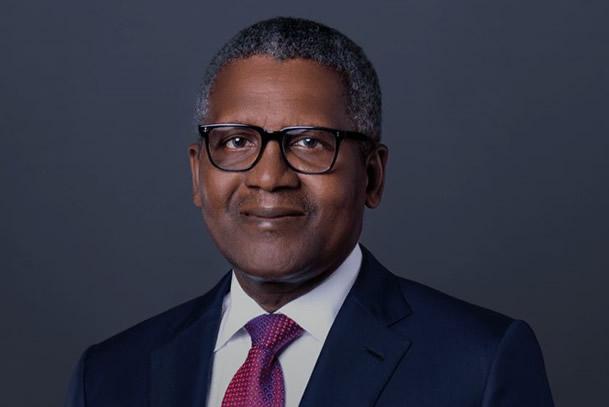
East Africa’s economic future may increasingly be influenced by decisions made in Lagos, not because Nigeria’s richest industrialist controls the region, but because Aliko Dangote is positioning private African capital at the centre of industries that governments across the continent have struggled to develop. From cement manufacturing in Tanzania and Ethiopia to ambitious proposals involving petroleum refining, fertiliser and regional infrastructure, his expanding interests raise a bigger question: who will control the industries that shape Africa’s next phase of economic development?
The question of who owns East Africa is not simply about land, companies or individual fortunes. It is about who finances the factories, controls essential supply chains, builds industrial infrastructure and ultimately captures the economic value generated by the region’s growing population.
Dangote’s ambitions offer an interesting lens through which to examine that question. His investments demonstrate the possibilities of African entrepreneurship on a continental scale, but they also expose a difficult contradiction. Africa wants industrial independence, yet much of its industrial future may depend on a relatively small number of powerful private investors.
Understanding that contradiction is essential to understanding the significance of Dangote’s expanding presence.
The industrial ambition behind Dangote’s empire
Aliko Dangote’s business empire did not become influential simply because of the size of his personal fortune. Its significance comes from a business strategy built around industries that underpin economic development.
Cement, fertiliser, petroleum refining and infrastructure are not ordinary consumer businesses. They influence the cost of constructing homes, operating factories, transporting goods, producing food and developing cities.
Dangote recognised that Africa’s dependence on imported industrial products represented a commercial opportunity. Rather than concentrating exclusively on importing and distributing finished goods, his companies increasingly invested in manufacturing facilities capable of supplying domestic and regional markets.
Cement became one of the clearest demonstrations of that strategy.
Dangote Cement has developed production operations across 11 African countries. Its published 2025 investor presentation reports an installed production capacity of approximately 55 million tonnes annually across its African operations.
The company’s presence in Tanzania and Ethiopia is particularly relevant to East Africa because these markets provide a foundation for its wider industrial ambitions.
The strategy is straightforward but commercially significant: establish production closer to consumers, secure access to essential raw materials, develop distribution networks and reduce dependence on imported finished products.
It is a model that could have consequences extending well beyond the cement industry.
East Africa becomes a strategic industrial frontier
Dangote’s East African footprint is not uniform. Some investments are established manufacturing businesses, others are joint ventures, while several major projects remain at different stages of development.
Tanzania provides one of the clearest examples of an established presence.
Dangote Cement operates an integrated cement manufacturing facility in Mtwara, with an installed annual capacity of approximately three million tonnes. The group held a 99.7% interest in its Tanzanian cement subsidiary at the end of 2025.
The location matters. Tanzania offers access to coastal transport routes and a growing domestic construction market. Its position also creates opportunities to serve neighbouring countries where infrastructure investment and urban expansion are generating demand for building materials.
Ethiopia presents a different opportunity.
Dangote Cement operates a 2.5-million-tonne-per-year integrated plant in the country. Its Ethiopian subsidiary was 99.97% owned by the group at the end of 2025.
The company’s management has also identified Ethiopia as an important expansion market, reporting that existing production capacity is being fully utilised.
These investments reveal an important distinction. Dangote is not simply entering East Africa to sell products. He is establishing production capacity in markets where industrial supply constraints can create opportunities for large-scale manufacturers.
However, the strategy also exposes the limitations of the region’s industrial environment. Electricity costs, transport infrastructure, foreign exchange restrictions, regulatory uncertainty and access to financing can determine whether an otherwise promising manufacturing investment becomes profitable.
Kenya and the $16 billion refinery question
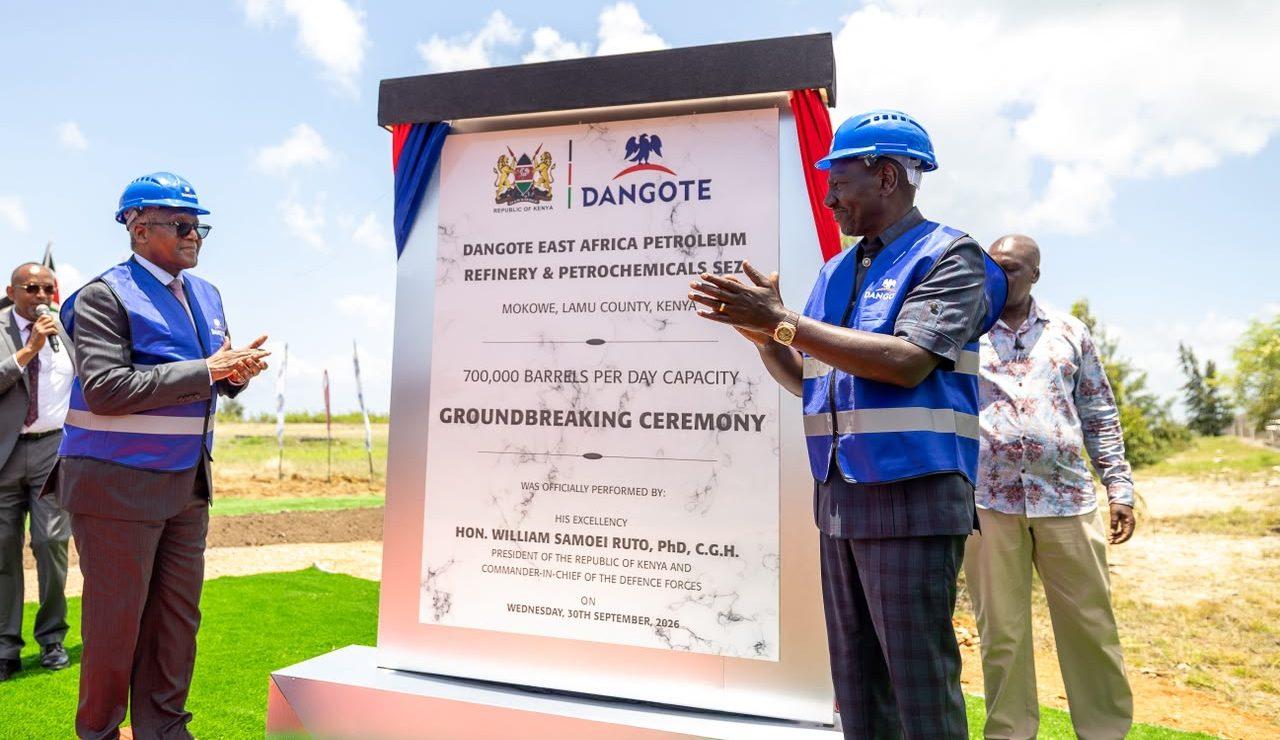
Kenya could become the most consequential chapter in Dangote’s East African ambitions.
On September 30, 2026, Dangote and Kenyan President William Ruto participated in the groundbreaking ceremony for a proposed 700,000-barrel-per-day petroleum refinery in Lamu County.
The project has an estimated investment value of $16 billion and is designed to serve Kenya and wider regional markets. It is intended to process crude oil from East African sources and support associated petrochemical industries.
The significance extends beyond petroleum.
A refinery of this scale could create demand for engineering services, logistics, storage facilities, transportation, chemicals, industrial packaging and specialised technical skills.
It could also strengthen the economic case for developing the wider Lamu Port-South Sudan-Ethiopia Transport corridor, commonly known as LAPSSET.
For Kenya, this represents an opportunity to move beyond being a consumer and transit point for imported petroleum products.
However, the project’s financial structure deserves attention.
Dangote has discussed financing through internal cash flows, bonds and a planned public offering. The group has also offered East African governments a combined 30% equity participation in the refinery, according to Bloomberg reporting.
Regional participation could help distribute the financial burden and give participating governments a direct interest in the project’s performance.
But an offer of equity is not the same as committed investment. The conditions attached to participation, financing arrangements, shareholder rights and distribution of commercial risks will matter considerably.
There is also a broader question about who benefits from such a large project.
Will Kenyan businesses secure meaningful contracts? Will local engineers and technical specialists occupy senior positions? Will communities in Lamu receive lasting economic opportunities, or will much of the project’s value be concentrated among international contractors and major shareholders?
The answers will determine whether the refinery becomes an instrument of broad-based development or primarily another large industrial asset.
Ethiopia’s fertiliser ambitions could change agriculture
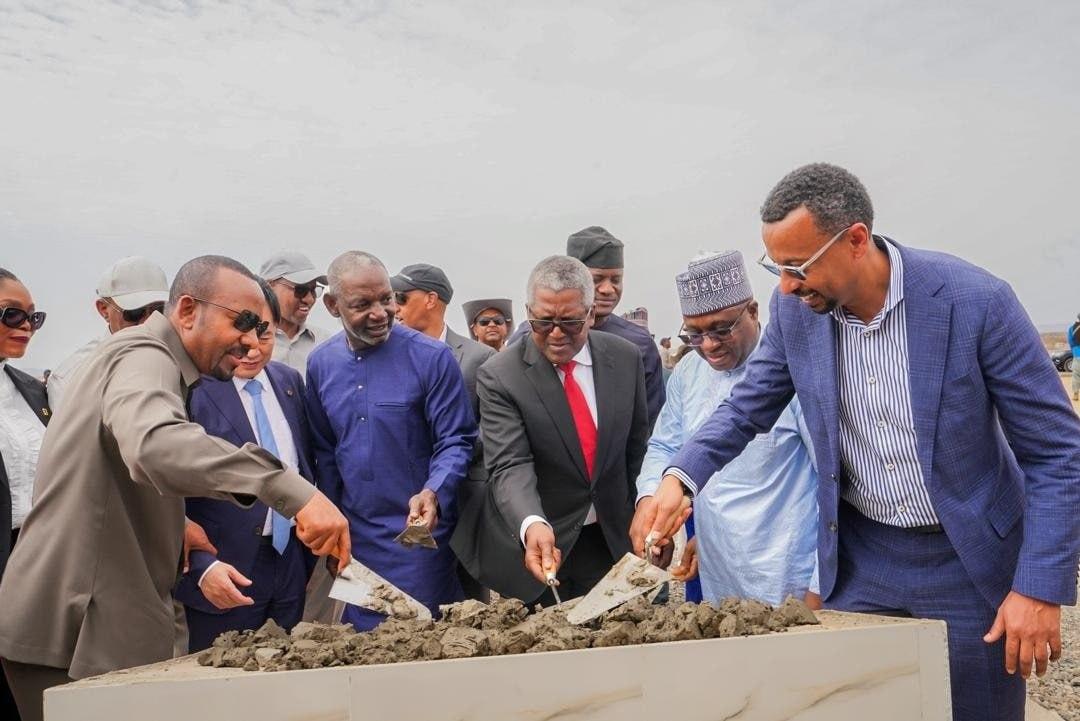
While Kenya is attracting attention through petroleum, Ethiopia may become equally important through fertiliser production.
In August 2025, Dangote Group and Ethiopian Investment Holdings signed a shareholders’ agreement for a $2.5 billion fertiliser complex in Gode.
The proposed facility has an annual production capacity of three million tonnes of urea. Under the agreement, Dangote holds a 60% stake, while the Ethiopian government’s investment holding company owns 40%.
The project is designed to use domestic natural gas resources and includes associated pipeline infrastructure.
Construction was officially launched in October 2025. In May 2026, Ethiopia’s Government Communication Service reported that construction activities were advancing following an inspection involving Dangote.
This investment has implications that go beyond the fortunes of a billionaire.
Fertiliser is an essential agricultural input. Countries dependent on imported fertiliser remain exposed to international commodity prices, shipping costs, currency fluctuations and geopolitical disruptions.
Domestic production could reduce some of these vulnerabilities.
It could also create opportunities for Ethiopia to supply neighbouring agricultural markets, provided production costs, distribution networks and cross-border trade arrangements remain competitive.
The most interesting aspect of this investment is the partnership structure.
Unlike a business model in which a foreign investor owns the entire operation, Ethiopia has negotiated a substantial government equity position.
That arrangement provides a possible template for other African governments seeking foreign capital without surrendering all ownership of strategically important industrial assets.
Nevertheless, the ultimate test will be affordability. A large fertiliser plant does not automatically guarantee that smallholder farmers will obtain cheaper inputs. Distribution, financing, competition and government agricultural policies will determine how much of the project’s benefits reach farms.
Uganda and Tanzania reveal the regional competition
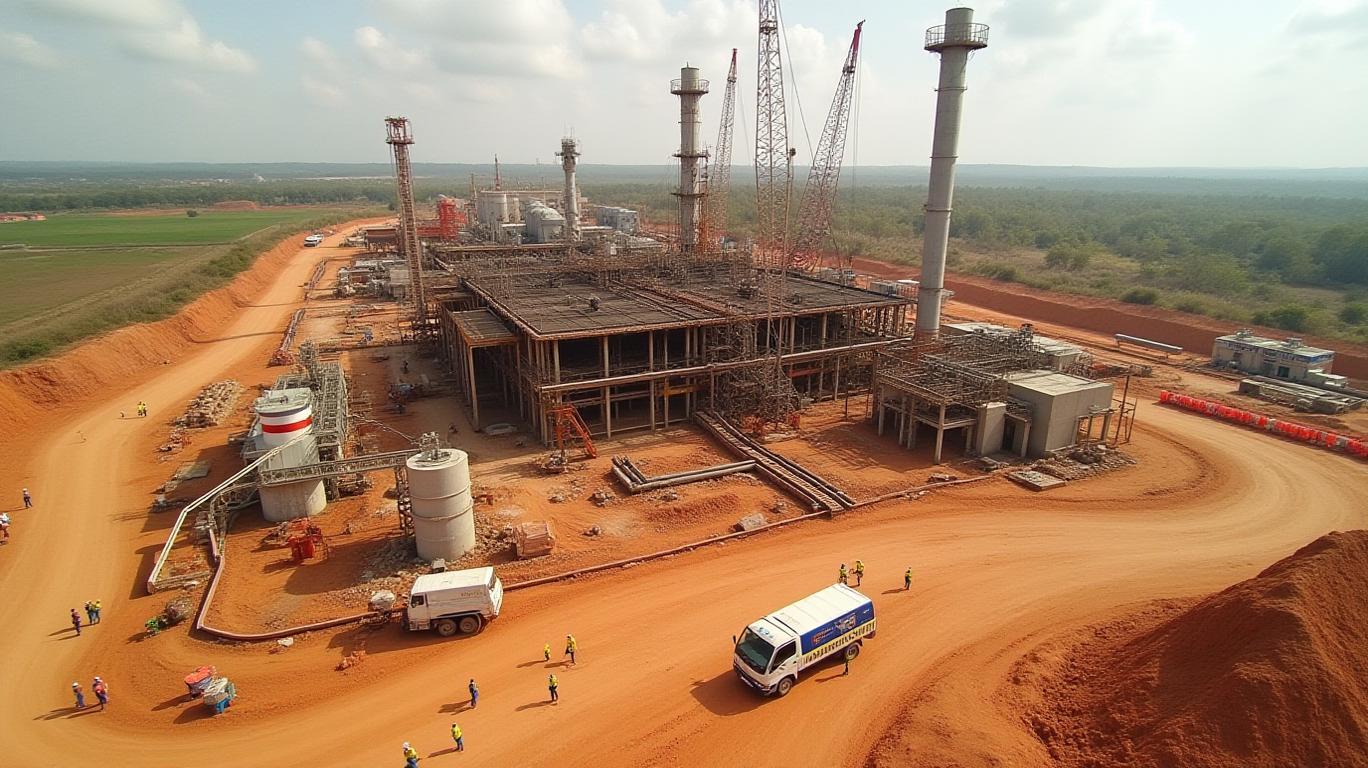
Dangote’s expansion also raises questions about the relationship between neighbouring countries competing for industrial investment.
Uganda has its own ambitions to develop a domestic petroleum refining industry.
Its proposed refinery at Kabaale, in the Hoima district, is intended to process domestically produced crude oil and serve local and regional markets.
The project has experienced repeated delays involving financing, negotiations and commercial arrangements. By September 2026, its final investment decision was still being targeted for the first quarter of 2027, according to reporting by The EastAfrican.
The emergence of the proposed Lamu refinery changes the competitive landscape.
A large coastal refinery could potentially serve markets that Uganda hopes to supply through its own facility.
Yet competition is not necessarily the only possible outcome.
Ugandan crude could become part of the wider regional petroleum supply chain, while different refineries could serve different markets and product requirements.
Ugandan President Yoweri Museveni has publicly supported the idea of regional refineries complementing one another rather than operating as isolated national projects. He made the argument during the September 2026 Lamu groundbreaking ceremony.
Tanzania presents another strategic dimension.
Its ports and transport networks are important to regional energy trade. The East African Crude Oil Pipeline, which connects Uganda’s oil-producing region to the Tanzanian port of Tanga, illustrates how national industrial strategies are already interconnected.
The question is whether governments can coordinate their investments or whether competition for capital, markets and infrastructure will undermine regional efficiency.
Why Kenya’s cement market remains an interesting exception
One detail complicates the narrative of Dangote’s East African expansion: Kenya is not currently a major operating cement manufacturing market for the group.
Although Dangote Cement has a Kenyan subsidiary, its presence should not be confused with an established production operation comparable to those in Tanzania and Ethiopia.
During the company’s September 2026 Capital Markets Day, Group Managing Director Arvind Pathak said Kenya was not included in its medium-term expansion plan because the company had not secured the suitable limestone reserves required for a competitive manufacturing operation.
He nevertheless indicated that the company remained open to opportunities if the necessary conditions were met.
This is an important illustration of how industrial expansion actually works.
A wealthy investor cannot simply enter every attractive market and expect to succeed. Manufacturing requires access to raw materials, reliable energy, transport infrastructure, competitive production costs and predictable regulations.
Kenya’s established cement manufacturers also create a competitive environment that would require careful evaluation before a major investment.
Dangote’s decision demonstrates that even an ambitious African conglomerate must make commercial calculations rather than pursue expansion for geographical visibility alone.
Who really benefits from Dangote’s expansion?
The central question is not how many factories Dangote owns. It is how much economic value these investments create within the countries where they operate.
Large industrial investments can generate several benefits.
They can create employment, develop local suppliers, increase demand for professional services, improve infrastructure and introduce manufacturing capabilities that would otherwise take years to establish.
They can also reduce the cost of importing finished products, provided domestic production is sufficiently competitive.
For African governments, attracting investors with the financial capacity to undertake multibillion-dollar projects is an important opportunity.
However, there is a difference between attracting investment and negotiating a good investment agreement.
Governments need to consider the distribution of economic benefits, including taxation, employment, local procurement, technology transfer, environmental obligations and the long-term development of domestic businesses.
This is particularly important when negotiating incentives for major industrial projects.
Tax concessions and special economic zone arrangements may attract investors, but their benefits should be measured against the public revenue and economic opportunities governments potentially surrender.
There is also a competition question.
If a dominant manufacturer controls substantial production capacity in an essential industry, policymakers must ensure that market power does not undermine competition or disadvantage smaller domestic producers.
Africa needs large industrial businesses. It also needs competitive markets in which entrepreneurs and smaller manufacturers have opportunities to grow.
The two objectives should not be treated as mutually exclusive.
The risks behind the industrial expansion
Dangote’s ambitions are impressive, but the scale of his projects creates considerable financial and operational exposure.
The proposed Lamu refinery is particularly significant.
A $16 billion investment requires enormous amounts of capital, sophisticated engineering, reliable crude supply, dependable infrastructure and a market capable of absorbing its output.
Its commercial success will depend on more than the ability to construct a refinery.
Crude supply agreements, international petroleum prices, financing costs, regulatory frameworks and competition from established international refineries will all influence its performance.
The energy transition presents another long-term consideration.
Although petroleum products will remain important to African economies for years, global investment in renewable energy, electric mobility and alternative fuels could change future demand patterns.
A refinery expected to operate for decades must be designed with these developments in mind.
The same principle applies to cement manufacturing.
Cement production is energy-intensive and generates significant carbon emissions. As African countries develop their industrial sectors, they will face increasing pressure to balance manufacturing growth with environmental sustainability.
There are also geopolitical considerations.
Dangote’s investments cross different regulatory systems, political environments and currency regimes. A change in government policy, restrictions on foreign exchange or disputes over commercial agreements could affect operations.
The Ethiopian fertiliser project, for example, depends on the successful development of natural gas infrastructure and the ability to deliver products to agricultural markets.
These risks do not make the investments unattractive. They demonstrate why industrial success requires strong institutions alongside financial resources.
Africa needs more than one Dangote
Perhaps the most important lesson from Dangote’s expansion is that Africa needs to develop an entire generation of industrial investors.
The continent cannot depend on a single billionaire, business group or government-backed institution to build its manufacturing future.
Dangote’s model demonstrates what concentrated African capital, long-term planning and an appetite for industrial risk can achieve.
But it also reveals a weakness in African economies: the limited number of companies capable of financing and executing large-scale industrial projects.
Consider the opportunities available across the continent.
Kenya has an established financial services sector, an important technology industry and a strategic position connecting several regional markets.
Tanzania has significant natural resources and access to the Indian Ocean.
Uganda has petroleum resources and agricultural potential.
Ethiopia has a substantial domestic market and ambitions to expand manufacturing.
Rwanda has pursued investment in logistics, services and industrial development.
Nigeria, meanwhile, provides a powerful example of how a large domestic market can support the growth of an African industrial conglomerate.
Each country has opportunities to develop businesses capable of competing beyond its borders.
However, this requires more than government investment conferences and announcements of billion-dollar projects.
It requires reliable electricity, affordable financing, skilled workers, predictable taxation, functioning transport systems and institutions that protect investors while safeguarding the public interest.
Regional integration is equally important.
The African Continental Free Trade Area offers an opportunity to build larger markets for African manufacturers. But its success depends on reducing non-tariff barriers, improving customs systems and making cross-border trade commercially practical.
A factory in Ethiopia should be able to compete for customers in neighbouring countries without facing unnecessary administrative obstacles.
Similarly, a manufacturer in Kenya should have opportunities to supply consumers in Uganda, Rwanda and Tanzania.
This is how industrial investment can become a continental development strategy rather than a collection of isolated national projects.
The real question is who controls Africa’s industrial future
Aliko Dangote’s expanding business interests have placed him in an unusual position within African economic history.
He is not simply building companies. He is participating in the development of industries that influence how African countries produce energy, manufacture construction materials, supply agriculture and connect regional markets.
His growing presence in East Africa therefore deserves attention beyond the size of his personal wealth.
Yet the idea that one billionaire could own East Africa would be a misleading interpretation of what is happening.
The region’s economic future will be shaped by governments, domestic entrepreneurs, international investors, public institutions, workers and consumers.
Dangote’s success will depend partly on his ability to work within these different economic and political environments. The countries receiving his investments must also ensure that the resulting opportunities strengthen their own productive capabilities.
There is a significant difference between hosting a major industrial investor and developing a competitive industrial economy.
East Africa has an opportunity to benefit from the former while building the latter.
The refinery in Lamu, the fertiliser complex in Gode and the established cement operations in Tanzania and Ethiopia could become important components of that transformation. But their ultimate value will be measured by the industries they create around them, the employment they generate and the economic opportunities they leave behind.
Perhaps the most important question is not who owns East Africa, but whether East Africans will own a meaningful share of the industries that determine their economic future.
That is the real test of Dangote’s expanding empire, and of Africa’s broader ambition to turn its markets, resources and population into lasting industrial power.
Who Owns Africa examines the people, companies, investments and institutions shaping Africa’s economic future.

More from Featured
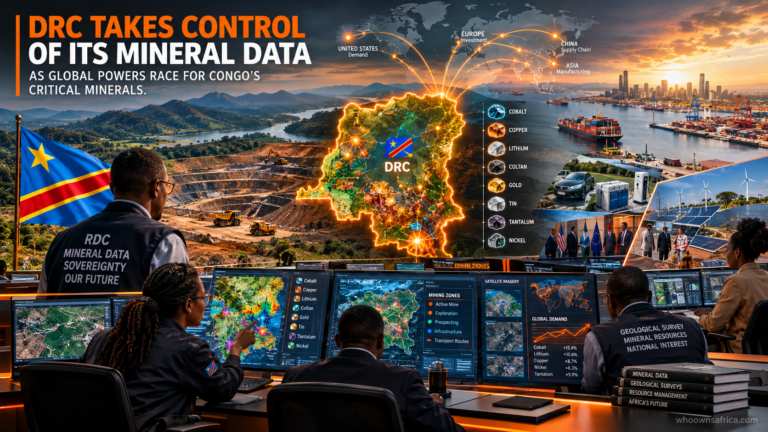
DRC takes control of its mineral data as global powers race for Congo’s critical minerals
Kinshasa is locking down its geological archives, betting that owning the map matters more than owning the mine.

Who is fueling Sudan’s drone war? The foreign networks behind Africa’s forgotten conflict
Foreign weapons, contractors, technology and supply routes are transforming Sudan’s war, leaving civilians trapped between rival armies and outside interests.