
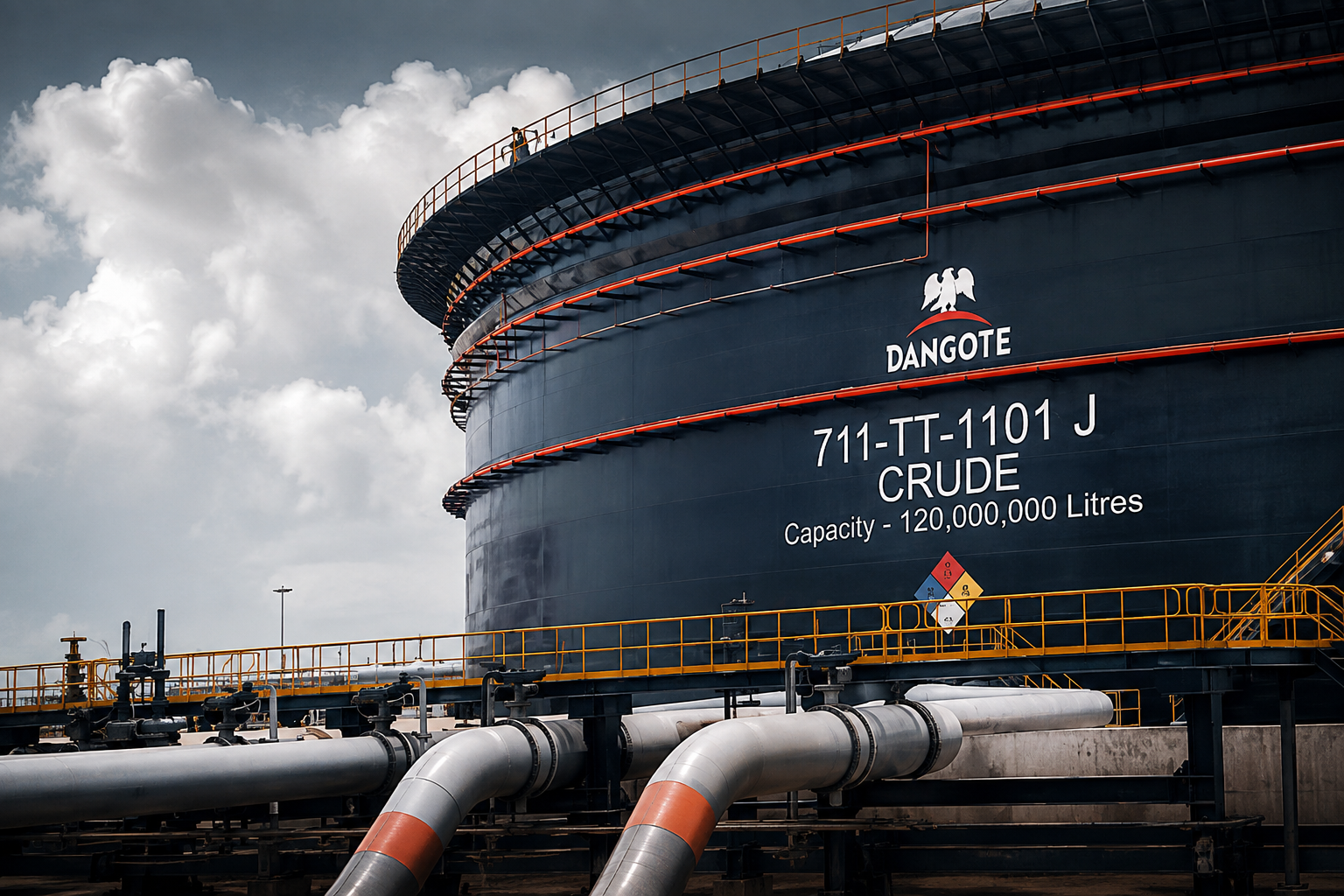
Nigeria’s Securities and Exchange Commission has approved the initial public offering of Dangote Petroleum Refinery and Petrochemicals FZE, clearing the way for what is set to become Africa’s biggest share sale on record and handing billionaire Aliko Dangote a company now valued at close to $47 billion.
The regulator’s approval, confirmed in a letter to lead issuing house Vetiva Advisory Services, allows the refinery to proceed with its Completion Board Meeting and signing ceremony, the final procedural steps before shares go on sale. The offer is expected to open on September 14, Bloomberg reported.
A Record-Breaking Offer
The refinery plans to sell 4.1 billion ordinary shares at 525 naira each, a price that sits toward the lower end of an indicative range of 500 to 595 naira per share. If fully subscribed, the sale could raise roughly 2.15 trillion naira, or about $1.55 billion at current exchange rates. That would make it the largest capital markets transaction in Nigeria’s history and the biggest share sale ever recorded on the African continent.
The SEC has also registered an additional 120.13 billion existing ordinary shares held by the company, a step that effectively opens the door for a broader free float over time, according to a report by Nairametrics. Dangote has said the offer will not be restricted to Nigerian investors alone. Speaking to investors in Botswana ahead of the approval, he described the listing as a pan-African offering rather than a purely domestic one, with payouts made in dollar terms.
Pricing and Valuation
At 525 naira a share across an enlarged base of 124.23 billion shares, the refinery’s implied valuation comes to roughly $46.9 billion, according to calculations by Billionaires.Africa. That marks a sharp jump from the valuation implied just two months earlier, when a private placement completed in July raised $2.5 billion and was oversubscribed by 3.7 times, pricing the company closer to $41.7 billion.
The IPO itself represents about 3.3 percent of the enlarged company. Combined with the roughly 6 percent already sold through the July private placement, that brings the total free float close to the 5 to 10 percent range that Dangote Group has previously signaled it intends to place in public hands. For a conglomerate that has funded most of its refining ambitions through private capital and debt, the shift toward public ownership marks a notable change in strategy. Readers can trace the broader Dangote Group ownership structure in WhoOwnsAfrica’s continuing coverage of the conglomerate.
The pricing decision itself offers a window into how bankers view risk in Nigeria’s capital markets right now. Setting the price near the floor of the range, rather than the middle or top, points to a deliberate strategy of leaving room on the table for early investors, a common tactic in large, closely watched offerings where underwriters want strong first-day demand rather than a struggle to fill the book. It also reflects lingering caution around currency risk, since the naira has been volatile against the dollar in recent years, a factor that weighs heavily on any Nigeria-denominated asset marketed partly to international buyers.
What It Means for Dangote’s Fortune
Aliko Dangote currently holds about 92.3 percent of the refinery, equivalent to roughly 110.88 billion shares. At the offer price, that stake is worth close to 58.21 trillion naira, or about $41.9 billion on paper. Once the IPO is completed, his holding is expected to dilute to around 89.25 percent, still an overwhelming majority stake in what would be a publicly listed company.
The listing has already begun to move the needle on his personal wealth. Forbes’ real-time billionaire tracker showed his fortune ticking up by a few million dollars in the days following the SEC’s approval, while the Bloomberg Billionaires Index had placed his total net worth at roughly $35.3 billion in the weeks before the announcement. A successful listing at the current offer price would push that figure meaningfully higher, reinforcing his position as Africa’s richest person. WhoOwnsAfrica has tracked how the refinery has reshaped Nigeria’s corporate ownership landscape since construction began.
Why the Refinery Needs Fresh Capital
The Dangote Petroleum Refinery and Petrochemicals Complex sits on roughly 2,635 hectares in the Lekki Free Zone outside Lagos. It is currently the largest single-train refinery in the world, with a processing capacity that has reached about 700,000 barrels per day, alongside a 900,000 tonne-per-year polypropylene plant, The Cable reported. The site is powered by its own dedicated 435-megawatt power plant, a scale that reflects the difficulty of building industrial infrastructure in a country where grid electricity remains unreliable.
Proceeds from the share sale are earmarked primarily for an expansion that would nearly double refining capacity to 1.4 million barrels per day, a target confirmed in a company statement carried by Starconnect Media. Management has said that milestone would make the plant the largest petroleum refinery in the world, surpassing existing facilities in Asia and the Middle East. The expansion is also designed to lift export volumes to markets across Africa and Europe, building on hard-currency revenue streams the company has been developing since it first began shipping refined products abroad.
Ending Nigeria’s Fuel Import Dependence
The refinery has been framed from the outset as a corrective to one of Nigeria’s longest-running economic problems, as Vanguard News noted in its coverage of the approval. Despite being Africa’s largest crude oil producer, the country spent decades importing the bulk of its refined fuel because state-owned refineries had fallen into disrepair. That dependence drained foreign exchange reserves and forced successive governments to maintain costly fuel subsidies that strained public finances.
Dangote’s refinery, a decade in the making, was built explicitly to change that equation by processing Nigerian and regional crude domestically rather than shipping it abroad for refining and importing it back as finished fuel. The project’s scale and cost, funded for years through a mix of equity, debt and now public capital, mirror the ambitions of Dangote Group’s other ventures, from cement to fertilizer, which WhoOwnsAfrica has profiled in its ongoing look at ownership across Africa’s oil and gas sector.
What Investors Will Be Watching
Analysts following the offer say the pricing, set toward the bottom of the indicated range, suggests underwriters were cautious about demand given the size of the deal and the volatility of the naira in recent years. The offer structure includes an underwriting programme intended to backstop the sale, alongside participation from both retail and institutional investors across the continent.
Investors will also be watching how the shares trade once listed, given that a deal of this size has few direct comparisons on African exchanges. The refinery’s revenue is closely tied to global refining margins and crude oil prices, both of which can swing sharply, adding a layer of risk that will need to be weighed against the scarcity value of owning a stake in Africa’s largest industrial asset.
There is also the question of how the offer is distributed across borders. Dangote’s pledge to treat the sale as a pan-African listing, rather than a strictly Nigerian one, could widen the pool of institutional buyers beyond local pension funds and banks that typically absorb large domestic offerings. If that ambition holds, it would mark one of the first times a Nigerian industrial asset has been marketed at this scale directly to investors elsewhere on the continent, a template other large family-controlled conglomerates in Africa may watch closely as they weigh their own paths to public markets.
The Road Ahead
With SEC approval secured and an offer date set for September 14, the next test for Dangote and his advisers is subscription demand itself. A fully subscribed offer would validate the near $47 billion valuation and give the refinery a war chest to fund its capacity expansion without leaning further on debt markets. A weaker outcome could raise questions about investor appetite for Nigerian equities at a time when the naira and broader macroeconomic conditions remain under scrutiny.
Either way, the listing marks a symbolic turning point for a project that has already reshaped Nigeria’s energy sector once. Whether it can do the same for the country’s capital markets is now a question for investors, rather than engineers, to answer.

More from Magazine

Seychelles’ Aldabra giant tortoise population hits 180,000
Seychelles’ Aldabra tortoise recovery offers a powerful lesson in conservation, patience and why protecting ecosystems can matter beyond borders.
Who owns South Africa’s fuel infrastructure?
South Africa’s fuel shock exposes the hidden ownership, infrastructure and corporate power shaping prices paid by consumers and industry.
Inside Ethiopia’s $12.5 billion bet to build Africa’s next aviation hub
Ethiopia’s massive Bishoftu airport aims to transform Ethiopian Airlines into Africa’s dominant aviation hub while attracting global investment and technology.