

Sudan’s war has increasingly become a conflict fought not only by Sudanese forces, but by foreign fighters, weapons networks and regional logistics operators, with Colombian ex-soldiers emerging as some of the most striking participants in a war that has devastated the country and drawn limited global attention.
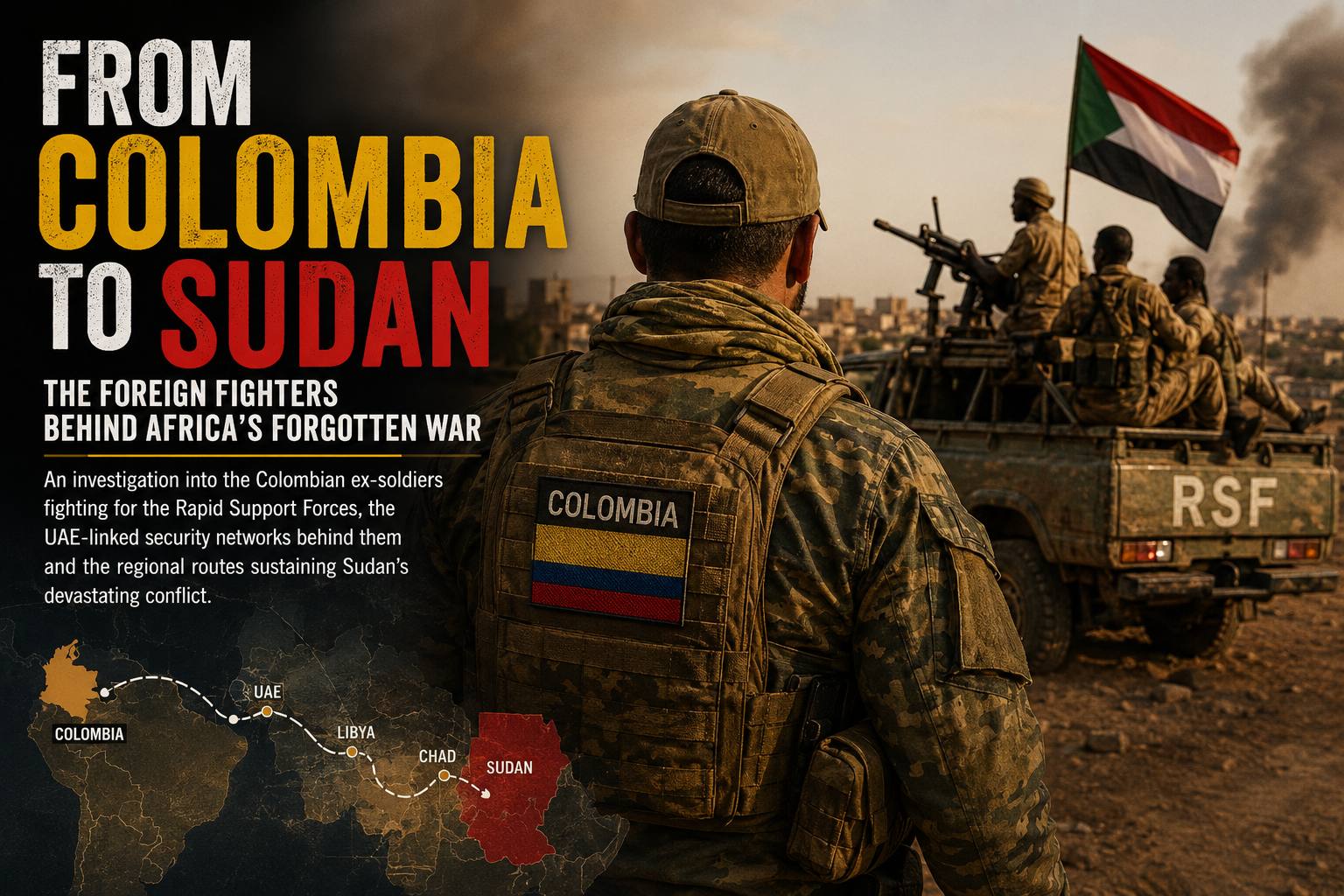
A Financial Times investigation published this month reported that about 2,000 Colombian former soldiers were recruited to fight alongside Sudan’s Rapid Support Forces, or RSF, in what appears to have been a highly organised operation involving private security companies and a network of transit points stretching from the United Arab Emirates to Libya, Somalia, Chad and Sudan.
Human Rights Watch reached similar conclusions in research published in May, although its documented number was lower at the time. It found evidence that at least 300 Colombian private military contractors had been deployed by September 2025, with recruitment linked to a Colombian company and deployment apparently involving Abu Dhabi-based Global Security Services Group, or GSSG.
The difference in the numbers reflects the difficulty of tracking a private military network operating across several countries and using commercial and military infrastructure. But both investigations point to the same broader development: Sudan’s war is no longer simply a domestic struggle between the Sudanese Armed Forces and the RSF.
It is becoming a regional conflict in which outside money, weapons, expertise and fighters can alter the balance on the battlefield.
From Colombia to Darfur
For the Colombians recruited into the network, the journey began thousands of kilometres from Sudan.
Many were former members of Colombia’s armed forces, a pool of personnel with years of experience fighting guerrillas, insurgents and organised criminal groups. Colombia’s long internal conflict has produced a large community of military veterans with combat experience that is attractive to private security companies operating in conflict zones.
According to Human Rights Watch, recruitment began as early as August 2024 through A4SI, a Colombia-based recruitment company. The organisation said GSSG appeared to be responsible for hiring and paying contractors after their initial recruitment.
The United States later imposed sanctions on individuals and companies involved in the recruitment network. In April 2026, the U.S. Treasury said former Colombian military personnel had been recruited through A4SI and its successor, Fénix, to fight for the RSF in Sudan.
The recruitment advertisements reportedly sought people with specialised military skills, including drone operators, snipers and translators.
That mattered because the Sudanese battlefield has evolved rapidly. Both the RSF and the army have increasingly relied on drones, anti-aircraft systems and other advanced weapons, turning a brutal ground war into a conflict where technical expertise can have an outsized impact.
The UAE connection
The most politically sensitive part of the story is the alleged connection between the Colombian fighters and the United Arab Emirates.
Human Rights Watch said the Colombian contractors travelled through UAE facilities before reaching Sudan. Researchers identified the Ghiyathi military base and another apparent military facility in Al Wathba as transit or training points. One contractor told the organisation that he received training from Emirati nationals at a UAE military facility.
The rights group also examined videos, photographs, travel records, company documents and satellite imagery as it reconstructed the routes.
GSSG is at the centre of those findings.
Human Rights Watch said the company, while formally private, has links to senior UAE officials and figures close to the country’s ruling establishment. It said GSSG appeared to have hired Colombian contractors who were eventually deployed alongside the RSF.
The UAE has repeatedly rejected allegations that it supports the RSF militarily or facilitates the movement of foreign fighters into Sudan.
In response to the Financial Times investigation, a UAE official said the country categorically rejected the allegations and said investigations had found GSSG was not involved in mercenary activity in Sudan. The official also said the UAE had not provided arms, military equipment or other military support to either side since the conflict began.
Those denials are central to the story because proving direct state involvement is different from establishing that private companies or individuals have operated within a country’s infrastructure.
A web of regional routes
The Colombian fighters did not travel by a single, obvious route.
Human Rights Watch documented several pathways into Darfur, including routes through eastern Libya, Somalia’s Puntland region and Chad. Contractors travelling through Libya moved from the UAE to Benghazi before continuing overland towards Sudan. Others travelled through Bosaso before moving through the UAE and Chad and eventually reaching Nyala in Darfur.
The routes matter because they overlap with a wider logistics network already associated with the RSF.
Reuters has previously reported that a remote airstrip in southern Libya became an important conduit for weapons, fuel and mercenaries destined for the Sudanese paramilitary force.
More recently, Reuters reported that aircraft linked to a U.S. military contractor’s network were used to transport weapons, drones and mercenaries for the RSF, with routes involving Sudan, Chad, Libya and Somalia.
Taken together, the reporting suggests that Sudan’s battlefield is connected by an informal regional supply chain extending across North and East Africa.
The fighters are only one part of it.
Aircraft, fuel, weapons, drones, military training and financial networks all have to move before a foreign fighter can reach a frontline.
El Fasher’s turning point
The significance of the Colombian deployment became clearer during the battle for El Fasher.
The North Darfur capital endured an 18-month siege before the RSF captured it in October 2025. Human Rights Watch documented mass killings and other abuses during the takeover and said Colombian fighters were present in and around the city.
The U.S. Treasury has also said Colombian fighters supported the RSF during the capture of El Fasher, where the paramilitary force was accused of mass killings, ethnically targeted torture and sexual violence.
The Financial Times reported that some Colombian fighters described the violence they encountered in Darfur as far beyond anything they had previously experienced.
Several fighters interviewed by the newspaper denied personally participating in atrocities, while describing torture, executions, child soldiers and widespread destruction around them.
That distinction is important.
The presence of foreign fighters in an area where atrocities occurred does not by itself prove that every fighter participated in those crimes. But it raises questions about the role of outside personnel in operations conducted by forces accused of serious violations of international law.
Beyond Sudan
The Colombian recruitment operation also reveals a wider transformation in African conflicts.
Foreign military contractors are not new to the continent. Sudan has long attracted outside actors because of its strategic position, gold resources and proximity to the Red Sea.
But the current conflict has created a more complex battlefield.
The RSF has received support from networks operating through neighbouring countries, while the Sudanese Armed Forces has also benefited from foreign military and political backing. Reuters has reported on regional supply routes supporting the RSF, while U.S. sanctions have targeted networks accused of supplying both sides of the conflict.
This internationalisation makes the war harder to stop.
A ceasefire negotiated in Sudan can be undermined if fighters, weapons and money continue to enter through neighbouring countries.
It also makes accountability harder.
A Colombian fighter can be recruited in Bogotá, trained in the Gulf, transported through Somalia or Libya and eventually deployed in Darfur. The company arranging the movement may be registered in one country, the aircraft may belong to another company and the battlefield commander may answer to an armed group operating thousands of kilometres away.
The business of war
For Who Owns Africa, the deeper question is not simply who is fighting in Sudan.
It is who owns the infrastructure that makes the fighting possible.
The Colombian fighters are one visible layer of a much larger system involving airports, private security firms, aviation companies, recruitment agencies, military suppliers and regional political alliances.
The network illustrates how modern African conflicts can become international without formally becoming wars between states.
Private companies can move personnel. Commercial aircraft can become military logistics platforms. Regional airports can function as gateways to battlefields. Veterans can become contractors. And governments can deny direct involvement while maintaining relationships with companies operating within their political and economic orbit.
That ambiguity is one of the defining features of Sudan’s war.
A war with no easy borders
Sudan’s conflict began in April 2023 as a power struggle between army chief Abdel Fattah al-Burhan and RSF leader Mohamed Hamdan Dagalo, known as Hemedti. It has since evolved into a wider conflict involving ethnic violence, competing territorial authorities, foreign weapons and international interests.
The humanitarian consequences have been immense.
Millions of Sudanese have been displaced, while famine and attacks on civilians have compounded the destruction.
Yet the appearance of Colombian fighters offers another way to understand the conflict.
Sudan is not isolated from the world.
Its war is embedded in a network that connects Latin American military veterans with Gulf security companies and African logistics corridors. It links Colombia to the UAE, Libya, Somalia, Chad and Darfur.
The journey from Colombia to Sudan may be one of the clearest illustrations yet of how Africa’s wars are increasingly shaped by actors who never intended to call the continent home.
For Sudanese civilians, however, the nationality of the fighter matters less than the weapon in his hands.
The real consequence is that every new foreign recruit can prolong a war that has already lasted more than three years.
And as long as the networks that move fighters, weapons and money remain intact, Sudan’s forgotten war risks becoming not only longer, but increasingly international.
This feature is based on recent reporting by the Financial Times and Reuters, Human Rights Watch research and U.S. government sanctions records. Allegations of UAE involvement are disputed by the UAE, which denies supporting the RSF or facilitating foreign fighters.

More from Magazine

Who owns South Africa’s fuel infrastructure?
South Africa’s fuel shock exposes the hidden ownership, infrastructure and corporate power shaping prices paid by consumers and industry.
How Aliko Dangote is turning Africa’s biggest refinery into a $47 billion public company
Nigeria's SEC has cleared a $1.6 billion share sale for Dangote's refinery, setting up Africa's largest-ever stock market listing.
Inside Ethiopia’s $12.5 billion bet to build Africa’s next aviation hub
Ethiopia’s massive Bishoftu airport aims to transform Ethiopian Airlines into Africa’s dominant aviation hub while attracting global investment and technology.