

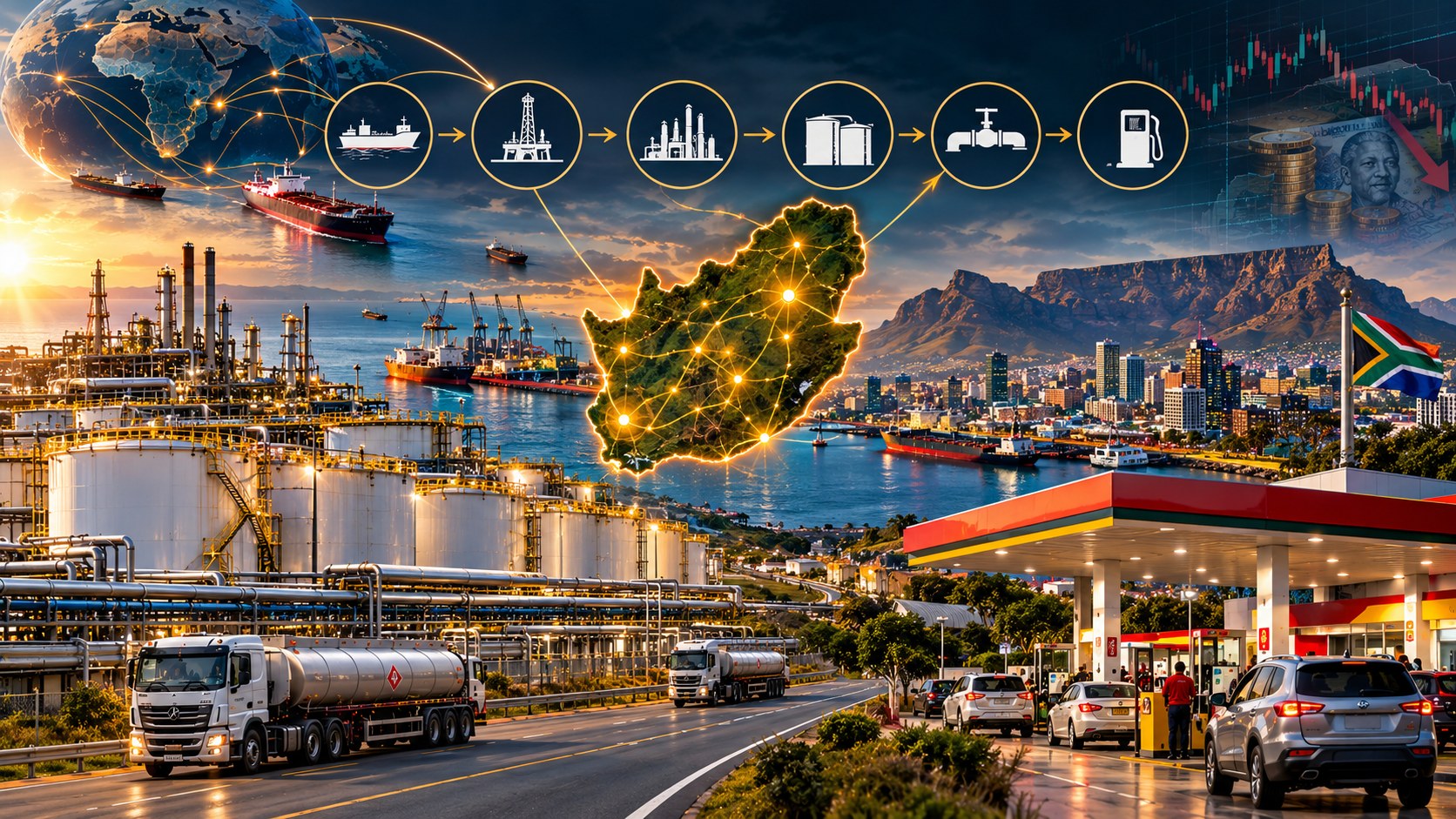
South Africa’s fuel shock is often described as a story about war, oil prices and a weaker rand. That is true, but it is incomplete. The more revealing question is who owns the infrastructure through which the shock travels, who has bargaining power along that chain, and who ultimately absorbs the cost.
The answer is not a single oil company, nor the government alone. It is a network of state-owned pipelines and ports, private storage terminals, refineries, importers, wholesalers, fuel retailers, logistics operators, manufacturers, farmers, airlines and millions of households. Ownership matters because fuel is not simply bought at a petrol station. It is moved, stored, refined, financed, regulated and taxed before a driver reaches the pump.
On October 7, South Africa enters another uncomfortable phase of that system. Petrol prices are rising by more than R3 a litre, with 95 petrol increasing by 333 cents and diesel by as much as 324.38 cents a litre. The government says the main pressure came from higher international crude and refined-product prices, while the rand offered almost no relief. Reuters reported that petrol could rise by as much as 12% and wholesale diesel by about 10%.
But the deeper story is not simply that international events have made South African fuel expensive. It is that decisions about ownership, refining capacity, pipelines, ports and strategic reserves have left South Africa more exposed to external shocks.
That is where the ownership question becomes important.
For WhoOwnsAfrica, this is the point. Ownership is not only about equity certificates or corporate logos. It is about who controls scarce infrastructure, who can expand capacity, who can withstand disruption, and who has enough balance-sheet strength to keep product moving when global markets become hostile. That is where corporate power becomes economic power for households.
The state owns the backbone
South Africa’s most strategically important fuel infrastructure sits, in large part, in the hands of the state.
Transnet is wholly owned by the South African government and controls the country’s ports, rail network and petroleum pipeline infrastructure. Its Transnet Pipelines division operates more than 3,100 kilometres of high-pressure petroleum and gas pipelines, linking coastal supply points with inland markets.
Transnet is now seeking private operators for five strategic fuel storage facilities in the Free State, KwaZulu-Natal and Mpumalanga. The facilities at Bethlehem, Kroonstad, Magdala, Ladysmith and Standerton are being offered on long leases, with investors expected to operate, maintain and improve them.
This is a revealing moment. The state is not necessarily withdrawing from fuel infrastructure. It is trying to extract more value from assets it already owns by bringing in private operators.
Ports are part of the power map
South Africa’s fuel system begins at the coast.
The country imports crude oil and increasing volumes of finished petroleum products. Those imports arrive through ports, making port infrastructure a critical part of energy security.
The Island View precinct at the Port of Durban is particularly important. The government has moved to renew leases for companies operating in the petrochemical hub, including Bidvest Tank Terminal, Vopak Terminal Durban, Astron Energy, Engen, TotalEnergies, Sasol and others.
The leases include conditions designed to protect long-term infrastructure investment and eventually transfer terminal infrastructure to the port authority after the concession period.
This illustrates the unusual ownership structure of South Africa’s fuel economy. The state owns the port environment. Private and state-linked companies operate terminals, storage and fuel businesses inside it. Consumers depend on the entire system, but ownership is divided across several institutions.
The consumer sees a number on a forecourt price board. Behind it is a chain of international shipping, port access, storage, pipeline transport, refining, wholesale margins, taxes, levies and retail margins.
Refining is the missing layer
The biggest strategic weakness is refining capacity.
South Africa has lost substantial crude-oil refining capacity in recent years. Government says the country currently has two operational crude oil refineries, Natref and Astron Energy, alongside Sasol’s Secunda coal-to-liquids operation.
The loss of capacity has increased dependence on imported refined products.
A Reuters report in July said South Africa had lost about half its refining capacity and consumes roughly 27 billion litres of oil products a year. A draft strategic stocks policy proposed requiring private fuel wholesalers and importers to hold 21 days of stocks, while the state would maintain 60 days.
The proposal is effectively an admission that ownership and market efficiency alone cannot guarantee resilience.
South Africa needs spare capacity.
Natref is a strategic asset
Natref, South Africa’s only inland crude oil refinery, is one of the most important pieces of the ownership puzzle.
The refinery is operated by Sasol and has historically been structured as a joint venture with TotalEnergies. But the ownership picture has changed. A minority stake is now being marketed after the collapse of British company Prax Group, which had acquired the stake from TotalEnergies.
Reuters reported in May that Trafigura was among bidders for the 36.36% interest, alongside two Black-owned South African energy companies. Sasol retains the majority stake and has a right of first refusal.
That potential transaction is more than a corporate deal.
Natref sits near the industrial heartland and supplies products into the inland economy. Its ownership determines who has a financial interest in one of the country’s most strategically significant sources of domestic refined fuel.
It also shows why the phrase “South Africa’s fuel industry” can be misleading. The industry is not owned by one bloc. It is a changing collection of state infrastructure, multinational businesses, local shareholders, commodity traders and strategic investors.
Astron brings another model
Astron Energy offers a different example.
Glencore owns 68% of Astron Energy South Africa, while Off The Shelf Investments holds 23% and employees hold 9%, according to the company.
Astron operates the Cape Town refinery and a large service-station network. Its ownership connects international commodity capital with physical refining and retail infrastructure in South Africa.
That matters because Glencore is not simply a fuel retailer. It is one of the world’s major commodity trading and natural-resource companies.
Shell is changing hands
Another major shift is already underway.
Shell has agreed to sell its downstream South African business to ADNOC Distribution, the retail and fuel-distribution arm of Abu Dhabi National Oil Company. The transaction is expected to close in 2027, subject to regulatory approvals.
The business includes about 580 company and dealer-owned mobility and convenience sites, along with commercial fuels, aviation, marine and lubricants operations.
Yet it would be wrong to interpret the deal as evidence that foreign ownership automatically causes higher fuel prices. South Africa’s pump prices are not simply set by the companies operating petrol stations.
The government regulates petrol prices through a formula linked to international refined-product prices, exchange rates and domestic costs. Diesel retail prices are not regulated in the same way, although a wholesale list price is published.
The ownership question is therefore about power and resilience, not a simplistic claim that one company sets the price.
The formula still rules
The Basic Fuel Price system is the mechanism through which the international shock enters the domestic market.
The Department of Mineral and Petroleum Resources says the formula is designed around import parity. It uses international refined-product prices, shipping-related costs and the rand-dollar exchange rate, before domestic taxes, levies, margins, transport costs and regulated charges are added.
A locally owned refinery does not necessarily mean cheap petrol. A foreign-owned refinery does not necessarily mean expensive petrol. The economics of crude, refined products, logistics, taxes and regulation still determine the final price.
Ownership matters because it determines who owns the assets, who earns returns, who carries investment risk and who has an interest in expanding capacity.
Who pays the bill?
A higher petrol price raises the cost of commuting, delivery services and household travel. Higher diesel prices are potentially more damaging because diesel is embedded in the operating costs of trucking, agriculture, construction, mining and parts of manufacturing.
The farmer pays more to operate machinery and transport produce.
The trucker pays more to move goods.
The supermarket pays more to move stock between distribution centres and stores.
The manufacturer pays more for logistics and industrial processes.
The airline faces pressure through jet-fuel costs.
The household eventually encounters some of those increases through higher prices.
This is why the fuel shock should not be treated as a motorists’ problem.
Fuel is an economic input. It is effectively a tax on movement when its price rises sharply.
The hidden winner is not obvious
It is tempting to assume that oil companies are the winners whenever petrol prices rise.
That is too simple.
Refiners can be squeezed by expensive crude and operational disruptions. Importers can face higher working-capital requirements. Retailers operate within regulated margin structures. Transport companies may have little ability to pass higher diesel costs to customers immediately.
The government also faces a dilemma.
Fuel taxes generate public revenue, but reducing levies during a price shock can protect households and businesses while weakening the fiscal position. South Africa demonstrated that tension earlier this year when it temporarily cut the fuel levy in response to the Iran-related energy shock.
The October increase shows the limits of that intervention. Relief can postpone the pain. It does not remove the underlying exposure.
The infrastructure question
The country has spent years discussing prices, but not enough attention is paid to the physical system underneath those prices.
Who owns the tanks?
Who controls the pipelines?
Who has access to port terminals?
Who has storage capacity when international shipping is disrupted?
Who can finance imports when prices spike?
Who can restart a refinery?
Who has enough inventory to withstand a month of disruption?
These questions are more important to energy security than the logo on the petrol station.
The government’s proposed strategic stock policy recognises this. Requiring private wholesalers and importers to hold 21 days of stock, while the state maintains 60 days, would represent a major change in how South Africa thinks about fuel security.
South Africa owns less than it thinks
There is an uncomfortable contradiction at the heart of the system.
South Africa has strong public ownership of strategic logistics infrastructure through Transnet. It has sophisticated private energy companies. It has major refineries and storage terminals. It has a large consumer market.
Yet it remains highly exposed to international energy shocks.
A state-owned pipeline does not compensate for inadequate refining capacity. A private storage terminal does not eliminate shipping risk. A refinery does not guarantee supply if its equipment is offline. Strategic stocks do not help if the system lacks the ability to move product to where it is needed.
Energy security is a chain. The weakest link determines resilience.
The next ownership battle
The next phase could be less about petrol stations and more about infrastructure.
The former SAPREF site in Durban is a case in point. The Central Energy Fund acquired the refinery precinct from Shell and BP in 2024 and is considering how to reuse its storage and transfer infrastructure while developing a longer-term plan to restore refining capacity.
The CEF has outlined a phased approach beginning with storage and movement of imported fuel, with a longer-term ambition to restore substantial refining capacity. Domestic refineries supplied about 78% of petroleum demand in 2019, compared with about 39% currently, according to the CEF plan reported in September.
The direction is therefore clear: the future fuel system is likely to be a hybrid.
The state will continue to own strategic infrastructure. Private companies will provide capital, operations, trading capacity and retail networks. Foreign investors will remain important. Black South African ownership will remain a political and economic priority. The challenge will be making those interests work together without sacrificing energy security.
What ownership really means
The phrase “Who Owns South Africa’s Fuel Infrastructure?” sounds like a question that should produce a list of shareholders.
It does not.
The more important question is who controls the points at which fuel can be imported, stored, moved, refined and sold.
On that measure, power is distributed.
Transnet controls the backbone of pipelines, ports and rail. Private companies operate major terminals and refineries. Sasol remains central to inland fuel production. Glencore controls Astron Energy. Shell’s downstream South African assets are moving toward ADNOC ownership. TotalEnergies remains a major retailer and has a stake in the Natref story through the changing ownership history. The Central Energy Fund is trying to reclaim a larger strategic role.
The real test
South Africa’s fuel crisis should therefore be judged by a harder standard than whether petrol crosses R30 a litre.
The real test is whether the country can keep fuel flowing when the world becomes unstable.
That means sufficient refining capacity. It means strategic reserves. It means functioning ports. It means reliable pipelines. It means storage capacity outside a handful of major hubs. It means investment in infrastructure and transparent access to essential facilities.
It also means recognising that energy security has a cost.
Someone must finance tanks that may sit partly unused. Someone must maintain pipelines that may not always operate at maximum capacity. Someone must carry inventories that tie up capital. Someone must pay for spare refining capacity.
If South Africa refuses to pay those costs in advance, it will pay them later through shortages, emergency imports, higher freight costs and sudden price shocks.
That is the deeper lesson of October’s fuel increase.
The war may have started far from South Africa. The crude may have travelled across oceans. The rand may have moved in response to global markets. But the economic consequences are being amplified by choices made much closer to home.
South Africa does not simply have a fuel-price problem.
It has an infrastructure ownership problem, an investment problem and a resilience problem.
The question for policymakers is no longer whether foreign or local companies should own the next refinery, terminal or service-station network.
The more important question is whether the ownership model can guarantee that South Africans have fuel when the global system is under stress, at a price the economy can survive.
That is the measure that should matter.
And it is also the question that tells us who really owns South Africa’s fuel future.

More from Magazine
How Aliko Dangote is turning Africa’s biggest refinery into a $47 billion public company
Nigeria's SEC has cleared a $1.6 billion share sale for Dangote's refinery, setting up Africa's largest-ever stock market listing.
Inside Ethiopia’s $12.5 billion bet to build Africa’s next aviation hub
Ethiopia’s massive Bishoftu airport aims to transform Ethiopian Airlines into Africa’s dominant aviation hub while attracting global investment and technology.

Who owns Africa’s mobile future? The battle behind MVNOs
Africa's mobile industry is entering a new ownership contest as MVNOs, fintechs and satellites challenge traditional telecom giants.