

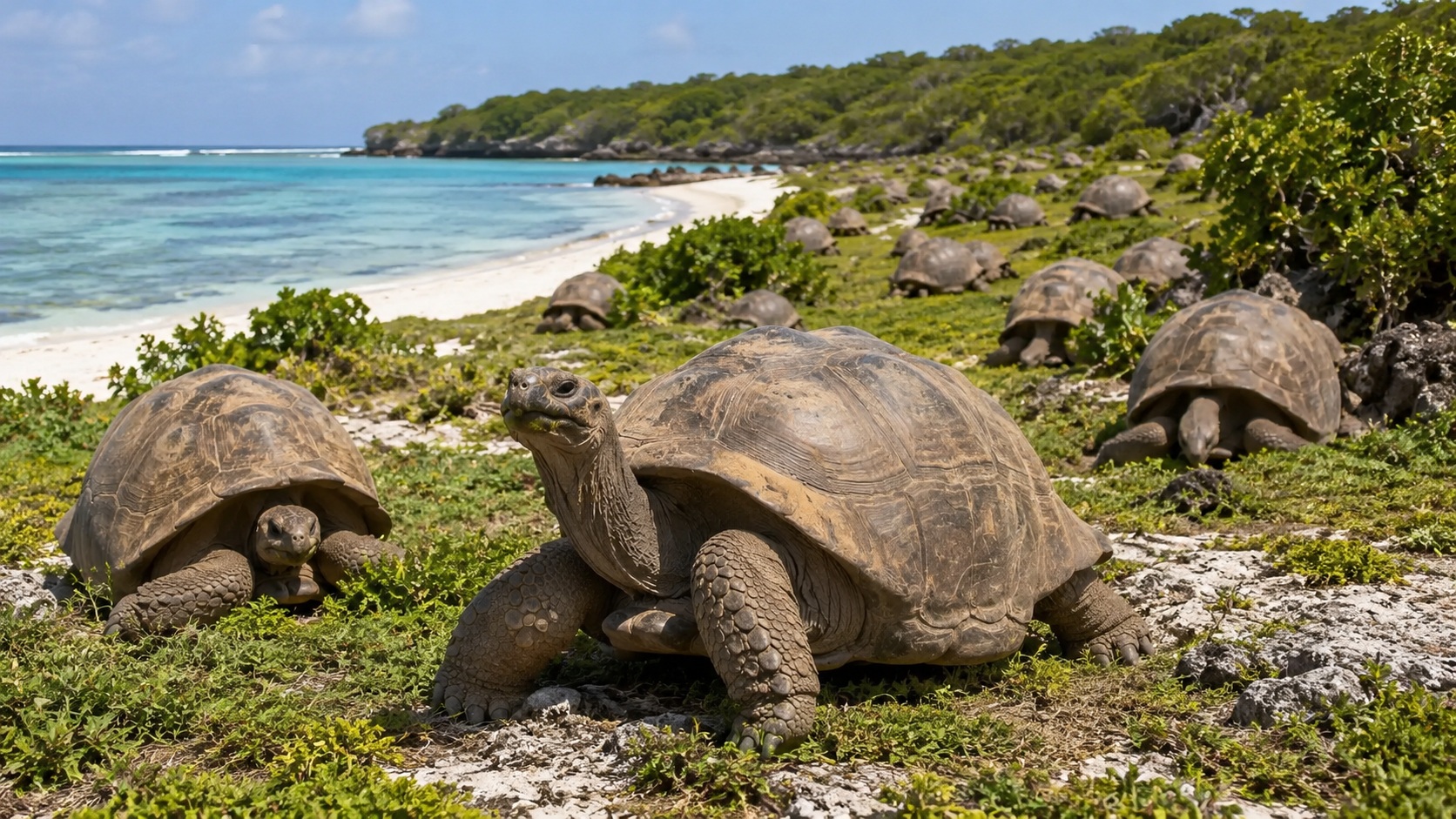
A population estimate of about 180,000 Aldabra giant tortoises is more than a remarkable wildlife statistic. It is evidence that sustained protection, scientific monitoring and political patience can still reverse ecological decline.
The number is extraordinary. It is also easy to misunderstand.
A new scientific study estimates that Aldabra Atoll in Seychelles is home to roughly 180,000 giant tortoises, the largest population estimate yet recorded for the species. Researchers from the Seychelles Islands Foundation and the University of Exeter reached the figure by analysing years of tortoise counts and applying statistical modelling to account for how difficult it is to detect animals across different habitats.
The important point is not simply that there are 180,000 tortoises.
The important point is that there are 180,000 tortoises because Aldabra was protected long enough for nature to recover.
A number with history
The Aldabra giant tortoise, Aldabrachelys gigantea, is not a species that escaped human pressure because it was somehow immune to it.
It was exploited.
For centuries, giant tortoises across the Indian Ocean were hunted and removed from islands by people who valued them as a source of food. Aldabra became the last major refuge for the species after giant tortoises disappeared from other Indian Ocean islands. Historical accounts show just how severe the pressure could become. UNESCO records that exploitation once reduced Aldabra’s tortoise population to extremely low levels.
That history gives today’s number its meaning.
A population of 180,000 is not simply an abundance figure. It is a measure of what happens when exploitation is eventually replaced by protection.
Aldabra’s isolation helped. So did policy.
The atoll received increasing protection from the 1960s, while the Seychelles Islands Foundation has managed research and conservation there since 1979. Aldabra was designated a strict nature reserve in 1981 and became a UNESCO World Heritage Site in 1982.
Those decisions did not produce an immediate headline.
They produced something much more valuable.
Time.
Conservation rarely looks dramatic
This is perhaps the most useful lesson in the new study.
Conservation is often presented through spectacular moments: an animal released into the wild, a forest protected, a poaching operation stopped, a species rescued from the edge.
Aldabra tells a different story.
Its success has been built through repeated monitoring, protection, habitat management and the willingness to leave an ecosystem largely alone.
The new research drew on five years of tortoise observations collected between 2018 and 2022. The analysis found the population was relatively stable, with an estimated average of more than 183,000 adult and sub-adult tortoises across the core sampling period.
That stability matters as much as the size.
A population can be large and still be heading in the wrong direction. A single impressive count does not prove long-term security.
Aldabra’s significance is that scientists now have stronger evidence that the population remains exceptionally large and broadly stable.
That is a conservation achievement worth examining closely.
The tortoises are part of the ecosystem
There is another reason the figure deserves attention.
Aldabra’s tortoises are not simply animals living inside a protected area. They help shape the ecosystem around them.
UNESCO describes Aldabra as an unusual natural laboratory where the giant tortoise occupies an ecological role more commonly associated with large herbivores. The animals graze vegetation, influence plant communities and help maintain ecological processes that have developed alongside them.
The Seychelles Islands Foundation goes further, describing the tortoise as central to the atoll’s terrestrial ecology. The presence of so many animals contributes to the formation of what is known as tortoise turf, a habitat shaped by grazing.
That changes how the 180,000 figure should be understood.
It is not just a count of individual animals.
It represents a functioning ecological system.
Remove the tortoises and the consequences would extend beyond the species itself. Vegetation would change. Seed movement would change. Grazing patterns would change. Other organisms would respond.
This is why conservationists increasingly describe species such as the Aldabra tortoise as ecosystem engineers.
Seychelles has protected something the world lost elsewhere
There is a temptation to view Aldabra as an isolated success, too remote to offer lessons for the rest of Africa or the wider Indian Ocean.
That would be a mistake.
The atoll demonstrates something fundamental about biodiversity protection.
If an ecosystem is sufficiently protected, and if destructive pressures are controlled over long periods, recovery is possible.
UNESCO says Aldabra retains an almost intact ecosystem and is home to hundreds of endemic species and subspecies. Its remoteness has reduced human interference, while its legal protection and management have helped preserve ecological processes.
That makes Aldabra valuable not only to Seychelles but to global conservation science.
It is a living reference point.
Scientists can study what a relatively intact island ecosystem looks like. Conservation managers can examine how species respond when pressure is reduced. Researchers can compare Aldabra with degraded islands where invasive species, habitat loss or human exploitation have altered ecological relationships.
The lesson is not that every ecosystem can be turned into Aldabra.
It is that some ecosystems can recover if society gives them the space and time to do so.
But 180,000 is not a guarantee
This is where celebration should become caution.
Aldabra is protected, but it is not protected from the climate.
The Seychelles Islands Foundation identifies sea-level rise, ocean acidification, warming and invasive alien species among the threats facing the atoll. UNESCO likewise identifies climate change, invasive species and other pressures as continuing risks to the World Heritage site.
The paradox is striking.
The tortoise population has recovered because humans learned to reduce certain pressures.
But humans are now creating pressures that cannot be stopped at the boundary of a reserve.
Aldabra cannot negotiate with rising seas.
It cannot vote against warming oceans.
It cannot prevent plastic from crossing thousands of kilometres of ocean.
In 2020, UNESCO reported that a major clean-up operation removed 25 tonnes of waste from Aldabra, including about 60,000 plastic flip-flops. Even one of the world’s most remote ecosystems is receiving pollution generated far beyond its shores.
That should complicate the celebration.
The 180,000 tortoises are proof that conservation works. They are not proof that the work is finished.
The next chapter is harder
The new population estimate should therefore be treated as a baseline for the future, not a final score.
Researchers themselves argue that long-term monitoring should continue and that successful conservation measures, including invasive species management, need to be maintained and expanded.
That may sound less dramatic than discovering a population of 180,000.
It is actually more important.
Conservation is often lost through complacency after a species begins to recover. Funding shifts. Monitoring weakens. Political priorities change. New threats are underestimated because yesterday’s threats appear to have been solved.
Aldabra offers a different model.
Protect the habitat.
Keep measuring.
Remove invasive pressures.
Limit damaging human activity.
Then keep doing it.
A bigger African conservation story
For Who Owns Africa, there is a broader question here.
Who owns a natural heritage that belongs to a country but matters to the planet?
Seychelles has legal sovereignty over Aldabra. But the scientific and ecological value of the atoll reaches far beyond its borders.
That is true across Africa.
From elephants and rhinos to mountain gorillas, baobabs, coral reefs and wetlands, some of the continent’s most important natural assets are national treasures with global significance.
Aldabra shows why ownership should not be confused with stewardship.
The real achievement is not possessing 180,000 giant tortoises.
It is having created conditions in which they can continue to exist.
That distinction will become increasingly important as climate change places protected areas under pressure.
The real measure of success
There is a satisfying simplicity to the 180,000 figure.
But the deeper story is slower and less spectacular.
A species once heavily exploited survived.
A remote ecosystem remained largely intact.
Scientists kept returning to count the animals.
Managers kept protecting the habitat.
And after decades of patience, the evidence now shows an extraordinary population.
That is what makes Aldabra’s tortoises important.
They are not merely a symbol of Seychelles.
They are a reminder that conservation can produce measurable results when protection is sustained for long enough.
The number 180,000 deserves attention.
The lesson behind it deserves even more.

More from Magazine

Who owns South Africa’s fuel infrastructure?
South Africa’s fuel shock exposes the hidden ownership, infrastructure and corporate power shaping prices paid by consumers and industry.

How Aliko Dangote is turning Africa’s biggest refinery into a $47 billion public company
Nigeria's SEC has cleared a $1.6 billion share sale for Dangote's refinery, setting up Africa's largest-ever stock market listing.
Inside Ethiopia’s $12.5 billion bet to build Africa’s next aviation hub
Ethiopia’s massive Bishoftu airport aims to transform Ethiopian Airlines into Africa’s dominant aviation hub while attracting global investment and technology.