

Lithium — a soft, silvery-white metal that is the lightest of all metals — has become one of the most strategically significant industrial materials of the twenty-first century, primarily because of its essential role in lithium-ion batteries that power electric vehicles, portable electronics, and grid-scale energy storage. As the global energy transition accelerates demand for battery storage technology, lithium has moved from a relatively niche industrial chemical to a commodity of critical geopolitical and economic significance, attracting intense interest from governments, mining companies, and technology manufacturers seeking secure supply of a material that underpins the clean energy transition. Africa holds significant lithium resources, and several countries are at various stages of lithium resource exploration and development, positioning the continent as a potentially important future contributor to global lithium supply.
Lithium Geology and African Resources
Lithium occurs in several geological forms, most commonly as minerals within hard rock pegmatite formations — coarse-grained igneous rocks — and as dissolved lithium salts in underground brines beneath salt flats in arid regions. The hard rock pegmatite form is more geologically common in Africa, with significant resources identified across several countries. Zimbabwe hosts some of the continent’s largest and best-documented hard rock lithium resources, with the Bikita lithium mine having been in production for decades, and more recent large-scale development of additional pegmatite deposits under way following significant investment from external parties attracted by the country’s lithium endowment. The Democratic Republic of Congo holds lithium resources among its broad mineral endowment. Mali, Namibia, Ghana, and several other African countries have documented lithium-bearing pegmatite occurrences at various stages of exploration and assessment. As global lithium demand growth has intensified, exploration activity targeting African lithium resources has accelerated, and the next decade is likely to see several African countries transition from exploration stage to production stage in lithium mining.
Hard Rock Lithium Mining
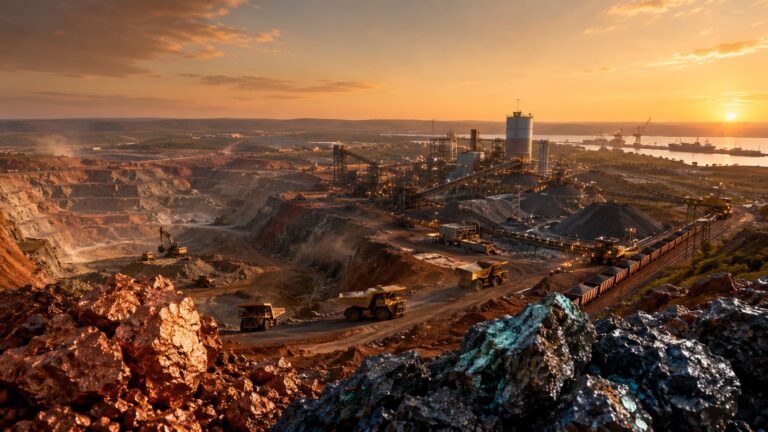
Hard rock lithium mining extracts spodumene and other lithium-bearing minerals from pegmatite formations using conventional open-pit or underground mining methods, depending on the depth and geometry of the ore body. The mined ore is then processed at a concentrator to produce a spodumene concentrate, which is typically exported for further processing into battery-grade lithium compounds — lithium hydroxide or lithium carbonate — at conversion facilities in the major lithium chemical processing countries. The processing chain from spodumene concentrate to battery-grade lithium hydroxide is technically demanding and capital-intensive, requiring controlled chemical conversion processes and stringent quality specifications demanded by battery manufacturers. Currently, the large majority of this conversion processing occurs outside Africa, with African producers selling spodumene concentrate at a fraction of the value of finished battery-grade lithium chemical — a clear illustration of the value addition gap that African producing countries are beginning to address through policy measures and investment attraction aimed at developing domestic or regional lithium processing capacity.
The Battery Value Chain and Africa’s Position
Understanding where Africa’s lithium resources fit in the broader battery value chain — from raw mineral through processed chemical to battery cell to battery pack to electric vehicle — is important for assessing both the economic opportunity and the policy choices facing producing countries. At the upstream end, mining produces spodumene concentrate or other lithium minerals. Chemical processing converts these into battery-grade lithium hydroxide or carbonate. Cell manufacturing uses lithium chemicals alongside other materials including cobalt, manganese, nickel, and graphite to produce the battery cells that store electrical energy. Battery pack assembly combines cells with management electronics into the packs that go into electric vehicles or energy storage systems. Vehicle manufacturing incorporates battery packs into complete electric vehicles. The large majority of economic value in this chain is generated in the processing, cell manufacturing, and vehicle assembly stages rather than in mining, and the countries where processing and manufacturing occur — currently dominated by China, with growing capacity in the United States, Europe, and South Korea — capture the largest shares of the value chain.
Beneficiation Policy and Processing Investment
Several African countries with lithium resources have introduced or are considering policies aimed at encouraging domestic processing of lithium beyond the concentrate stage, following the example of other resource producers that have used export restrictions, differential export taxes, or mandatory domestic processing requirements to incentivise in-country beneficiation. The rationale is straightforward: if the largest share of value is in processing rather than mining, capturing more of that processing domestically would generate substantially greater economic returns from the lithium resource than exporting concentrate alone. The challenge is that competing for global battery-grade lithium chemical production requires substantial capital investment, technical expertise, reliable energy supply, environmental management capability, and a commercial customer base willing to qualify and procure from new sources — a package of requirements that is not easily assembled in the same timeframe as the policy mandate to process domestically.
Competition for Lithium Investment
African lithium resources compete for development investment with lithium resources in other parts of the world, including the major producers in Australia, Chile, and Argentina, and growing production in several other countries. Investment decisions by mining companies reflect the comparative economics of different resource options — ore grade, metallurgical characteristics, capital cost, operating cost, country risk, and infrastructure access — alongside strategic considerations about supplier diversification that are driving some battery material users to actively seek to develop supply outside the current major producer concentration. African lithium resources offer genuine geological merit in several cases but face infrastructure challenges — limited rail and road access to remote deposit locations, power supply requirements for processing operations — that affect comparative project economics and require infrastructure co-investment to address.
Environmental and Community Considerations
Lithium mining, like all mining activities, requires careful environmental and social management. Open-pit hard rock mining involves significant land disturbance, waste rock management, and dust generation. Water use in ore processing is a consideration in the semi-arid environments where some lithium deposits are located. Community consultation and benefit-sharing with communities in proximity to mining operations are important both for social licence to operate and for ensuring that mining development translates into tangible local benefit rather than pure extraction. The global emphasis on responsible sourcing of battery materials — driven by sustainability commitments of electric vehicle manufacturers and their investors — creates market incentives for lithium production that meets strong environmental and social standards, potentially advantaging producers with demonstrably high environmental performance over those cutting corners on environmental management.
Looking Ahead
Africa’s lithium sector is poised for significant growth as global demand for battery materials accelerates and exploration activity continues to delineate the continent’s lithium resource endowment. The long-term development impact for producing countries will be shaped by how effectively they navigate the tension between speed of production development — capturing revenue from a resource that is in high global demand now — and the longer-term goal of processing beneficiation that would generate greater economic value from the same resource. The cobalt experience, where large-scale extraction with limited domestic processing has generated geopolitical attention and social concern alongside export revenue, provides a reference point for African lithium producers thinking about how to structure their engagement with the global battery supply chain in a way that genuinely serves long-term national development goals.

More from Mining
Who owns Africa’s critical minerals? The new battle for copper, cobalt and lithium
Copper, cobalt and lithium are reshaping Africa’s mining map as global powers compete for resources, influence and long-term supply security.