

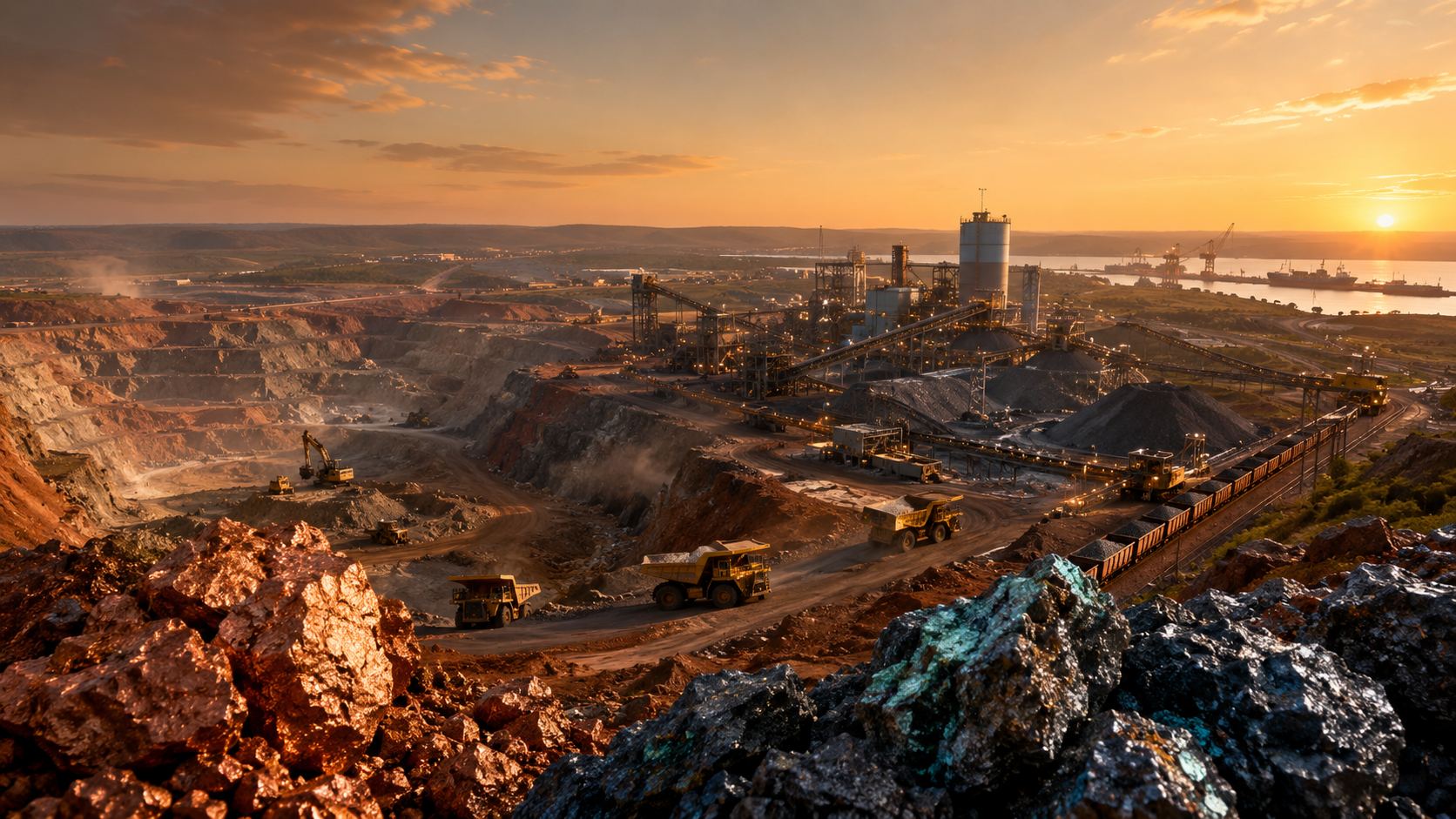
Africa’s mining map is being redrawn as copper, cobalt, lithium and other strategic minerals move from being commodities to geopolitical assets, drawing Chinese companies, Gulf sovereign investors, Western governments and African states into an increasingly competitive race for control.
The shift is visible in Zambia, where the U.S. Trade and Development Agency is supporting a feasibility study for the expansion of a copper and cobalt project owned by U.S.-based Metalex Commodities. It is also visible in the Democratic Republic of Congo, where Washington is trying to deepen its role in a sector long dominated by Chinese investors.
Saudi Arabia, meanwhile, is building its own position. Its Manara Minerals investment vehicle has been created to secure overseas supplies of minerals such as copper and lithium as Riyadh seeks to diversify its economy beyond oil.
The question for Africa is no longer simply who is mining.
It is who owns the mines, who finances them, who controls processing, who buys the output and who ultimately captures the value?
Zambia: the copper contest
Zambia is at the centre of the new competition.
The country’s Copperbelt and North-Western Province contain some of the world’s most important copper deposits, alongside cobalt and nickel resources. The government is increasingly seeking greater participation in mining projects while investors compete for access to future production.
At Kansanshi, one of Zambia’s largest copper and gold mines, Canada’s First Quantum Minerals owns 80%, while state-controlled ZCCM Investments Holdings owns 20%.
At Mopani Copper Mines, the ownership balance has shifted in the opposite direction. International Resources Holding, an investment company backed by Abu Dhabi interests, acquired 51% through Delta Mining in 2024, while ZCCM-IH retained 49%. The transaction involved an investment of up to $1.1 billion.
This makes Zambia an unusually important test of the new mining model.
China has historically been deeply involved in the country’s copper industry. Western mining companies remain major operators. African state participation is significant. And Gulf capital has now entered directly into ownership.
Saudi Arabia has also been exploring Zambian opportunities. Reuters reported in 2024 that Manara Minerals was in advanced talks to acquire a 15% to 20% minority stake in First Quantum’s Zambian copper and nickel assets, potentially worth $1.5 billion to $2 billion.
The U.S. approach is different.
Rather than immediately taking large equity positions, Washington is seeking to build alternative supply chains. The USTDA grant to Metalex is intended to finance technical work examining an expansion of the Kazozu copper and cobalt operation that could add up to 25,000 metric tons of copper and cobalt concentrates annually.
The strategic message is clear: Western capital wants access to minerals without leaving the supply chain entirely in Chinese hands.
DRC: the prize everyone wants
If Zambia is a major copper battleground, the DRC is the centre of the cobalt contest.
The country dominates global cobalt production and is also one of the world’s most important copper producers. That makes it indispensable to electric vehicles, batteries, power networks and advanced manufacturing.
But ownership is fragmented.
At Kamoto Copper Company, Glencore indirectly owns 70%, while Gécamines and other Congolese state interests collectively hold 30%. KCC produced 188,700 tonnes of copper and 22,900 tonnes of cobalt in 2025.
At Kamoa-Kakula, another giant copper operation, Canada’s Ivanhoe Mines and China’s Zijin Mining each hold an indirect 39.6% interest, with the DRC government holding 20%.
The structure illustrates the new reality.
China does not need to own every mine outright to have enormous influence over the supply chain. Its companies hold major stakes in mines, provide capital and technology, and remain deeply embedded in processing and refining.
But that dominance is now being challenged.
Reuters reported in February that Glencore was in discussions to sell a 40% stake in its DRC copper and cobalt operations to the U.S.-backed Orion Critical Mineral Consortium in a deal that could value the assets at around $9 billion including debt.
Washington has also been courting additional Congolese projects. U.S. officials say American companies are showing significant interest in DRC mining assets as part of a wider minerals partnership designed to reduce dependence on Chinese supply chains.
Kinshasa is increasingly trying to use that rivalry to its advantage.
The government has tightened its grip over cobalt exports and has sought greater control over trading and value addition. In June, Congo withdrew unused cobalt export quotas and reassigned them to a state-controlled entity.
For African governments, this is an important change.
The objective is shifting from attracting any investor to choosing between competing investors.
Guinea: China and the iron giant
Guinea demonstrates that the minerals race is broader than batteries.
The Simandou iron ore project is one of the biggest mining developments in Africa and could reshape global iron ore supply. It also provides one of the clearest examples of China’s growing influence.
In January, China’s Baowu Resources increased its stake in the Winning Consortium Simandou to 51%, taking control of the operator developing Blocks 1 and 2. The consortium owns 85% of the local operating company, while the Guinean state holds the remaining interest.
The southern blocks, meanwhile, are being developed through Simfer, involving Rio Tinto, a Chinalco-led Chinese consortium and the Guinean government.
Guinea’s lesson is that control can extend beyond the mine itself.
Railways, ports, financing, processing and export infrastructure can be as strategically important as the mineral concession.
Zimbabwe: China’s lithium stronghold
Zimbabwe offers perhaps the clearest example of China’s influence over a new mineral before it becomes a mature global industry.
Chinese companies have invested heavily in Zimbabwe’s lithium sector since 2021. Zhejiang Huayou Cobalt controls Prospect Lithium Zimbabwe, while Sinomine owns Bikita Minerals. Other Chinese companies including Chengxin Lithium, Yahua Group and Canmax Technologies are also involved.
The scale of the investment has helped make Zimbabwe Africa’s leading lithium producer.
But Harare wants more.
Zimbabwe plans to ban exports of unprocessed lithium concentrates from January 2027, following its earlier restrictions on raw lithium ore. The objective is to force greater domestic processing and capture more value inside the country.
The policy highlights one of Africa’s central problems.
Owning a mine does not necessarily mean owning the value chain.
If the concentrate leaves Africa for processing elsewhere, the country producing the mineral may capture only a fraction of the eventual value of the battery, vehicle or technology built from it.
Namibia: China meets Western capital
Namibia shows how different forms of foreign capital can coexist.
At Rössing Uranium, China’s state-owned nuclear giant CNNC controls 68.62% after acquiring Rio Tinto’s stake in 2019.
At Langer Heinrich, Australia’s Paladin Energy owns 75%, while CNNC’s overseas uranium arm holds 25%.
The result is striking.
Chinese capital has a major position in Namibia’s uranium industry, while Australian and Western-linked investors remain important elsewhere.
Namibia is also attracting interest in critical minerals beyond uranium, making it another country where future competition could involve copper, lithium, rare earths and other strategic resources.
South Africa: African capital still matters
South Africa is different again.
Its mining industry has deep roots in European and North American capital, but African ownership has become increasingly important through companies such as African Rainbow Minerals.
ARM and Assore each hold 50% of Assmang, whose operations include the Black Rock manganese mines.
Manganese is increasingly strategic because of its role in steelmaking and emerging battery technologies.
South Africa is also trying to turn its mineral wealth into an industrial advantage. In June, the government proposed extending automotive incentives to battery minerals including lithium, cobalt, graphite, copper and rare earths, with requirements for regional and local value addition.
That approach points toward a broader African ambition: not simply exporting rocks, but building industries around them.
The Gulf enters the race
The arrival of Gulf capital may prove to be one of the most important developments in African mining.
The United Arab Emirates has already moved aggressively. IRH took a 51% stake in Mopani, giving Gulf investors direct operational control over a major Zambian copper producer.
Saudi Arabia is taking a somewhat different route.
Manara Minerals, created by Saudi mining company Ma’aden and the Public Investment Fund, has so far completed a $2.5 billion investment for a 10% stake in Vale Base Metals. Reuters reported in January that Saudi Arabia was considering spinning off Manara from the PIF and strengthening its technical mining capabilities.
Its interest in Africa is therefore not simply about buying mines.
It is about securing future supply.
For Riyadh, copper and lithium can become industrial inputs for batteries, electric vehicles, renewable energy and manufacturing. For Abu Dhabi, mining assets can provide long-term exposure to global commodity flows.
Who is winning?
China remains the most deeply embedded player.
Its advantage comes from decades of investment, relationships with African governments, mining expertise and, critically, control of processing capacity. Zimbabwe’s lithium industry, Guinea’s Simandou project and major DRC copper operations demonstrate that reach.
Western capital is responding, but its model is changing.
The United States and its allies increasingly view mining through the lens of supply-chain security. The DRC has become a major test case, while Zambia is attracting U.S.-linked project development and investment.
Gulf investors occupy the middle ground.
They can deploy large amounts of capital relatively quickly, often through sovereign-backed investment vehicles, while maintaining a commercial rather than purely geopolitical approach.
African governments, however, may have the strongest bargaining position they have had in years.
Competition between China, the Gulf and the West gives countries such as Zambia and the DRC more options.
The real ownership question
The next phase of Africa’s mining race will not be decided solely by who owns 51% of a mine.
It will be decided by who controls the entire chain.
Who provides the financing? Who owns the rail line? Who controls the port? Who processes the concentrate? Who provides the technology? Who signs the offtake agreement? And who sets the price?
Those questions matter because copper, cobalt and lithium are becoming strategic assets in the global economy.
Africa has the resources.
The contest now is over who captures their value.
For the continent’s governments, the opportunity is enormous. But so is the risk of replacing one form of dependency with another.
The winners may ultimately be those African countries that use competing foreign investors to build domestic processing, infrastructure, technology and industrial capacity.
In that contest, ownership of the mineral may be only the beginning.

More from Mining
Tata Chemicals Exit: Who will control Kenya’s lake Magadi Soda Ash Wealth?
Kenya ordered Tata Chemicals out of Lake Magadi, reviving debate over foreign ownership and who truly benefits from Africa's minerals.
Who really owns Africa’s critical minerals?
Global powers compete for Africa's copper, cobalt, lithium and rare earth resources as governments seek greater control over ownership, processing and long term value creation.