

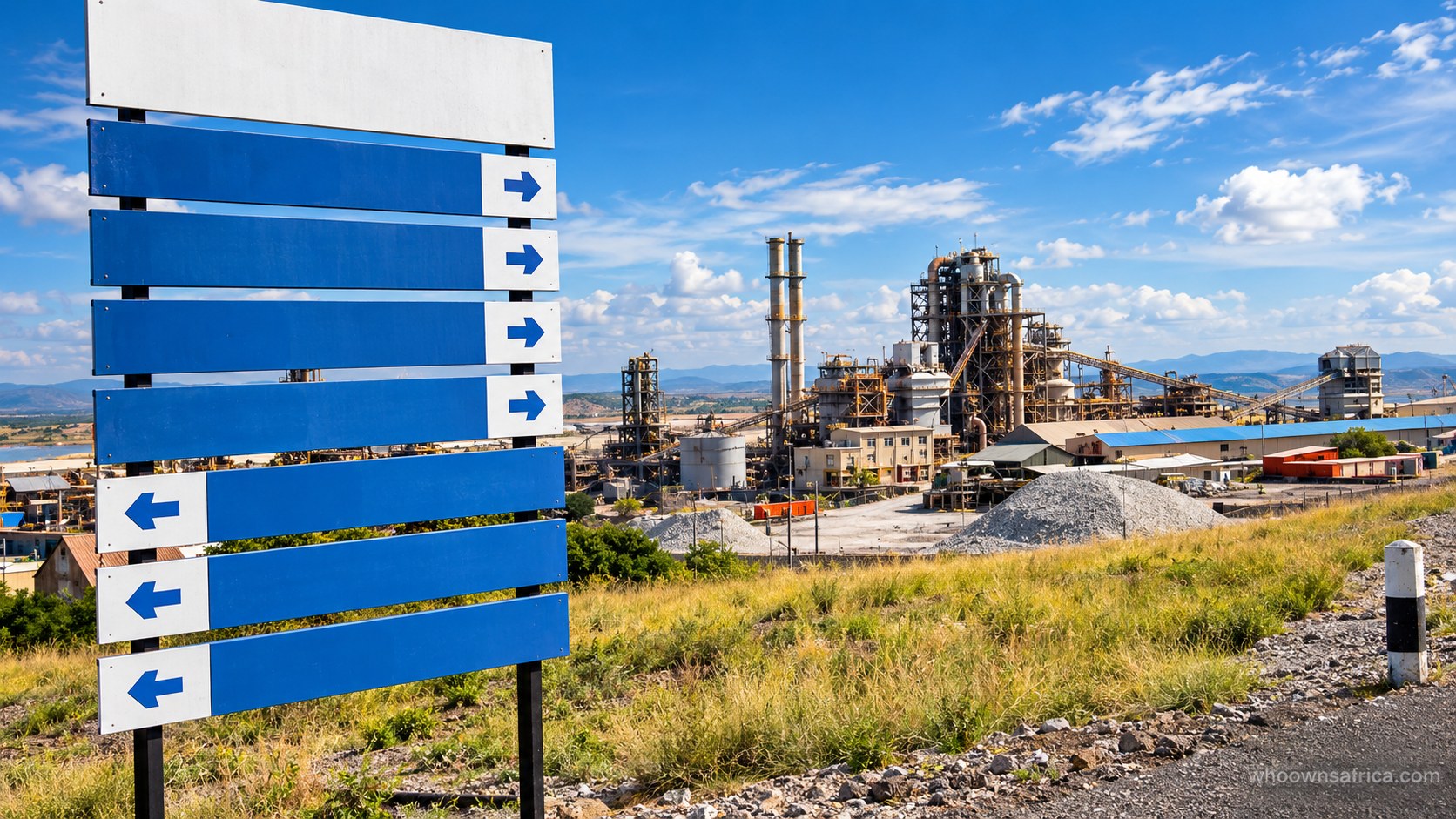
Kenyan President William Ruto ordered the Indian conglomerate Tata Chemicals to leave the country, escalating a dispute over Lake Magadi’s soda ash reserves that goes to the heart of a question many African economies are now asking out loud: who actually owns Africa’s minerals, and who gets to profit from them.
Speaking during a development tour of Kajiado County, Ruto said the company had extracted value from the lake for more than a century while building little in return, and he wants it gone.
The remarks, confirmed by the Associated Press, mark the most direct intervention yet in a standoff that began in July, when Kenya’s Ministry of Mining, Blue Economy and Maritime Affairs suspended Tata Chemicals Magadi’s operations. What started as a regulatory compliance review has now become a political flashpoint over foreign investment, resource nationalism and the industrial ambitions of a government eager to show it can turn raw minerals into local jobs.
A century-old mine faces a presidential ultimatum
Lake Magadi sits roughly 100 kilometres southwest of Nairobi in the Rift Valley, and it has been mined for trona, a naturally occurring sodium carbonate used to make soda ash, since 1911. The site passed through several owners over the decades before becoming part of Britain’s Brunner Mond group, which India’s Tata Chemicals acquired in 2005. The Kenyan subsidiary formally adopted the Tata name in 2011, meaning the group has controlled the operation for roughly two decades of its 115-year history.
Today, Tata Chemicals Magadi Limited is widely described as Africa’s largest producer of natural soda ash, a mineral used across glass manufacturing, detergents, paper production and water treatment. More than 95 percent of its output moves by a dedicated railway line to the Port of Mombasa before being shipped abroad, largely to markets in Asia and the Middle East. Kenyan government figures cited by the ministry put annual shipments at more than 350,000 tonnes, with soda ash exports valued at roughly $56.9 million in the year to July 2025.
Ruto did not mince words about what he thinks that arrangement has delivered for Kajiado. “I told them to pack and leave. They have been taking our resources and shipping them to India,” he said, according to reporting from wire coverage of the announcement. He added that the government intends to bring in a replacement investor on one condition: it must build an actual glass factory in the county, not simply extract and export.
Why Kenya suspended the mine in the first place
The presidential order did not come out of nowhere. It follows a formal suspension notice issued on July 28 by Mining Cabinet Secretary Hassan Joho, who said the company had failed to resolve a long list of statutory obligations under Kenya’s Mining Act. According to a statement from the Kenya News Agency, the unresolved issues included the absence of a clear mineral beneficiation and value-addition strategy, outstanding royalty reconciliation and payment obligations, and gaps in export reporting.
The ministry also flagged weaker community outcomes than expected from a company of Tata Chemicals’ size, pointing to poor implementation of its Community Development Agreements, thin employment and skills-transfer plans for Kenyan workers, limited local procurement, and shortfalls in environmental compliance. Joho said the decision followed years of unsuccessful engagement between his department and the company, and that any resumption of mining would require documented proof of full compliance, according to Kenyan news outlets that reviewed the ministry’s communiqué.
Those are not small administrative details in Kenya’s mining sector. Royalty payments, local content and beneficiation strategies sit at the centre of the country’s broader push, formalised in its mining and minerals policy framework, to ensure that extractive industries contribute more than export tonnage to the national economy.
Tata Chemicals says it is compliant
For its part, Tata Chemicals Magadi has pushed back on the government’s characterisation. In a filing to the National Stock Exchange of India, the company said it remains “fully compliant” with Kenyan regulations and is awaiting formal communication from Nairobi regarding the outcome of its compliance review. The company has not confirmed whether it received an official directive to exit the country, but it said it remains committed to “constructive engagement” with the government.
The dispute lands at an awkward moment for the parent company. Tata Chemicals Limited reported a steep drop in consolidated profit for the first quarter of its 2027 financial year, with net profit falling more than 80 percent year on year even as revenue rose, according to market analysis of the company’s results. Losing access to one of its lowest-cost natural soda ash sources, at a time when global soda ash prices are already under pressure, would add a further complication to that recovery.
Ruto’s bet: force the value chain to stay home
The Kenyan leader has framed the standoff less as a legal dispute and more as a statement of industrial policy. His argument is a familiar one across resource-rich economies: raw material leaves the country cheaply, gets converted into higher-value goods elsewhere, and the profit from that conversion is booked abroad rather than at home. Applied to Magadi, that means soda ash going out through Mombasa while the glass, detergents and chemicals it eventually becomes are manufactured, and sold, far from Kajiado.
“We have said we are bringing in a new company, and the new ruling for the new company is that they must establish a glass processing company here and also another company for processing chemicals here in Kajiado,” Ruto said, according to local reporting from the county tour. The message doubles as a broader signal to other foreign operators in Kenya’s extractive sector: continued access to the country’s mineral wealth will increasingly be tied to demonstrable local investment, not just royalty payments.
It is a strategy that fits into Kenya’s wider ambitions around local industrialisation and value addition, an agenda the government has pursued with varying success across sectors from textiles to agriculture. Soda ash, given its scale and its more than century-long extraction history at Magadi, has become a highly visible test case for whether that policy can actually be enforced against an established multinational investor.
Part of a wider pattern across resource economies
Kenya is not acting in isolation. Governments across the developing world, from Zimbabwe’s push on lithium processing to Indonesia’s ban on unprocessed nickel ore exports, have moved in recent years to force mineral beneficiation onshore rather than allow raw commodities to leave for processing abroad. The underlying argument is consistent: the real economic value in a mineral lies not in the extraction itself but in what gets manufactured from it, and that value should not automatically default to wherever the parent company happens to be headquartered.
For a continent whose growth has long been tied to commodity exports, from cobalt in the Democratic Republic of Congo to bauxite in Guinea, the Magadi dispute is a case study in how quickly that arrangement can be challenged when a government decides the terms of the original investment no longer serve national interests. It also raises a harder question for foreign investors operating across Africa’s extractive industries: how much local infrastructure, employment and processing capacity is now the implicit price of continued market access, regardless of what the original licence agreement said.
What happens next at Lake Magadi
No formal timeline has been set for Tata Chemicals’ exit, and the company has given no public indication that it intends to leave voluntarily. Kenya’s government has said it wants a replacement investor bound by conditions requiring a domestic glass plant and a chemicals processing facility in Kajiado, though it has not named a candidate or outlined how quickly a transition of that scale could realistically happen at a site with more than a century of existing infrastructure and a dedicated rail link to Mombasa.
The bigger question hanging over Magadi is not really about one company or one lake. It is about whether Kenya, and by extension other African governments watching closely, can convert political pressure into an enforceable industrial policy that survives the departure of one investor and the arrival of the next. For the communities of Kajiado who have lived alongside the mine for generations, the answer will be measured not in export tonnage or diplomatic statements, but in whether a factory is actually built.

More from Mining
Who really owns Africa’s critical minerals?
Global powers compete for Africa's copper, cobalt, lithium and rare earth resources as governments seek greater control over ownership, processing and long term value creation.
Who owns Africa’s critical minerals? The new battle for copper, cobalt and lithium
Copper, cobalt and lithium are reshaping Africa’s mining map as global powers compete for resources, influence and long-term supply security.