

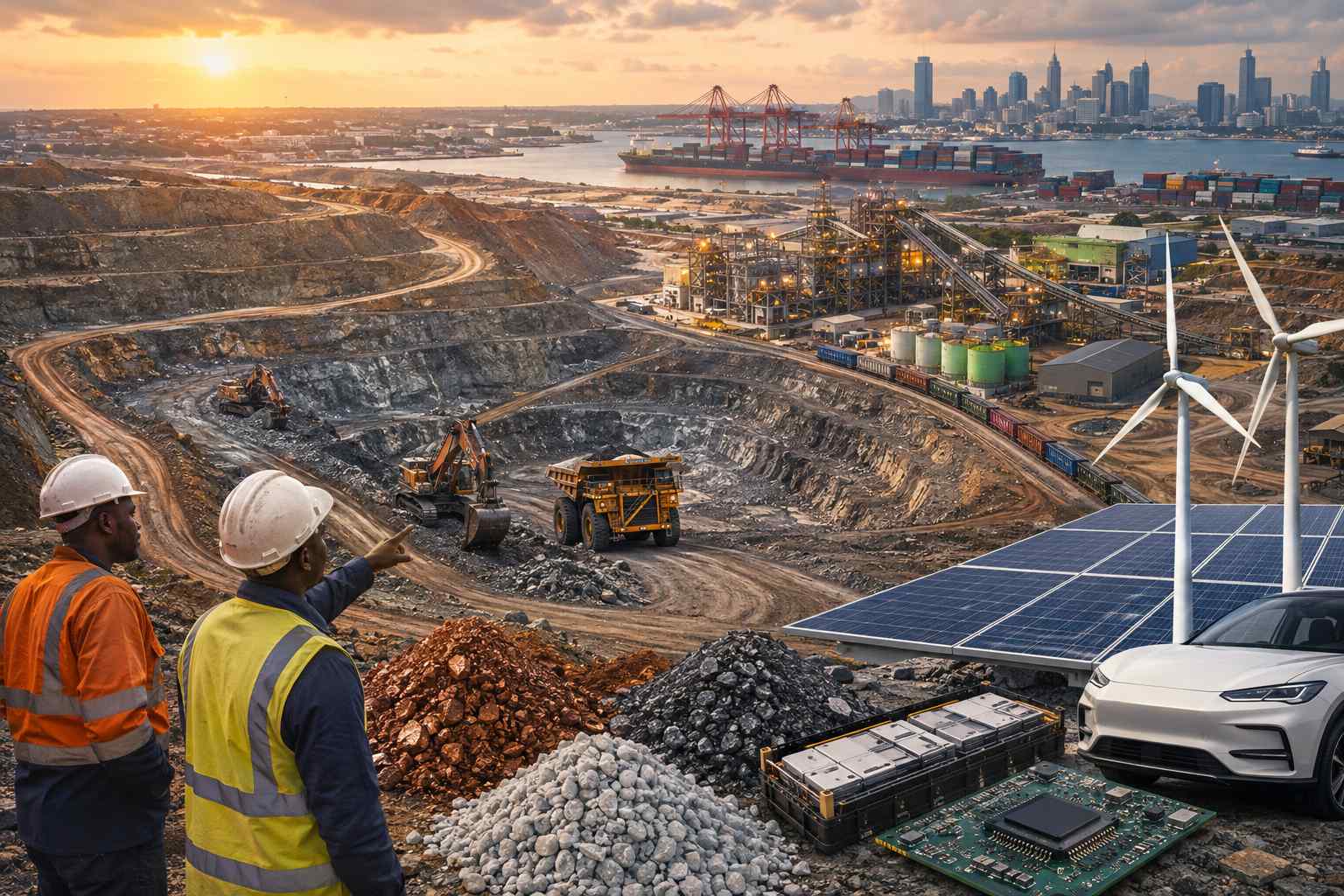
Africa’s vast reserves of copper, cobalt, lithium, manganese, graphite and rare earth minerals have become the focus of an increasingly intense global contest that stretches far beyond mining. Ownership of these resources is no longer measured simply by who holds a mining licence. It is increasingly determined by who finances projects, controls processing plants, owns transport infrastructure, signs long term supply agreements and captures the greatest share of the economic value.
As demand for minerals essential to electric vehicles, renewable energy, artificial intelligence and defence technologies continues to surge, Africa has emerged as one of the world’s most strategically important resource frontiers.
New race
The scramble for Africa’s critical minerals marks one of the biggest geopolitical shifts of the decade. Countries that once viewed African mining primarily as a source of raw materials now see the continent as indispensable to industrial competitiveness and national security. Governments and multinational corporations are investing billions of dollars to secure future supplies of minerals that underpin clean energy technologies, semiconductor manufacturing, military equipment and advanced electronics.
China remains the dominant foreign player across much of Africa’s mining sector after spending decades investing in mines, refineries, transport infrastructure and long term partnerships with governments. Western nations, led by the United States and European allies, are attempting to reduce their dependence on Chinese supply chains by supporting new mining projects and transport corridors across southern and central Africa. Gulf investors, particularly from Saudi Arabia and the United Arab Emirates, have also entered the sector aggressively, bringing sovereign wealth and long term investment strategies that are reshaping ownership structures.
Ownership puzzle
Asking who owns Africa’s critical minerals does not produce a simple answer. In many countries, ownership is shared between foreign mining companies, state owned enterprises and private investors. In others, governments retain minority stakes while international companies operate the mines. Beyond legal ownership lies another layer of control involving processing facilities, financing, logistics and commodity trading.
This distinction matters because a country may technically own its mineral resources while earning only a fraction of the value generated from them. Concentrates are often exported for refining overseas before returning as high value battery materials, electronic components or industrial products. The greatest profits frequently accrue not at the mine but further along the supply chain where refining, manufacturing and technology development take place.
China’s lead
China’s influence extends well beyond mine ownership. Chinese companies have secured stakes in major copper, cobalt and lithium operations while simultaneously investing in processing capacity that dominates global supply chains. This integrated strategy allows Chinese firms to influence pricing, processing and downstream manufacturing even where they do not own every mining asset outright.
Zimbabwe illustrates this approach clearly. Chinese companies have become the leading investors in the country’s rapidly expanding lithium industry, helping transform Zimbabwe into Africa’s largest lithium producer. The Democratic Republic of Congo also demonstrates China’s long standing presence through major investments in copper and cobalt operations, sectors that remain essential to global battery production.
Western response
The United States and Europe have responded by encouraging private investment and infrastructure projects designed to diversify mineral supply chains. Rather than attempting to replicate China’s model immediately, Western governments have focused on financing exploration, supporting feasibility studies and strengthening transport networks linking mines to international markets.
One of the most significant initiatives is the Lobito Corridor, intended to improve export routes from Zambia and the Democratic Republic of Congo through Angola. The project reflects a broader effort to provide alternative pathways for African mineral exports while reducing reliance on existing logistics networks. Reuters has reported that these investments are becoming central to Western industrial policy as governments seek more resilient supply chains.
Gulf expansion
The Gulf states have become influential new participants in Africa’s mining sector. Investment vehicles backed by Saudi Arabia and the United Arab Emirates are acquiring strategic stakes in mining companies while searching for long term supplies of copper, lithium and other industrial minerals.
Their approach differs from both China and Western governments. Gulf investors often pursue commercial opportunities supported by sovereign capital rather than explicit geopolitical objectives. Their growing presence has introduced another major source of financing for African mining projects, giving governments additional options when negotiating investment agreements.
African leverage
Perhaps the biggest change is that African governments now possess greater bargaining power than they did during previous commodity booms. Competition among China, Western nations and Gulf investors allows governments to negotiate better terms, demand greater local participation and pursue industrial policies aimed at increasing domestic value addition.
Several countries are introducing restrictions on exports of raw minerals in an effort to encourage local refining and manufacturing. Zimbabwe plans to tighten controls on lithium exports to stimulate domestic processing, while other governments are exploring similar measures across cobalt, copper and graphite industries. The objective is to move beyond exporting unprocessed ore and instead build industries capable of creating jobs, technology and higher export earnings.
Country examples
Ownership structures vary significantly across the continent. Zambia’s Kansanshi mine combines Canadian majority ownership with state participation through ZCCM Investments Holdings. Mopani Copper Mines reflects a newer trend, with Abu Dhabi backed investors acquiring a controlling stake while the Zambian state retained a substantial minority holding.
In the Democratic Republic of Congo, ownership is shared among global mining giants, Chinese investors and state owned companies. Kamoa Kakula involves Canadian, Chinese and government interests, while Kamoto Copper Company combines Glencore ownership with Congolese state participation.
Guinea’s Simandou iron ore project demonstrates another model where Chinese investment, international mining companies and the Guinean government share ownership alongside major investments in railways and port infrastructure. These arrangements show that no single country or company dominates every aspect of Africa’s mining landscape.
Beyond mining
Ownership increasingly depends on assets beyond the mine itself. Railways, ports, electricity networks, financing arrangements, refining facilities and long term purchasing agreements can determine who ultimately benefits most from mineral production.
China’s investment strategy has often combined mining with infrastructure development, strengthening its position across the supply chain. Western governments are now supporting similar infrastructure investments, recognising that access to minerals requires more than equity stakes in mining companies. Processing capacity remains especially important because it transforms raw materials into products that command far higher prices on global markets.
Future outlook
Demand for critical minerals is expected to remain strong as countries accelerate investments in renewable energy, electric vehicles, artificial intelligence infrastructure and advanced manufacturing. Africa’s abundant reserves ensure that the continent will remain central to this global transformation for decades.
The greatest opportunity for African nations lies in converting mineral wealth into broader industrial development. Success will depend on transparent governance, effective regulation, local skills development and strategic investment in refining and manufacturing. Competition among foreign investors provides leverage, but only if governments negotiate agreements that create lasting economic benefits beyond extraction alone.
Bottom line
The answer to who really owns Africa’s critical minerals is more complex than the names listed on mining licences. Ownership today is distributed across multinational corporations, state owned enterprises, sovereign wealth funds and African governments. Yet real control increasingly depends on who finances production, processes minerals, owns infrastructure and commands global supply chains.
Africa possesses the resources the world urgently needs. Whether the continent captures the full value of those resources will depend less on who extracts the minerals and more on who controls every stage between the mine and the finished product. As geopolitical competition intensifies, African governments have an unprecedented opportunity to reshape that equation, ensuring that ownership is measured not only in shares and licences but also in jobs, industrial capacity and long term economic prosperity.

More from Mining
Tata Chemicals Exit: Who will control Kenya’s lake Magadi Soda Ash Wealth?
Kenya ordered Tata Chemicals out of Lake Magadi, reviving debate over foreign ownership and who truly benefits from Africa's minerals.
Who owns Africa’s critical minerals? The new battle for copper, cobalt and lithium
Copper, cobalt and lithium are reshaping Africa’s mining map as global powers compete for resources, influence and long-term supply security.