

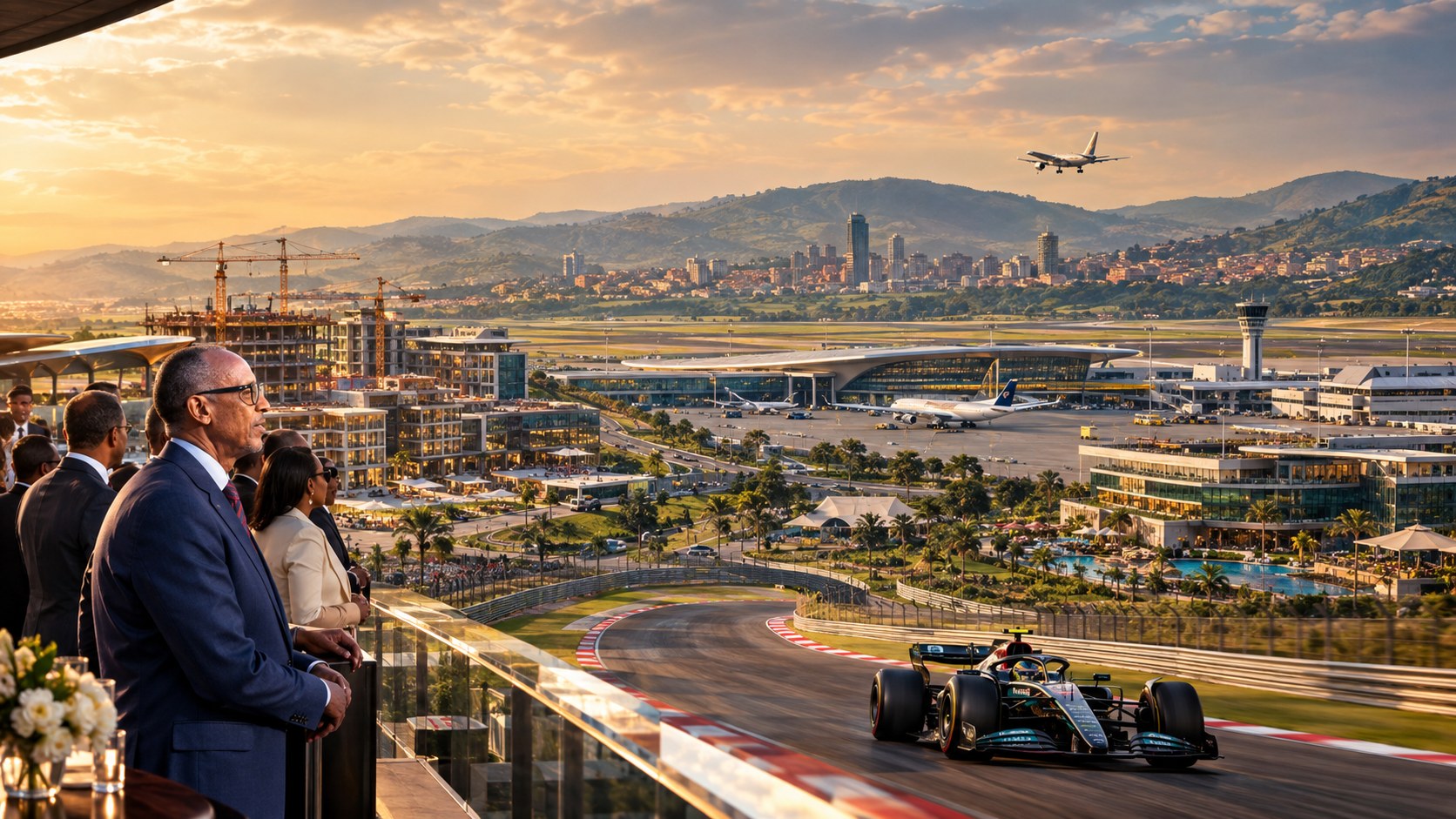
Formula 1 may be coming back to Africa, but the more important race may not happen on the circuit. It will happen around it, where land, hotels, logistics, aviation, sponsorship and international capital compete to capture the economic value created by one of the world’s most powerful sporting brands.
Reports that Rwanda has reached an agreement to host a Formula 1 Grand Prix from 2030 represent a potentially important moment for African sport. Reuters reported on October 6 that Rwanda is scheduled to bring Formula 1 back to the continent in 2030, citing a report by RacingNews365 that an agreement had been reached. The proposed venue would be a new permanent circuit near Kigali, close to Bugesera International Airport.
There is an important qualification. Formula 1, the FIA and the Rwandan government had not publicly confirmed the agreement at the time of reporting. The proposed 2030 race should therefore be treated as a reported development rather than an officially secured calendar event.
That distinction matters.
But it does not make the underlying investment story any less interesting.
In fact, it may make it more interesting.
The race is only the beginning
The instinctive reaction to a Formula 1 announcement is to think about racing.
Who will win?
Which driver will dominate?
Will Lewis Hamilton compete?
Will Africa finally have another Grand Prix?
Those are legitimate questions. They are also the least consequential questions for investors.
The real question is what happens to the land surrounding the circuit.
Rwanda is not simply proposing to build a racetrack. It is developing an economic corridor in one of the country’s most strategically important growth areas.
The proposed circuit is expected to sit roughly 40 kilometres from Kigali, near Bugesera International Airport. That location is significant because the airport itself is part of Rwanda’s wider ambition to expand its international connectivity and develop new economic activity outside the traditional Kigali core.
Put a global sporting event beside a major airport and the economics change.
Suddenly, the surrounding land is no longer just land.
It becomes a potential hospitality district.
A logistics zone.
A luxury residential market.
A corporate events destination.
A media and broadcasting centre.
A retail opportunity.
A sponsorship ecosystem.
And potentially, a new address for international capital.
Bugesera is the bigger story
For Who Owns Africa, this is where the Formula 1 story becomes much more interesting.
The question is not whether Rwanda can build a circuit.
The question is who will own the ecosystem that develops because the circuit exists.
Rwanda’s own National Strategy for Transformation identifies the Bugesera airport area as an opportunity for private-sector real estate development. The strategy also targets a substantial increase in tourism revenues and specifically identifies large events, sport tourism, meetings and exhibitions as ways to expand the country’s high-value tourism economy.
That suggests Formula 1 would fit into an existing economic strategy rather than stand alone as an extravagant sporting project.
This distinction is crucial.
A Grand Prix that arrives for one weekend and leaves behind an empty circuit is expensive entertainment.
A Grand Prix that becomes an anchor for hotels, conference facilities, restaurants, commercial property, aviation, logistics and international events is infrastructure.
That is a completely different investment proposition.
Follow the airport
The airport may ultimately matter more than the racetrack.
A Formula 1 weekend brings an unusually concentrated population of international visitors. Drivers, teams, sponsors, engineers, media organisations, hospitality companies, wealthy spectators and corporate guests all need to arrive, sleep, move, eat and conduct business.
That requires an ecosystem.
Bugesera International Airport is already central to Rwanda’s plans for expanding that ecosystem. The surrounding area is also being positioned for industrial and logistics development.
The Rwandan government has identified Bugesera among priority locations for industrial infrastructure, with public investment directed toward roads, electricity, water and other basic infrastructure intended to attract investors.
The implications extend beyond motorsport.
An airport attracts airlines.
Airlines attract passengers.
Passengers create demand for hotels.
Hotels support conferences.
Conferences support restaurants, retail and transport.
Industrial infrastructure attracts companies.
Companies create demand for offices and housing.
And once a global event such as Formula 1 enters the equation, the entire corridor can acquire a new international identity.
This is how sporting infrastructure becomes economic infrastructure.
Who owns the land?
This may be the most important question Rwanda’s F1 ambition raises.
When governments announce transformational projects, the public conversation normally focuses on what will be built.
Investors focus on who owns what.
Who owns the land around the circuit?
Who owns the hotels?
Who receives the concessions?
Who develops the retail centres?
Who controls parking and transport?
Who owns the hospitality businesses?
Who captures the advertising inventory?
Who supplies construction materials?
Who manages the logistics?
Who controls the digital infrastructure?
And, perhaps most importantly, who owns the real estate that becomes more valuable because the Grand Prix exists?
These questions should be asked before the first Formula 1 car reaches Rwanda.
Rwanda’s development strategy already anticipates greater private investment in real estate, including around the Bugesera airport area. The country’s investment authorities also describe real estate as a significant economic sector, driven by urbanisation and demand for residential and commercial space.
Formula 1 could therefore become a catalyst for a much larger property story.
The $1 billion question
The $1 billion figure in the headline should be understood as an analytical framing, not a confirmed project budget.
There is currently no credible basis for presenting $1 billion as the officially announced cost of Rwanda’s Formula 1 project.
But the figure is useful because it captures the scale of the ecosystem that could eventually surround a Grand Prix.
A modern Formula 1 destination requires much more than asphalt.
There is the circuit itself, grandstands, paddock facilities, safety systems and hospitality infrastructure.
Then come roads, parking, utilities, accommodation, security, telecommunications and transport.
Beyond those immediate requirements is the secondary development that can follow.
Hotels can be built for international visitors.
Luxury residences can target wealthy travellers and executives.
Restaurants can serve an expanding business and tourism population.
Conference facilities can extend the economic value beyond race weekend.
Entertainment districts can create additional visitor spending.
Commercial property can follow new infrastructure.
The cumulative investment could eventually reach a very large figure, depending on how aggressively the surrounding corridor develops.
That is why the ownership question deserves more attention than the headline race date.
Rwanda is selling a destination
There is another layer to this strategy.
Rwanda has spent years building an international brand around Kigali, tourism, conferences, conservation and high-profile sports partnerships.
Formula 1 would add another powerful component.
The sport is no longer simply a European racing championship. It has become a global entertainment and commercial platform, with races increasingly designed around tourism, hospitality, celebrity culture and corporate networking.
For Rwanda, that is attractive.
The country does not need millions of spectators every weekend.
It needs the right visitors.
A wealthy international traveller attending a Grand Prix can spend considerably more across hotels, restaurants, transport, entertainment and premium hospitality than an ordinary tourist.
That is consistent with Rwanda’s stated ambition to move toward higher-value tourism. Its national strategy targets tourism revenues of $1.1 billion, up from $620 million, while also seeking to increase meetings, incentives, conferences and exhibitions revenues.
Formula 1 fits naturally into that ambition.
Africa’s ownership problem
There is also a broader African question.
For decades, major international sporting events have often been presented as opportunities for African cities to gain global visibility.
But visibility is not ownership.
Africa can host a major event without controlling the intellectual property.
It can provide land without owning the resulting commercial assets.
It can build infrastructure while foreign companies capture the operating revenues.
It can welcome international tourists while local businesses remain peripheral to the highest-value contracts.
That is the ownership problem.
Rwanda has an opportunity to approach Formula 1 differently.
The objective should not simply be to put Kigali on television.
It should be to ensure that African companies, investors, entrepreneurs and institutions participate meaningfully in the economic architecture surrounding the race.
The circuit can be international.
The ownership opportunity should be African.
The South Africa comparison
Rwanda’s emergence also tells us something about the changing geography of African motorsport.
South Africa has the continent’s strongest Formula 1 heritage, with Kyalami having hosted the last African World Championship Grand Prix in 1993. Competing efforts to bring the sport back to South Africa have continued, but Rwanda has now emerged as the leading reported candidate for 2030.
That is not simply a sporting upset.
It is an infrastructure story.
Formula 1 needs governments and investors capable of building an ecosystem around the race. Rwanda has positioned itself as a country able to make long-term infrastructure decisions, coordinate projects and market itself internationally.
The question is whether that model can translate into a financially sustainable Grand Prix.
The risk behind the glamour
The excitement should not obscure the risks.
Formula 1 is expensive.
A permanent circuit must meet stringent technical and safety requirements.
The associated infrastructure must work at international standards.
Hotels must have sufficient capacity.
Transport networks must handle exceptional demand.
And the event must remain commercially viable after the opening excitement disappears.
There is also the danger of speculative real estate.
Whenever a major airport, highway or international sporting project is announced, land prices can move before the economic fundamentals have caught up.
That creates opportunities, but also creates risks.
A Formula 1 announcement should not automatically be interpreted as a guarantee of rising property values.
Infrastructure projects can be delayed.
Projects can change.
Race calendars can change.
And international sporting agreements can evolve.
Investors should therefore distinguish between a confirmed infrastructure project, a proposed development and a speculative expectation.
The real prize
The most interesting possibility is not that Rwanda hosts one spectacular Grand Prix in 2030.
It is that the race becomes an anchor for an entirely new economic district.
Imagine a Formula 1 weekend where an international executive flies into Bugesera, stays in a nearby five-star hotel, attends a corporate summit, visits Kigali, invests in property and returns the following year.
That is a recurring economic relationship.
The circuit becomes the hook.
The airport becomes the gateway.
The hotels become the accommodation layer.
The real estate becomes the permanent asset.
The logistics network becomes the economic backbone.
And Formula 1 becomes the global marketing machine.
That is a far more valuable proposition than ticket sales.
Africa’s next ownership race
This is why Rwanda’s Formula 1 ambition deserves to be watched from the boardroom as closely as from the grandstand.
The reported 2030 agreement, if formally confirmed, would end a 37-year absence of Formula 1 from Africa.
But the bigger story would be what Rwanda builds around it.
The Grand Prix could become one of the most visible pieces of a much broader transformation of Bugesera and the Kigali airport corridor.
The winners will not necessarily be the people standing on the podium.
They could be the companies that own the hotels.
The developers that control strategically located property.
The logistics companies moving people and equipment.
The telecommunications firms connecting the event to the world.
The African businesses supplying services.
The investors financing the infrastructure.
And the institutions capable of turning a three-day spectacle into a year-round economic platform.
For Rwanda, Formula 1 is therefore not merely a bet on racing.
It is a bet on geography.
It is a bet on infrastructure.
It is a bet on tourism.
It is a bet on Kigali’s global brand.
And ultimately, it is a bet on ownership.
The question Africa should be asking is not simply whether Rwanda can bring Formula 1 back to the continent.
It is this:
When the lights go out and the engines fall silent, who will still own what Formula 1 helped build?
That may prove to be the real race.

More from Sports

How Yan Diomandé became the most expensive African soccer player in history
From dirt pitches in Abidjan to a record-breaking move to Real Madrid, the 19-year-old Ivorian winger has risen through football with remarkable speed, talent and resilience.

Senegal appoint Patrick Vieira as head coach with AFCON qualifiers looming
Dakar-born Vieira takes charge after World Cup disappointment, with Senegal targeting AFCON qualification and renewed continental success.
Africa has 54 votes. Why the continent is becoming FIFA’s kingmaker
Africa's growing voting power is reshaping the balance between football, money and global politics.