
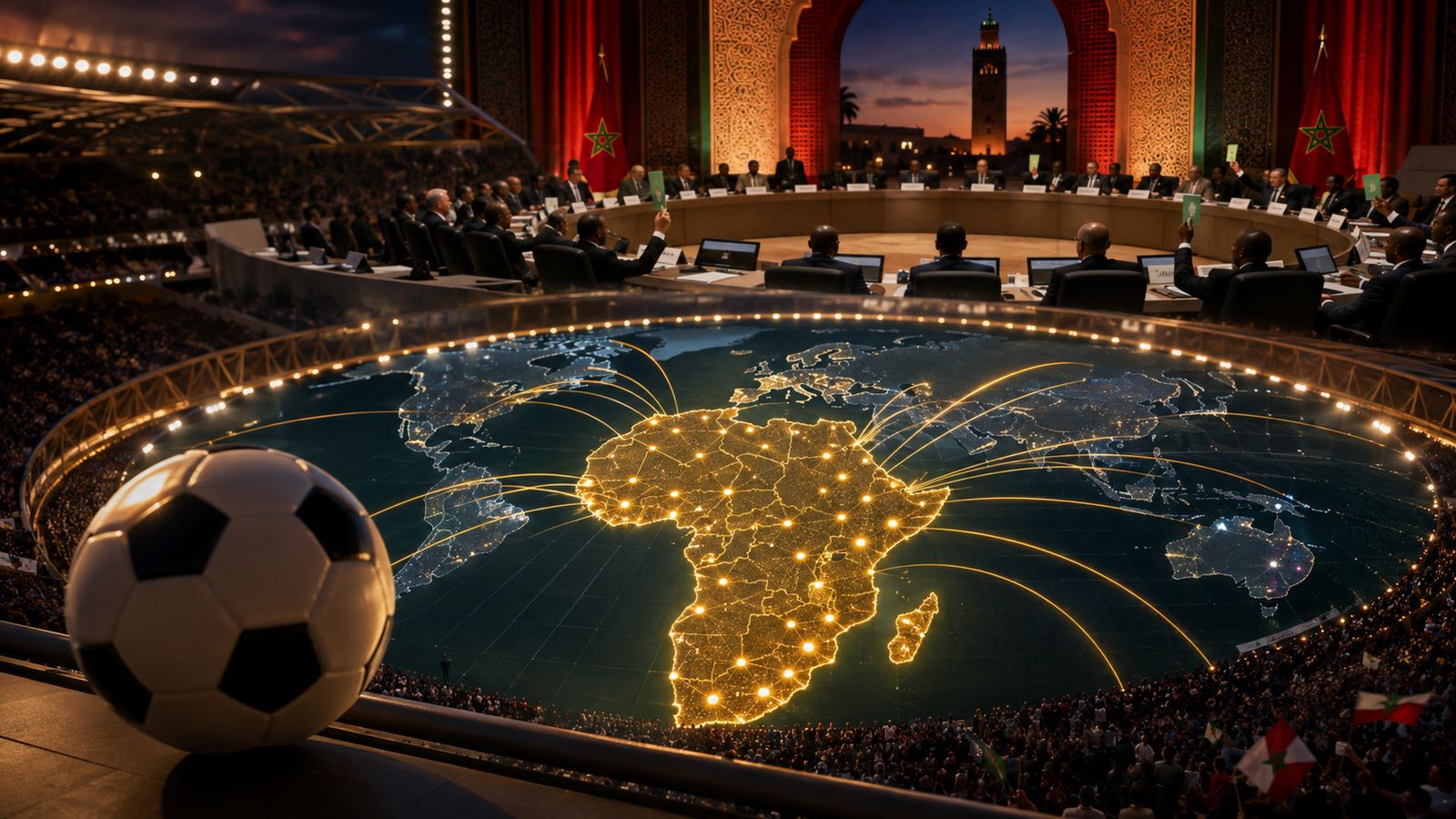
Africa’s influence over the future of world football is no longer measured only by goals, trophies or the number of players it exports to Europe’s biggest leagues. It can now be counted in votes. The continent’s 54 FIFA member associations represent more than a quarter of FIFA’s 211 members, giving Africa the potential to become the single most important swing bloc in the contest for control of football’s governing body.
That arithmetic is becoming especially important as FIFA President Gianni Infantino faces growing opposition before next year’s presidential election in Morocco.
The contest is still fluid. UEFA, the Asian Football Confederation and CONCACAF have challenged Infantino’s leadership after FIFA abandoned a controversial proposal to sell a 20% stake in a new commercial entity tied to its competitions. The plan was intended to raise about $4.2 billion from private investors but was withdrawn after a backlash over governance and consultation.
Africa, by contrast, has largely remained in Infantino’s camp.
The Confederation of African Football, or CAF, unanimously backed him in April and reaffirmed that support in August. CAF President Patrice Motsepe has said the final decision should be left to FIFA’s 211 members through the electoral process.
That support matters because FIFA’s electoral system gives every national association one vote.
One country, one vote
FIFA’s voting structure is unusually egalitarian for an organisation whose members vary enormously in population, wealth and football influence.
Germany has one vote. Nigeria has one. Brazil has one. Cabo Verde has one. The smallest football associations have the same formal voting weight as the sport’s commercial giants.
FIFA’s statutes state that each member has one vote at Congress. That means Africa’s 54 associations, if they acted together, could command more than a quarter of the available votes.
A candidate needs a simple majority of 106 votes when there are two candidates in the decisive vote. Africa alone cannot elect a FIFA president, but neither can it easily be ignored.
That distinction is crucial.
Africa is not necessarily a voting bloc in the strict sense. National federations retain their own interests, political relationships and priorities. Reuters reported last week that African associations have historically sometimes ignored CAF recommendations in FIFA presidential elections and other major votes.
So the continent’s power lies less in the certainty of 54 identical ballots than in the possibility of 54 votes being persuaded, negotiated or assembled around a common interest.
That makes Africa a kingmaker.
Development changes the calculation
The politics cannot be separated from money.
Under FIFA’s Forward programme, development funding has expanded dramatically since Infantino became president. FIFA says more than $1 billion has been invested in African football through the programme since 2016, with support to Africa expected to reach about $1.28 billion by the end of 2026.
Across the world, FIFA’s Forward 3.0 programme has earmarked $2.25 billion for the 2023-26 cycle. Each of FIFA’s 211 member associations can receive funding for football projects and operational costs.
For wealthy European federations, such sums may not determine a presidential vote.
For smaller associations where football infrastructure, coaching programmes, national teams and youth development depend heavily on international funding, the calculation can be very different.
That does not mean African federations are simply buying into Infantino’s politics. It means they have tangible reasons to value a FIFA leadership that has made development funding a central part of its relationship with them.
Malawi Football Association President Fleetwood Haiya, for example, has credited FIFA investment with helping the country’s football development and said Infantino remains his preferred candidate unless a credible alternative offers a stronger programme for poorer nations.
The political message is straightforward: development is power.
More places, more influence
Africa’s leverage has also grown on the field.
The expansion of the men’s World Cup from 32 to 48 teams has given CAF nine direct places at the 2026 tournament, plus another opportunity through the FIFA Play-Off Tournament. Nine African teams qualified directly, a record for the continent.
That expansion is more than a sporting statistic.
For African football administrators, additional World Cup places mean more national teams can access the tournament’s financial rewards, global exposure and commercial opportunities. It also demonstrates the political value of FIFA’s long-running argument that global football should distribute opportunities more widely beyond Europe’s traditional powers.
This is where football governance becomes geopolitics.
European football has enormous financial strength. UEFA and Europe’s major leagues generate vast commercial revenues, and European clubs remain the centre of the global transfer market. Reuters has described UEFA as the economic engine of world football, despite having 55 of FIFA’s 211 member associations.
FIFA’s political model is different.
It gives small associations a vote equal to that of the biggest football nations.
Infantino has built much of his presidency around that distinction.
Africa and Europe’s competing visions
The current crisis exposes a deeper divide.
European officials have focused heavily on governance, transparency and consultation following FIFA’s attempt to establish FIFA Forward Enterprise, the proposed commercial subsidiary that would have handled rights associated with FIFA competitions.
The African position has been more pragmatic.
CAF has supported Infantino while stressing governance, due process and transparency. Its backing suggests that many African administrators do not see the dispute simply as a referendum on Infantino personally. They also see a question about who controls football’s financial future and how its revenues are distributed.
That difference reflects different positions within the football economy.
Europe controls many of the world’s richest leagues and clubs. Africa has an enormous player pool and a huge football audience, but many national associations operate with fewer commercial resources.
FIFA’s development system therefore gives the governing body a powerful relationship with African football.
The result is an unusual political equation. UEFA may have greater economic leverage, but Africa has significant electoral leverage.
Morocco’s strategic position
The geography of the next FIFA election adds another layer.
The 2027 FIFA Congress and presidential election will be held in Morocco. The country is already one of Africa’s most ambitious football powers and will co-host the 2030 World Cup with Portugal and Spain.
Morocco has also been among the African and Arab associations that have backed Infantino.
Its rise illustrates how football is increasingly used as an instrument of international influence.
Hosting major tournaments, investing in stadiums and developing national teams can strengthen a country’s diplomatic profile. For African states, football offers a rare global platform where the continent can negotiate with Europe, Asia, the Americas and the Middle East on relatively equal institutional terms.
The FIFA Congress in Morocco will therefore be more than a presidential election.
It will be a gathering of national football associations at a moment when the global football order is being contested.
The 54 votes are not guaranteed
There is a danger in treating Africa as a single political actor.
CAF may endorse a candidate, but national federations ultimately cast the votes. History shows that African associations can break ranks when their national interests differ from the position of the continental confederation.
That makes the African vote both powerful and unpredictable.
Egypt, Morocco and Niger have formally backed Infantino, while other African federations have taken a more cautious approach as pressure on the FIFA president has increased. A challenger could still emerge before the November deadline for candidates, potentially changing the calculations across the continent.
The most important question is therefore not whether Africa has 54 votes.
It is who can persuade enough of those 54 associations that their interests will be better served by one candidate than another.
A new football balance
The answer will matter beyond FIFA headquarters in Zurich.
Africa’s growing influence is part of a broader transformation in global football. The sport’s centre of commercial gravity remains heavily European, but its political centre is increasingly dispersed.
Asia has 47 FIFA members. Africa has 54. CONCACAF has 41. Europe has 55. In this system, football’s smaller and developing markets can collectively challenge the influence of the richest leagues and clubs.
That is why the fight over FIFA’s presidency is not simply about Infantino.
It is about what FIFA should be: a commercially aggressive global sports corporation, or a political federation that redistributes football’s wealth and opportunities across 211 national associations.
Africa has a strong interest in the second model.
Its administrators have watched FIFA development funding grow, World Cup access expand and African football gain greater visibility. They also understand that the continent’s 54 votes give it something that cannot easily be measured in dollars.
It gives Africa bargaining power.
For decades, global football politics was often described as a contest dominated by Europe and a handful of powerful national federations. That era is changing.
The continent that once complained about being underrepresented in the world’s biggest football tournament now has enough votes to influence who runs the organisation that controls it.
The 54 ballots will not necessarily move together.
But candidates for FIFA’s presidency will have to count them, court them and listen to them.
That is the real measure of Africa’s rise.
The continent is no longer simply asking for a place at football’s table. Increasingly, it has a hand on the chair.

More from Sports
How Yan Diomandé became the most expensive African soccer player in history
From dirt pitches in Abidjan to a record-breaking move to Real Madrid, the 19-year-old Ivorian winger has risen through football with remarkable speed, talent and resilience.
Senegal appoint Patrick Vieira as head coach with AFCON qualifiers looming
Dakar-born Vieira takes charge after World Cup disappointment, with Senegal targeting AFCON qualification and renewed continental success.