

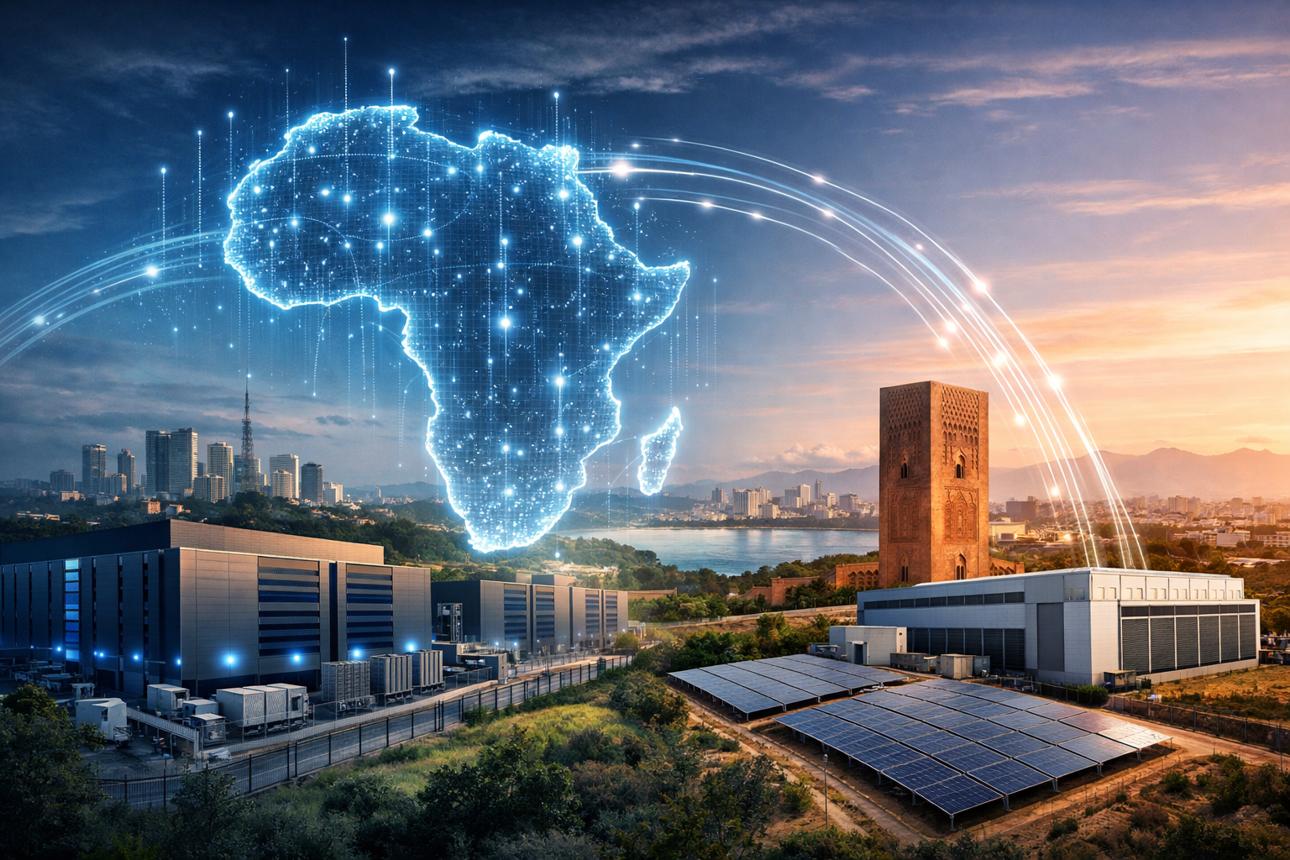
Africa’s artificial intelligence revolution may ultimately be decided not by the companies developing the smartest applications, but by those owning the computers, data centres, electricity networks and digital infrastructure that make those applications possible. As global technology companies position themselves across the continent, a new competition is emerging over who will control the foundations of Africa’s digital economy.
The excitement surrounding artificial intelligence has created an investment race extending far beyond Silicon Valley. From Johannesburg and Nairobi to Lagos, Cairo and Casablanca, the infrastructure required to power the next generation of digital services is attracting international capital, telecommunications companies, cloud providers and infrastructure investors.
For Africa, the opportunity is substantial. A continent with a young population, expanding digital markets and growing demand for financial technology, e-commerce, digital government and industrial automation represents an important frontier for the global technology industry.
But beneath the investment announcements lies a more consequential question: will Africa become an owner and producer of the infrastructure powering the artificial intelligence economy, or will it primarily become a market consuming technologies developed, hosted and controlled elsewhere?
The answer will have implications extending beyond technology. It will influence economic competitiveness, national security, industrial development, employment, political independence and the distribution of wealth in the decades ahead.
The Infrastructure Race Is Bigger Than Artificial Intelligence
Artificial intelligence is often presented as a competition between software developers, technology entrepreneurs and companies building increasingly powerful AI models. In reality, the industry depends on an extensive physical infrastructure that is expensive, strategically important and difficult to replicate.
That infrastructure includes:
- Data centres that house computing equipment and store information.
- High-performance processors and graphics processing units required to train and operate AI models.
- Cloud computing platforms that provide businesses and governments with access to computing resources.
- Fibre-optic networks and submarine cables connecting African markets to international digital networks.
- Reliable electricity generation, cooling systems and water infrastructure.
These components form the foundation of the modern AI economy. Whoever controls them can influence the cost, accessibility and direction of technological development.
Africa remains significantly underrepresented in this infrastructure. Research by the United Nations Economic Commission for Africa indicates that the continent has considerable data-centre development potential, although capacity remains concentrated in a relatively small number of markets.
Industry projections suggest that African data-centre demand could expand substantially by 2030, creating opportunities for billions of dollars in new infrastructure investment.
For international technology companies, this represents an opportunity to establish long-term commercial positions in a market where demand for computing infrastructure is expected to increase.
For African governments, it presents a difficult strategic choice: how to attract the capital and technical expertise required without surrendering too much control over essential digital infrastructure.
The Global Companies Positioning Themselves
The competition is not being driven by a single company or country. It involves American technology giants, Middle Eastern investment groups, international infrastructure operators and African businesses seeking to establish themselves in a rapidly expanding industry.
Amazon Web Services: Building an Established African Cloud Position
Amazon Web Services (AWS) has established an important position through its Cape Town cloud region, launched in 2020.
Its presence allows African businesses, financial institutions, public agencies and developers to access cloud computing services locally rather than relying exclusively on infrastructure outside the continent.
Amazon has announced substantial investments in its South African cloud infrastructure, including a commitment to expand its investment through 2029.
The significance extends beyond the physical facilities. AWS provides an ecosystem of software, storage, databases, security services and computing tools that businesses increasingly depend on.
Once organisations build their operations around a cloud platform, moving to another provider can become expensive and technically complicated.
That creates a long-term commercial relationship between the infrastructure provider and the customer.
For African businesses, the benefits include access to sophisticated technology without building expensive facilities themselves. The challenge is ensuring that access to foreign cloud platforms also encourages domestic technical expertise, competition and local innovation.
Microsoft and G42: The Strategic Importance of Kenya
The partnership between Microsoft and Abu Dhabi-based G42 illustrates how international AI investment is increasingly connected to national infrastructure strategies.
In May 2024, the companies announced a $1 billion digital investment initiative for Kenya. A central component was a proposed geothermal-powered data centre intended to support a new East Africa Azure cloud region.
The broader programme also included connectivity investment, AI research, local-language technology development and digital skills training.
However, the project has faced significant implementation challenges.
Reuters reported in May 2026 that negotiations had stalled over proposed payment guarantees and the amount of data-centre capacity the Kenyan government would need to commit to purchasing. Kenya’s government maintained that discussions were continuing and the project had not been abandoned.
The distinction between an announced investment and an operational facility is important.
Large AI data centres require substantial electricity, specialised equipment, long-term commercial agreements and predictable regulatory conditions. Securing these requirements can be considerably more complicated than announcing an investment partnership.
For Kenya, the project represents an opportunity to strengthen its position as an East African technology hub. But it also demonstrates why governments must carefully evaluate the financial obligations attached to major infrastructure agreements.
Google: Connecting Cloud Infrastructure With AI Development
Google is pursuing a broader strategy that combines cloud infrastructure, connectivity, research and artificial intelligence.
Its Johannesburg cloud region, launched in 2025, strengthened its ability to serve South African businesses and organisations requiring local cloud services.
In July 2026, Google announced that it had exceeded its $1 billion commitment to Africa’s digital transformation ahead of schedule. It also unveiled further AI, connectivity and infrastructure initiatives.
Google’s investment is particularly significant because the company operates across several layers of the digital economy.
Its influence extends from internet connectivity and cloud computing to AI development, digital advertising and software services.
This creates opportunities for African entrepreneurs to develop businesses using advanced technology. However, it also raises questions about the concentration of digital infrastructure and the bargaining power of local companies.
The more essential a platform becomes to an economy, the greater the importance of transparent pricing, competition and effective regulation.
Equinix: The International Interconnection Opportunity
The American digital infrastructure company Equinix is expanding its African presence through acquisitions and new infrastructure.
Its planned $22 million Lagos facility, announced in November 2025, formed part of a wider investment ambition of approximately $100 million across Africa over two years.
The Lagos project was intended to strengthen connections between Nigerian businesses, international networks and cloud service providers.
Equinix’s business model illustrates an important aspect of the AI infrastructure race: not every influential company needs to develop its own AI model.
Companies controlling the physical locations where networks, cloud platforms and businesses connect can occupy valuable positions in the digital economy.
This interconnection layer is particularly important for African markets where international connectivity, latency and access to reliable hosting remain significant commercial considerations.
African Infrastructure Companies Are Entering the Contest
The assumption that Africa’s AI infrastructure future will be determined exclusively by American and Middle Eastern technology companies overlooks an increasingly important group of African-focused operators.
These businesses may not command the financial resources of global hyperscalers, but they are building facilities, attracting institutional capital and establishing networks across multiple African countries.
Raxio Group is among the significant examples.
In July 2026, the company announced that its committed capital had exceeded $380 million, supported by additional investment from shareholders Roha and Meridiam.
The company also secured a $100 million financing package from the International Finance Corporation in 2025.
Its operations and expansion plans span markets including Uganda, Ethiopia, Mozambique, the Democratic Republic of Congo, Côte d’Ivoire and Angola.
Raxio is also increasing infrastructure capacity to accommodate higher-density computing and emerging AI workloads.
Another important player is Cassava Technologies, through its Africa Data Centres business.
Its strategy combines data-centre development with telecommunications, cloud services and renewable-energy partnerships.
The company’s infrastructure expansion reflects a broader opportunity for African businesses to participate in the ownership and operation of the continent’s digital backbone.
Meanwhile, Digital Realty has an established African presence through Teraco, one of the continent’s major data-centre operators.
These companies demonstrate that the African market is not simply a destination for international investment. It is also developing its own infrastructure businesses capable of attracting global institutional financing.
The central question is whether these African-focused operators can grow into competitive regional platforms rather than remaining smaller participants in an industry dominated by multinational technology groups.
Why Electricity Could Determine Who Wins Africa’s AI Race
There is a contradiction at the heart of Africa’s AI ambitions.
The continent has some of the world’s most significant renewable energy resources, including solar, geothermal, hydroelectric and wind potential. Yet many African economies continue to experience electricity shortages, unreliable distribution networks and high energy costs.
Artificial intelligence infrastructure makes this problem more complicated.
Traditional data centres already require substantial electricity to operate servers, cooling equipment and security systems. AI facilities can require considerably greater computing density, making their energy requirements even more demanding.
This creates a new competition between technology investment and national energy priorities.
South Africa illustrates the challenge. Data-centre operators are increasingly exploring renewable energy agreements, independent generation and electricity wheeling arrangements to secure reliable power.
Amazon, for example, has renewable-energy projects supporting its South African operations. Teraco is also developing large-scale renewable-energy arrangements to support its facilities.
Kenya has a potentially different advantage.
Its geothermal resources provide an opportunity to develop data centres using relatively stable renewable electricity. This is one reason the proposed Microsoft-G42 investment attracted considerable attention.
However, renewable energy availability does not automatically translate into unlimited electricity for industrial projects. Transmission infrastructure, grid stability, water availability, land use and competing demand must also be considered.
The African AI infrastructure race will therefore reward countries capable of connecting digital development with long-term energy planning.
Governments that offer tax incentives without investing in electricity infrastructure may attract announcements but struggle to sustain operations.
More importantly, policymakers must avoid a situation in which large technology facilities receive preferential access to scarce electricity while households, hospitals, schools and local manufacturers face persistent shortages.
The economic value of a data centre should be assessed against its contribution to the wider economy, not simply the amount of foreign capital it attracts.
The Ownership Question: Who Benefits From African Data?
The most important debate surrounding AI infrastructure is not necessarily where data centres are located. It is who owns and controls the economic value generated by the information processed inside them.
Every digital transaction produces information.
Mobile money payments, online shopping, agricultural transactions, healthcare records, government services and financial activities create enormous quantities of data.
Artificial intelligence systems can use information to identify consumer behaviour, improve financial services, predict demand, optimise logistics and develop commercial products.
For businesses, this information has significant economic value.
For governments, it can improve public administration, economic planning and service delivery.
For technology companies, it represents an important resource for developing and improving digital products.
But the distribution of these benefits is not automatically equal.
An African company may generate customer information, purchase computing services from an international provider and use foreign software to develop an AI-powered product. The resulting commercial value may be distributed among several companies, many of which are headquartered outside Africa.
This does not necessarily represent exploitation. International technology partnerships can create substantial economic benefits.
However, it demonstrates why African governments must understand the commercial arrangements surrounding digital infrastructure.
Data localisation alone is not sufficient to establish digital sovereignty.
A server physically located in an African country can still be operated by a foreign company under contractual arrangements governed by foreign law.
Meaningful sovereignty requires a combination of regulatory authority, technical expertise, cybersecurity capabilities, domestic ownership and the ability to develop competitive local technology.
The African Union has recognised this challenge.
Its Continental Artificial Intelligence Strategy, adopted in 2024, emphasises the importance of African-led research, computing infrastructure, high-quality datasets, skills development and responsible AI governance.
The issue is therefore no longer simply whether Africa should adopt AI.
It is whether African institutions will have sufficient influence over the systems shaping their economies.
The Risk of Becoming a Digital Colony
Africa’s historical experience with natural resources provides an important warning.
For decades, many countries exported minerals, agricultural commodities and energy resources while importing higher-value manufactured products.
The result has often been an unequal distribution of economic benefits along international supply chains.
The AI economy could reproduce a similar pattern.
Africa could supply the users, markets, information, natural resources and electricity required by international technology businesses while importing the most expensive computing services and software.
Consider the relationship between critical minerals and artificial intelligence.
The global expansion of data centres requires enormous investments in electrical equipment, cooling systems, batteries, telecommunications infrastructure and specialised electronics.
These industries depend on minerals and industrial supply chains in which African countries play important roles.
Yet extracting minerals is not the same as controlling the technology industries that use them.
A country that supplies raw materials without developing manufacturing, engineering, research and intellectual property capabilities captures only part of the potential value.
The same principle applies to digital infrastructure.
Building a data centre is important, but developing African companies that design, operate, maintain and innovate around that infrastructure is equally important.
Without local industrial capacity, Africa risks becoming a customer of the AI economy rather than one of its principal producers.
This is why the discussion should move beyond the number of international companies investing on the continent.
It should examine how much domestic economic value those investments create.
African Governments Face a Difficult Policy Choice
Attracting foreign technology investment is necessary. Few African countries currently possess the financial resources, technical expertise and infrastructure required to independently build globally competitive AI ecosystems.
However, governments have considerable influence over the conditions under which investment takes place.
They can negotiate local skills-development programmes, support domestic research institutions, establish transparent procurement arrangements and create incentives for African companies to participate in infrastructure projects.
They can also strengthen competition policies to prevent excessive concentration of essential digital services.
Three priorities deserve particular attention.
First, African capital must participate in digital infrastructure ownership.
Pension funds, insurance companies, sovereign investment institutions, development banks and private investors should have opportunities to finance commercially viable data centres and related infrastructure.
This would allow more of the financial returns from the digital economy to remain within African economies.
Second, governments should make technology transfer measurable.
Investment agreements should encourage meaningful training, local engineering participation, research partnerships and the development of domestic suppliers.
The objective should not be to impose unrealistic localisation requirements that discourage investment. It should be to ensure that foreign partnerships strengthen local capabilities over time.
Third, African countries need stronger regional cooperation.
Not every country needs its own large hyperscale data centre.
Some markets may be better served through regional infrastructure connecting several countries, reducing duplication and improving economies of scale.
The African Continental Free Trade Area could provide a framework for advancing digital trade, common standards and cross-border digital services.
A more integrated market would also give African technology companies the opportunity to compete beyond their domestic economies.
The Opportunity for African Entrepreneurs and Businesses
The AI infrastructure race should not be viewed exclusively through the activities of multinational corporations.
It could create opportunities for an entirely new generation of African businesses.
Data-centre construction requires electrical engineers, architects, cooling specialists, cybersecurity professionals, network technicians and construction companies.
Cloud computing creates opportunities for software developers, managed-service providers, digital consultants and technology startups.
AI adoption also opens markets in agriculture, healthcare, financial services, education, manufacturing, transport and logistics.
For example, an agricultural technology company in Kenya could develop AI systems that help farmers identify crop diseases, forecast weather-related risks and improve productivity.
A Nigerian financial technology company could use AI to improve fraud detection and credit assessments.
A South African manufacturer could deploy intelligent systems to reduce production costs and improve supply-chain management.
These opportunities become more commercially sustainable when businesses have affordable access to computing resources and reliable digital infrastructure.
There is also an important opportunity in African languages.
Most globally dominant AI systems have historically been developed around languages with extensive digital datasets and significant commercial markets.
Africa’s linguistic diversity creates a substantial research and commercial opportunity for companies developing AI systems that understand Swahili, Hausa, Yoruba, Amharic, Zulu and other African languages.
However, developing competitive African AI models requires investment in datasets, computing resources, researchers and institutions capable of maintaining these systems.
The continent needs more than access to international AI platforms. It needs companies capable of creating products that international platforms cannot easily replicate.
What Happens Next?
The next five years could determine the structure of Africa’s digital economy for decades.
Several developments will be particularly important:
- Data-centre expansion: Whether announced projects become operational facilities and whether new capacity meets actual market demand.
- Cloud competition: Whether African businesses gain more affordable choices among international and regional cloud providers.
- Energy investment: Whether electricity infrastructure expands quickly enough to support digital industrialisation without worsening existing shortages.
- Local ownership: Whether African investors and companies become meaningful shareholders and operators of essential infrastructure.
- AI regulation: Whether governments establish effective frameworks protecting citizens while encouraging innovation and investment.
- Research and skills: Whether universities, startups and technology companies develop the expertise needed to produce competitive African AI solutions.
There are also risks that deserve attention.
Large infrastructure projects can become financially unsustainable if demand fails to materialise. Announced capacity can exceed the market’s ability to absorb it. High electricity and financing costs can undermine profitability. Regulatory uncertainty can delay investment, while weak cybersecurity can expose sensitive information to serious threats.
The industry should therefore resist treating every announced data centre as evidence of an AI revolution.
Investment figures, construction announcements and projected capacity are not the same as operational computing power or measurable economic benefits.
Africa needs commercially viable infrastructure, not simply impressive announcements.
The Real Prize Is Ownership, Not Investment Announcements
The global competition to build Africa’s AI infrastructure is ultimately a competition over economic power.
Amazon, Microsoft, Google, Equinix and international infrastructure investors recognise that the continent’s digital economy will require enormous investment in computing, connectivity and cloud services.
African companies such as Raxio and Cassava are also positioning themselves to participate in this transformation.
Their investments could help close infrastructure gaps, strengthen regional connectivity and create opportunities for businesses that have historically struggled with expensive or unreliable digital services.
But the presence of global technology companies does not automatically translate into African technological independence.
A country can host advanced data centres, use sophisticated AI applications and attract billions of dollars in digital investment while remaining dependent on foreign computing platforms, intellectual property and technical expertise.
That is the distinction policymakers must understand.
Africa should welcome international investment, but it must also develop the financial institutions, engineering capabilities, research ecosystems and domestic companies necessary to participate in the ownership of the digital economy.
The continent’s experience with minerals, oil and other natural resources offers a powerful lesson: possessing valuable assets does not guarantee control over the industries that create wealth from them.
The same mistake must not be repeated in artificial intelligence.
The defining question of Africa’s AI revolution will not be how many international technology companies establish facilities on the continent.
It will be how many African companies emerge as owners, innovators and global competitors because those facilities exist.
Africa does not simply need to become a destination for the world’s AI infrastructure. It needs to become a place where the technology, businesses and economic power of the AI age are built and owned.

More from Tech

India’s UPI is coming to Zimbabwe: Is Africa finally breaking free from expensive payments?
Zimbabwe's UPI talks reveal how digital payments could reshape financial sovereignty, regional commerce and Africa's relationship with global technology powers.
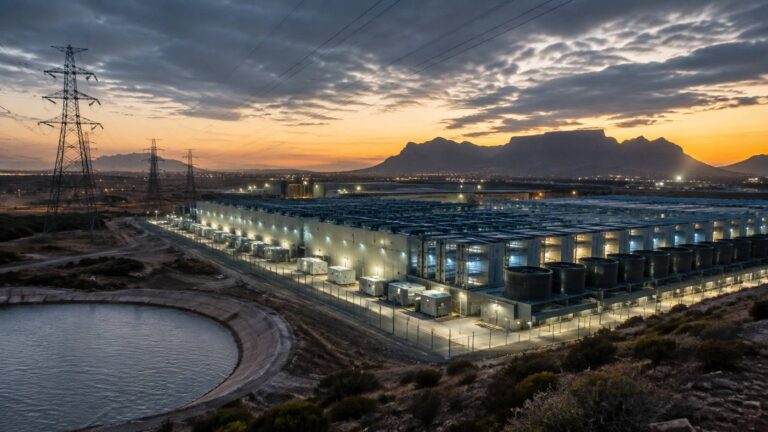
Africa’s AI boom has a hidden cost: South Africa faces water and power questions
South Africa’s data-centre boom promises digital growth while raising urgent questions over water, electricity, ownership and public accountability in Africa.

Africa’s digital revolution: 7 government tech projects reshaping the continent
Governments across Africa are accelerating digital transformation through AI, digital identity, cybersecurity, fintech, and e-government reforms that are reshaping economies.