


Zimbabwe’s interest in India’s Unified Payments Interface is about much more than making it easier to pay for groceries or send money from one phone to another. It is a sign that the next contest over Africa’s financial future may be fought not in bank branches, but inside the invisible infrastructure that moves money every second.
That is why Zimbabwe’s talks with NPCI International, the overseas arm of India’s payments infrastructure, deserve more attention than the technical language surrounding them might suggest.
The proposal is simple on the surface. Zimbabwe wants a more efficient digital payments architecture that can connect banks, mobile money operators, fintech companies and other payment providers. The ambition is to make transactions faster and cheaper while bringing more economic activity into the formal financial system.
But underneath that ambition lies a much larger question.
Who controls the rails on which African money travels?
The real story is the infrastructure
For years, much of the conversation about African financial technology has focused on the applications people see.
Mobile wallets. Banking apps. QR codes. Digital lenders. Payment platforms.
Those products matter, but they sit on top of infrastructure that determines how money actually moves.
India understood this distinction early.
UPI was designed as an interoperable layer rather than simply another payment application. That matters because consumers do not necessarily have to remain locked inside one bank or one technology company. Different institutions can connect to a common system and compete around the services built on top of it.
The scale is now enormous. NPCI data show that UPI processed more than 24.5 billion transactions in August 2026 across 752 participating banks.
That is no longer an experiment.
It is infrastructure at national scale.
Zimbabwe is therefore not merely looking at an Indian payment app. It is examining a model for constructing a digital financial highway.
And that distinction could prove important for Africa.
Zimbabwe has a complicated monetary history
Zimbabwe is an unusual place to test the proposition that payment infrastructure can strengthen financial sovereignty.
The country has spent decades confronting one of the hardest problems in monetary economics: public confidence in money.
Hyperinflation destroyed the credibility of the Zimbabwe dollar during the 2000s. The US dollar subsequently became deeply embedded in everyday economic life. Zimbabwe later introduced the Zimbabwe Gold currency, known as ZiG, in 2024.
Today, authorities are trying to build confidence around ZiG while maintaining a multicurrency environment.
That makes payments politically and economically significant.
A payment system does not determine whether a currency is trusted. But it can determine how easily people use that currency.
If a local currency is difficult to spend, difficult to transfer and expensive to convert, consumers naturally look for alternatives.
If digital infrastructure makes domestic transactions seamless, the incentives can change.
This is where the UPI discussion becomes particularly interesting.
Zimbabwe’s central bank has already been working to modernise its payment ecosystem. Its regulatory framework emphasises electronic transactions, interoperability, consumer protection and financial inclusion.
The UPI discussions therefore fit into a broader transformation already underway.
The question is whether they can accelerate it.
The opportunity is bigger than Zimbabwe
There is a temptation to see Zimbabwe’s UPI discussions as an isolated bilateral technology deal.
That would miss the larger African story.
African economies have spent years trying to reduce the cost of moving money across borders. Yet sending money between neighbouring countries can still involve multiple currencies, intermediaries, settlement systems and fees.
For ordinary workers, small businesses and families receiving remittances, those frictions are not abstract.
They are a tax on economic activity.
A Zimbabwean trader dealing with a supplier in Zambia does not care which institution technically settles the transaction. The trader cares about how much money arrives, how quickly it arrives and how much disappears along the way.
The same is true for a migrant worker sending money home.
The promise of interoperable instant payments is therefore potentially transformative.
It could reduce the number of intermediaries standing between a sender and recipient.
It could also make small-value transactions economically viable.
That matters enormously in Africa, where millions of people operate businesses at a scale too small to absorb high transaction costs.
India is exporting more than technology
There is another dimension that should not be overlooked.
India is increasingly presenting its digital infrastructure as part of its international economic engagement.
UPI is one of the clearest examples.
The system has already expanded internationally through partnerships and acceptance arrangements. India’s ambition is not simply to sell software. It is to build connections between payment ecosystems and establish Indian-designed digital infrastructure as part of the global financial landscape.
Zimbabwe’s interest therefore gives India something valuable: another opportunity to demonstrate that its technology can work beyond its enormous domestic market.
That matters geopolitically.
For decades, Africa’s digital infrastructure has been heavily influenced by European, American and increasingly Chinese technology companies.
India offers another model.
It is neither a Western financial institution nor a Chinese state-backed technology giant.
Its proposition is different: an interoperable public digital infrastructure model developed at extraordinary scale and increasingly offered to international partners.
For African governments seeking more choices, that is attractive.
But sovereignty has a price
There is a danger in describing foreign technology as financial liberation simply because it is cheaper.
Digital sovereignty is not achieved by replacing one dependency with another.
If Zimbabwe builds critical payment infrastructure around technology controlled outside the country, it must still consider questions of governance, data, cybersecurity, resilience and long-term dependence.
Who owns the architecture?
Who controls upgrades?
Where is transaction data stored?
Who can access it?
What happens if diplomatic relations deteriorate?
What happens if the technology becomes commercially expensive?
And who carries the cost when the system fails?
These questions rarely appear in the excitement surrounding instant payments.
They should.
A country can become less dependent on foreign banks while becoming more dependent on foreign technology.
That is not necessarily a bad trade. But it is a trade.
The lesson from India’s own experience
There is another reason Zimbabwe should study India’s experience carefully.
UPI’s success did not happen because technology alone solved India’s financial problems.
It was built alongside regulation, banking reforms, widespread mobile connectivity, identity infrastructure, competition among payment applications and a large population willing to adopt digital transactions.
Even India’s model is now confronting questions about sustainability.
Reuters has reported that India is introducing a merchant discount rate on certain higher-value UPI transactions from October 15, after years in which UPI became synonymous with free payments.
That is an important warning.
Cheap payments are not actually free.
Someone pays for servers, cybersecurity, fraud prevention, connectivity, compliance, customer support and system maintenance.
The challenge for Zimbabwe will therefore be to build an affordable system without creating an infrastructure that cannot sustain itself.
The informal economy is the real test
For all the discussion about banks and fintech companies, Zimbabwe’s biggest test will happen outside the boardroom.
It will happen in markets.
At roadside stalls.
In small shops.
Among transport operators.
With informal traders.
Among people who may have a mobile phone but do not have a traditional bank account.
If a new payment system only makes life easier for established banks and large companies, its social impact will be limited.
If it allows a small trader to receive money instantly, maintain basic transaction records and access financial services without excessive fees, the impact becomes much more significant.
This is where digital payments can become economic infrastructure rather than consumer technology.
A payment history can help demonstrate that a small business exists.
Reliable transaction records can improve access to credit.
Digital receipts can create accountability.
Electronic payments can reduce the risks associated with carrying cash.
And lower transaction costs can make small businesses more competitive.
The promise is therefore not simply convenience.
It is economic visibility.
Africa should not become a digital consumer
This is perhaps the most important lesson.
Africa has often been an enthusiastic consumer of technologies designed elsewhere.
The continent buys smartphones.
It uses foreign cloud platforms.
It imports payment technologies.
It consumes social media platforms.
It depends heavily on overseas technology infrastructure.
There is nothing inherently wrong with adopting foreign technology. The problem arises when adoption becomes permanent dependence without developing local capabilities.
Zimbabwe’s UPI discussions should therefore trigger a bigger African debate.
Can countries adopt global technology while simultaneously building domestic expertise?
Can African engineers participate in designing and maintaining the systems?
Can local companies build businesses on top of the infrastructure?
Can regional payment networks eventually connect different national systems?
Can African governments negotiate partnerships that include technology transfer, local capacity building and strong data protections?
Those questions are more important than whether a QR code works.
The continental opportunity
The African Continental Free Trade Area was created around the idea that African economies should trade more with one another.
But trade agreements alone do not move money.
Payment systems do.
A continent can eliminate tariffs and still struggle with commerce if a business in Harare cannot cheaply pay a supplier in Lusaka, Nairobi or Accra.
That is why digital payments could become one of the hidden foundations of African integration.
The future African marketplace may not be built first through giant shopping centres or multinational corporations.
It could emerge through millions of small transactions taking place every day between businesses that previously could not afford to transact across borders.
Zimbabwe could become one small but important part of that experiment.
The bigger contest is already underway
There is a broader geopolitical story here.
China has spent years expanding its technological and infrastructure footprint across Africa.
Western companies remain deeply embedded in telecommunications, cloud computing, finance and software.
India is increasingly offering another technological partnership.
African countries themselves are becoming more ambitious, with governments and regional institutions pushing digital public infrastructure, interoperable payments and locally relevant financial technology.
The competition will not necessarily be about which foreign power owns Africa’s digital economy.
The more important question is whether African countries can negotiate from a position of strength.
That means choosing technologies rather than merely receiving them.
It means understanding the architecture rather than simply using the application.
It means developing domestic technical expertise.
And it means ensuring that digital transformation strengthens economic sovereignty instead of quietly relocating dependency.
Zimbabwe has an opportunity
Zimbabwe should not sell the UPI discussion as a technological miracle.
Nor should it reject it because the technology originates outside Africa.
The sensible approach is more demanding.
Use what works.
Negotiate hard.
Protect national interests.
Build local capacity.
Keep the system interoperable.
And make the ordinary consumer the ultimate measure of success.
If UPI can reduce transaction costs, expand financial inclusion and help Zimbabwean businesses operate more efficiently, it deserves serious consideration.
But the country’s policymakers should look beyond the immediate promise of cheaper payments.
They should ask what kind of financial system they want to build around that infrastructure.
That is the profound opportunity.
Zimbabwe is not simply deciding how its citizens will pay.
It is deciding who will help build the rails of its digital economy.
And that is a decision that will increasingly matter across Africa.
The most important competition in African finance may no longer be between banks.
It may be between payment architectures.
The countries that understand that early will have more influence over their economic future.
The countries that do not may discover, years later, that they were never simply customers of digital infrastructure.
They were living inside it.

More from Tech
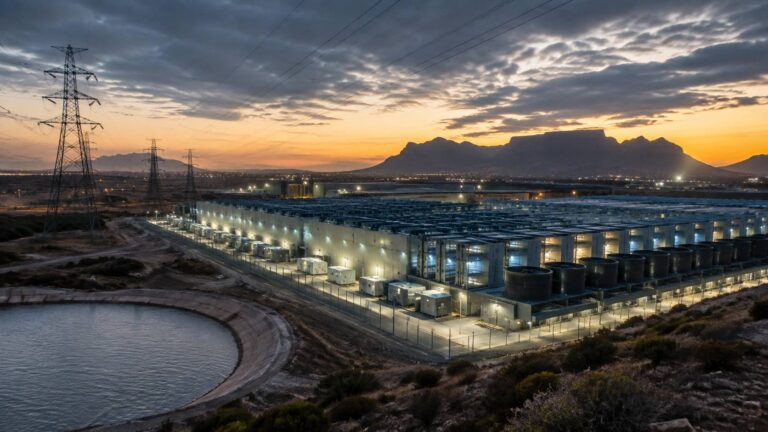
Africa’s AI boom has a hidden cost: South Africa faces water and power questions
South Africa’s data-centre boom promises digital growth while raising urgent questions over water, electricity, ownership and public accountability in Africa.

Africa’s digital revolution: 7 government tech projects reshaping the continent
Governments across Africa are accelerating digital transformation through AI, digital identity, cybersecurity, fintech, and e-government reforms that are reshaping economies.

Samsung widens lead in a declining MEA smartphone market
Samsung strengthens its market leadership across the Middle East and Africa as falling demand, supply shortages, and rising premium smartphone sales reshape competition.