

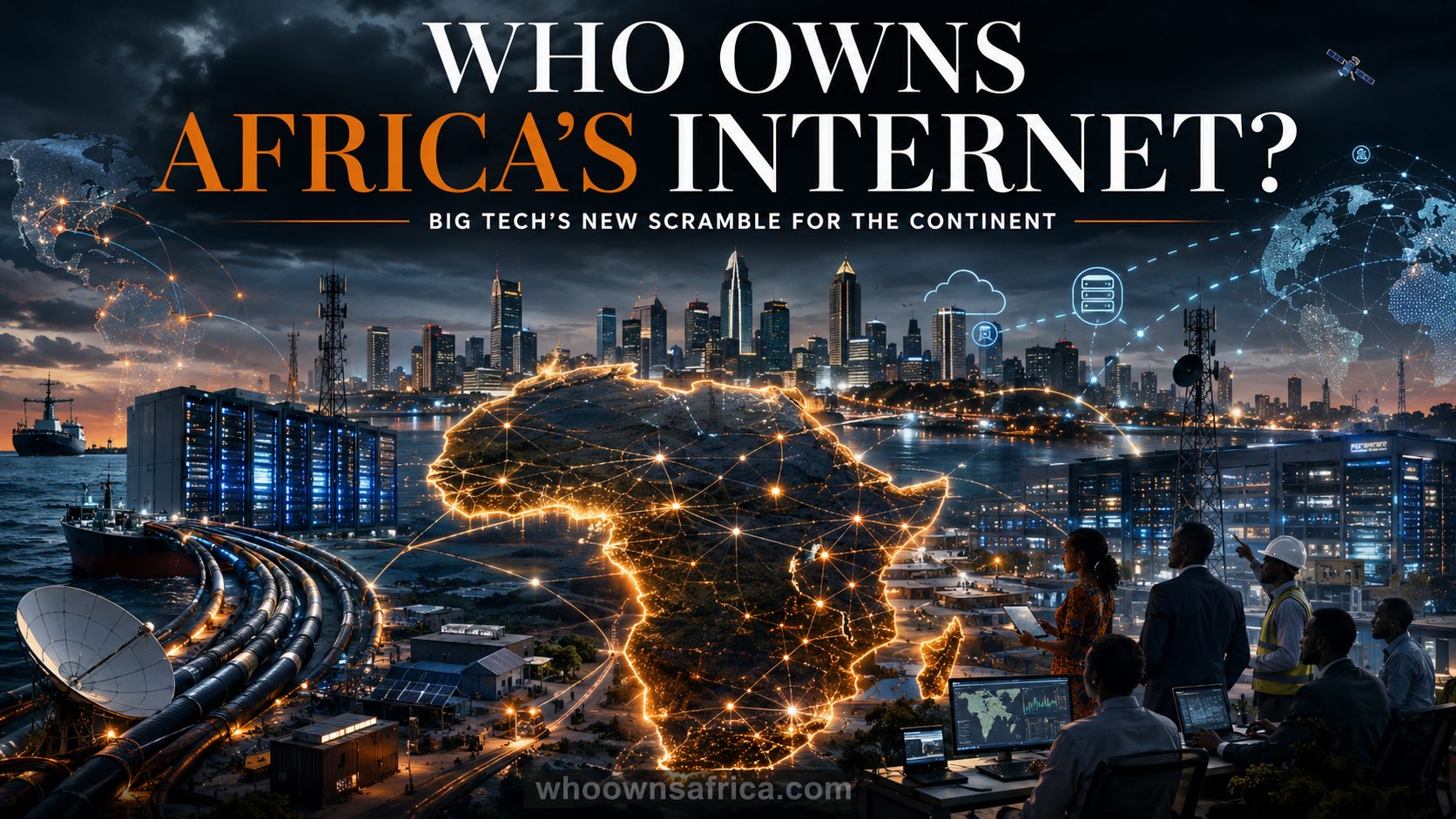
Africa’s internet is becoming the newest frontier in the global technology race, with Google, Meta, Microsoft, Amazon and satellite operators investing heavily in the cables, data centres, cloud platforms and networks that increasingly determine how Africans connect, work and do business.
The investment promises faster connections, new jobs and a larger digital economy. But beneath the headline numbers is a more difficult question: as foreign companies build the infrastructure on which Africa’s digital future depends, who will ultimately control the continent’s data?
The contest is no longer simply about selling smartphones or internet subscriptions. It is about owning pieces of the infrastructure beneath the internet itself.
From submarine cables crossing the Atlantic and Indian oceans to cloud regions, artificial intelligence facilities and low-Earth-orbit satellites, some of the world’s most powerful technology companies are positioning themselves at strategic points across Africa.
For governments, the opportunity is enormous. For technology companies, so is the market.
A continent still waiting to come online
Africa remains one of the world’s largest untapped internet markets.
According to the International Monetary Fund, only 38% of Africans used the internet in 2024, compared with 68% globally. The gap is particularly significant because reliable connectivity is increasingly becoming a prerequisite for participation in banking, education, healthcare, commerce and government services.
The infrastructure deficit is equally important. Africa’s population is growing rapidly, yet many communities remain poorly served by fibre networks, mobile infrastructure and reliable electricity.
That creates an unusual investment proposition.
Technology companies are not entering a mature market merely to compete for existing users. They are helping build the market itself.
The IMF estimates that artificial intelligence could increase sub-Saharan Africa’s economic output by as much as 4% over the next decade if countries improve electricity supply, internet connectivity and digital skills. Without those improvements, the potential economic contribution could be dramatically smaller.
That helps explain why infrastructure has become the centre of the competition.
Google builds digital corridors
Google has spent years building a network of infrastructure designed to strengthen connections between Africa and the rest of the world.
Its Equiano submarine cable connects Europe with the African coastline, including landing points in countries such as Nigeria, Togo, Namibia and South Africa. Google is also developing Umoja, a broader connectivity route linking Africa with Australia through South Africa and terrestrial infrastructure across eastern and central Africa.
The strategy goes beyond laying cables.
Google’s Africa infrastructure programme also includes cloud services and plans for additional connectivity hubs. In July, Google announced a Digital Exchange Port in South Africa’s Eastern Cape that will connect to the Umoja cable and planned fibre links to India.
The significance is strategic.
A submarine cable is not simply a faster internet connection. It is part of the physical infrastructure through which international data moves.
Whoever builds and operates those networks gains a position in the architecture of the digital economy.
Meta’s cable encircles Africa
Meta has pursued an equally ambitious strategy through 2Africa.
The core 2Africa system was completed in late 2025. At about 45,000 km, it is designed to connect Africa, Europe and parts of Asia and is described by Meta as the world’s longest open-access subsea cable system. It uses 16 fibre pairs and significantly expands potential capacity along the routes it serves.
For Africa, additional cable capacity matters because connectivity has historically depended on a limited number of international routes.
Cable failures have demonstrated how vulnerable that arrangement can be. In 2024, damage to several submarine cables disrupted internet and telecommunications services across parts of Africa, highlighting how much modern economies depend on infrastructure that sits thousands of metres below the sea.
More cables can therefore mean more than speed. They can mean resilience.
But the ownership question remains.
The cloud is the new territory
The next layer of the contest is taking place inside data centres.
Cloud computing allows governments, banks, hospitals, businesses and technology companies to store and process enormous quantities of information without owning all the underlying hardware themselves.
That makes cloud providers increasingly important economic actors.
Amazon Web Services already operates an AWS Region in Cape Town, while Google and Microsoft have also expanded their cloud presence and infrastructure across the continent.
South Africa remains the continent’s dominant data-centre market, accounting for a large share of Africa’s existing capacity. Recent investment has accelerated as companies prepare for rising demand from cloud computing and AI.
The attraction is obvious.
Local data centres can reduce latency, improve reliability and help companies comply with national regulations.
But they also raise another question: does storing African data inside Africa automatically make that data African-controlled?
The answer is no.
Location is not the same as sovereignty
Data sovereignty is becoming one of the most important issues in Africa’s digital economy.
A server may physically sit in Nairobi, Johannesburg or Lagos while being owned, operated or governed by a foreign company.
That distinction matters because control involves more than geography. It includes ownership of the hardware, management of the software, access to encryption keys, contractual arrangements, applicable laws and the ability of governments to regulate or access information.
Countries are increasingly responding.
Nigeria, for example, is strengthening data localisation requirements in sensitive sectors, while South Africa’s POPIA framework regulates the transfer of personal information outside the country.
Across Africa, the regulatory landscape is becoming more sophisticated. A January 2026 mapping of the continent’s privacy regimes identified 43 data protection laws across 55 African countries, reflecting the growing importance governments attach to control over personal information.
For Big Tech, that means the African market is no longer governed solely by commercial considerations.
Governments increasingly want a say in where data is stored, how it is processed and who can access it.
Microsoft’s Kenya test
Kenya illustrates both the promise and the difficulty of the new infrastructure race.
Microsoft and UAE-based AI company G42 announced a planned $1 billion investment in a Kenyan data-centre project in 2024, designed to support Microsoft’s Azure cloud services in East Africa and use geothermal power.
But the project has since encountered difficulties over electricity capacity and payment arrangements.
Reuters reported in May that the project had faced delays amid negotiations over payment guarantees and the amount of power required. Kenya’s government said the project had not been cancelled and that its structure needed further work.
The episode exposes a fundamental constraint on Africa’s digital ambitions.
Data centres require enormous amounts of electricity.
A country can attract billions of dollars in technology investment and still struggle to provide the power needed to operate the infrastructure.
That makes energy policy part of digital policy.
The satellite battle arrives
The race is also moving above the continent.
Starlink has expanded rapidly across African markets since launching in Nigeria in 2023. By mid-2026, the service had reached 27 African countries and was estimated to have about 500,000 users on the continent.
Satellite internet is particularly significant in areas where fibre and mobile towers are expensive or difficult to build.
But Starlink is no longer alone.
Amazon is bringing its Amazon Leo satellite network, formerly known as Project Kuiper, into the African connectivity race. Kenya has been selected for Amazon’s first African satellite gateway, giving the country a strategic role in the company’s planned network.
The battle between satellite operators could ultimately benefit consumers by increasing competition and extending coverage.
It could also deepen dependence on foreign-owned networks.
Who benefits?
For African governments, the calculation is complicated.
Foreign capital can build infrastructure much faster than many governments could finance it alone. Better internet can help small businesses reach international markets, allow students to access online education and enable hospitals to use digital services.
The economic upside is substantial.
But infrastructure ownership also creates long-term dependencies.
If a handful of global companies control major cables, cloud platforms, data centres, satellite networks and AI computing capacity, African governments and businesses may have limited alternatives when prices rise, contracts change or geopolitical tensions emerge.
This is why digital sovereignty should not be confused with shutting foreign companies out.
Africa needs investment.
What it needs is bargaining power.
The opportunity for Africa
The most important question may therefore not be whether Google, Meta, Microsoft, Amazon or satellite companies should invest in Africa.
It is what African countries negotiate in return.
Governments can demand stronger local partnerships, investment in skills, transparent data governance, local employment and support for domestic technology companies.
They can encourage competition rather than allowing individual infrastructure providers to become indispensable.
They can also invest in public digital infrastructure that gives citizens and businesses alternatives.
For African economies, the objective should be to move beyond being consumers of imported technology.
The continent has the opportunity to become an owner, developer and exporter of digital services.
The battle is only beginning
Africa’s internet is entering a new phase.
The first digital race was about getting people online. The next is about controlling the infrastructure that keeps them online.
Submarine cables, cloud platforms, data centres and satellites may sound like separate industries, but together they form the physical backbone of Africa’s digital economy.
The companies investing billions understand this.
The real competition is not simply for today’s internet users. It is for tomorrow’s data, businesses, AI systems and digital economies.
Africa has spent decades discussing who owns its oil, minerals and land.
The next ownership question is less visible but potentially just as consequential:
Who owns the infrastructure through which Africa’s digital future will run?
For African governments, regulators and businesses, the answer will depend on decisions being made now, while the infrastructure is still being built.

More from Tech
Africa’s AI boom has a hidden cost: South Africa faces water and power questions
South Africa’s data-centre boom promises digital growth while raising urgent questions over water, electricity, ownership and public accountability in Africa.
Africa’s digital revolution: 7 government tech projects reshaping the continent
Governments across Africa are accelerating digital transformation through AI, digital identity, cybersecurity, fintech, and e-government reforms that are reshaping economies.

Samsung widens lead in a declining MEA smartphone market
Samsung strengthens its market leadership across the Middle East and Africa as falling demand, supply shortages, and rising premium smartphone sales reshape competition.