

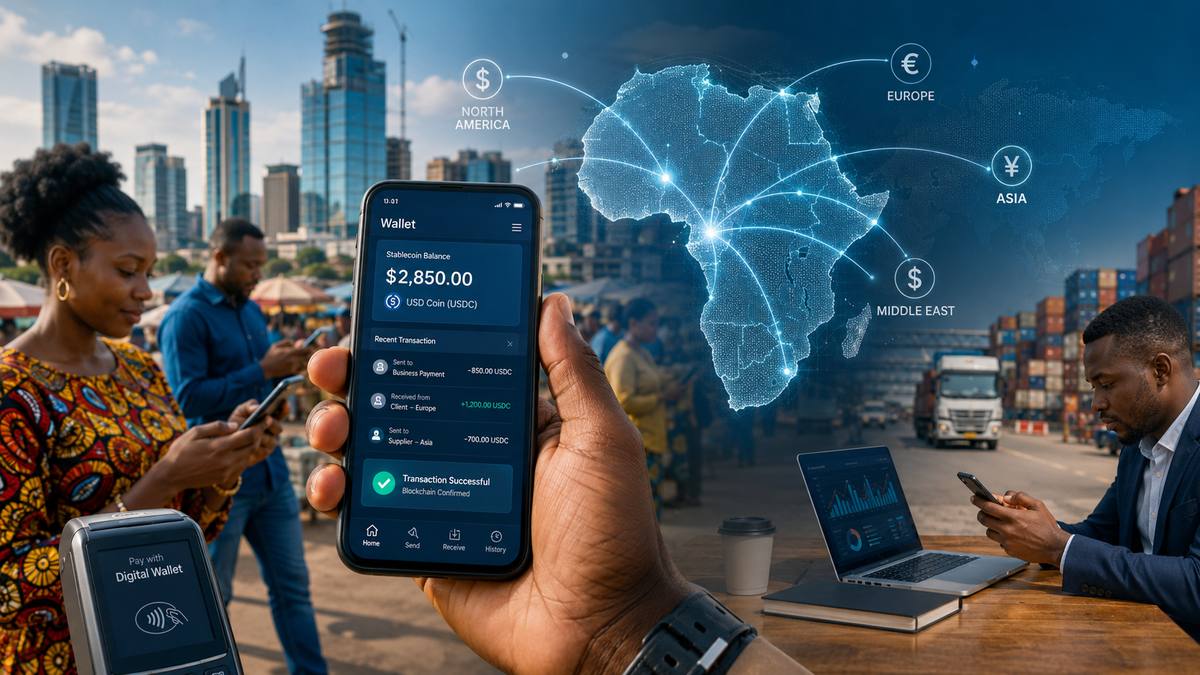
Africa’s economy is showing signs of renewed momentum, but one of the continent’s biggest constraints remains the cost and complexity of moving money across borders. As businesses, workers and consumers increasingly turn to digital finance, stablecoins are emerging as a potential new settlement rail, connecting African markets to the global financial system with fewer intermediaries and, in some cases, lower costs.
The rise is happening alongside a broader expansion of digital payments and fintech services. Mobile money has already transformed everyday transactions across much of the continent. Stablecoins could take that transformation into another area: international payments, remittances, trade settlement and dollar-based transactions.
The opportunity is significant, but so are the risks. Regulators are weighing concerns over money laundering, capital flight, monetary sovereignty and the possibility that dollar-linked digital assets could deepen dependence on foreign currencies.
For Africa, the question is no longer whether stablecoins exist. It is whether they can become trusted financial infrastructure.
From crypto asset to payment rail
Stablecoins are digital tokens designed to maintain a relatively stable value, usually by being pegged to an asset such as the U.S. dollar. The largest examples include dollar-linked tokens such as Tether’s USDT and Circle’s USDC.
Their original role was largely within cryptocurrency markets, where traders needed a digital asset that could act as a substitute for cash without the price swings associated with Bitcoin and other cryptocurrencies.
That use is changing.
Stablecoins are increasingly being positioned as payment and settlement infrastructure. Because transactions can be sent through blockchain networks at any time, they can potentially move value across borders without relying entirely on the traditional correspondent banking system.
Research from Chainalysis shows that stablecoin activity has expanded rapidly in Sub-Saharan Africa, with the region experiencing strong growth in retail and professional-sized transfers. The firm also identified stablecoins being used in high-value transactions connected to trade between Africa, the Middle East and Asia.
That matters because traditional cross-border payments can involve several banks, payment providers and currency conversions before money reaches its destination.
Stablecoins offer a different model.
A business could potentially convert local currency into a dollar-backed digital token, transfer it across a blockchain network and have a recipient convert it into local currency or use it directly through a digital wallet.
The blockchain becomes the settlement layer.
Nigeria is showing where demand is strongest
Nigeria has become one of Africa’s clearest examples of the demand for dollar-linked digital assets.
An International Monetary Fund analysis cited by Reuters found that Nigerians increasingly use U.S. dollar-pegged stablecoins for cross-border transfers. Between July 2023 and June 2024, Nigeria received about $59 billion in crypto inflows, accounting for around 60% of stablecoin activity in Sub-Saharan Africa during that period.
The attraction is straightforward.
For businesses and individuals dealing with international payments, access to dollars can be more important than access to another cryptocurrency. A dollar stablecoin provides digital exposure to the U.S. currency without requiring the recipient to hold a traditional bank account in the United States.
It can also operate through a smartphone.
That fits Africa’s existing digital-finance landscape, where consumers have already demonstrated a willingness to use mobile phones as financial tools.
But the growth also reflects deeper economic pressures.
Currency depreciation, foreign-exchange shortages and expensive international transfers can create strong incentives for people to seek alternatives. In Nigeria, these factors have helped turn stablecoins from a crypto-market product into a practical financial tool.
Reuters reported in February that Nigeria and South Africa were among the African markets showing the strongest growth in stablecoin demand.
The remittance opportunity
Remittances could become one of stablecoins’ most important African use cases.
Millions of Africans live and work outside their home countries, sending money to families and businesses across borders. The existing remittance industry is large, but transferring relatively small amounts can be expensive, particularly where traditional financial infrastructure is limited.
The IMF, as cited by Reuters, said average remittance costs in Sub-Saharan Africa were about 9%, compared with roughly 6% globally.
Even a modest reduction in those costs could leave more money in the hands of households.
Stablecoins could potentially reduce the number of intermediaries involved in a transaction. A sender could acquire a dollar stablecoin, transfer it digitally and allow a local payment provider to convert the funds into the recipient’s currency.
But the blockchain itself does not solve every problem.
Someone still has to provide the local cash-out service. Exchange rates still matter. Wallet providers need reliable compliance systems. Users need protection if funds are stolen or an issuer fails.
The future of stablecoin payments will therefore depend not only on blockchain technology but also on the financial companies built around it.
African fintech sees a new infrastructure layer
Africa’s fintech sector may be among the biggest beneficiaries.
Over the past decade, African technology companies have built payment platforms that allow customers to transfer money, pay bills, receive salaries and operate businesses from mobile phones.
Stablecoins could add an international layer to those systems.
A fintech company serving merchants in Kenya, Nigeria, Ghana or South Africa could potentially use stablecoins to settle international transactions while presenting customers with a familiar local-currency interface.
The customer might never know a blockchain transaction took place.
That is likely to be an important part of mainstream adoption.
Consumers generally do not want to manage private keys, choose blockchain networks or understand gas fees. They want to send money, receive money and pay for goods.
The companies that make stablecoins invisible to the end user could therefore have a significant advantage.
Chainalysis has argued that stablecoins have moved beyond trading into payments, remittances and merchant services, with traditional financial institutions increasingly examining them as programmable payment infrastructure.
Cross-border trade is the bigger prize
Remittances may be the most visible use case, but business payments could ultimately represent the larger opportunity.
African companies routinely trade across borders, yet the continent remains divided into numerous currencies and banking systems.
A Kenyan importer buying goods from a supplier in Nigeria, for example, may have to navigate multiple currency conversions and banking relationships. A regional digital settlement system could potentially reduce some of those frictions.
Stablecoins could become one component of such a system.
They could also support African companies selling digital services to customers overseas. Freelancers, software developers, online merchants and small exporters could receive payments in a digital dollar and convert them into local currency when needed.
That could make it easier for smaller companies to participate in international commerce.
The development of regional payment infrastructure is already underway through traditional financial channels. In July, South Africa added Angola’s kwanza to a regional cross-border payment system, expanding the range of currencies supported by the platform.
Stablecoins would not necessarily replace these systems. They could operate alongside them.
The most realistic future may therefore be a hybrid one, where banks, mobile-money platforms, fintech companies, instant-payment systems and blockchain networks interact.
The dollarisation problem
The strongest argument for stablecoins is also one of the biggest concerns for African policymakers.
Most of the stablecoins currently used for international transactions are linked to the U.S. dollar.
That makes them attractive when local currencies are unstable. But widespread use could also increase dependence on the dollar.
For central banks, that creates a difficult policy question.
If consumers and businesses increasingly hold digital dollars instead of local currencies, monetary authorities could find it harder to influence domestic liquidity and demand. Governments could also lose some visibility over cross-border capital flows.
The IMF has warned that stablecoin adoption can create risks around monetary sovereignty, financial stability and capital flows, particularly in emerging markets. Reuters reported that these concerns are already part of the debate in Nigeria.
There is also the question of illicit finance.
Blockchain transactions are recorded publicly, but that does not automatically mean every user is identifiable. Regulators therefore want exchanges, wallet providers and financial institutions to maintain strong know-your-customer and anti-money-laundering controls.
Africa cannot afford to build a faster payment system that becomes easier to exploit for fraud.
Regulation will decide the next phase
The regulatory environment is developing unevenly across the continent.
South Africa has emerged as one of the region’s more advanced markets for crypto regulation, while Nigeria has been moving toward a more structured framework for digital-asset activity.
Chainalysis said South Africa had established a comparatively mature regulatory environment for crypto-asset service providers, while Nigeria was moving toward a more formal supervisory approach as authorities responded to substantial digital-asset activity.
That divergence could influence where stablecoin businesses build infrastructure.
Clear rules can attract institutional investment because banks and payment companies know what activities are permitted and what compliance standards they must meet.
Uncertainty can have the opposite effect.
African governments therefore face a balancing act: regulate enough to protect consumers and financial stability without pushing legitimate innovation into informal markets.
Banks are unlikely to disappear
Stablecoins are sometimes presented as a threat to banks.
That may be too simplistic.
Banks could become some of the biggest participants in a stablecoin-based financial system.
They can provide custody, foreign-exchange services, compliance, liquidity, settlement accounts and conversion between digital assets and national currencies.
The emergence of regulated stablecoins globally suggests that the technology is increasingly being considered by mainstream financial institutions rather than only cryptocurrency companies. In August, a Standard Chartered-backed venture began rolling out a Hong Kong dollar stablecoin for institutional applications, including payments and settlement.
The same logic could eventually apply in Africa.
Instead of banks fighting blockchain payment rails, they may integrate them.
Africa’s mobile-money lesson
Africa has already shown the world how financial infrastructure can leapfrog traditional systems.
Mobile money demonstrated that a country does not need decades of branch expansion to achieve widespread digital financial access.
Stablecoins could represent another leap.
But the lesson from mobile money is that technology alone does not create adoption. Successful platforms combine technology with agents, regulation, consumer trust, liquidity and practical everyday use.
Stablecoins will face the same test.
A token that is technically capable of moving money instantly is not useful if users cannot easily buy it, sell it or spend it.
The winners will probably be the platforms that connect blockchain settlement to familiar African payment systems.
A new financial rail, not a revolution overnight
The idea of stablecoins transforming Africa’s payments market should therefore be treated as a long-term structural possibility rather than an overnight revolution.
Crypto adoption in Sub-Saharan Africa is already significant. Chainalysis estimated that the region received more than $205 billion in on-chain value between July 2024 and June 2025, a 52% increase from the previous year.
But much of that activity remains connected to trading and investment rather than everyday purchases.
The next stage will be harder.
Stablecoins must move from crypto exchanges into payroll, commerce, remittances, supplier payments and other real-world financial activities.
If that happens, Africa could become one of the world’s most important testing grounds for blockchain-based payments.
The continent’s fragmented currencies, large remittance flows, expanding fintech industry and demand for dollar access create a unique environment for experimentation.
The race is already underway
Africa’s payment infrastructure is entering a period of competition between different models.
Traditional banks are building faster payment systems. Fintech companies are creating digital wallets. Regional institutions are expanding cross-border settlement networks. Central banks are exploring digital currencies and regulatory frameworks. Stablecoin issuers are building another layer on top of the internet.
No single technology is guaranteed to win.
But stablecoins have one major advantage: they combine the global reach of the internet with the stability of a familiar currency.
That makes them particularly relevant to an African economy increasingly connected to international trade, global labour markets and digital commerce.
The $1 trillion payments opportunity is therefore about more than cryptocurrency.
It is about who controls the infrastructure through which African money moves.
If regulators can manage the risks, banks and fintech companies can build reliable on- and off-ramps, and stablecoin issuers can provide transparent reserves and strong consumer protections, digital dollars could become an important part of Africa’s financial architecture.
For consumers, the change may eventually feel ordinary.
A worker sends money home. A Kenyan company pays a supplier in another country. A Nigerian freelancer receives a foreign client payment. A merchant settles an international invoice.
Behind each transaction, a stablecoin may be doing the work.
That is the real significance of the technology. Africa may not simply become a bigger market for cryptocurrency. It could become a laboratory for a new generation of global payment infrastructure.

More from Tech

Africa’s AI boom has a hidden cost: South Africa faces water and power questions
South Africa’s data-centre boom promises digital growth while raising urgent questions over water, electricity, ownership and public accountability in Africa.

Africa’s digital revolution: 7 government tech projects reshaping the continent
Governments across Africa are accelerating digital transformation through AI, digital identity, cybersecurity, fintech, and e-government reforms that are reshaping economies.

Samsung widens lead in a declining MEA smartphone market
Samsung strengthens its market leadership across the Middle East and Africa as falling demand, supply shortages, and rising premium smartphone sales reshape competition.