

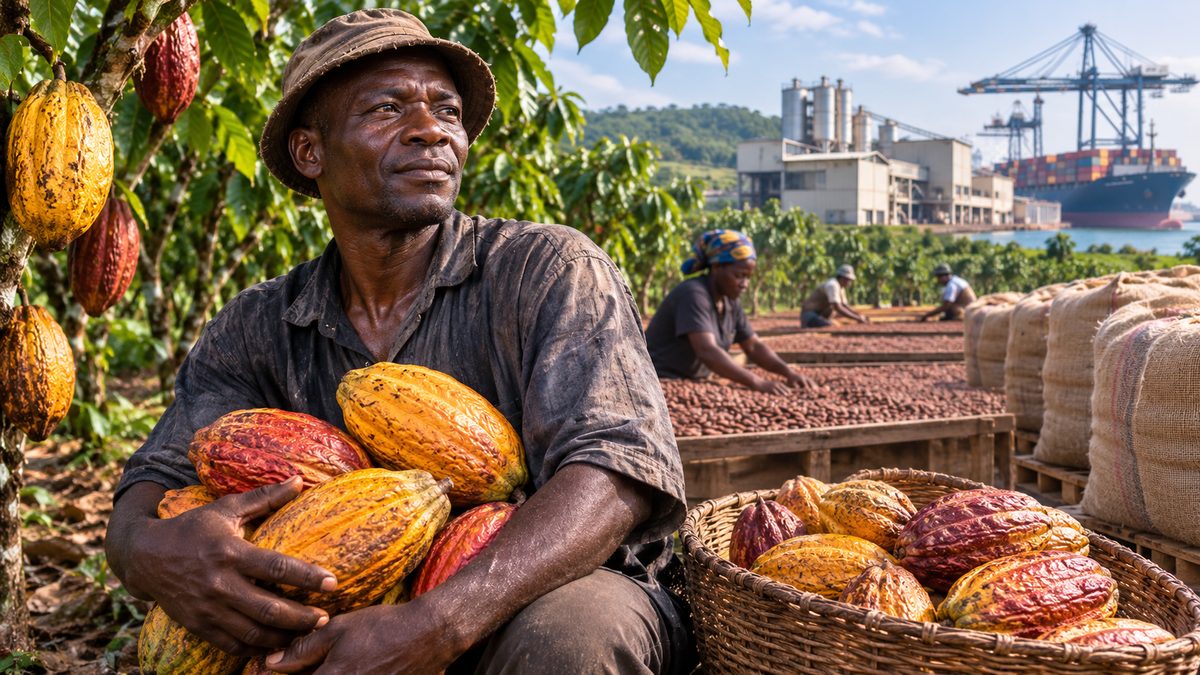
Africa grows the cocoa that keeps the world’s chocolate industry running, but much of the value created from those beans is captured after they leave the continent. Now, a new European Union regulation is forcing the industry to rethink how cocoa is produced, traced and traded.
From Dec. 30, 2026, companies covered by the EU Deforestation Regulation will have to show that cocoa entering the European market is not linked to deforestation and can be traced to the land where it was produced. For West Africa, this is not simply an environmental story. It is a business story about farmers, exporters, European buyers, supply chains and, ultimately, who makes the money.
Africa’s cocoa advantage
Walk through the cocoa economy of West Africa and one fact becomes difficult to ignore: Africa has the crop, but it does not control every stage of the business.
Côte d’Ivoire, Ghana, Nigeria and other African producers supply a huge share of the world’s cocoa. The International Cocoa Organization estimated global cocoa production at about 4.7 million tonnes for the 2024/25 season, with West Africa remaining the dominant producing region.
For millions of African farmers, cocoa is more than an export commodity. It pays school fees, supports households and provides income in rural communities. Yet the journey from cocoa pod to chocolate bar takes the product through a much larger international system.
Farmers grow, harvest, ferment and dry the beans. Traders and exporters collect them and move them towards ports. International companies then process the cocoa into butter, powder and liquor before manufacturers turn those ingredients into chocolate and other consumer products.
That is where the economics begin to change.
The farmer earns from the bean. The companies further along the supply chain can earn from processing, manufacturing, branding, distribution and retail.
The result is an industry in which Africa is indispensable, but still captures only part of the value.
Europe changes the game
The European Union is now adding another layer to that relationship.
The EU Deforestation Regulation, known as EUDR, covers cocoa alongside commodities including coffee, palm oil, rubber, soy, cattle and wood. Its central objective is to prevent products linked to deforestation or forest degradation from entering the European market.
For cocoa companies, the change is significant.
From Dec. 30, 2026, large and medium-sized operators covered by the rules will need to demonstrate that their products meet the regulation’s requirements. Smaller operators generally have until June 30, 2027.
That means European buyers will need much more information about the cocoa they purchase.
It will not be enough to say that a shipment came from Ghana or Côte d’Ivoire. Companies will need supply-chain information that allows them to establish where the cocoa was produced and whether the land meets the regulation’s requirements.
For an industry built around hundreds of thousands of small farms, that is a major undertaking.
The traceability race
The most difficult part may be tracing the beans back to the farm.
Cocoa production in West Africa is largely carried out by small-scale farmers, many of whom operate in remote rural areas. Mapping every farm and connecting it to a reliable digital record requires people, technology and money.
Exporters must collect geographic information. They need to verify land use and maintain records that can be relied upon by European buyers.
This is not a one-time exercise.
Supply chains change. Farmers change cooperatives. Production areas change. Records need to be updated and verified.
In Nigeria, the scale of the challenge is already becoming clear.
Reuters reported on Aug. 17 that major exporter Sunbeth Global had mapped 124,000 hectares of farmland covering about 60,000 tonnes of cocoa in its supply chain. The company said it had spent between $30 and $70 per tonne on compliance-related work, including mapping, training and digital traceability.
For a major exporter, that is a significant investment.
For a small cooperative, it could be overwhelming.
Who will pay?
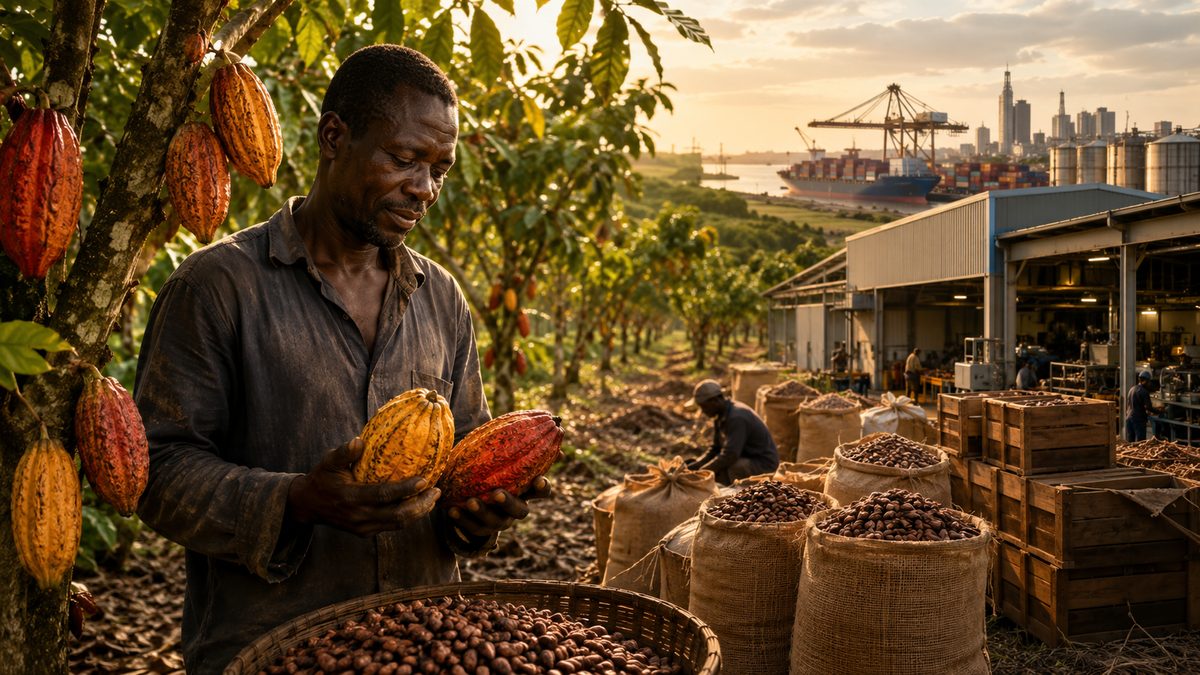
That is perhaps the most important question facing the African cocoa industry.
The EU regulation places due-diligence obligations on companies placing covered products on the European market. But those companies need information from African suppliers to meet those obligations.
The pressure therefore travels down the supply chain.
European buyers ask exporters for information. Exporters ask cooperatives. Cooperatives ask farmers.
The financial cost can travel in the same direction.
African exporters are already warning that European buyers are reluctant to fully absorb the additional expenses. Reuters reported that some Nigerian exporters have seen their margins squeezed because of the cost of mapping and tracing cocoa.
That creates a difficult situation.
If exporters pay the full cost, their margins decline. If they push the cost down the chain, farmers and cooperatives may receive less.
Either way, somebody has to pay.
Côte d’Ivoire faces a huge test
No country illustrates the challenge better than Côte d’Ivoire.
The world’s largest cocoa producer is responsible for a substantial share of global supplies and is deeply connected to the European market.
But its size is also its weakness when it comes to traceability.
A Reuters report in May, citing analysis by Trase, found that only about half of Côte d’Ivoire’s cocoa could be traced to where it was grown. The remainder moved through indirect or complex supply chains.
That gap matters because the European regulation depends heavily on reliable information about the origin of commodities.
The problem is not necessarily that all untraced cocoa comes from deforested land.
The problem is that buyers may not have enough evidence to prove where it came from.
For exporters, that creates a commercial risk.
A farmer can produce perfectly legitimate cocoa, but if the supply chain cannot provide the required information, the beans may become harder to sell into certain European channels.
Ghana has a similar challenge
Ghana faces many of the same pressures.
Its cocoa sector supports millions of livelihoods and remains a major source of export earnings. But farmers are also dealing with ageing trees, production costs, disease and changing weather conditions.
At the same time, land-use pressures are creating environmental concerns.
That makes the European regulation particularly important.
Ghana does not only need to produce enough cocoa. It increasingly needs to demonstrate how and where that cocoa was produced.
That requires stronger systems from the farm to the port.
It also requires investment.
A cost that could become an asset
There is another way to look at the traceability challenge.
Instead of seeing it only as a European compliance requirement, African governments and businesses could treat it as new infrastructure for the cocoa industry.
A properly mapped cocoa sector would give governments better information about farmers and production areas.
It could help identify where farmers need seedlings, training, fertiliser or financing.
It could also make it easier to monitor production and improve supply-chain efficiency.
For exporters, reliable information could strengthen relationships with international buyers.
And for consumers, traceability could make African cocoa more valuable.
People increasingly want to know where products come from and whether they were produced responsibly.
A chocolate company able to tell consumers that its cocoa came from identifiable farms and communities could potentially turn that information into a selling point.
The question is whether African farmers will share in the value.
Data is becoming part of the cocoa business
The cocoa industry is entering an era in which information could become almost as important as the physical commodity.
A farm’s location matters.
Its production records matter.
Its environmental history matters.
Its legal status matters.
All that information can influence whether cocoa is accepted by a major international buyer.
That creates a new form of economic power.
Companies that control the systems collecting and verifying the information may gain greater influence over the supply chain.
For Africa, this raises an important question: will African institutions control the data generated by African farmers, or will the information become another part of the value chain controlled elsewhere?
This may sound like a technical issue.
It is not.
Data can influence market access, pricing, financing and commercial relationships.
As the global cocoa industry becomes more traceable, data ownership could become part of the wider debate about who owns Africa’s commodities.
Europe needs African cocoa
The relationship between Africa and Europe is not entirely one-sided.
Europe needs African cocoa.
West Africa needs access to European consumers.
Recent reporting shows the scale of that interdependence. West Africa produces roughly 70% of the world’s cocoa, while about two-thirds of the region’s exports go to the European Union.
That gives African producers an important source of leverage.
European chocolate manufacturers need reliable supplies. If large quantities of African cocoa fail to meet the new requirements, European buyers could face shortages and higher costs.
Industry experts cited by Reuters have warned that the European market could face a supply squeeze if exporters and buyers cannot prepare adequately.
This means the transition should not be treated as Africa’s problem alone.
European companies also have a commercial interest in helping African suppliers build systems that work.
The danger for small farmers
The biggest risk is that the new rules unintentionally create two cocoa markets.
Large exporters with money, technology and experienced teams may be able to comply.
Small cooperatives may struggle.
Farmers without accurate land records or access to mapping services could face greater difficulty entering formal export supply chains.
That would create a troubling outcome.
A regulation designed to protect forests could increase the economic pressure on the farmers who depend on cocoa for their livelihoods.
The answer should not be to weaken environmental standards.
The answer should be to share the cost of achieving them.
If Europe wants deforestation-free cocoa, then European buyers, governments and development partners have a role to play in helping producers meet the standard.
Africa’s bigger opportunity
The EUDR debate also exposes a much larger opportunity.
Africa does not have to remain primarily a supplier of raw cocoa beans.
It can process more of its cocoa.
It can produce more cocoa butter, cocoa powder and cocoa liquor.
It can manufacture chocolate.
It can develop brands.
And it can sell finished products to African consumers and international markets.
That would fundamentally change the economics of the industry.
A tonne of raw cocoa beans is a commodity.
A finished chocolate product carries the additional value of processing, packaging, branding, marketing and distribution.
Every additional stage creates opportunities for jobs and businesses.
That is why local value addition matters.
Africa does not need to capture the entire chocolate value chain overnight. But every additional stage performed within African economies means more value can remain on the continent.
From cocoa beans to African brands
The future of African cocoa may ultimately depend on branding as much as farming.
African producers have something international chocolate companies cannot easily manufacture: origin.
Cocoa from Côte d’Ivoire, Ghana, Nigeria or Cameroon can be connected to particular communities, landscapes and farming traditions.
Traceability could make that story more powerful.
Instead of selling anonymous cocoa beans into a global market, African companies could increasingly market cocoa based on origin, quality and sustainability.
That creates the possibility of African premium brands.
It also creates an opportunity to connect farmers directly to higher-value markets.
But building brands requires investment.
It requires processing plants, packaging, marketing expertise, distribution networks and access to finance.
Those are precisely the areas where Africa needs to move further up the value chain.
The price problem
The cocoa market is also becoming harder to predict.
Global production has experienced major disruptions in recent seasons, while cocoa prices have moved sharply in response to supply concerns, weather conditions and changing demand.
The International Cocoa Organization estimated 2024/25 global production at about 4.723 million tonnes and grindings at about 4.628 million tonnes in its May 2026 update. It estimated a small global supply surplus for the season.
For farmers, price volatility makes long-term planning difficult.
High prices can provide money for investment in farms.
Lower prices can quickly expose how fragile the business is.
Now exporters also have to budget for traceability.
That creates another financial pressure at a time when the industry is already trying to recover from years of supply and price volatility.
The real ownership question
For Who Owns Africa, this is where the cocoa story becomes much bigger than chocolate.
Ownership is not simply about who owns the farm.
It is about who controls the chain around the farm.
Who finances the farmer?
Who buys the cocoa?
Who controls storage and logistics?
Who processes the beans?
Who owns the brands?
Who reaches the consumer?
And who controls the data?
Those questions determine where the money ultimately goes.
Africa has spent decades exporting valuable commodities while importing many of the finished products made from them.
Cocoa is a powerful example of that pattern.
The continent produces the raw material that chocolate companies need, yet much of the higher-value business happens elsewhere.
The EUDR will not automatically change that.
But it could create a moment when African governments and businesses rethink the entire supply chain.
A different cocoa future
The European deforestation regulation could become another cost imposed on African exporters.
Or it could become a catalyst for change.
The difference will depend on what African countries do with the new traceability systems.
If they are built only to satisfy European buyers, Africa may simply become better at complying with somebody else’s rules.
But if the same systems are used to improve farmer financing, strengthen cooperatives, support local processing and build African brands, they could become part of a much bigger transformation.
That is the opportunity.
Africa already has the farmers.
It already has the land.
It already produces the cocoa.
What it needs is greater control over the value created after harvest.
The next battle
The coming years could therefore reshape the African cocoa industry.
Europe is raising the standard for market access.
African producers must respond.
But compliance should not be the end goal.
The larger goal should be a cocoa economy that is productive, traceable and profitable for the people who produce it.
That means protecting forests without pushing farmers out of formal markets.
It means building digital systems without giving away control of valuable data.
It means meeting international standards while developing African standards and capabilities of equal importance.
And it means moving beyond the export of raw beans.
Africa grows the cocoa. Europe may control an important part of the rules. But the biggest question is whether Africa can gain greater control over what happens next.
The answer will not be determined by one regulation.
It will be determined by investment, policy, technology, processing capacity and the willingness of African businesses to move further up the value chain.
The cocoa bean begins its journey on an African farm.
The next chapter of the industry should ensure that more of the value created along that journey stays in Africa.

More from Business
Who owns Quickmart? Inside Kenya’s KSh15 billion supermarket IPO
Quickmart’s public listing exposes how Kenyan retail, private equity and everyday consumer power are quietly reshaping who owns the country’s economy.

How Mr Eazi became a major shareholder in Ghana’s pharmaceutical industry
Nigerian musician Mr Eazi's investment firm Zagadat Capital has quietly built a major stake in a Ghanaian drug maker.

Who owns Africa’s new wealth? The companies and sectors creating the continent’s next billionaires
African governments are competing for global capital with tax incentives, but the bigger question is who will own the wealth created.