

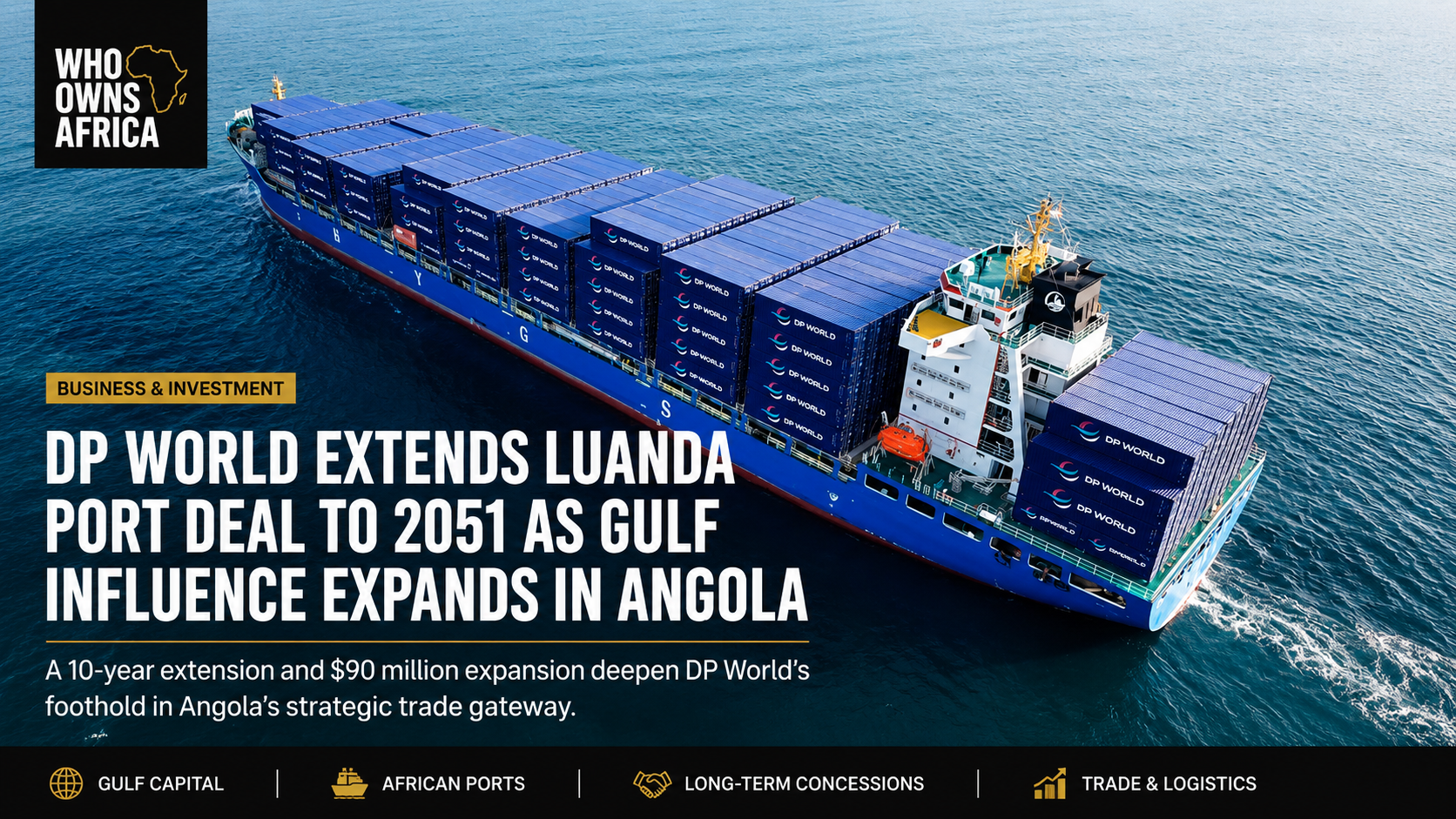
There is a bigger story behind DP World’s decision to remain at Angola’s Port of Luanda until 2051: control of trade infrastructure is becoming as strategically important as ownership of natural resources.
DP World has secured a 10-year extension to its concession to operate the multipurpose terminal at the Port of Luanda, taking the agreement to 2051, while committing a further $90 million to expand the facility. The investment will raise the terminal’s design capacity from 500,000 twenty-foot equivalent units, or TEUs, to 1.2 million TEUs.
At first glance, this looks like another port expansion story. It is not.
For Angola, the decision is about whether Luanda can become more than a national gateway. For DP World, it is about embedding itself deeper into one of Africa’s most strategically located economies. And for the wider continent, it offers another example of how Gulf capital is increasingly acquiring influence through infrastructure that sits at the centre of trade.
The distinction matters. DP World does not own the Port of Luanda. The port remains a public corporation. DP World operates the multipurpose terminal under a concession. But in modern global trade, a long-term operating concession over a strategically important terminal can provide significant commercial influence without requiring outright ownership of the underlying asset.
The concession is the story
DP World began operating the terminal in March 2021 after winning a 20-year concession. The original agreement called for $190 million of investment over the concession period and was intended to transform the facility into a modern maritime hub.
Five years later, the numbers have changed substantially.
DP World says it has invested more than $260 million since taking over operations. Container volumes have risen from 177,000 TEUs to more than 350,000 TEUs, while the terminal has gained additional yard space and equipment. The company has also increased the number of mobile harbour cranes to eight and expanded refrigerated container connections from 630 to 700.
The new commitment adds another $90 million over two years.
The terminal’s quay will be extended by 222 metres, taking it to about 830 metres. The operating area will increase by 10 hectares to 37 hectares. DP World will also acquire three ship-to-shore cranes and 12 semi-automated rubber-tired gantry cranes.
The objective is not simply to move more containers. It is to make Luanda capable of handling larger vessels and more complex cargo flows, including two Post-Panamax vessels simultaneously. DP World says the expansion could reduce vessel turnaround times by up to 50%.
That is where the economics become more interesting.
Capacity is not the same as demand
The headline figure is 1.2 million TEUs.
But Angola is not yet moving 1.2 million containers through this terminal. Current throughput is above 350,000 TEUs, according to DP World. The new figure is a design capacity, not a prediction that cargo volumes will immediately reach that level.
That difference should not be overlooked.
Infrastructure investors routinely build ahead of demand. The logic is straightforward. If port capacity is inadequate, shipping lines can avoid a market, logistics companies can face higher costs and manufacturers may hesitate to invest. If capacity expands first, the infrastructure can help create the conditions for additional trade.
The bet, therefore, is not simply on Angola’s existing cargo.
It is on Angola’s future.
The Port of Luanda itself describes the facility as the country’s main maritime port and most important logistics infrastructure. It says about 80% of Angola’s imports and exports pass through the port.
That gives the terminal importance far beyond the boundaries of its concession.
Angola is becoming a logistics proposition
For decades, Angola’s international economic identity has been dominated by oil.
That remains understandable. Hydrocarbons have shaped the country’s exports, government revenues and investment relationships for years. But infrastructure deals such as the Luanda concession point towards another economic proposition: Angola as a logistics and connectivity market.
This is particularly important because geography gives Luanda a natural advantage.
The capital sits on the Atlantic coast and serves Angola’s largest concentration of economic activity. The port has road and rail connections into the country, while its coastal position gives it access to international shipping routes.
The opportunity is to connect those advantages into something larger.
A more efficient port can support manufacturers. Manufacturers can create demand for logistics services. Logistics networks can encourage warehousing and distribution. Those activities can attract financial services, industrial investment and new trade routes.
The port therefore becomes an economic platform rather than simply a place where containers are loaded and unloaded.
That is the strategic possibility behind the $90 million investment.
Gulf capital is buying time, not just assets
For Who Owns Africa, the most important element of the deal is arguably not the size of the cheque.
It is the length of the concession.
A concession running to 2051 gives DP World a long investment horizon. Ports are not businesses that can be built, operated and judged over a short corporate cycle. They require expensive infrastructure, equipment, technology, labour and relationships with shipping lines.
Long concessions make those investments more commercially rational.
They also create something less visible but strategically important: continuity.
DP World can plan its Luanda operation around a multi-decade horizon. Angola, meanwhile, gains an international operator with a reason to keep investing in the facility rather than treating it as a short-term contract.
This is one of the defining features of Gulf investment in African infrastructure.
The Gulf states have increasingly positioned themselves as capital providers, logistics operators and trade intermediaries linking Africa with Asia, the Middle East and global markets. Ports are particularly attractive because they sit at the intersection of commerce, geography and strategic access.
DP World’s wider African portfolio illustrates the pattern.
In Tanzania, the company operates Terminal 1 at Dar es Salaam under a 30-year concession and has committed more than $500 million to modernisation and technology. DP World also operates an inland dry port in Kigali under a 25-year concession, linking Rwanda and neighbouring landlocked economies with maritime gateways.
Seen in that context, Luanda is not an isolated investment.
It is another node in a broader logistics network.
The network matters more than the terminal
This is perhaps the most important shift in understanding companies such as DP World.
The modern port operator is no longer simply a company that owns cranes and collects handling fees.
The ambition is increasingly to connect ports with inland logistics, freight forwarding, warehousing, customs services, shipping and industrial zones.
DP World itself describes its strategy as an integrated global trade platform. Its 2025 annual report said the company handled 93.4 million TEUs across its ports and terminals business and invested $3.1 billion in expanding its global logistics network.
The significance for Africa is considerable.
A port concession can become much more valuable when it is connected to cargo generation inland and distribution networks beyond the port.
That is why the Luanda expansion should be watched alongside Angola’s broader infrastructure ambitions.
The country is also pushing the Lobito Corridor, which links Angola’s Atlantic coast with mineral-producing regions of the Democratic Republic of Congo and Zambia. Angolan authorities have described the corridor as a strategic regional asset for economic integration and logistics competitiveness.
Luanda and Lobito are not interchangeable gateways. But together they show why Angola is becoming more important in the contest to shape regional trade routes.
The ownership question is more complicated
For an ownership-focused publication, there is another question worth asking.
Who actually controls the infrastructure?
The answer is not simply DP World.
The Port of Luanda remains publicly owned and operated as a public corporation. DP World holds a concession to operate a specific multipurpose terminal. That means legal ownership and commercial control are different things.
This distinction is increasingly important across Africa.
Governments are often unwilling or unable to finance every major infrastructure upgrade themselves. Private operators bring capital, technology and management expertise. In exchange, they receive long-term operating rights and the opportunity to earn returns from the infrastructure.
It can be a sensible bargain.
But it also means that influence over critical infrastructure increasingly sits across a network of governments, concessionaires, financiers, shipping companies and logistics operators.
The real question is therefore not only who owns an asset.
It is who has the ability to determine how that asset functions, where investment goes, which customers it serves and how efficiently goods move through it.
By that measure, a concession lasting until 2051 is significant.
Angola gets capital, DP World gets optionality
The relationship works because the interests are broadly aligned.
Angola needs modern infrastructure capable of supporting diversification and trade. DP World needs commercially viable gateways where growing cargo volumes can justify long-term investment.
The $90 million expansion gives Angola additional physical capacity without requiring the government to finance the entire project.
For DP World, it creates the opportunity to increase volumes and deepen its position in the country’s logistics economy.
But neither side gets a guaranteed outcome.
A larger terminal does not automatically produce larger trade flows.
Angola still needs reliable electricity, roads, railways, customs systems, industrial capacity and predictable regulation. Shipping lines need commercial reasons to increase services. Importers and exporters need competitive logistics costs.
The terminal can remove one bottleneck. It cannot solve all of them.
That is why the next five years will matter more than the announcement itself.
What to watch next
The most revealing metric will not be the size of the investment.
It will be utilisation.
If cargo volumes rise materially towards the expanded capacity, the investment will begin to look like evidence of a genuine transformation in Angola’s trade position.
If capacity grows much faster than demand, the project may instead demonstrate the difficulty of building logistics infrastructure ahead of an economy’s industrial development.
There are also wider questions.
Will new shipping services follow? Will manufacturers use Angola as a regional production and distribution base? Will logistics parks develop around the port? Can Angola lower the cost and time involved in moving goods inland?
And perhaps most importantly, can the country convert infrastructure investment into broader economic ownership?
That last question matters because infrastructure can create value without necessarily distributing it evenly.
A port may become more efficient while the surrounding economy remains weak. A concession may attract foreign capital without creating enough local suppliers. Container volumes may rise without a corresponding expansion in domestic manufacturing.
The measure of success should therefore be broader than port performance.
A strategic foothold through 2051
DP World’s extended concession is best understood as a long-term bet on Angola’s place in African trade.
The $90 million expansion is tangible. The larger story is strategic.
DP World is securing another 10 years of operating rights while increasing the terminal’s capacity, physical footprint and ability to handle larger vessels. Angola is securing additional capital and technical capacity while retaining public ownership of the wider port infrastructure.
Neither side is giving away the entire strategic picture.
But the agreement demonstrates how economic influence is increasingly built in Africa: through concessions, infrastructure, logistics networks and patient capital.
For Who Owns Africa, that is the story worth following.
The important question is not whether DP World owns Luanda.
It does not.
The more consequential question is what it means for a Dubai-based logistics company to have operating influence over a major African gateway for another quarter of a century.
By 2051, the answer could be much bigger than a terminal.
It could be a logistics ecosystem, a regional trade corridor and a durable link between Angola, Gulf capital and global commerce.
That is why the Luanda concession deserves attention beyond the $90 million headline. It is a reminder that in the next phase of Africa’s economic development, ownership will increasingly be about who controls the infrastructure through which value moves.

More from Business
Egypt is building a new African business network: Here’s who stands to gain
Egypt is turning African diplomacy into a commercial network linking manufacturers, farmers, financiers and markets across the continent.
Kenya wants to build Africa’s electric-car future: Inside the $3 billion EV bet
Kenya’s electric vehicle ambition is becoming an industrial strategy, testing whether Africa can move beyond importing technology to building it.

From Lagos to Lamu: How Dangote is building Africa’s first truly continental oil empire
From Lagos to Lamu, Dangote is turning refining, capital markets and regional trade into a new argument about African ownership.