

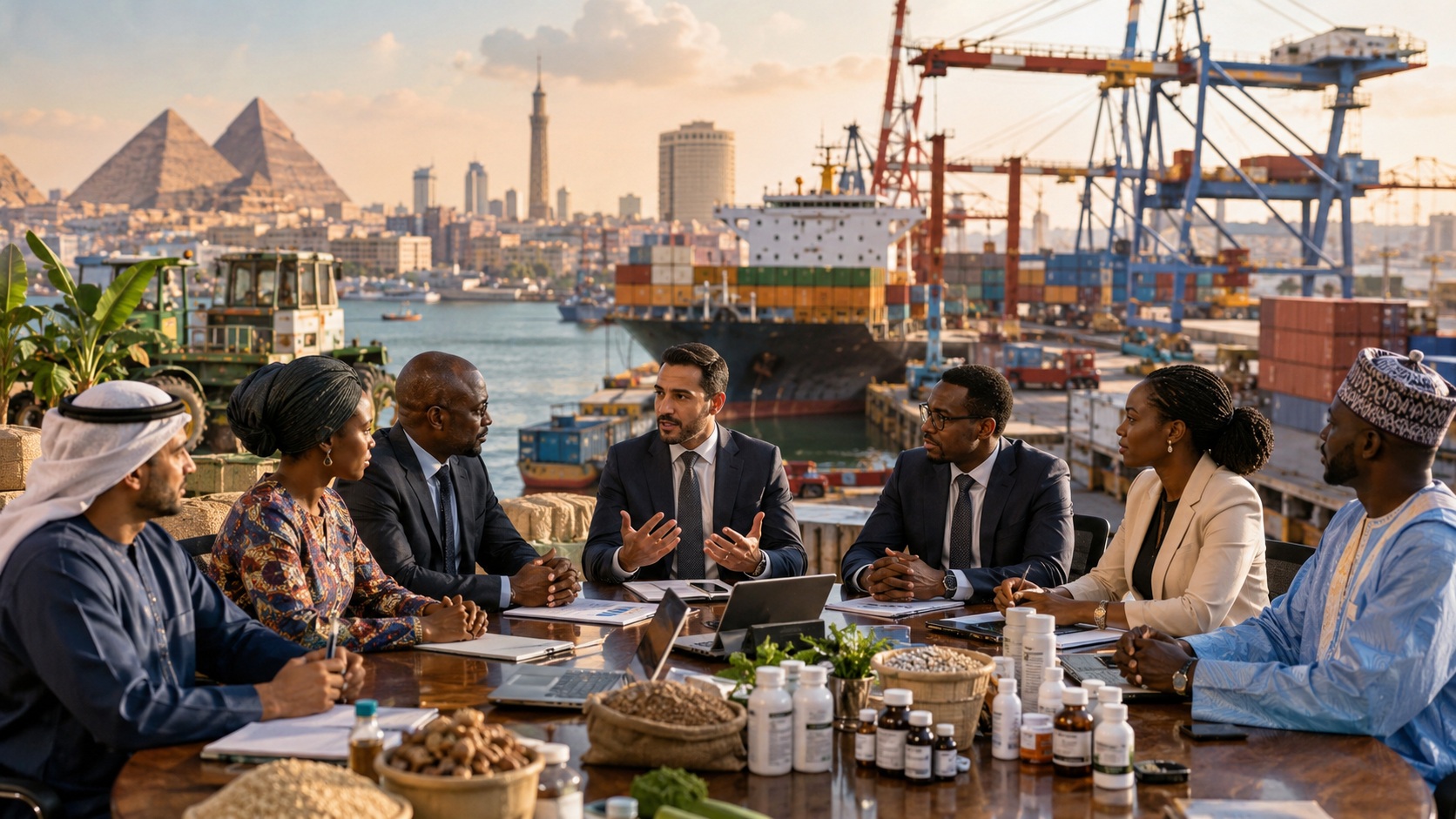
Egypt’s latest push into Africa is less about signing another round of diplomatic agreements and more about building the commercial relationships that could determine who manufactures, trades and invests across the continent.
That distinction matters.
The Alamein Africa Business Forum has brought together African governments, businesses, investors and financial institutions around an ambition that goes beyond conventional trade diplomacy. The forum seeks to connect companies, capital and markets while turning the African Continental Free Trade Area into something closer to a functioning commercial reality.
For Egypt, this is a strategic opportunity. For other African economies, it could become an opportunity or a competitive challenge, depending on how effectively they position themselves.
The question for African businesses is therefore not simply what Egypt is selling.
It is what kind of African business network Egypt is trying to build.
From exports to production
Egypt has historically approached many African markets through exports. The more significant shift now is toward investment, production and supply chains.
That change is visible in the agreements emerging around the Alamein forum.
Egypt and South Africa moved to strengthen business cooperation, while Egyptian company El Araby Group and South Africa’s Malben Engineering agreed to establish a platform for manufacturing automotive components. Broader discussions included vehicle manufacturing, component production, testing and certification.
This is potentially more important than another increase in bilateral trade.
If Egyptian and South African companies can manufacture components jointly, source materials from different African markets and sell into multiple countries, they begin creating a regional value chain.
That is precisely the kind of integration that AfCFTA was designed to encourage.
Instead of Africa exporting raw materials and importing finished products, the economic logic becomes different: African resources feed African factories, which supply African consumers.
Egypt wants to be one of the platforms through which that happens.
South Africa is the strategic partner
The Egyptian South African relationship deserves particular attention because the two economies bring different strengths to the table.
South Africa has a deep industrial base, established manufacturers, sophisticated financial institutions and extensive corporate experience across African markets.
Egypt brings its own manufacturing capabilities, a large domestic market, ports, logistics infrastructure and geographic access linking Africa with the Middle East and Mediterranean.
Together, they offer something larger than bilateral trade.
They can potentially connect industrial capabilities across northern and southern Africa.
The automotive sector illustrates the idea. Vehicles are rarely produced entirely in one country. Components, metals, electronics, engineering services and final assembly can be distributed across several markets.
If African manufacturers can coordinate those activities, the continent becomes more competitive.
If they cannot, Africa risks remaining a collection of national markets separated by expensive logistics, inconsistent standards and limited industrial cooperation.
Tanzania could gain from agribusiness
Agriculture presents another important dimension of Egypt’s strategy.
Egypt and Tanzania have discussed cooperation involving agribusiness and land reclamation initiatives, while Tanzania has also shown interest in Egyptian port operations.
The significance extends beyond farming.
Africa has enormous agricultural potential but remains heavily dependent on food imports. The contradiction between the continent’s resources and its continued reliance on imported food and manufactured goods remains one of its biggest economic challenges.
Egyptian investment in agricultural production in Tanzania could therefore become part of a wider model involving cultivation, irrigation, processing, logistics and distribution.
That model could benefit Tanzania by bringing capital, technology and market access.
It could benefit Egypt by strengthening its food and commercial supply networks.
The larger prize, however, is the creation of an African agricultural value chain.
Chad points to another opportunity
The pharmaceutical agreement between Egypt and Chad offers a different but equally important signal.
Egypt’s drug regulator has moved toward stronger cooperation with Chad covering pharmaceutical exports and regulatory coordination involving medicines, biological products and medical supplies.
This is exactly the type of cooperation Africa needs if it wants to reduce dependence on pharmaceutical imports from outside the continent.
Medicine manufacturing is not simply a commercial question. It involves regulation, standards, distribution, financing and reliable supply chains.
Egypt has developed a sizeable pharmaceutical manufacturing sector. Chad, meanwhile, sits in a region where access to medicines remains a major economic and public health challenge.
A stronger Egyptian pharmaceutical presence in Central Africa could therefore create a bridge between manufacturing capacity and underserved markets.
The bigger lesson is that African integration will not be built by trade agreements alone.
It will be built through practical systems that allow a product manufactured in one African country to move efficiently into another.
Equatorial Guinea widens the network
The agreements with Equatorial Guinea broaden the picture further.
Egypt and Equatorial Guinea have established mechanisms for deeper cooperation, with memoranda covering agriculture, culture, tourism and aquaculture.
At first glance, these sectors appear disconnected.
They are not.
Agriculture requires finance, infrastructure and logistics. Tourism depends on transport and services. Aquaculture requires technology, investment and access to markets.
Taken together, they demonstrate a broader Egyptian approach: build multiple commercial entry points rather than depend on one sector.
That creates resilience.
Finance will decide the outcome
There is one major question hanging over all these ambitions: who pays for the expansion?
The forum’s partnership with Afreximbank is significant because African integration requires more than political declarations. Businesses need trade finance, export credit, investment capital and mechanisms for managing cross-border risk.
Egypt has also been discussing mechanisms to support Egyptian investment across African markets. Officials have identified sectors including healthcare, tourism, transport, energy, resources and financial services as areas with significant potential.
This could become one of the most consequential parts of the strategy.
Capital determines which agreements become factories, farms, warehouses and logistics corridors, and which remain documents in government archives.
Kenya and East Africa should pay attention
For East African economies, Egypt’s strategy deserves close observation.
Egypt is seeking stronger connections with COMESA and East Africa, while Egyptian businesses are exploring investment opportunities in markets including Kenya.
That creates both opportunity and competition.
Kenyan manufacturers, financial institutions, agribusinesses and logistics companies could potentially partner with Egyptian firms seeking African expansion.
But African companies should also ask whether they are prepared to compete with Egyptian manufacturers entering their markets with greater access to capital, established industrial capacity and government-backed trade promotion.
The answer should not be protectionism.
It should be partnership and stronger African companies.
The real test is implementation
The most important message from Alamein may be that Africa does not lack ambition or vision. The challenge is turning those ambitions into well-prepared, financed and implemented projects.
That is the test Egypt now faces.
A forum can create relationships.
A memorandum can create expectations.
Only investment creates lasting economic integration.
If the automotive partnerships lead to factories, if agricultural agreements produce commercially viable farms and processing facilities, and if pharmaceutical cooperation improves regional supply chains, Egypt’s African strategy will have substance.
If not, Alamein risks becoming another high-level gathering remembered for its speeches and signatures.
The opportunity is much bigger than that.
Egypt is attempting to build a network in which African countries are not simply destinations for exports, but partners in production.
That is a profound shift in the logic of African commerce.
And if it succeeds, the winners will not be Egypt alone. South African manufacturers, Tanzanian farmers, Chadian healthcare systems, Equatorial Guinean businesses and East African companies could all benefit from a continent where capital, goods and expertise move more easily across borders.
For Who Owns Africa, that is the story worth watching.
The future of African integration may not be decided in the conference hall.
It may be decided by the factories, farms, ports, pharmacies, banks and companies that emerge after everyone has gone home.

More from Business
DP World extends Luanda port deal to 2051 as Gulf influence expands in Angola
DP World’s Luanda extension reveals how Gulf capital is reshaping African trade infrastructure through long-term concessions, logistics and strategic access.
Kenya wants to build Africa’s electric-car future: Inside the $3 billion EV bet
Kenya’s electric vehicle ambition is becoming an industrial strategy, testing whether Africa can move beyond importing technology to building it.

From Lagos to Lamu: How Dangote is building Africa’s first truly continental oil empire
From Lagos to Lamu, Dangote is turning refining, capital markets and regional trade into a new argument about African ownership.