

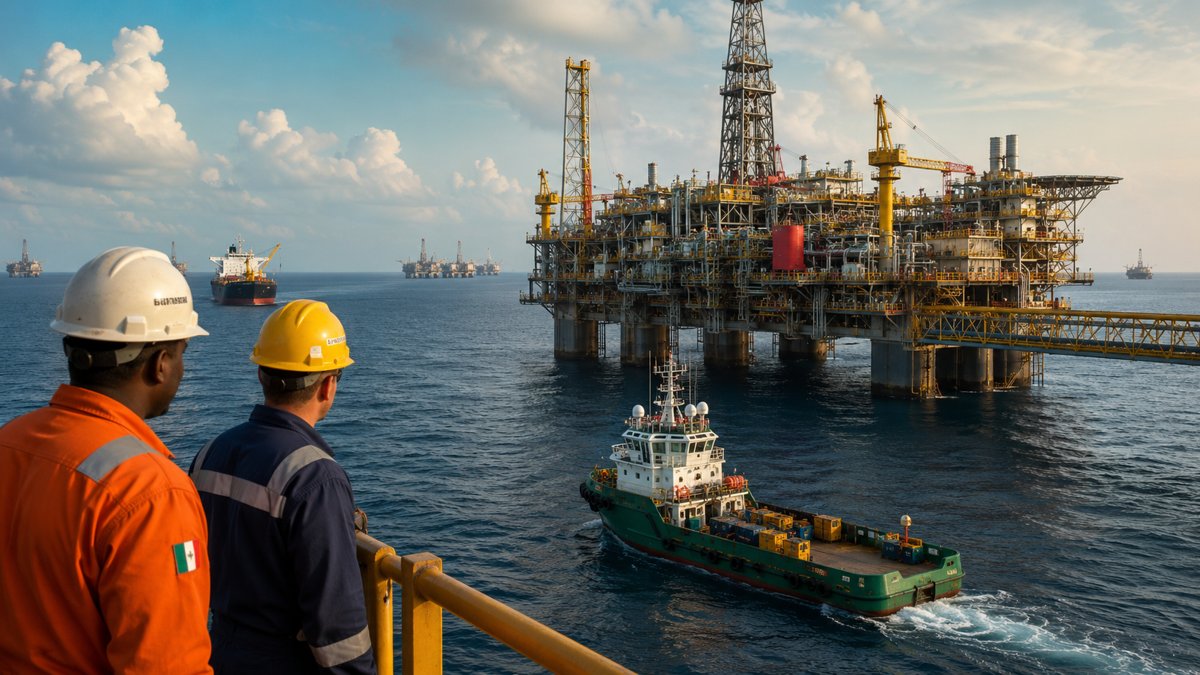
Nigeria has approved a new deep-water oil and gas investment framework that could unlock as much as $50 billion in investment, reviving projects that have been delayed for years and reopening a contest over who will capture the biggest share of the country’s next oil boom.
The reforms offer international oil companies a more predictable fiscal regime while Nigeria hopes the new investment will translate into higher production, government revenue, jobs and stronger domestic participation.
For Africa’s largest oil producer, the stakes are high.
Nigeria has struggled to attract sufficient new upstream capital despite holding vast petroleum resources. Its deep-water fields require billions of dollars in upfront investment, sophisticated technology and long development timelines. Investors have also faced regulatory uncertainty, high operating costs and competing opportunities elsewhere.
The new framework is an attempt to change that calculation.
President Bola Tinubu’s administration says the incentives could unlock up to $50 billion in offshore investment, beginning with major developments such as Shell’s approximately $10 billion Bonga South West project.
But attracting the money is only half the story.
The bigger question for Nigeria is how much wealth will remain in the country once the oil begins flowing.
The offshore prize
Nigeria’s deep-water sector is already home to some of its most important oil developments. Fields operated by international companies have provided a significant share of the country’s crude production, while production-sharing contracts have become an important mechanism for bringing foreign capital and expertise into projects.
The economic logic is straightforward.
International oil companies finance exploration and development, provide technology and operate complex offshore infrastructure. Nigeria, through its government institutions and contractual arrangements, receives revenue through taxes, royalties, profit oil and other payments.
The balance between these interests determines who makes money.
Nigeria’s official reserves remain substantial. The Nigerian Upstream Petroleum Regulatory Commission said in April that the country had 37.01 billion barrels of oil and condensate reserves as of January 1, 2026, alongside 215.19 trillion cubic feet of gas reserves.
Yet reserves underground do not automatically translate into wealth above ground.
Projects have to receive final investment decisions, secure financing, reach production and generate enough cash to compensate investors for the risks and costs involved.
That is where the new framework matters.
Why foreign oil companies matter
Deep-water oil is expensive.
A company investing billions of dollars in an offshore project needs confidence that the fiscal terms will remain commercially viable for decades. A change in taxes, production terms or regulatory requirements can alter the economics of a project that may take years to develop.
Nigeria’s new framework replaces project-by-project negotiations with a rules-based system designed to provide greater certainty to investors. The government has also introduced tax incentives intended to improve the economics of qualifying offshore developments.
For international oil companies, that could be significant.
Companies such as Shell, ExxonMobil and other major operators already have extensive experience, infrastructure and technical capabilities in Nigerian waters. ExxonMobil, for example, has said it is preparing potential investments involving Usan and the Owowo deep-water project, while its Erha production-sharing contract has been extended to 2042.
The incentives therefore could turn previously marginal or delayed projects into investable ones.
That creates an immediate winner: the investor that can deploy capital quickly and secure attractive project economics.
But the government also stands to benefit if production rises.
How Nigeria gets paid
The Nigerian government does not simply wait for an oil company to sell crude and hand over a percentage of the proceeds.
The country’s petroleum fiscal system contains several mechanisms through which the state captures value. These include royalties, taxes, contractual profit-sharing arrangements and other statutory payments.
Production-sharing contracts are particularly important in deep-water developments.
Under a typical PSC structure, an oil company initially recovers eligible costs from production before the remaining profit oil is divided according to contractual terms. The exact economics vary from contract to contract.
This means Nigeria’s share of the headline value of an oil project cannot be measured simply by looking at the size of the investment.
A $10 billion project does not mean Nigeria receives $10 billion, nor does it mean the oil company keeps everything after recovering its costs.
The real distribution depends on oil prices, production volumes, development costs, taxes, royalties and the terms negotiated under the relevant petroleum contract.
NNPC’s changing role
Nigeria’s national oil company, NNPC Ltd, is another important player.
The company participates in petroleum projects and remains central to the country’s energy sector, while reforms have sought to make it operate more commercially.
Its financial performance illustrates the scale of the sector.
NNPC reported an after-tax profit of 5.76 trillion naira, equivalent to about $4.26 billion, for 2025, with revenue of 60.52 trillion naira. It also reported 14.71 trillion naira in statutory payments to government agencies and partners.
More deep-water production could therefore create another channel through which the Nigerian state benefits.
But NNPC’s role is also changing.
In February, Nigeria’s Finance Ministry said NNPC would stop collecting a 30% management fee and a 30% frontier exploration fund deduction from profit oil and profit gas under production-sharing contracts, following President Tinubu’s Executive Order 9. The government said the measures were intended to safeguard petroleum revenues accruing to the federation.
That suggests a broader effort to improve the amount and transparency of petroleum revenue reaching the state.
Bonga South West becomes the test
The approximately $10 billion Bonga South West development could become one of the clearest tests of whether the new framework works.
The project is significant not only because of its size, but because it demonstrates the kind of capital-intensive offshore development Nigeria wants to bring back.
If the project moves forward successfully, it could send a powerful signal to other investors.
If it remains delayed despite the new incentives, investors may conclude that fiscal reform alone is not enough.
For Nigeria, this is an important distinction.
Oil companies need attractive economics, but they also need efficient approvals, infrastructure, security, predictable regulation and the ability to execute projects without prolonged administrative delays.
The government therefore faces pressure to make the new rules work in practice, not simply announce them.
The Nigerian businesses waiting
The beneficiaries of the offshore revival may extend beyond the multinational oil companies.
A new investment cycle could create opportunities for Nigerian engineering firms, logistics companies, fabrication yards, shipping operators, construction businesses, financial institutions and professional-service providers.
Local-content requirements could increase the participation of Nigerian companies in supply chains, although the extent of those benefits will depend on the capacity of domestic businesses to meet the technical and financial requirements of major offshore projects.
The government has already emphasised greater Nigerian participation as part of its wider upstream reforms.
For local businesses, the opportunity is potentially enormous.
But offshore oil is a highly specialised industry. Without access to capital, technology and international partnerships, many Nigerian companies could remain suppliers rather than becoming major owners of assets.
That distinction matters when asking who will actually make money.
The government’s gamble
Nigeria is effectively making a trade-off.
It is offering investors better economics and greater certainty in the hope of attracting capital that could otherwise flow to competing oil provinces.
The immediate cost could be lower government revenue per barrel under some projects than would have been possible under tougher fiscal terms.
The potential reward is a much larger production base.
That is the central gamble.
If a project never gets developed, the government cannot collect taxes or royalties from it. If improved incentives make a previously stalled project commercially viable, the state can potentially collect revenue from production that otherwise would not exist.
The challenge is ensuring that incentives do not become unnecessarily generous at the expense of public revenue.
Who stands to win?
The first likely winners are international oil companies that can bring capital and technology to Nigeria’s offshore fields.
The second are contractors and Nigerian businesses positioned to participate in the supply chain.
The third is NNPC and the wider Nigerian state, provided production increases and contractual revenues are effectively captured.
Nigerian citizens are the longer-term potential beneficiaries.
But that benefit is not automatic.
Higher oil production can increase government revenue, yet the economic impact depends on how that money is managed. Revenue can support infrastructure, electricity, healthcare, education and industrial development. It can also disappear into inefficient spending, debt obligations or poorly managed public programmes.
The history of African oil producers offers plenty of warnings.
The bigger African competition
Nigeria is also competing for global energy capital at a time when investors have more choices.
Angola remains a major offshore producer. Namibia is attracting attention following major discoveries. Senegal and Côte d’Ivoire have emerged as important new oil and gas markets, while Mozambique continues to pursue large gas developments.
Nigeria therefore cannot assume that its enormous reserves will guarantee investment.
The country must compete on cost, speed, fiscal stability and project execution.
Its new framework is an attempt to do exactly that.
The $50 billion question
The headline figure of $50 billion is potentially transformative, but it should not be mistaken for guaranteed money.
It represents the investment that Nigeria hopes the new framework can unlock.
The real measure of success will be what happens next: final investment decisions, drilling, construction, first oil, production growth and government revenue.
Nigeria has the geological resources.
It has experienced international operators.
It has a large domestic market and an established petroleum industry.
What it has lacked is enough confidence from investors to commit capital at the scale required by modern deep-water projects.
The new framework is designed to close that gap.
For Nigeria, the ultimate test will not be whether foreign companies make money. They must make money for the projects to happen.
The test will be whether Nigeria makes enough money alongside them.
If the answer is yes, the $50 billion gamble could become one of the most important chapters in Nigeria’s attempt to rebuild its oil industry.
If the answer is no, the country could find itself once again with enormous resources beneath its waters, but too little wealth reaching the people who own them.

More from Business

Who owns Quickmart? Inside Kenya’s KSh15 billion supermarket IPO
Quickmart’s public listing exposes how Kenyan retail, private equity and everyday consumer power are quietly reshaping who owns the country’s economy.

How Mr Eazi became a major shareholder in Ghana’s pharmaceutical industry
Nigerian musician Mr Eazi's investment firm Zagadat Capital has quietly built a major stake in a Ghanaian drug maker.

Who owns Africa’s new wealth? The companies and sectors creating the continent’s next billionaires
African governments are competing for global capital with tax incentives, but the bigger question is who will own the wealth created.