

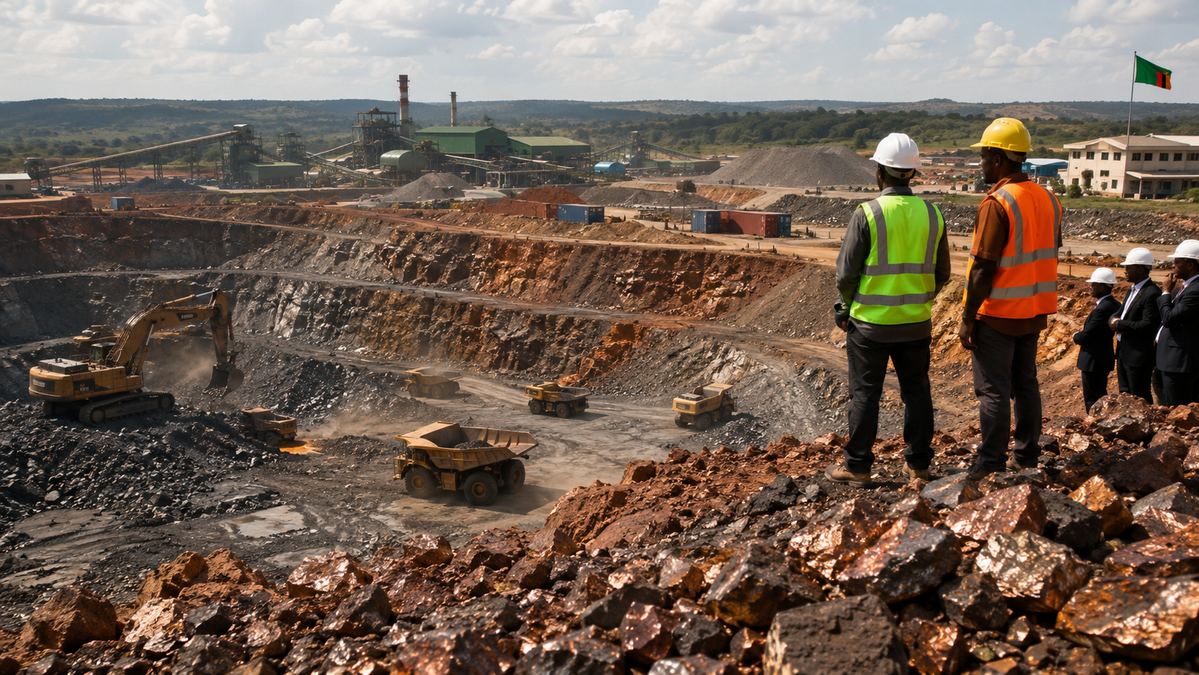
Zambia is betting that a new copper boom can transform its economy, with foreign mining companies committing billions of dollars, the government targeting a dramatic increase in production and global demand for the metal rising. Yet beneath the investment figures is a question that has followed Zambia for decades: who really owns the wealth generated by the country’s copper?
The answer is more complicated than simply pointing to the companies operating Zambia’s mines. The Zambian state has significant minority interests in several major mining assets through ZCCM Investments Holdings, while international companies control many of the largest operations. At the same time, the government collects taxes and royalties, workers earn wages and thousands of local businesses depend on mining activity.
That makes Zambia’s copper industry a story about much more than mining. It is a story about ownership, foreign investment, government revenue, jobs, industrialisation and the balance of power between a resource-rich African country and some of the world’s largest mining and investment groups.
As Zambia emerges from its debt crisis and looks to attract another wave of mining capital, the stakes are rising. The country wants more copper, more investment and more economic growth. Its citizens, however, want to know whether a bigger copper industry will also mean a bigger share of national wealth reaching ordinary households.
Zambia’s copper boom
Copper has been at the centre of Zambia’s economy for generations, but the industry is entering another period of rapid expansion.
The government has set a target of producing three million tonnes of copper a year by 2031. Reaching that level would require a major expansion of existing mines, the development of new deposits, more exploration and substantial investment in electricity, transport and processing infrastructure.
The ambition comes as global demand for copper is strengthening. The metal is indispensable to power transmission, electric vehicles, renewable energy infrastructure, construction and data centres. As countries invest in electrification and new energy systems, copper has become one of the minerals increasingly viewed as strategically important.
Zambia, already Africa’s second-largest copper producer, is consequently attracting attention from investors far beyond the traditional mining sector. Reuters reported ahead of Zambia’s August 2026 election that mining companies had committed more than $10 billion in investment since President Hakainde Hichilema took office in 2021.
The opportunity is enormous.
But so is the challenge.
More copper production does not automatically translate into greater prosperity. The real economic test will be whether Zambia can convert its geological wealth into sustainable public revenue, stronger local companies, better infrastructure, skilled employment and industries that remain productive long after individual mines eventually close.
Who owns Zambia’s copper mines?
The ownership structure provides the first clue to where the wealth goes.
ZCCM-IH, the Zambian state investment company, holds minority interests across a number of important mining operations. Its current portfolio includes stakes in Konkola Copper Mines, Kansanshi Mining, CNMC Luanshya Copper Mines, Lubambe, Mingomba and Mopani Copper Mines.
At Kansanshi, one of Zambia’s largest copper producers, ZCCM-IH owns 20%, while First Quantum Minerals owns the remaining 80%. The mine also produces gold and other products and is located near Solwezi in North-Western Province.
At Konkola Copper Mines, ZCCM-IH holds 20.6%, with Vedanta holding 79.4%. At CNMC Luanshya Copper Mines, ZCCM-IH owns 20%, while CNMC holds 80%. The same 20% state stake exists at Lubambe, while ZCCM-IH has a 20% interest in Mingomba Mining alongside KoBold Metals, which holds 80%.
The pattern is significant.
Zambia is not absent from its mining industry. The state has ownership positions and therefore a claim to dividends and other shareholder benefits. But in several major mines, foreign investors remain the controlling shareholders.
That means the question of who owns Zambia’s copper cannot be answered simply by saying either “Zambia” or “foreign investors”.
The ownership is shared.
The bigger question is who receives the greatest economic benefit.
The Mopani test
Mopani Copper Mines provides one of the clearest examples of Zambia’s changing approach to mining ownership.
The mine is now owned 49% by ZCCM-IH and 51% by International Resources Holding through Delta Mining. The structure followed a transaction in which Delta agreed to invest up to $1.1 billion for its 51% stake. ZCCM-IH retained a significant minority position.
The deal illustrates a fundamental problem faced by resource-rich governments.
Owning a mine is valuable, but running a major copper operation requires enormous amounts of capital. Underground mines need continuous investment in shafts, machinery, processing facilities, power, exploration and maintenance. When production falls or infrastructure becomes outdated, billions of dollars can be required to restore an operation.
For Zambia, bringing in an international strategic investor meant giving up majority ownership in Mopani while gaining access to new capital.
That is the trade-off.
A government can pursue greater ownership, but it must also have the financial capacity and technical expertise to operate the assets efficiently. Otherwise, a larger state stake may not necessarily translate into greater national wealth.
Mopani therefore offers a useful lesson for the wider African debate about resource nationalism. Ownership matters, but so do capital, management, productivity and the terms under which investment is secured.
The foreign investor question
Foreign mining companies are often presented as the winners in Africa’s resource economy. But their role is more complicated than that.
Developing a major copper deposit can require billions of dollars before a company generates a return. Investors provide financing, engineering expertise, equipment, technology and access to international markets. They also take commercial risks if copper prices fall or projects encounter delays.
For Zambia, this capital is important.
For investors, Zambia offers something increasingly valuable: large copper resources at a time when global industries are seeking reliable supplies of the metal.
The relationship can therefore benefit both sides.
The difficult part is determining how much of the value remains in Zambia.
That depends on the tax system, royalties, government equity, local procurement, wages, infrastructure spending, environmental obligations and the extent to which copper is processed domestically.
A mine can be majority foreign-owned and still generate substantial economic value for its host country if the fiscal and regulatory framework is effective.
The reverse is also possible. A government can own a large stake in a mining company and still struggle to create national wealth if the operation is inefficient, undercapitalised or poorly governed.
Where does the copper money go?
The value generated by Zambia’s copper industry moves through several channels.
Mining companies earn revenue from selling copper. Governments collect taxes and royalties. State investment companies can receive dividends from their ownership stakes. Employees receive salaries, while local contractors and suppliers earn income from providing goods and services to the mines.
The broader economy benefits from foreign exchange earnings and spending generated by mining activity.
But these benefits are not evenly distributed.
The government can collect substantial mining revenue without every household feeling an immediate improvement in living standards. Revenue can be used to finance public infrastructure, education, healthcare and other services, but the impact depends on how effectively the money is managed.
This is one reason why Zambia’s copper boom is also a political story.
Reuters reported before the August 2026 election that although Zambia’s economy had improved following years of debt difficulties, poverty and high living costs remained major concerns for voters.
For citizens, the most important economic statistic is often not copper production.
It is whether life becomes more affordable.
Whether jobs become easier to find.
Whether electricity becomes more reliable.
Whether roads improve.
And whether young people can build a future without leaving the country.
Copper and the 2026 election
Zambia’s copper industry has become inseparable from the country’s political economy.
President Hakainde Hichilema came to power in 2021 promising economic reform and a better relationship with investors. His administration has worked to restructure Zambia’s debt and restore investor confidence while encouraging new mining investment.
The August 2026 election has put that record under scrutiny.
Reuters reported on Aug. 16 that Hichilema was leading the presidential vote count, with results from 105 of 226 constituencies reported at the time.
The outcome matters to the copper sector because mining companies are looking for predictable policies over decades, not simply one election cycle.
New mines can take years to develop. Expansion projects require long-term financing. Exploration companies need confidence that licences, taxes and regulations will remain sufficiently stable to justify billions of dollars in investment.
At the same time, Zambia’s politicians face pressure from citizens who expect the country’s mineral wealth to deliver visible economic benefits.
That tension is unlikely to disappear after the election.
If anything, it could become stronger as copper production rises.
The three-million-tonne ambition
Zambia’s target of producing three million tonnes of copper annually by 2031 has become the central symbol of the country’s mining ambitions.
Achieving it would dramatically increase Zambia’s importance in the global copper market. But the target also exposes the scale of the infrastructure challenge.
Mining consumes large amounts of electricity. Copper production requires roads and railways capable of moving heavy equipment and minerals. New mines require skilled workers, water, processing capacity and reliable supply chains.
Zambia’s power sector is therefore critical to the copper story.
A country cannot substantially expand copper production if mines regularly face electricity shortages.
Transport is equally important. Zambia is landlocked, meaning its copper must travel through regional transport corridors to reach international markets. Better rail infrastructure could reduce costs and improve the competitiveness of Zambian exports.
The regional mineral boom is already attracting investment in transport. Reuters reported in August that rail operators and infrastructure investors were increasing their focus on mineral corridors across Southern and Central Africa, including routes serving Zambia and neighbouring mining economies.
Copper production, in other words, is not just a mining problem.
It is an infrastructure problem.
The value-addition opportunity
The biggest opportunity may not be producing more copper.
It may be doing more with the copper Zambia already produces.
For decades, many African economies have exported raw or semi-processed minerals and imported finished products made from those same resources. That model generates export revenue but limits the number of jobs and businesses created domestically.
Zambia has an opportunity to change that equation.
More copper processing, refining and manufacturing could create additional industries around the mining sector. Companies could produce cables, electrical components and other copper-based products closer to the source of the raw material.
That would create demand for engineers, technicians, transport companies, construction firms, technology providers and financial services.
The result would be a broader economic ecosystem rather than an economy dominated by extraction.
This is particularly important as Zambia seeks to increase production. If the country simply exports more copper concentrate, it will become a bigger mining economy. If it builds industries around copper, it could use the boom to accelerate industrialisation.
That distinction could determine whether the current copper cycle becomes another commodity boom or a genuine economic transformation.
Can Zambian companies benefit?
Another important part of the ownership debate is often overlooked: local businesses.
A large copper mine does not operate alone. It needs trucks, fuel, food, machinery, construction services, security, engineering, information technology, accommodation and professional services.
If those services are supplied primarily by foreign companies, much of the economic value leaves the country.
If more Zambian businesses can compete for those contracts, the impact of mining investment becomes much larger.
This is why local procurement policies matter.
The objective should not be to exclude international suppliers simply because they are foreign. Instead, Zambia needs to build domestic companies capable of meeting the technical, financial and quality standards required by major mining operations.
That requires access to finance, training, technology and predictable contracts.
Over time, a successful mining supply chain could create thousands of businesses that survive beyond the life of individual mines.
The state’s changing role
ZCCM-IH is central to Zambia’s effort to maintain a financial interest in the mining industry.
Its portfolio demonstrates that the state wants more than tax revenue from copper. It wants direct exposure to the value created by mining assets. The company also has investments in energy and other sectors connected to Zambia’s wider economy.
But state ownership brings responsibilities.
ZCCM-IH must ensure that its investments are commercially sound. It must protect shareholder value and ensure that its representatives can effectively participate in the governance of companies in which it holds stakes.
The challenge is especially important because mining projects can last for decades.
Decisions made today about ownership, financing and investment could determine how much wealth Zambia receives long after current political leaders have left office.
China, the West and Zambia’s copper
Zambia’s copper resources are also becoming strategically important in global geopolitics.
China has long played a major role in Zambia’s mining sector and remains a significant commercial partner. At the same time, the United States and other Western governments are increasingly interested in critical mineral supply chains that reduce dependence on concentrated sources of supply.
That creates new bargaining power for Zambia.
When multiple global powers want access to the same mineral resources, the host country has more opportunities to negotiate.
But leverage is only useful when it is backed by strong institutions.
Zambia must be able to evaluate investment proposals, understand financing structures and negotiate contracts that protect its long-term interests. It also needs transparent systems that allow citizens to understand how public resources are being managed.
The copper boom therefore creates an opportunity not only to attract investment but also to strengthen Zambia’s negotiating position in the global critical minerals economy.
The environmental question
There is another side to the ownership debate that cannot be ignored.
Copper mining has environmental costs. Mining operations can affect land, water and surrounding communities, while processing can generate waste and other environmental risks.
As production expands, Zambia will need to ensure that environmental protections keep pace with investment.
A mine that produces billions of dollars in copper but leaves communities with damaged land or polluted water cannot be considered an unqualified economic success.
Responsible mining therefore has to be part of the ownership equation.
The people who live closest to the mines should not carry the environmental costs while distant shareholders receive most of the financial benefits.
Who really owns the wealth?
The simplest answer is that nobody owns it alone.
Zambia controls its mineral resources as a sovereign state. Foreign companies operate and own controlling stakes in several major mining businesses. ZCCM-IH holds minority interests. Employees, contractors and local businesses receive a portion of the economic value, while the government collects taxes and royalties.
But the more important question is not who owns the copper underground.
It is who captures the value once that copper is extracted.
That value can be divided among shareholders, governments, workers, suppliers and communities. The balance depends on the agreements Zambia signs, the strength of its institutions and the country’s ability to build industries around mining.
This is why Zambia’s copper boom deserves close attention.
The country has the mineral resources.
It has investors willing to commit billions.
It has a government determined to increase production.
And it has a global market that increasingly needs copper.
What remains uncertain is how much of the resulting wealth will remain in Zambia.
The bigger African lesson
Zambia’s experience reflects a much wider debate across Africa.
From copper and cobalt in Central Africa to lithium in Zimbabwe and Namibia, oil and gas in East Africa, and critical minerals across the continent, African countries are confronting the same question: how can natural resources become a foundation for national wealth rather than simply a source of exports?
There is no single answer.
Some countries may choose larger state ownership. Others may prefer private investment combined with stronger taxation and regulation. Many will attempt to build local processing industries and manufacturing capacity.
What matters is whether the model creates lasting value.
Zambia’s copper boom offers a test case.
If the country succeeds in increasing production while strengthening public finances, expanding local businesses, developing skills and building processing industries, the boom could become a turning point.
If production rises but the economy remains heavily dependent on exporting raw materials, the opportunity could prove much smaller than the headline investment figures suggest.
The real question
Zambia does not need to choose between foreign investment and national ownership.
It needs to find a model in which the two can coexist without the country surrendering too much of the value created by its natural resources.
Foreign capital can build mines.
Zambian institutions must ensure that those mines build an economy.
That means collecting a fair share of taxes and royalties, protecting the public interest in state-owned investments, encouraging local suppliers, developing processing capacity and investing mining revenue in infrastructure and human capital.
The copper beneath Zambia’s soil is finite.
The wealth it can create does not have to be.
If managed well, copper can finance businesses, skills, infrastructure and industries that outlive the mines themselves. That is the difference between an extraction economy and a resource-powered industrial economy.
For Zambia, the next decade will show which path it takes.
The question is no longer simply who owns Zambia’s copper. The real question is who owns the future that Zambia’s copper can create.

More from Business

Who owns Quickmart? Inside Kenya’s KSh15 billion supermarket IPO
Quickmart’s public listing exposes how Kenyan retail, private equity and everyday consumer power are quietly reshaping who owns the country’s economy.

How Mr Eazi became a major shareholder in Ghana’s pharmaceutical industry
Nigerian musician Mr Eazi's investment firm Zagadat Capital has quietly built a major stake in a Ghanaian drug maker.

Who owns Africa’s new wealth? The companies and sectors creating the continent’s next billionaires
African governments are competing for global capital with tax incentives, but the bigger question is who will own the wealth created.