

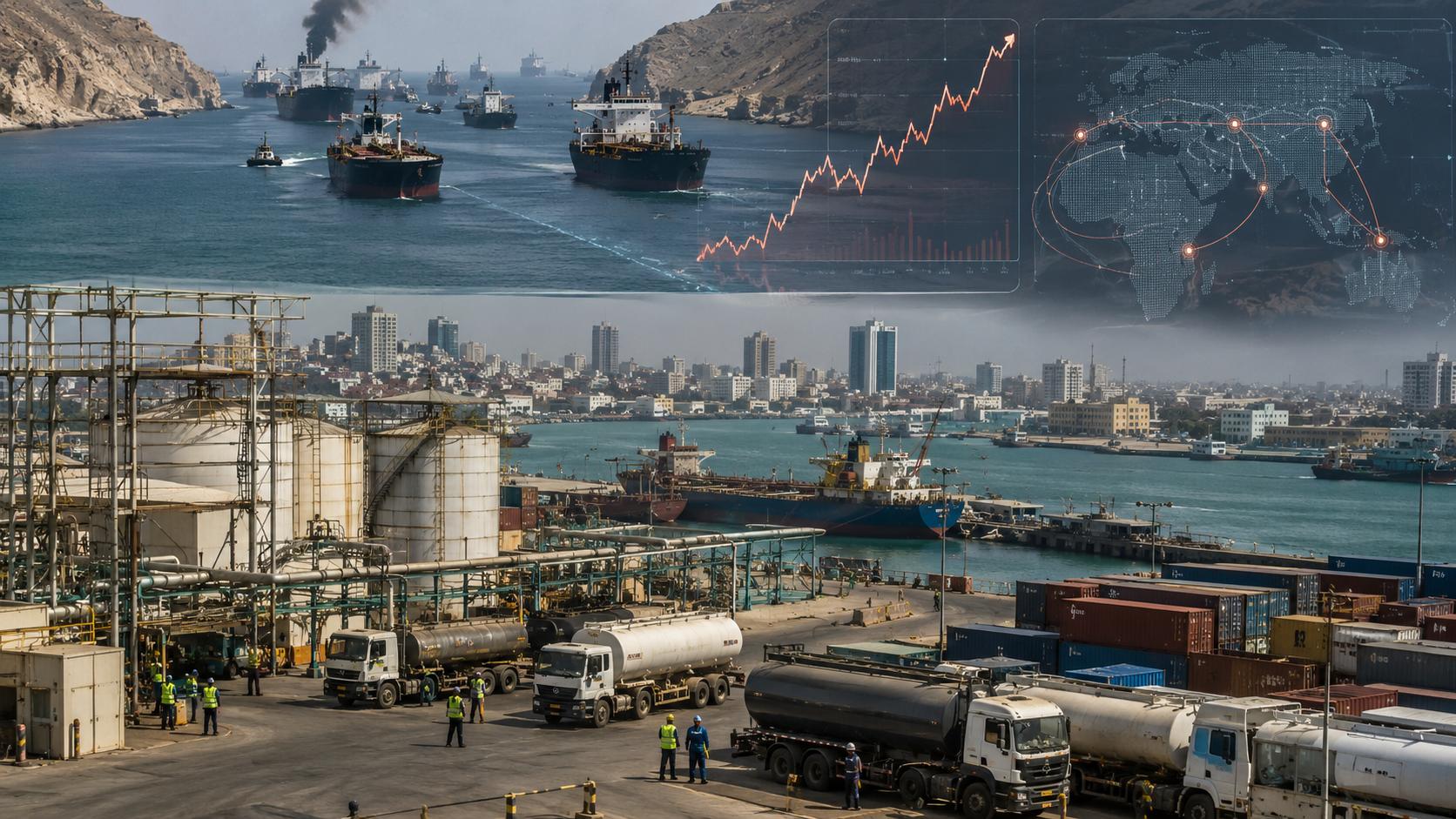
The latest attacks on oil-linked vessels in the Strait of Hormuz are sending another warning to African economies already struggling with high living costs: a prolonged disruption to one of the world’s most important energy corridors could make fuel, transport, food and foreign exchange significantly more expensive.
The risks are particularly acute for countries that import most of their refined petroleum products, leaving consumers and governments exposed to movements in global crude prices even when domestic oil production is substantial.
Africa feels the impact of the Hormuz crisis
The Strait of Hormuz has become a central pressure point in the global energy market as tensions surrounding Iran, the United States and Gulf shipping continue. The waterway normally handles a huge share of internationally traded oil and gas, making any sustained disruption a concern far beyond the Middle East. UN Trade and Development has described the strait as carrying around a quarter of global seaborne oil trade, alongside significant volumes of liquefied natural gas and other commodities.
The latest escalation has involved vessels linked to the United Arab Emirates’ state oil company ADNOC. Reuters reported that two ADNOC vessels were attacked while transiting the strait on Aug. 13, with no injuries reported. Further reports this weekend said another UAE-owned tanker had been attacked, reinforcing concerns over the safety of commercial shipping.
For Africa, the problem is not simply whether oil physically reaches the continent.
It is also the price paid to secure it.
When ships face longer routes, greater security risks and higher insurance premiums, the cost of moving every barrel increases. Those costs eventually reach fuel importers, transport companies, manufacturers, farmers and households.
Oil prices transmit the shock
Oil markets have already reacted sharply to uncertainty surrounding the strait.
Brent crude rose about 5% in early August to around $87.72 a barrel as investors reassessed the prospects of a prolonged disruption.
That matters for African countries because petroleum products remain embedded in almost every part of their economies.
Diesel powers trucks, buses, agricultural machinery and industrial equipment. Petrol supports private transport, motorcycles and small businesses. Jet fuel affects aviation. Fuel oil and gas influence electricity generation in some markets.
A rise in crude prices can therefore become an economy-wide shock.
The World Bank has warned that higher fossil-fuel import bills can widen current-account deficits and put pressure on currencies. Currency depreciation then makes imported fuel even more expensive, creating a feedback loop in which the original oil shock becomes a broader inflation problem.
For countries already dealing with weak currencies, high interest rates and expensive debt, that cycle could be particularly damaging.
Import dependence is Africa’s vulnerability
Africa produces large quantities of crude oil, but production does not automatically translate into cheap fuel for African consumers.
Several countries continue to depend heavily on imported refined products because domestic refining capacity has historically been insufficient, unevenly distributed or unreliable.
That creates a structural vulnerability.
A country can be an oil producer and still be exposed to international fuel prices if it exports crude and imports petrol or diesel.
Nigeria provides an important example.
The country remains one of Africa’s largest oil producers, but for years it relied heavily on imported refined petroleum products. The emergence of the 650,000-barrel-per-day Dangote refinery is changing that equation by increasing domestic refining capacity and reducing dependence on imported fuel. Reuters reported this month that the refinery has become an important supplier during the global energy disruption and that its owners are seeking to expand its role in African fuel markets.
That shift could provide Nigeria with a degree of protection compared with countries that remain almost entirely dependent on imported refined fuel.
But it does not make Nigeria immune.
Crude oil is globally traded, and domestic fuel prices remain affected by international market conditions, logistics and foreign exchange costs.
Kenya faces another fuel squeeze
For countries such as Kenya, the exposure is more direct.
Kenya imports most of its petroleum requirements, making the country sensitive to international crude prices, freight charges, insurance costs and exchange-rate movements.
Fuel prices also have an unusually broad economic effect.
When diesel becomes more expensive, trucking companies raise costs. Farmers face higher expenses for machinery and transport. Manufacturers pay more to move raw materials and finished goods. Public transport operators face higher operating costs.
Eventually, the increase can appear in the price of food.
Current fuel data illustrate the scale of the challenge. Gasoline prices in Kenya were around $1.65 per litre in July, according to Trading Economics, placing the country among markets where fuel costs remain significant for households and businesses.
A prolonged international oil shock could therefore arrive at a difficult time for Kenyan consumers already sensitive to food and transport prices.
South Africa faces pressure from both sides
South Africa presents a different case.
The country has a larger industrial base and more developed energy infrastructure than many African economies, but its economy remains vulnerable to imported crude and refined-product price movements.
Higher fuel prices would affect logistics, mining, manufacturing and agriculture.
The rand could also come under pressure if the oil bill rises sharply. A weaker currency would increase the local-currency cost of imported energy, potentially amplifying the initial shock.
The experience of the current crisis has already demonstrated how governments can be forced into difficult fiscal decisions.
The World Bank said South Africa introduced emergency fuel levy relief costing an estimated 17.2 billion rand, while Kenya deployed 5 billion Kenyan shillings from its Petroleum Development Levy Fund.
Such measures can soften the immediate impact on consumers.
But they are expensive.
Inflation could return through transport
The most important channel for Africa may not be crude oil itself.
It is transport.
Africa’s economies depend heavily on road freight. In many countries, trucks carry food, construction materials, agricultural inputs and manufactured goods across long distances.
When diesel prices rise, the cost of transporting those products rises as well.
That means an oil shock can move quickly from international energy markets to a market in Nairobi, Accra, Lagos, Johannesburg or Addis Ababa.
For low-income households, the consequences can be severe because food and transport already account for a large share of monthly spending.
Governments then face pressure to intervene.
They can subsidise fuel, reduce taxes or delay price increases. But each option carries a fiscal cost.
The alternative is to allow higher prices to pass through to consumers, risking renewed inflation and political dissatisfaction.
Neither option is comfortable.
The currency problem
Oil is generally traded in U.S. dollars.
That creates an additional vulnerability for African economies.
If oil prices rise at the same time as local currencies weaken against the dollar, importers effectively face two price increases.
This is particularly important for countries with limited foreign-exchange reserves.
An expensive energy import bill can consume more dollars, putting additional pressure on the currency. The weaker currency then raises the local cost of fuel, creating another inflationary cycle.
African currencies have already experienced significant pressure in 2026. Analysts have linked recent currency weakness across several markets partly to concerns about higher energy costs and external financing conditions.
A prolonged Hormuz disruption could intensify those pressures.
Debt makes the shock harder
Higher oil prices also create a problem for governments carrying large debt burdens.
When inflation rises, central banks may be reluctant to cut interest rates. In some cases, they may have to maintain restrictive monetary policy for longer.
That makes borrowing more expensive.
Governments simultaneously face higher fuel-related spending and greater pressure to protect households.
The result can be a squeeze on public finances.
Some African countries could find themselves spending more on fuel subsidies while having less money available for infrastructure, healthcare, education and investment.
The longer the crisis lasts, the more difficult that trade-off becomes.
Africa’s oil producers have an advantage
The crisis does not affect every African economy in the same way.
Oil exporters could benefit from higher crude prices because government revenues and foreign-exchange earnings can increase.
Countries such as Angola, Nigeria and Algeria have the potential to gain from stronger oil revenues if production remains stable and export markets are accessible.
But even oil producers face complications.
If their domestic populations pay international prices for refined fuel, higher crude prices can still raise the cost of living. Governments may also come under pressure to increase subsidies.
The real advantage comes when a producer can combine crude production with adequate domestic refining capacity.
That is why Nigeria’s refining expansion is strategically important.
Refining capacity becomes a security issue
The Hormuz crisis is therefore exposing something bigger than Africa’s dependence on imported oil.
It is exposing dependence on imported refined fuel.
The distinction is important.
A country with substantial crude reserves but little refining capacity remains exposed to international supply chains. A country with refineries capable of supplying domestic and regional markets has greater control over its energy security.
Recent developments around the Dangote refinery demonstrate the potential.
West African regulators are now working toward regional fuel pricing and trading mechanisms, with Nigeria’s expanded refining capacity potentially giving the region greater influence over fuel markets.
If developed properly, such infrastructure could reduce Africa’s vulnerability to future external shocks.
The crisis creates an investment opportunity
There is another side to the disruption.
Energy crises often reveal where investment is most urgently needed.
Africa needs more refineries, storage facilities, pipelines, renewable power, electric transport and regional energy infrastructure.
It also needs stronger regional markets that can move energy and fuel efficiently across borders.
The goal should not simply be to shield consumers from every global price increase.
It should be to make African economies less vulnerable to those increases.
The World Bank has argued that electric mobility could become part of Africa’s economic resilience strategy by reducing dependence on imported petroleum and lowering exposure to global oil-price shocks.
That transition will take time.
Africa’s immediate transport needs remain heavily dependent on petrol and diesel. But electric buses, motorcycles, three-wheelers and commercial fleets could gradually reduce the amount of imported fuel required by major cities.
What happens if Hormuz remains disrupted?
The biggest uncertainty is duration.
A short disruption could produce a temporary price spike followed by stabilisation if shipping resumes and markets regain confidence.
A prolonged crisis would be different.
Shipping companies could continue avoiding the waterway. Insurance costs could remain elevated. Refiners could compete aggressively for alternative supplies. Freight rates could rise, while governments would face growing pressure to protect consumers.
Reuters reported that shipping traffic through the Strait of Hormuz had fallen sharply by Aug. 12, with only a small number of vessels being tracked compared with normal traffic levels before the crisis.
That decline matters because markets respond not only to barrels physically lost but also to uncertainty over future supply.
Even if enough oil exists globally, getting it to the right refinery at the right time can become more expensive.
Africa’s longer-term lesson
The Hormuz crisis is ultimately a reminder of how closely African economies are tied to events far beyond the continent.
A conflict thousands of kilometres away can influence the price of a matatu ride in Nairobi, the cost of transporting maize in Zambia or the price of electricity generated by fuel-powered plants.
That vulnerability will not disappear when the current crisis ends.
Africa’s energy challenge is structural.
The continent needs greater refining capacity, diversified energy supplies, stronger electricity systems, regional fuel markets and faster investment in alternatives to imported petroleum.
For investors, that means opportunities in infrastructure, renewable energy, storage, logistics, refining and electric mobility.
For governments, it means treating energy security as an economic strategy rather than simply a fuel-pricing problem.
And for consumers, the immediate reality is more difficult.
If the Strait of Hormuz remains under pressure and oil prices stay elevated, the cost will not stop at the pump.
It will move through trucks, factories, farms, airlines and shops.
The lesson for Africa is clear: energy independence is not only about producing oil. It is about having enough control over how energy is refined, transported, priced and consumed.
The countries that invest in that resilience now will be better positioned when the next global energy shock arrives.

More from Business
Who owns Quickmart? Inside Kenya’s KSh15 billion supermarket IPO
Quickmart’s public listing exposes how Kenyan retail, private equity and everyday consumer power are quietly reshaping who owns the country’s economy.

How Mr Eazi became a major shareholder in Ghana’s pharmaceutical industry
Nigerian musician Mr Eazi's investment firm Zagadat Capital has quietly built a major stake in a Ghanaian drug maker.

Who owns Africa’s new wealth? The companies and sectors creating the continent’s next billionaires
African governments are competing for global capital with tax incentives, but the bigger question is who will own the wealth created.