
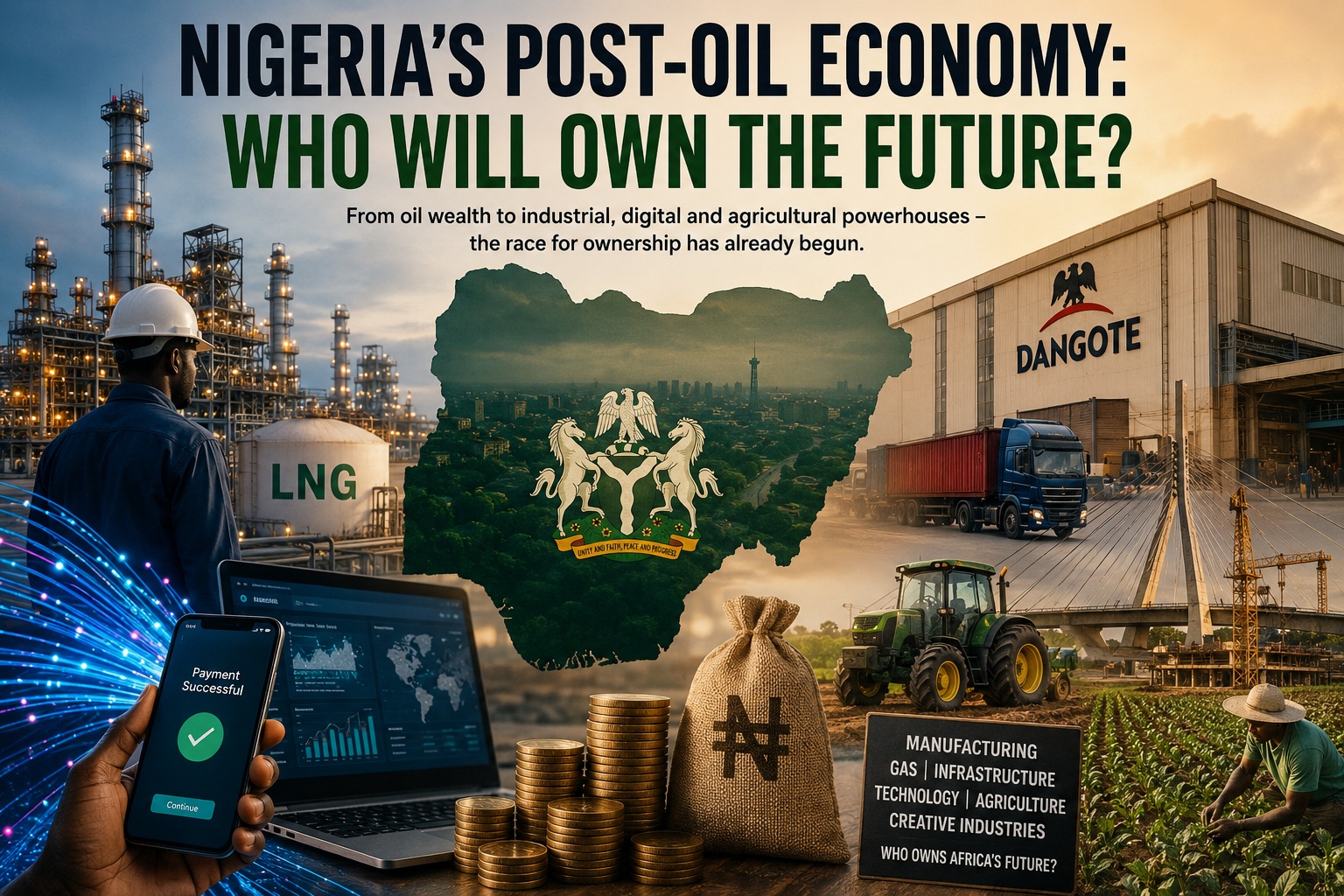
Nigeria is telling a compelling economic story: oil is no longer supposed to be the destination, but the capital that finances Nigeria’s next industrial age. The harder question is who will own that future.
President Bola Tinubu’s latest argument about Nigeria’s economy is bigger than another promise to reduce dependence on crude oil. It is a proposition about ownership.
The president says Nigeria is moving toward a more diversified economy built around manufacturing, agriculture, gas, infrastructure, digital technology and the creative industries. At the same time, the Nigerian Upstream Petroleum Regulatory Commission says licensing rounds conducted since the Petroleum Industry Act have generated or projected about $103 billion in investment.
That figure deserves attention, but not simply because it is large.
The more important question is what happens after the capital arrives.
Who owns the factories? Who owns the pipelines? Who finances the roads and ports? Who controls the digital platforms through which Nigerians transact? Who owns the listed companies? Who receives the dividends? And, perhaps most importantly, will ordinary Nigerians become shareholders in the economy being built in their name?
This is where Nigeria’s post oil story becomes much more interesting.
Oil may be financing its own replacement
Nigeria is not abandoning oil in the conventional sense.
It is trying to use oil and gas differently.
At the fifth anniversary of the NUPRC, Tinubu said petroleum resources should provide the energy, foreign exchange and investment needed to build a modern economy. NUPRC chief executive Oritsemeyiwa Eyesan said four licensing exercises since the Petroleum Industry Act accounted for about $103 billion in investment spent or projected.
That distinction matters.
A country does not become post oil simply because crude production rises more slowly as a share of the economy. It becomes less vulnerable to oil when capital generated by natural resources is converted into productive assets outside the resource itself.
Nigeria has attempted this before.
The difference now is that several pieces of the industrial puzzle are appearing at the same time.
Refining is expanding. Gas investment is returning. Cement and food processing have become major domestic industries. Digital payments have moved from a niche technology to basic economic infrastructure. Pension funds have become a significant pool of domestic capital.
The question is whether these developments create a broad ownership economy or another concentration of wealth.
Dangote shows both possibilities
No company illustrates Nigeria’s economic transition more clearly than Dangote.
The Dangote Group has spent decades moving from commodities into cement, fertiliser, logistics, power and, most dramatically, refining. Its 700,000 barrels per day refinery represents the clearest example of an attempt to turn Nigeria’s raw material advantage into domestic industrial capacity.
Now the ownership model is changing.
Dangote Petroleum Refinery is preparing an initial public offering designed to attract millions of Nigerian retail investors. Reuters reported this week that the company is targeting as many as 10 million retail investors, while its current share sale could raise about 2.15 trillion naira, or roughly $1.6 billion, if fully subscribed.
That could become more important than the money raised.
It could determine whether one of Africa’s most important industrial assets remains primarily a family controlled enterprise or becomes a national investment asset with millions of Nigerians holding a stake.
Dangote Cement provides another lesson. Dangote Industries held about 87% of the company at June 2026, according to its financial statements.
The model is therefore clear: Nigerian industrial capital can build enormous productive assets, but ownership can remain highly concentrated.
The refinery IPO could test whether Nigeria is ready to change that model.
BUA represents another industrial power centre
Abdul Samad Rabiu’s BUA Group is another major force in Nigeria’s emerging industrial economy.
BUA’s interests span cement, sugar, food production, rice, flour, infrastructure, logistics and other businesses. BUA Foods and BUA Cement are particularly important because they sit directly inside the food and construction supply chains that a more diversified Nigerian economy requires.
The ownership concentration is striking.
Research published in August showed Rabiu’s direct and indirect interest in BUA Foods at about 92.6%, while his combined economic interest in BUA Foods and BUA Cement represented a substantial portion of the Nigerian Exchange’s total market value.
This is not necessarily a problem.
Nigeria needs investors willing to put billions of dollars into factories, plants and infrastructure when financing costs are high and the operating environment remains difficult.
But it raises an unavoidable question.
If the government succeeds in creating a large non oil economy, will the biggest gains accrue mainly to the industrial families that already possess capital?
Foreign capital is not leaving Nigeria
The post oil story is also not a story of Nigerians replacing foreigners.
It is a story of foreign and Nigerian capital becoming more deeply intertwined.
Tolaram is a useful example.
The Singapore linked industrial group has built a substantial manufacturing footprint in Nigeria and became majority owner of Guinness Nigeria after acquiring Diageo’s 58.02% stake. By the end of 2025, Tolaram’s N-Seven subsidiary held 70.86% of Guinness Nigeria.
This is a powerful signal about where global capital sees opportunity.
Foreign investors may no longer need to own an oil field to participate in Nigeria’s growth. They can own manufacturing capacity, consumer brands, financial technology, telecommunications infrastructure or logistics networks.
That changes the ownership map.
The next generation of foreign influence in Nigeria may be less visible than an oil major. It may sit inside a factory, a payment platform, a data centre, a telecom network or an infrastructure concession.
Technology may be the most international sector
Nigeria’s technology economy has a different ownership structure again.
Flutterwave, Moniepoint, Interswitch and other financial technology companies have attracted international institutional investors alongside Nigerian founders and executives.
Moniepoint’s $200 million Series C financing was led by Development Partners International, with LeapFrog Investments and other investors including Visa, IFC, Google’s Africa Investment Fund and Proparco participating.
Flutterwave, meanwhile, has continued expanding its payments ecosystem and acquired Nigerian open banking company Mono in an all stock transaction in 2026. Mono itself had attracted investors including Tiger Global, General Catalyst and Target Global.
Interswitch provides an older version of the same story. Private equity firm Helios Investment Partners remains its majority shareholder after acquiring a controlling interest in 2010, with TA Associates later taking a minority stake.
This is the new Nigerian economy in miniature.
The founders may be Nigerian. The customers are overwhelmingly African. The technology is developed locally. But the ownership capital can come from London, New York, Silicon Valley, development finance institutions and global private equity.
Nigeria is becoming a marketplace for global capital, not simply a recipient of foreign aid.
Pension money could change everything
There is, however, another owner waiting in the background.
Nigerian pension savers.
The pension industry had assets of about 31.8 trillion naira by August 2026, according to data from PenCom. Domestic equities accounted for more than 6 trillion naira, while infrastructure funds and private equity allocations were also growing.
That matters because pension money is patient money.
A foreign private equity investor can eventually sell. A multinational can restructure. A founder can transfer wealth to the next generation.
But pension capital represents millions of Nigerian workers saving for retirement.
PenCom has also expanded the room available for pension funds to invest in equities and alternative assets. Its 2026 addendum increased permissible ordinary share limits for several RSA fund categories, giving pension fund managers greater scope to participate in Nigerian companies.
This creates an extraordinary possibility.
The Nigerian worker could become an owner of the Nigerian economy without personally starting a company.
A nurse in Kano, a teacher in Enugu or an engineer in Port Harcourt may ultimately own tiny portions of banks, manufacturers, infrastructure funds and technology companies through pension savings.
That is potentially the most important ownership story in Nigeria.
Infrastructure will decide who captures the value
Nigeria’s infrastructure buildout is another ownership battleground.
Ports, roads, railways, power systems and logistics networks determine which businesses can scale and which communities remain economically isolated.
The Lekki Deep Sea Port demonstrates how complex ownership can become. Under its concession structure, the federal government holds 5%, Lagos State 20% and the private investor or manager 75%, with the project operating under a 45 year build, own, operate and transfer arrangement. China Harbour Engineering was the EPC contractor.
This model is likely to become increasingly important.
Nigeria cannot finance every infrastructure project from public revenue. Private capital, development finance and pension money will therefore have to participate.
But ownership determines who receives the long term economic returns.
A road can be publicly celebrated while the financing structure quietly determines who benefits from tolls, land appreciation, logistics activity and surrounding commercial development for decades.
That is why Nigeria’s infrastructure policy is also an ownership policy.
Gas may be the bridge economy
Gas occupies an especially important position because it can connect the old economy to the new one.
Nigeria needs gas to support electricity generation, industrial production, fertiliser, petrochemicals and export earnings. The government wants increased gas production while using petroleum sector reforms to attract capital.
Seplat Energy is one of the clearest examples of Nigerian private capital expanding within this transition.
Heirs Holdings, controlled by Tony Elumelu, became a major shareholder in Seplat and is set to have Elumelu become chairman in 2027. In September, entities controlled by Elumelu increased their combined Seplat holding to 21.07%.
Meanwhile, Shell’s former onshore Nigerian subsidiary has moved into Nigerian investor ownership through Renaissance Africa Energy, following Shell’s divestment. Shell says it continues to focus on offshore deepwater and integrated gas activities in Nigeria.
The pattern is revealing.
Foreign oil companies are not simply disappearing. Nigerian investors are acquiring assets while international companies reposition themselves toward areas where they believe their capital and expertise will earn the best returns.
That is a transfer of ownership, but not necessarily a transfer of control over the whole value chain.
The industrial families are already positioned
Nigeria’s economic future is therefore unlikely to be owned by one group.
But several powerful centres of capital are already visible.
Dangote has cement, refining, fertiliser, logistics and industrial infrastructure.
BUA has cement, food production, sugar, logistics and related industrial businesses.
Elumelu’s Heirs interests span energy, banking, power, technology and other sectors.
Tolaram is deeply embedded in consumer manufacturing and distribution.
International groups such as MTN, Airtel, Visa and global investment firms remain major participants in Nigeria’s communications and digital economy.
A recent analysis of major Nigerian Exchange companies found that major shareholders connected to companies including Dangote Cement, BUA Cement, BUA Foods, MTN Nigeria, Airtel Africa and Seplat represented a striking concentration of market value.
This tells us something uncomfortable.
Nigeria may be diversifying economically while remaining concentrated financially.
The real post oil question
This is why the phrase “post oil economy” can be misleading.
The end of oil dependence does not automatically produce economic democracy.
Nigeria can reduce its dependence on crude exports while creating new concentrations of wealth around cement, food, gas, telecoms, finance, ports, infrastructure and technology.
The owners may simply change.
The country could move from oil barons to industrial barons, from petroleum rent to infrastructure rent, or from crude exports to digital monopolies.
The better outcome is different.
Nigeria could use this transition to create a broad shareholder economy in which pension funds, retail investors, Nigerian entrepreneurs, cooperatives and long term domestic institutions own meaningful portions of the productive assets being built.
The Dangote refinery IPO is therefore worth watching for more than its valuation.
The expansion of pension investment matters for more than retirement.
The rise of Nigerian technology companies matters for more than innovation.
And the return of upstream investment matters for more than barrels.
All of these developments are pieces of the same question.
Who owns Nigeria when the oil economy finally becomes the old economy?
Tinubu’s government may succeed in attracting the capital. NUPRC may succeed in improving regulation. Companies may build the factories and infrastructure.
But history will judge the transition by something more difficult than investment figures.
It will judge who accumulated the assets.
If ownership remains concentrated among a small number of industrial families and foreign institutions, Nigeria will have diversified its economy without fully democratizing its wealth.
If pension savers, retail investors, entrepreneurs and domestic institutions become genuine owners, the post oil transition could become something much bigger.
It could mark the beginning of Nigeria’s first truly broad based industrial middle class.
That is the economic story worth following now.
Not simply who is investing in Nigeria. Who will own Nigeria?

More from Economy
Senegal’s $13 billion debt reckoning: Who really owns Africa’s future?
Senegal’s debt restructuring is testing whether oil wealth can restore economic sovereignty or deepen dependence on external creditors and markets.
Uganda’s shilling is falling. Who is paying the price?
Uganda’s currency weakness and soaring fuel costs expose the deeper economic burden carried quietly by households, traders and small businesses.

Africa is growing at 4.3%. So who actually owns the growth?
Africa's growth is accelerating, but the real contest is over who captures wealth, jobs, assets and economic power across societies.