
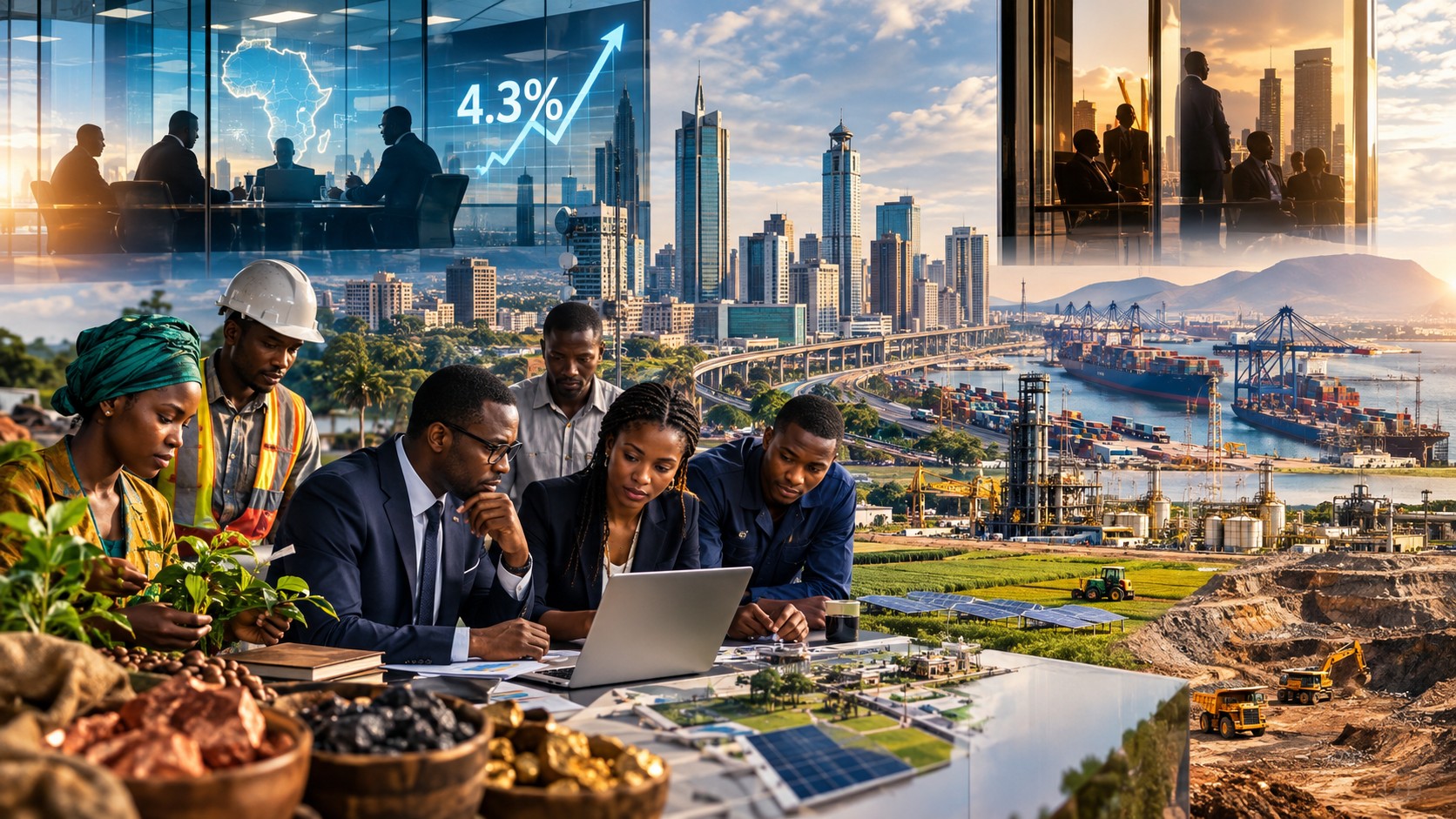
Africa is growing again, and on paper the number looks encouraging. The World Bank expects Sub-Saharan Africa to expand by 4.3% in 2026, up from 4.1% in its April forecast. But beneath that reassuring headline sits a harder question: when Africa grows, who actually gets to own the gains?
The question matters because economic growth is not the same thing as economic progress. A country can produce more, export more, attract more investment and report stronger gross domestic product while ordinary households remain squeezed by food prices, weak wages, expensive credit and declining purchasing power.
That is the uncomfortable contradiction at the centre of Africa’s current economic story.
The continent is not standing still. Investment is returning in parts of the region. Inflation has eased in several economies. Governments are undertaking difficult reforms. Energy transition, digital technology and artificial intelligence are creating new areas of opportunity. The World Bank says growth forecasts have been upgraded for nearly three-quarters of Sub-Saharan African countries, including Angola, Ethiopia, Nigeria and Zambia.
But growth alone does not answer the ownership question.
And ownership may be the most important economic question Africa faces over the next decade.
Growth is not the same as prosperity
The first mistake is to treat the 4.3% figure as a verdict on how Africans are doing.
It is not.
GDP measures the value of economic activity. It does not tell us who owns the companies producing that value, who controls the land on which production takes place, who receives the profits, who pays the taxes, who holds the debt or who gets the jobs created by investment.
That distinction becomes especially important in a continent with one of the world’s fastest-growing working-age populations.
The World Bank says the region could see a net increase of about 740 million people of working age by 2050, while up to 12 million young people are expected to enter the labour market each year. Yet only about 3 million new formal wage jobs are currently being created annually.
That is not simply a jobs problem. It is an ownership problem.
If millions of young Africans enter economies where productive assets are concentrated among a relatively small number of firms, investors and politically connected interests, then economic growth can coexist with economic exclusion.
The economy becomes larger without becoming broad enough.
The 4.3% illusion
There is another number that deserves almost as much attention as the headline growth rate.
Per capita income growth is expected to reach only about 1.8% in 2026. Reuters reported that the World Bank’s latest assessment sees this increase as insufficient to substantially reduce poverty.
That gap tells us something important.
A population can live in a country whose economy is expanding rapidly while experiencing only modest improvement in individual economic circumstances.
Imagine an economy growing at 4.3% while its population is expanding quickly, government debt remains expensive and inflation pushes up the cost of essential goods. The headline economy becomes bigger, but the household economy may feel almost unchanged.
For a young person searching for work, the distinction between GDP growth and income growth is not academic.
For a small business owner facing expensive credit, it is not academic.
For a family paying more for electricity, transport, food and school fees, it is not academic.
Growth becomes meaningful when it changes those realities.
Who owns the productive assets?
This is where Africa’s economic debate needs to become more uncomfortable.
Who owns the mines?
Who owns the banks?
Who owns the largest telecommunications companies?
Who controls logistics networks, ports, industrial parks and agricultural supply chains?
Who owns the data generated by African consumers?
Who owns the intellectual property created by African workers?
And increasingly, who owns the infrastructure that will power Africa’s digital economy?
These are not ideological questions. They are questions about where income ultimately goes.
Africa has spent decades exporting commodities while importing a large share of the manufactured products derived from those commodities. Copper leaves one country and returns as machinery. Cocoa leaves another and returns as chocolate. Crude oil is exported while refined petroleum products are imported.
The continent therefore participates in global value chains without always controlling the most profitable sections of those chains.
That is the deeper meaning of ownership.
The resource paradox
Africa’s natural resources should be one of its greatest economic advantages.
They can also become a trap.
When an economy depends heavily on oil, minerals or other commodities, growth can rise when global prices are favourable and collapse when prices turn. The country earns foreign exchange, governments collect royalties and companies make profits, but the broader economy may not develop enough productive capacity outside the resource sector.
The World Bank has repeatedly warned that resource-rich and fragile economies face structural difficulties in translating growth into poverty reduction.
The problem is not that Africa has resources.
The problem is what happens after extraction.
If raw materials leave the continent with limited processing, Africa captures only part of the value. If technology, finance, insurance, logistics and intellectual property are controlled elsewhere, even more of the value leaves.
The real transformation therefore cannot simply be about extracting more.
It has to be about owning more of the value chain.
Debt changes the equation
There is another owner in the room: the creditor.
Public debt across Sub-Saharan Africa has broadly stabilised at around 57% of GDP, according to the World Bank. Yet debt-service costs remain high enough to constrain spending on health, education and infrastructure.
This matters because money spent servicing debt cannot simultaneously be spent building productive capacity.
A government facing heavy repayment obligations has fewer choices. It may postpone infrastructure. It may reduce public investment. It may raise taxes. It may cut subsidies. It may borrow again.
That can create a cycle in which economic growth is used partly to service yesterday’s borrowing rather than finance tomorrow’s productivity.
The World Bank says declining development assistance is adding further pressure and is urging countries to mobilise domestic resources, deepen local capital markets and secure more sustainable financing.
The ownership question therefore extends beyond companies.
Who owns the debt?
Who receives the interest?
Who carries the repayment burden?
And who ultimately benefits from the projects financed by borrowing?
These questions deserve greater public attention because debt is not simply a number on a government balance sheet. It shapes the choices available to an entire generation.
The foreign investor debate needs nuance
It would be easy to turn this argument into a simple story about foreign investors taking African wealth.
That would be too convenient, and often wrong.
Africa needs foreign capital. It needs technology, expertise, infrastructure financing, access to markets and international partnerships.
The problem begins when foreign investment becomes a substitute for domestic ownership rather than a catalyst for it.
A successful investment should ideally leave behind more than an operating asset. It should help create local suppliers, skilled workers, domestic shareholders, technology transfer, stronger tax revenues and companies capable of competing independently.
The question should not be whether capital is foreign or African.
The better question is whether the investment expands African economic capability.
Africa’s missing middle
One of the continent’s biggest economic weaknesses is the shortage of large African-owned companies capable of operating across borders and competing globally.
Africa has entrepreneurs. It has technology companies. It has banks, manufacturers, agricultural businesses, logistics firms and consumer brands.
But the scale remains uneven.
This is partly why the African Continental Free Trade Area matters beyond the language of trade diplomacy. A genuinely integrated continental market could give African companies a much larger customer base from which to scale.
A company that is too small to compete internationally may become competitive when it can sell across dozens of African markets.
That is how ownership can change.
Not through slogans, but through scale.
AI could repeat the old pattern
The World Bank’s latest report places artificial intelligence among Africa’s major opportunities. It argues that affordable, locally adapted AI tools could improve education, agriculture, health, finance, logistics and public administration.
But there is a warning hidden inside that opportunity.
Africa could repeat the same economic pattern in the digital economy that it experienced with commodities.
It could become a huge market for technology created elsewhere, generating enormous amounts of data and revenue without owning enough of the underlying infrastructure, platforms and intellectual property.
That would be a new version of an old problem.
The answer is not to reject foreign technology. Africa cannot afford technological isolation.
The answer is to build African capability around it.
That means reliable electricity, affordable connectivity, digital skills, data governance, local capital, research institutions and companies capable of developing products for African and global markets.
If Africa merely consumes the digital economy, others will own it.
If Africa builds it, the economic equation changes.
The real measure of growth
The most important African economic statistic may eventually be one that does not appear in a GDP report.
It may be the percentage of Africans who own productive assets.
That could mean shares in companies, stakes in pension funds, ownership of businesses, productive land, intellectual property or financial assets.
An economy becomes more inclusive when ordinary citizens are not only consumers of growth but participants in ownership.
This is where pension systems, capital markets and financial inclusion become critical.
If African savings are pooled and invested productively inside African economies, citizens can become owners of the companies and infrastructure around them.
That is a very different model from an economy where citizens save little, governments borrow externally and profitable assets are predominantly controlled by foreign or highly concentrated domestic capital.
The challenge is building institutions that make broad ownership possible.
The political economy of growth
This ultimately brings the conversation back to politics.
Economic policy determines who gets access to land, licences, contracts, credit, infrastructure and markets.
Weak institutions can turn economic opportunity into private privilege.
Strong institutions can turn it into public wealth.
This does not mean every African government must control the economy. In many cases, excessive state control has produced inefficiency, corruption and poor investment.
The better objective is a state capable of enforcing rules, collecting taxes fairly, protecting competition, investing in public goods and preventing monopolistic control.
Markets work best when they are competitive.
Ownership becomes productive when new businesses can enter.
Investment becomes transformative when it creates linkages throughout the economy.
Growth becomes inclusive when people have a realistic chance to participate in it.
Africa’s next economic argument
Africa should welcome the 4.3% forecast.
It is better than stagnation. It signals resilience. It reflects reforms that are beginning to produce results in several economies. It shows that the continent is not condemned to permanent low growth.
But celebrating the number is not enough.
The more serious question is what Africa does with the growth.
If the next decade produces larger GDP figures but leaves ownership concentrated, debt burdens high and formal employment scarce, history will record another period of missed opportunity.
If growth instead creates African companies that can scale, workers who acquire valuable skills, households that accumulate assets, governments that invest in productive infrastructure and economies that capture more value from their own resources, then 4.3% could become something more important than a forecast.
It could become the beginning of structural transformation.
That is the distinction Africa should care about.
The continent does not simply need more growth.
It needs more ownership of growth.
And that means asking a question that economic headlines often avoid: when Africa gets richer, who gets to keep the wealth?
That is where the real African economic story begins.

More from Economy
Uganda’s shilling is falling. Who is paying the price?
Uganda’s currency weakness and soaring fuel costs expose the deeper economic burden carried quietly by households, traders and small businesses.
Somalia’s $2 billion blue economy: Where will the investment go?
Somalia courts foreign capital for its untapped ports, fisheries and coastline, though security and governance risks still worry global investors.
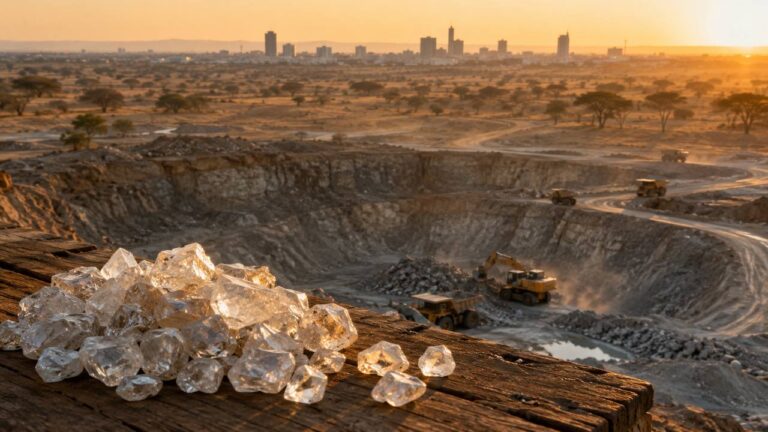
Botswana’s diamond crisis deepens as country searches for new sources of economic growth
Botswana's diamond-reliant economy is projected to rebound in 2026, yet mounting public debt and weak global demand threaten lasting recovery.