

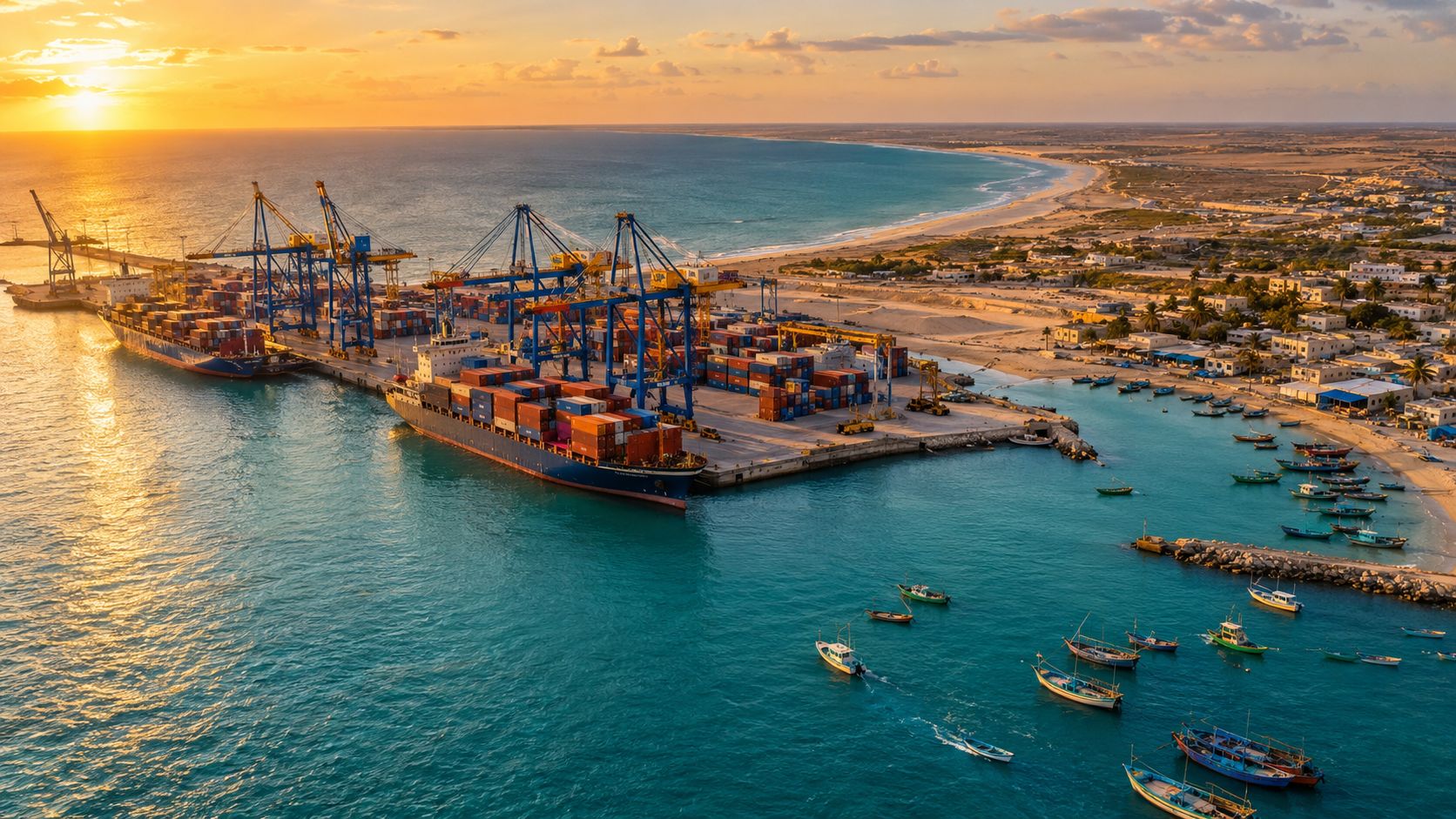
Somalia is making its most direct pitch yet to global investors: a coastline stretching more than 3,300 kilometres, an economic zone rich in tuna, and a maritime sector officials say could be worth $2 billion a year. The question now is whether that promise can survive the country’s security gaps, fragmented governance and a crowded field of foreign powers already jockeying for a stake.
At the first-ever Somalia Maritime Conference held in Mogadishu in August, President Hassan Sheikh Mohamud called on international investors to help unlock what he described as a strategic national asset capable of energising the economy and creating jobs, according to The East African. The two-day gathering, hosted by the Ministry of Ports and Marine Transport, produced a communique committing Somalia to stronger maritime security and sustainable development of its marine resources.
It was a carefully staged moment. For more than a decade, Somalia’s waters were better known abroad for piracy than for opportunity. Now the government wants a different story told, one in which the same coastline becomes a magnet for shipping lines, fishing fleets and energy companies. For context on how foreign capital is already reshaping the continent’s coastal assets, see our broader coverage of who controls Africa’s strategic infrastructure.
A $2 Billion Bet on the Sea
The $2 billion figure has circulated in Somali policy circles for several years. Dr Abdiaziz Hussein Hassan, an academic at the Somali National University, has argued that artisanal fishing alone could generate around $400 million annually, with deep-sea fishing contributing a further $1.6 billion, according to reporting by The East African. Somalia sits at the centre of the only tuna upwelling zone in the Indian Ocean, a natural advantage that few coastal nations can claim.
A separate government-commissioned strategy paper put the potential financing pool from blue economy activities, including fisheries, ports and eventual offshore oil and gas royalties, in a wide range spanning hundreds of millions to billions of dollars annually. The wide spread in these estimates is itself telling: Somalia’s maritime wealth remains more theoretical than measured, and turning projections into actual revenue will depend on infrastructure, security and regulation that mostly do not yet exist.
Africa’s Longest Coastline, Still Largely Untapped
Somalia holds the longest coastline on mainland Africa, a geographic fact that officials repeat often because it underpins almost every pitch to investors. That coastline touches both the Gulf of Aden and the Indian Ocean, placing Somalia along one of the busiest shipping corridors in the world, the route linking the Suez Canal to markets in Asia and East Africa.
Yet decades of conflict left the sector largely undeveloped. Illegal, unreported and unregulated fishing by foreign vessels has drained value from Somali waters for years, a problem officials say has cost coastal communities far more than any pirate ever did. Rebuilding a functioning fisheries licensing regime, one that favours long-term concessions over the short-term, season-long licences Somalia granted to foreign vessels until recently, is now central to the government’s strategy.
Turkey’s Deepening Footprint
No foreign partner has moved faster than Turkey. In December 2025, Somalia signed a Strategic Cooperation and Service Agreement in Ankara establishing SOMTURK, a joint venture led by OYAK, the pension and investment fund tied to Turkey’s armed forces, according to analysis published by Horn Review. The arrangement gives the Turkish-affiliated entity exclusive rights to license, monitor and enforce rules across Somalia’s exclusive economic zone, in exchange for a revenue share reported at around 30 percent.
A separate maritime transport agreement signed in February 2026 is meant to upgrade Somali ports and formalise qualifications for local seafarers, tying Somali labour into Turkish-managed supply chains. Turkey’s state oil company has also begun offshore drilling in Somali waters, deploying a deep-sea vessel to explore blocks under Ankara’s earlier 2024 hydrocarbons deal with Mogadishu. Critics argue the terms favour the foreign operator, but the Somali government frames the partnership as the price of protection it says it cannot yet provide on its own.
Ports: Berbera, Mogadishu and the Race for Trade Routes
Ports remain the most tangible proof that foreign capital can transform Somali infrastructure. Dubai-based DP World has invested up to $442 million to develop the Port of Berbera in Somaliland, the breakaway region in the country’s north, expanding container capacity from 150,000 to 500,000 twenty-foot equivalent units a year, according to Gulf News and the Maritime Executive. The 30-year concession, signed in 2016, also includes a special economic zone designed to serve landlocked Ethiopia.
Mogadishu’s federal government has pursued its own port upgrades, while Kismayo and other secondary ports remain candidates for future concessions. The competition between Somaliland’s Berbera project and the federal government’s ambitions in the south illustrates a recurring theme in Somali investment: political fragmentation often shapes where capital flows as much as commercial logic does. Puntland, another semi-autonomous region, has at times contradicted federal blue economy policy outright, a friction that investors weighing long-term commitments cannot ignore.
Beyond Fish and Freight: Sesame, Trade and Diversification
Somalia’s maritime ambitions are increasingly tied to its broader export strategy. The Ministry of Commerce and Industry is finalising a National Plan for 2026 to 2030 aimed at attracting at least $35 million in new investment to boost processing and export capacity for sesame and fish, according to FTL Somalia. A protocol signed with China in July 2026 opened a pathway for Somali fishery products to reach Chinese markets, a small but symbolically important step toward diversifying export destinations beyond regional neighbours.
These smaller deals matter because they build the processing and quality-control infrastructure that a $2 billion blue economy would eventually require. Somalia currently exports most of its raw sesame and fish with minimal local value addition, meaning much of the profit from these commodities is captured elsewhere in the supply chain.
Why Investors Are Watching, and Hesitating
Somalia’s pitch lands at a moment when African coastal states across the continent are courting blue economy capital, from offshore wind in South Africa to fisheries reform in West Africa. Somalia’s advantage is scale and location; its disadvantage is risk. Maritime security remains fragile, piracy has not been fully extinguished, and overlapping claims between the federal government and regional administrations complicate contract enforcement.
Foreign direct investment in Somalia has historically concentrated in telecommunications, money transfer and, more recently, ports and energy exploration, sectors where a single dominant operator can manage its own security and logistics. Fisheries, by contrast, involve thousands of small vessels and coastal communities, making enforcement of licensing rules and revenue collection far harder to centralise. Analysts say this is precisely why deep-sea concessions to established foreign players may move faster than reforms benefiting Somalia’s own artisanal fishing communities.
What Comes Next
The communique from August’s maritime conference set out commitments on security cooperation, environmental protection and sustainable resource management, but communiques are easier to sign than to implement. Somalia’s government will need to show it can enforce licensing rules evenly, resolve disputes with Somaliland and Puntland over jurisdiction, and ensure that revenue from deals like SOMTURK and the Berbera concession actually reaches national development priorities rather than narrow interests.
For now, the $2 billion figure functions less as a confirmed revenue stream and more as an invitation, a marker of what Somalia’s coastline could be worth if security holds, governance improves and the current wave of port and fisheries deals matures into a coordinated national strategy rather than a patchwork of competing foreign interests.

More from Economy
Senegal’s $13 billion debt reckoning: Who really owns Africa’s future?
Senegal’s debt restructuring is testing whether oil wealth can restore economic sovereignty or deepen dependence on external creditors and markets.
Nigeria says it is breaking free from oil, but who will own the new economy?
Nigeria’s post oil economy could create a new industrial elite, deepen foreign influence, or finally widen ownership among ordinary Nigerians.
Uganda’s shilling is falling. Who is paying the price?
Uganda’s currency weakness and soaring fuel costs expose the deeper economic burden carried quietly by households, traders and small businesses.