

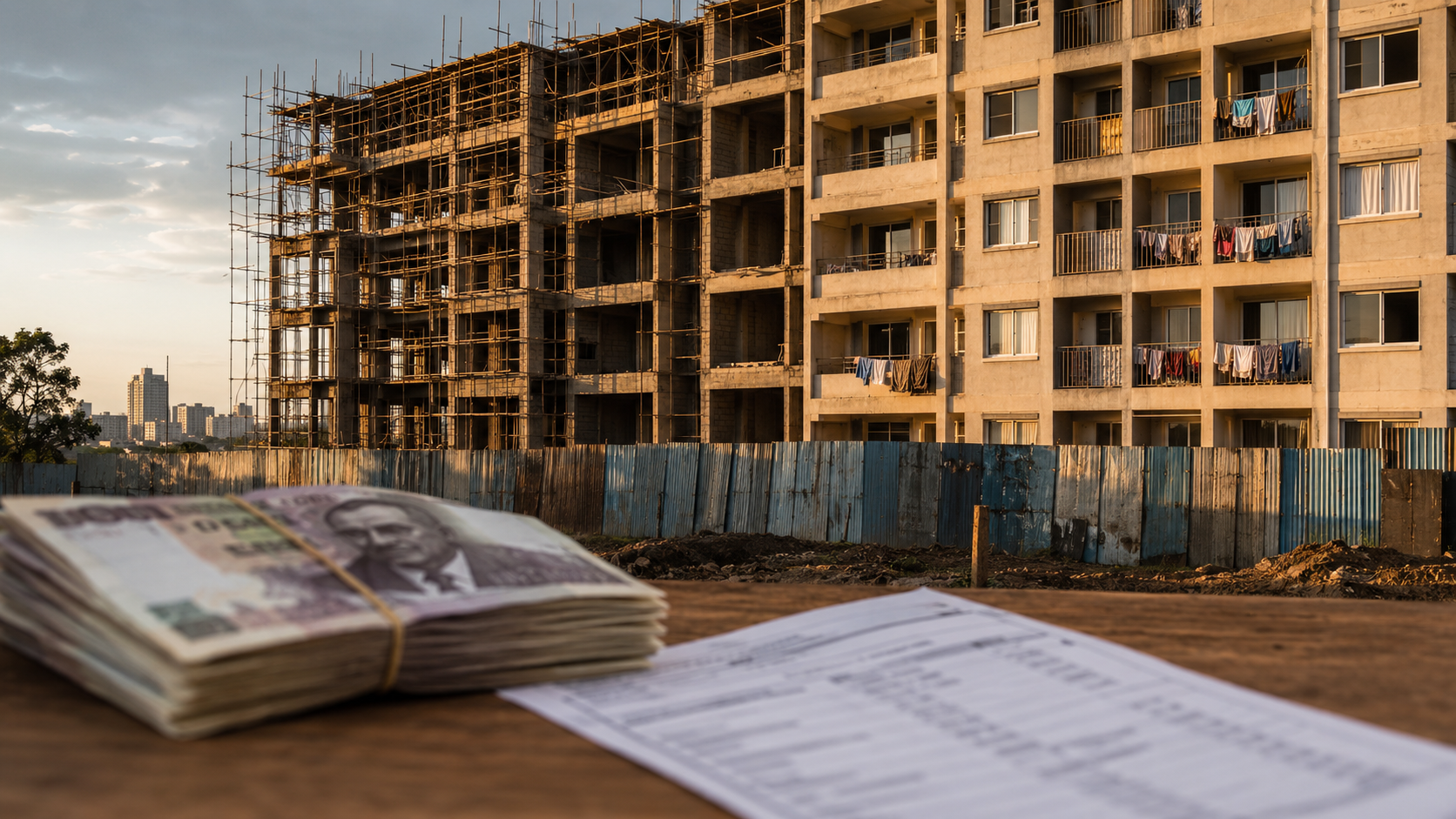
When President William Ruto’s government rolled out the Affordable Housing Levy in 2024, the pitch to Kenyans was straightforward: every salaried worker and their employer would each hand over 1.5% of gross pay every month, and that pooled money would build a million new homes by 2027. It was sold as a national ownership project, a way for ordinary Kenyans to buy into the country’s housing future rather than watch it built without them.
More than two years on, the numbers tell a messier story. By June 2025, the Affordable Housing Fund had collected roughly Sh73.2 billion in a single financial year, comfortably beating the Treasury’s own Sh63.2 billion target. Collections have kept climbing since, reaching close to Sh79.9 billion in the year to June 2026 and pushing cumulative receipts past Sh200 billion since the levy began. On paper, that looks like a policy succeeding at the one thing it was designed to do: pull money out of payslips reliably, month after month.
Delivery has not kept pace. Government figures cited in an Auditor-General review showed only 3,611 housing units completed against a levy that is meant to help close an annual shortfall of roughly 200,000 units. Other government tallies put annual completions even lower in some years, in the low thousands rather than the hundreds of thousands promised. Meanwhile, a significant slice of the money sitting in the fund, around Sh45.5 billion by one account, has been parked in Treasury Bills rather than put into construction, with officials citing the phased nature of project approvals as the reason cash is not moving as fast as it is arriving.
A loophole enforcement never closed
The most uncomfortable finding in this story is not the slow construction pipeline. It is what Auditor-General Nancy Gathungu’s office uncovered when it went looking for the money that should have arrived and did not. Her audit found that at least 6,390 companies were remitting Pay-As-You-Earn tax, which the Kenya Revenue Authority can enforce, while simply not deducting or remitting the housing levy, which it could not.
The root cause was a structural gap in the original Affordable Housing Act of 2024. KRA collected the levy but had no explicit legal mandate to chase down employers who failed to pay it. That enforcement job sat instead with the Affordable Housing Board, a body that, according to the audit, relied on KRA’s own remittance records and had no independent access to taxpayer data. In effect, the collector had no enforcement teeth, and the enforcer had no data. Gathungu’s report noted plainly that the board could not verify what it was owed because it had no reliable mechanism to check actual remittances against expected ones.
Housing Principal Secretary Charles Hinga has since acknowledged the gap, telling officials KRA needed explicit legal powers before it could meaningfully pursue defaulting employers. That admission mattered, because it confirmed that money legally owed by workers and employers alike had, for at least two years, been slipping through a hole the government itself had built into the law.
The law finally catches up
Parliament has since moved to close that hole. The Finance Act 2026 amended the Tax Procedures Act to give the KRA Commissioner-General explicit power, under a new Section 39B, to recover unremitted levies as though they were unpaid tax. Officials now put the scale of the problem starkly: more than Sh100 billion in housing levy contributions is estimated to have gone unpaid or unremitted since the programme began.
With that legal power in hand, KRA has signalled a harder line. Non-compliant firms and individuals now risk having their KRA PINs suspended or deactivated, their bank accounts frozen, and claims placed against their property to recover what is owed, with smaller debts of Sh100,000 or less recoverable through a faster summary process. Hinga has said the authority is now running internal reconciliations to identify exactly who has failed to remit and to begin recovery. It is worth noting that default has skewed toward the informal sector, where verifying and enforcing self-declared income has always been harder than deducting from a formal payslip, though the audit’s 6,390-company finding shows plenty of registered, payroll-processing employers were part of the problem too.
The levy has never been free of political friction. It survived a High Court ruling that briefly declared it unconstitutional, was suspended for a period before Parliament rewrote the legislation in 2024, and continues to draw criticism from opposition politicians who argue it piles a fresh mandatory deduction onto workers already absorbing other statutory contributions. That history is part of why the compliance gap matters so much: a levy born out of legal controversy and rebuilt through fresh legislation was always going to need airtight enforcement to hold public trust, and for two years it did not have it.
Borrowing against future paychecks
Even with tighter enforcement on the horizon, the government still faces a large financing gap for its housing pipeline. Parliamentary budget documents point to a shortfall of roughly Sh118.3 billion for the 2026/27 construction programme, against a total sector allocation that has climbed to a record Sh143.7 billion. To close part of that gap, the State Department for Housing has proposed raising about Sh100 billion through a bond backed by future levy collections, a mechanism known as securitisation, alongside a further Sh50 billion expected from sales of completed housing units.
In practical terms, securitisation means pledging Kenyans’ future 1.5% payroll deductions to repay bondholders over what could be up to a decade. Analysts who have examined the plan warn that once investors are locked in, unwinding or scrapping the levy becomes far harder, regardless of which government is in power or how loudly critics call for it to end. That is a meaningful shift in what the levy actually is. What began as a temporary-sounding contribution toward a housing goal starts to look, once securitised, like a fixed feature of Kenyan payslips for years to come, tied to a debt obligation rather than a target date.
The financing squeeze has been compounded by external setbacks. The World Bank trimmed the commercial financing it had earlier committed to help Kenya mobilise for its housing and reform programme, cutting the planned figure by roughly two-thirds. That reduction has left the housing programme leaning more heavily on domestic sources, including the securitisation plan and the levy itself, to make up the difference.
Who actually benefits
Strip away the housing branding and the deeper question is about accountability rather than construction schedules. Money is being deducted from millions of paychecks under legal compulsion. A meaningful share of what should have been collected was never remitted at all. And the government’s answer to its own enforcement failure has, so far, been to borrow against future collections rather than simply plug the leak faster.
Lawmakers on Parliament’s Finance Committee have raised a related concern that cuts even deeper than compliance gaps: that the Kenyans most likely to actually secure a unit under the programme are those who already qualify for a mortgage, while lower-income contributors who cannot raise a deposit keep paying into the fund with no realistic path to owning one of the homes it builds. That dynamic turns a redistributive-sounding levy into something closer to a subsidy for buyers who were already closer to homeownership, funded in part by workers who are not.
For a publication asking who owns Africa’s assets and institutions, this is not really a story about who ends up owning finished housing stock, though that matters too. It is a story about who currently holds claim over, and bears responsibility for, tens of billions of shillings sitting in a public fund, moving between payroll systems, Treasury Bills and now potentially bond markets, faster than it is moving into finished homes.
What to watch next
Several threads are worth following as this story develops. The first is what happens to the roughly Sh45 billion parked in Treasury Bills, including who authorised that allocation and what return it is earning compared with the cost, in stalled housing supply, of not building faster. The second is the mechanics of the proposed Sh100 billion bond, including which investors or institutions end up underwriting it and what recourse levy payers have if construction continues to lag behind the repayment schedule. The third is geographic: matching where the relatively small number of completed units have actually landed against where levy collections are heaviest, likely Nairobi, Mombasa and other urban, payroll-dense counties. The fourth is the list of non-compliant employers itself; a disclosure of which of the 6,390 flagged companies have since been brought into compliance, and which have not, would be a natural follow-up story built on public records requests to the Auditor-General or KRA.
None of this means the levy has failed outright. Collections have consistently beaten Treasury targets, and enforcement powers that did not exist two years ago are now on the books. But the gap between what has been collected, what has been delivered, and what has quietly gone missing in between is large enough that Kenyans funding this programme from their own paychecks have a reasonable claim to ask, in plain terms, who is actually accountable for the money once it leaves their payslip.

More from Economy

Senegal’s $13 billion debt reckoning: Who really owns Africa’s future?
Senegal’s debt restructuring is testing whether oil wealth can restore economic sovereignty or deepen dependence on external creditors and markets.

Nigeria says it is breaking free from oil, but who will own the new economy?
Nigeria’s post oil economy could create a new industrial elite, deepen foreign influence, or finally widen ownership among ordinary Nigerians.

Uganda’s shilling is falling. Who is paying the price?
Uganda’s currency weakness and soaring fuel costs expose the deeper economic burden carried quietly by households, traders and small businesses.