

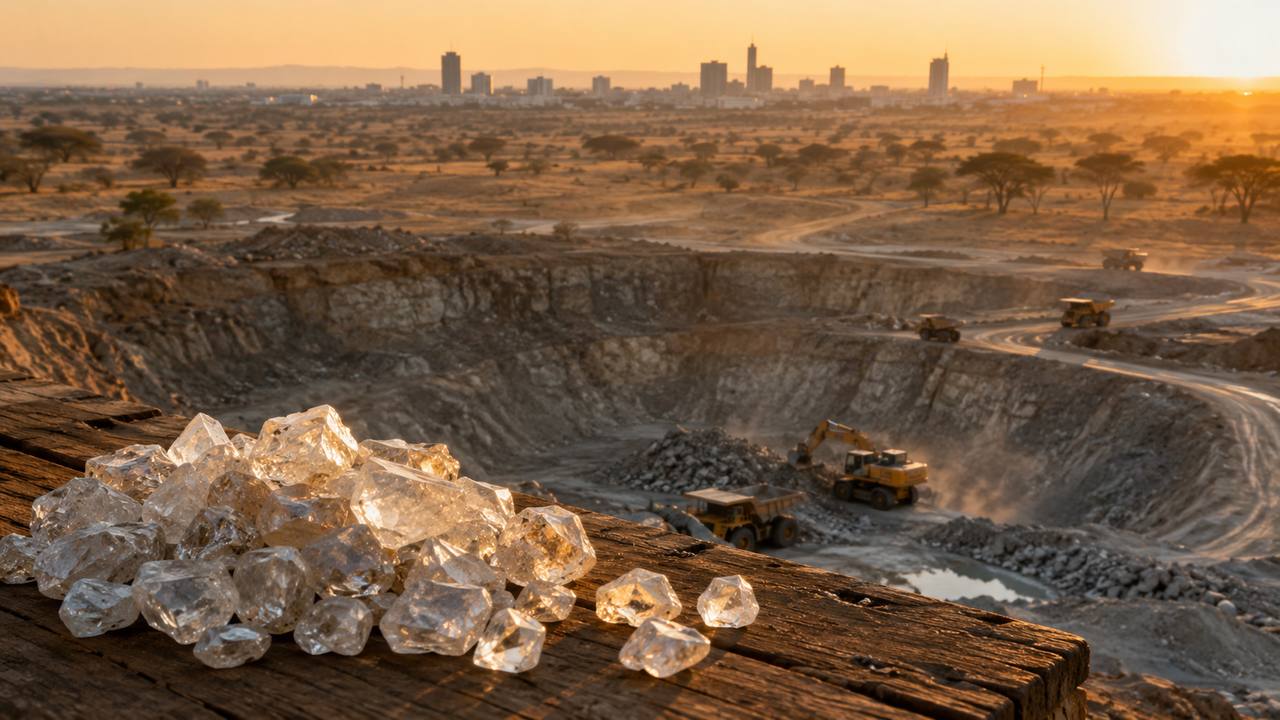
Botswana’s economy, long treated as a rare African success story built on diamonds and disciplined public finances, is entering a new and uncomfortable phase. Growth is expected to return in 2026 after two straight years of contraction, yet the recovery is arriving alongside a debt load that is climbing past the government’s own legal limits, exposing just how dependent this small, landlocked nation remains on a single gem that the world is buying less of.
A rebound built on shaky ground
Finance Minister Ndaba Gaolathe told parliament in February that the economy is projected to grow 3.1% in 2026, a marked improvement after estimated contractions of 0.4% in 2025 and 2.8% in 2024. It is a welcome number for a country that had come to expect steady, diamond-fuelled expansion for decades. But the minister’s own budget speech carried a warning alongside the good news: the debt-to-GDP ratio is set to reach roughly 38.8% by March 2026 and climb further to about 44.7% by March 2027, pushing past the statutory ceiling of 40% of GDP.
Gaolathe acknowledged that breaching the ceiling could unsettle investors in the short term, but argued that the alternative, a sharp round of spending cuts to stay within the limit, would inflict greater economic damage. It is a trade-off familiar to commodity-dependent governments everywhere: borrow to cushion the shock, or cut and risk deepening it. Botswana has chosen to borrow, and the strain is already visible in public services that depend on diamond revenue to function.
Diamonds still carry the economy
Diamonds are not a peripheral industry in Botswana; they are the backbone of the state itself. They account for roughly one third of government revenue and about three quarters of foreign exchange earnings, a level of concentration that leaves the entire economy exposed whenever global demand softens. That is precisely what has happened. Weaker consumer appetite in key markets, a broader luxury spending slowdown, and the rapid rise of lab-grown alternatives have combined to push prices and production volumes down for several consecutive years.
Debswana, the joint venture between the government and De Beers that generates the vast majority of national diamond sales, cut output by roughly a quarter in 2024 and trimmed production further in 2025 as it worked through a swelling stockpile rather than chase volume into a weak market. Government receipts from the sector fell in step, squeezing the fiscal space that once allowed Botswana to run one of the more conservative budgets on the continent.
Why the downgrade matters
The pressure has not gone unnoticed by credit markets. S&P Global Ratings downgraded Botswana’s sovereign rating in March, pointing to prolonged structural weakness in the diamond market and the fiscal strain it has created. The country remains in investment grade, but only just, and the agency’s message was clear: fiscal discipline alone can no longer offset the risk that comes from depending so heavily on one commodity.
A downgrade of this kind tends to raise borrowing costs at exactly the moment a government needs cheap financing most. Investors price sovereign risk partly on the trajectory of debt, not just its current level, and Botswana’s trajectory is now moving in the wrong direction for the first time in a generation. Officials in Gaborone have stressed that the move to diversify revenue sources is no longer optional, framing it as the only credible route back to a stronger credit position over the medium term.
The African Development Bank’s latest outlook paints a similar picture. Public debt has jumped from about 33% of GDP in 2024 to nearly 41% in 2025, financed largely through borrowing to plug a widening deficit. Foreign reserves have also thinned, falling to roughly $3.1 billion by the end of 2025, equivalent to just over four months of import cover, down from $3.5 billion a year earlier. Inflation is contained and the banking sector remains well capitalised, but the room for fiscal manoeuvre is narrowing.
A separate World Bank assessment frames the numbers even more starkly, noting that public debt has nearly doubled from 22% of GDP in 2023 to close to 40% in 2025. The bank’s economists argue the country now faces a genuine inflection point, one where the choices made over the next few years will determine whether Botswana diversifies successfully or simply borrows its way through another commodity cycle.
The human cost behind the numbers
Behind the credit ratings and GDP projections are workers who built careers around the mines. Job losses at Debswana and its contractors have rippled through towns such as Orapa, where installers, drivers and technicians who expected years more on renewable contracts have instead been made redundant. Diamond revenue also underwrites large parts of Botswana’s health and education systems, and the squeeze has already contributed to shortages in public clinics, a strain that has drawn attention from international outlets covering the country’s wider social fallout.
Joseph Tsimako, president of the national miners’ union, has put it plainly: diamonds financed the schools, hospitals and roads that modern Botswana was built on, and the industry now has an obligation not to abandon the people who built it, even as it shrinks. That tension between fiscal necessity and social protection is likely to shape domestic politics for years to come.
Turning crisis into an investment pitch
What makes Botswana’s story different from many resource-dependent economies is the institutional foundation it can draw on. The country has consistently ranked among the most attractive mining and investment jurisdictions in Africa on the Fraser Institute’s annual survey, prized by investors for political stability, contract enforceability and low corruption. That reputation is now being redirected toward a broader pitch: come for the diamonds, stay for everything else.
Analysts at Deloitte Africa have argued that Botswana’s regulatory predictability, rather than its mineral wealth alone, is what continues to draw capital even as diamond earnings soften. That distinction matters for policymakers trying to build a case to sovereign wealth funds, pension managers and private equity firms that have historically viewed the country purely through the lens of its gem exports. A stable rule of law, they note, is a harder asset to replicate than a diamond mine, and it is the one advantage Botswana can lean on regardless of where global commodity prices go next.
Government agencies are actively courting capital into sectors beyond mining, including tourism and eco-tourism around the Okavango Delta and Chobe National Park, agro-processing and beef exports, financial technology and digital services, renewable energy, and value-added diamond cutting and polishing rather than raw export. The Botswana Investment and Trade Centre has positioned several of these as priority sectors, and industry analysts argue that mining and tourism should be treated as complementary pillars rather than competing claims on policy attention.
Tourism in particular is gaining ground as a genuine second engine. Botswana has leaned into a low-density, high-value model, favouring boutique lodges and remote airstrips over mass tourism, a strategy that protects its wildlife while generating foreign currency that does not depend on gem prices in Antwerp or Mumbai. Diversifying a workforce trained for heavy machinery into hospitality and conservation is not a quick fix, but it is one of the few paths that plays to the country’s existing strengths.
What comes next
Business sentiment inside Botswana is cautiously aligned with the government’s own forecasts, if a touch more conservative. A Bank of Botswana survey of firms across thirteen sectors found companies expecting output to expand by about 2.1% in 2026, a real improvement on the previous year’s contraction but still below the finance ministry’s 3.1% target. Firms in construction, real estate and finance remain the most guarded about near-term conditions, a sign that the recovery, while real, is uneven across the economy.
For now, Debswana plans to lift production to around 18 million carats in 2026, a tentative rebuilding of volume even as prices stay soft and inventories remain elevated. Whether that translates into a durable recovery or simply another round of stockpiling will depend on demand trends in the United States, China and India, markets Botswana has little control over.
What the country can control is how quickly it builds the non-mining economy investors are now being asked to bet on. Botswana’s diamond crisis has, in effect, become a test case for the entire continent: whether a resource-rich, well-governed nation can convert institutional credibility into a genuinely diversified economy before its debt ceiling, and its patience, run out.
The bottom line
Botswana is not facing a crisis of governance or credibility in the way some of its regional peers are. Its institutions remain intact, its currency is managed conservatively through a crawling peg, and its sovereign wealth fund still offers a buffer that most commodity exporters never build. What it faces instead is a narrower, more specific problem: an economy engineered around one export that the world is buying differently than it used to. That is a solvable problem, but only if the diversification drive now underway moves faster than the debt clock ticking toward 2027.

More from Economy

Senegal’s $13 billion debt reckoning: Who really owns Africa’s future?
Senegal’s debt restructuring is testing whether oil wealth can restore economic sovereignty or deepen dependence on external creditors and markets.
Nigeria says it is breaking free from oil, but who will own the new economy?
Nigeria’s post oil economy could create a new industrial elite, deepen foreign influence, or finally widen ownership among ordinary Nigerians.
Uganda’s shilling is falling. Who is paying the price?
Uganda’s currency weakness and soaring fuel costs expose the deeper economic burden carried quietly by households, traders and small businesses.