

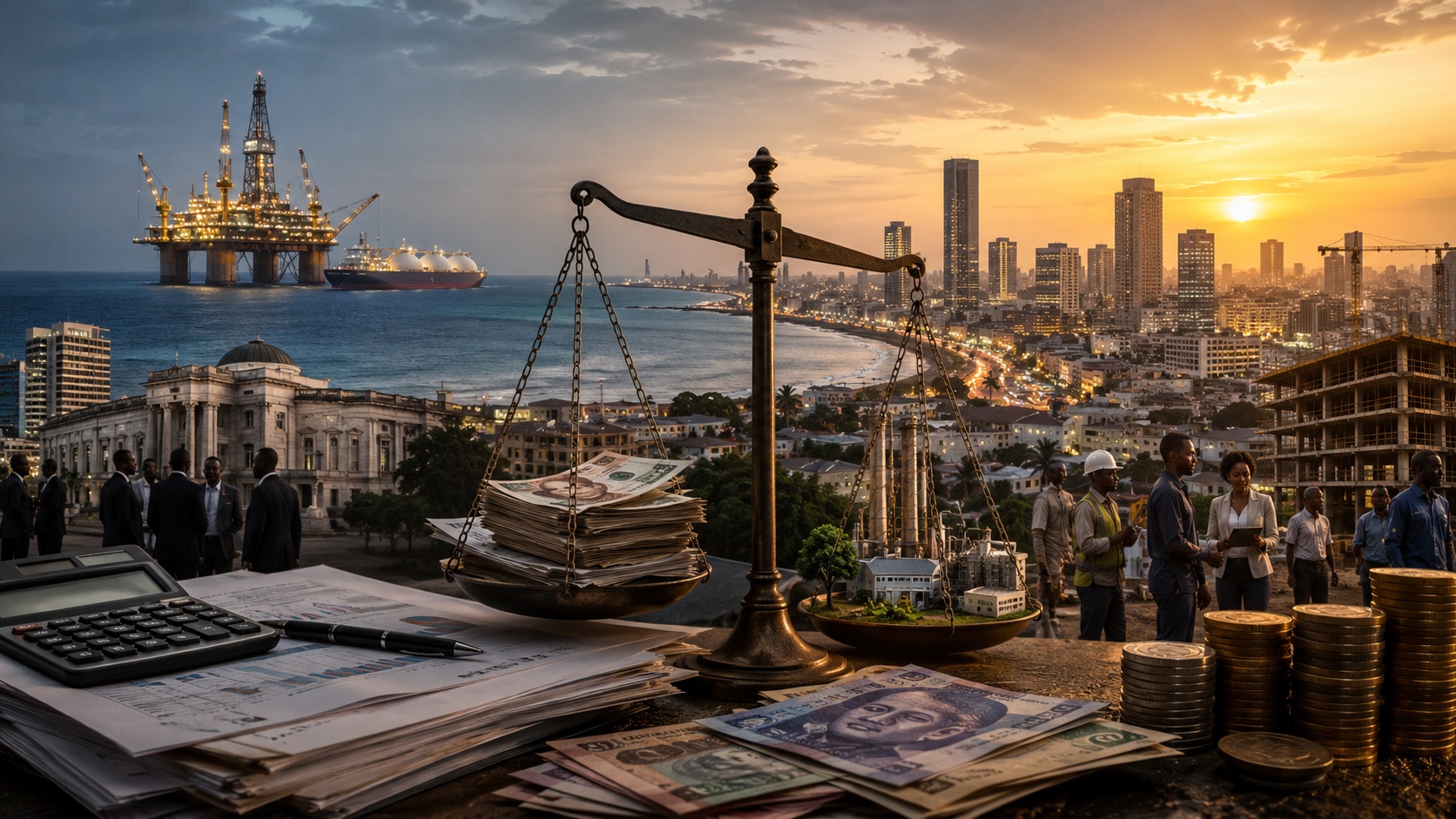
Senegal’s debt crisis has reached a decisive moment, but the real question is not simply how much Dakar owes. It is whether the country’s emerging oil and gas wealth will give it greater control over its economic future or become another source of leverage for the creditors already waiting to be paid.
That distinction matters.
Senegal is moving toward an agreement with official creditors and bondholders by the end of 2026, two years after the discovery of previously misreported public debt pushed the country into a severe fiscal crisis. Analysts have estimated the undisclosed liabilities at around $13 billion, although the IMF’s own assessment has put the additional debt at more than $11 billion. Central government debt reached about 25.2 trillion CFA francs, or $44 billion, at the end of 2025.
The numbers are large enough to dominate the discussion.
But numbers alone can obscure the political economy underneath them.
Senegal is not dealing with one creditor, one loan or one institution. It is negotiating within a complicated financial system involving bilateral governments, multilateral lenders, commercial banks, bondholders, regional investors and derivative counterparties.
At the same time, the country is entering a new economic era shaped by oil and gas production.
That coincidence creates the real story.
Senegal is trying to repair the financial consequences of yesterday while attempting to decide what tomorrow’s resource wealth should look like.
The debt is not owned by one side
The first mistake in discussing Senegal’s debt is to imagine a single external creditor standing across the negotiating table.
There is no such creditor.
France and China are among Senegal’s largest bilateral creditors and are expected to be central to negotiations. Multilateral institutions hold a significant portion of the country’s external debt, while private investors and banks account for much of the remainder. Reuters reported that multilateral lenders held about 40% of Senegal’s external debt in 2024, with export credit accounting for another 9%.
That division is important because different creditors have different expectations.
The IMF is concerned with restoring debt sustainability and ensuring that its future financing supports a credible economic programme.
Bilateral creditors want assurances about repayment and comparable treatment.
Bondholders are principally concerned with the value and terms of their investments.
Banks have their own contractual protections.
Regional financial institutions have a broader interest in maintaining the credibility of West Africa’s financial architecture.
Senegal therefore faces a negotiation involving several different definitions of what constitutes a fair solution.
Its latest plan seeks an agreement in principle with official creditors and bondholders by December. The government has also said it wants a constructive contribution from roughly $1.72 billion in total return swaps, or TRS, derivative financing instruments backed by government securities.
That is an unusual complication.
TRS arrangements are relatively untested in sovereign restructurings. The IMF classifies Senegal’s TRS as external debt because the counterparties are non-residents, while Senegal has indicated that CFA franc-denominated debt itself will remain outside the restructuring.
The significance is bigger than the $1.72 billion.
It demonstrates how sovereign borrowing has become increasingly sophisticated, and increasingly difficult for citizens to see.
A government can borrow without simply issuing a conventional bond or signing a traditional bilateral loan. Financial engineering can provide cheaper or faster access to money, but it can also make the structure of public liabilities more difficult to understand.
For Senegal, transparency is therefore not an accounting issue.
It is a sovereignty issue.
What exactly is being protected?
Senegal has made clear that CFA franc-denominated debt will not be included in its debt treatment.
That decision is politically and financially significant.
Roughly 30% of central government debt was CFA franc-denominated at the end of 2024, according to Reuters. Senegal subsequently increased its reliance on regional borrowing after access to international markets deteriorated. Regional issuance more than doubled to 2.2 trillion CFA francs in 2025 and reached 2 trillion CFA francs by the end of August 2026.
Keeping that debt outside the restructuring protects domestic and regional investors.
It also creates a difficult burden-sharing question.
If a large portion of the debt remains untouched, creditors inside the restructuring perimeter could be asked to absorb a greater share of the adjustment.
That is precisely why bondholders are watching the process closely.
Senegal’s outstanding international bonds total about $5.2 billion, with a creditor committee representing roughly $2.2 billion in face value, Reuters reported this week.
The private sector therefore has a powerful incentive to ask a straightforward question.
Why should one category of creditors bear losses while another category is protected?
There may be good reasons for the distinction. Domestic financial stability matters. Regional markets matter. Senegal cannot simply destabilise the institutions through which its economy is financed.
But every exemption has a price.
If domestic debt is protected, more adjustment may fall on external creditors.
If external creditors receive less favourable terms, future borrowing costs could rise.
And if investors believe that regional debt will always be protected while international debt absorbs the losses, the composition of future borrowing could change.
That is why Senegal’s restructuring is not merely about reducing a debt number.
It is about establishing the rules of the next debt cycle.
Oil changes the equation
Then there is the resource question.
Senegal is no longer simply a country with future oil and gas potential. Hydrocarbon production has become an important part of the economy.
The IMF said economic growth reached 6.7% in 2025, supported by a strong expansion of the hydrocarbon sector. Oil exports also helped narrow the current account deficit.
This should be good news.
But resource wealth does not automatically create economic sovereignty.
It depends on what happens to the money.
Oil and gas revenues can pay for infrastructure, education, health, industrial development and domestic investment.
They can also pay creditors.
The difference is not semantic. It is the difference between using natural resources to build an economy and using natural resources primarily to stabilise a balance sheet.
Senegal now has to make that choice.
The temptation will be obvious.
Once revenues begin to rise, creditors can point to them as evidence that the country has greater capacity to service debt. Investors can treat future hydrocarbon income as a source of repayment confidence. Government can use resource revenues to reduce immediate fiscal pressure.
All of that is understandable.
But there is a danger in treating oil as an answer to a debt problem.
Oil is finite.
Prices fluctuate.
Production can disappoint.
Large projects require foreign capital, technology and infrastructure.
And hydrocarbon revenues can create the illusion of fiscal abundance while leaving the underlying productive economy insufficiently diversified.
For Senegal, the objective should therefore be larger than debt sustainability.
It should be resource sustainability.
The IMF is part of the solution
It would be simplistic to portray the IMF as an external force imposing its will on Senegal.
The country needs financing, credibility and a framework capable of coordinating creditors.
In September, IMF staff reached a staff-level agreement with Senegal on a proposed three-year Extended Credit Facility worth about $2.2 billion. The programme is subject to approval by the IMF’s executive board and requires financing assurances from Senegal’s partners.
The proposed programme focuses on domestic revenue mobilisation, public debt management, fiscal governance, oversight of state-owned enterprises and private-sector-led growth.
Those reforms address a problem that cannot be blamed on international lenders.
Senegal’s debt crisis was also a crisis of domestic governance.
The discovery of previously misreported liabilities exposed weaknesses in public financial management and debt reporting. The IMF has repeatedly called for stronger transparency and safeguards following the misreporting episode.
That is where the sovereignty argument becomes more complicated.
A country cannot strengthen its sovereignty while failing to know precisely how much it owes.
Nor can it demand greater control over its financial future while allowing public liabilities to accumulate outside effective scrutiny.
Fiscal transparency is therefore not something imposed from Washington.
It is part of the foundation of national independence.
The Common Framework has something to prove
Senegal’s decision to pursue debt treatment under an enhanced G20 Common Framework is another test.
The framework was created to coordinate official creditors and help countries with unsustainable debt negotiate comprehensive treatment.
Its weakness has been speed.
Previous cases, including Ghana and Zambia, have taken longer than governments and investors initially expected. Senegal is attempting to improve on that experience by pursuing parallel engagement between official creditors and private investors and encouraging greater information sharing.
That is important because time is not neutral in a debt crisis.
While negotiations continue, governments face financing constraints.
Businesses wait for government payments.
Banks reassess risk.
Investors demand higher returns.
Public investment can suffer.
Senegal’s arrears stood at 1.956 trillion CFA francs, or roughly $3.5 billion, as of March 2025, according to the prime minister. The government has said clearing those arrears is necessary to prevent further damage to economic activity.
A slow restructuring can therefore deepen the problem it is designed to solve.
Senegal is attempting to demonstrate that the Common Framework can operate faster when creditors are engaged simultaneously rather than sequentially.
If it succeeds, the consequences will extend well beyond Dakar.
The African question is bigger
Senegal’s dilemma is ultimately an African dilemma.
Governments across the continent need capital.
Africa needs roads, electricity, ports, railways, digital infrastructure, industrial capacity, housing and human capital.
The uncomfortable reality is that much of this investment requires borrowing.
External finance is not inherently a problem.
The problem begins when the structure of borrowing becomes more powerful than the economic transformation it was supposed to finance.
That is the line Senegal now has to walk.
The country needs enough restructuring to restore fiscal space without destroying access to capital.
It needs international support without becoming permanently dependent on international support.
It needs oil and gas revenues without becoming dependent on hydrocarbons.
And it needs stronger public finances without imposing austerity that undermines the investment required for future growth.
This is not an easy balance.
But it is the balance that determines sovereignty in a modern economy.
Who owns the future?
The phrase “debt crisis” can make the problem sound mechanical.
It is not.
Debt determines who gets paid first. It determines which government programmes can be protected during a fiscal squeeze. It influences the cost of future borrowing. It affects how much money is available for infrastructure and social spending.
In that sense, debt is ultimately about choices.
And choices are the substance of sovereignty.
Senegal now has an opportunity to use restructuring differently.
The immediate objective should be to reduce debt-service pressure and restore financial credibility. But the longer-term objective should be to ensure that fiscal space is converted into productive capacity.
That means stronger domestic revenue collection.
It means greater transparency around public borrowing.
It means developing local industries around Senegal’s natural resources rather than exporting value with limited domestic processing.
It means building institutions capable of negotiating complex financial instruments before they become liabilities.
And it means ensuring that oil and gas revenues create assets that outlive the hydrocarbons themselves.
If Senegal manages that transition, the debt crisis could become a painful but necessary turning point.
If it does not, the country could simply move from one form of dependence to another.
The creditors may change.
The financial instruments may change.
The language may change from restructuring to reprofiling.
But the underlying relationship would remain the same: future income being used to solve yesterday’s financial problems.
That is why Senegal’s $13 billion debt reckoning deserves attention far beyond the balance sheet.
The real issue is not whether Senegal can persuade creditors to wait longer or accept lower returns.
It is whether the country can use this moment to redefine the relationship between borrowing, resources and development.
Senegal is discovering that economic sovereignty is not achieved when a country stops borrowing.
It is achieved when borrowing becomes a tool of development rather than a substitute for it.
And that leaves Senegal with the most important question of all.
When the oil begins to pay for the debt, who owns the future that remains?

More from Economy
Nigeria says it is breaking free from oil, but who will own the new economy?
Nigeria’s post oil economy could create a new industrial elite, deepen foreign influence, or finally widen ownership among ordinary Nigerians.
Uganda’s shilling is falling. Who is paying the price?
Uganda’s currency weakness and soaring fuel costs expose the deeper economic burden carried quietly by households, traders and small businesses.

Africa is growing at 4.3%. So who actually owns the growth?
Africa's growth is accelerating, but the real contest is over who captures wealth, jobs, assets and economic power across societies.