

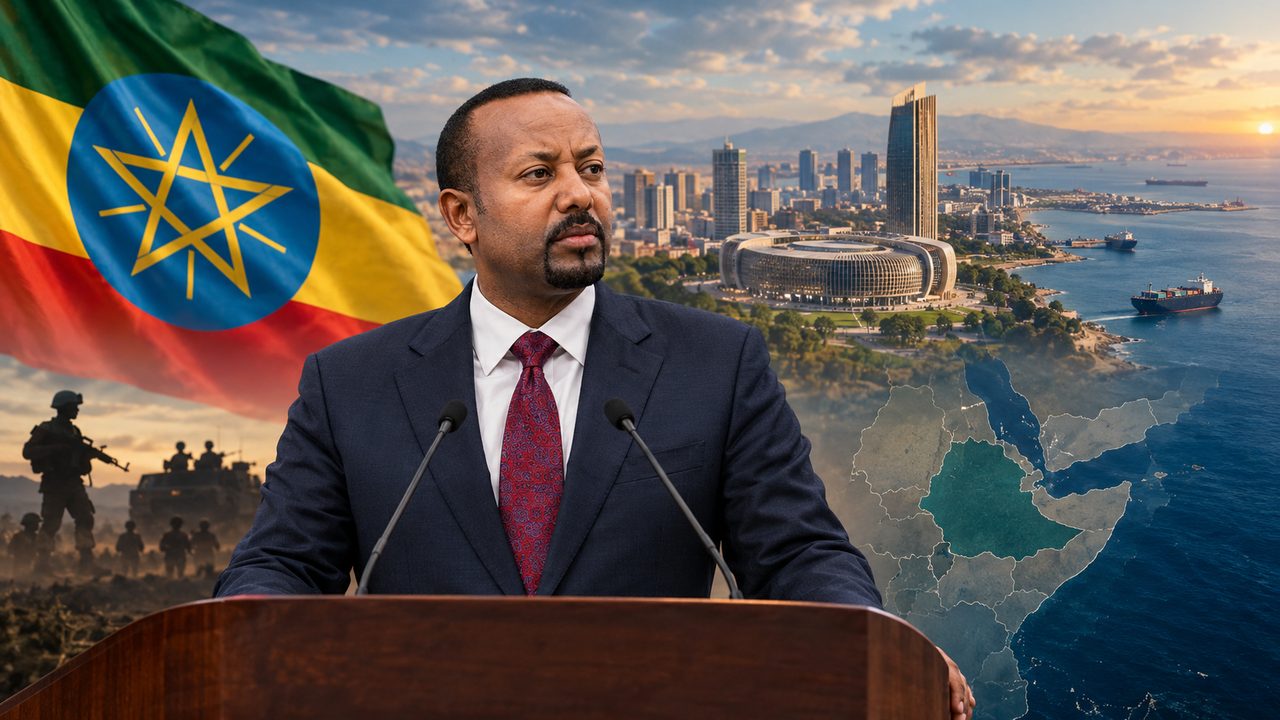
Abiy Ahmed’s new five-year mandate begins at a moment when Ethiopia has more political power concentrated in Addis Ababa, but far less strategic room for error.
Parliament formally reappointed Abiy as prime minister on October 5 after the June election gave his Prosperity Party 438 seats, roughly 90% of the contested seats. The new seventh parliament therefore gives him the political authority to pursue his agenda with few legislative obstacles. Yet the timing is striking. Ethiopia is entering this new chapter while fighting has returned to Tigray, diplomatic relations with Eritrea have collapsed, and the question of access to the Red Sea has become inseparable from the country’s wider security calculations.
A mandate with a warning
The easiest reading of Abiy’s victory is that Ethiopia has chosen continuity. The deeper reading is that the election has handed the prime minister responsibility for resolving problems that electoral arithmetic cannot solve.
The June vote was held across much of Ethiopia, but not everywhere. Tigray did not vote, while insecurity prevented voting in parts of Amhara and other conflict-affected areas. Reuters reported before the election that more than 50 million people were registered, but that violence and political instability remained serious obstacles in several regions.
A large parliamentary majority does not automatically translate into political legitimacy across a country as large and diverse as Ethiopia. Prosperity Party dominance gives Abiy the capacity to legislate, but not necessarily to reconcile competing visions of the state.
The return of Tigray
The most immediate test is no longer theoretical.
Fighting that erupted in September has pushed Tigray back to the centre of Ethiopian politics. Federal forces have advanced into the region, including taking control of Mekelle’s airport and subsequently the city, while Tigrayan forces have withdrawn from some positions. On October 5, humanitarian sources reported further airstrikes and artillery exchanges, with at least 17 people killed in attacks around Tigray.
This is not simply a military setback or battlefield complication. It is a reminder that the political settlement following the 2020-2022 Tigray war never fully resolved the questions that produced the conflict.
The danger for Abiy is that military momentum can create an illusion of political resolution. Capturing territory is not the same as creating a durable settlement. A government can restore administrative control while leaving the grievances, distrust and competing national narratives that fuel another war intact.
The first Tigray war was extraordinarily costly, with researchers estimating hundreds of thousands of deaths through violence, famine and the collapse of health services. A return to sustained warfare would test whether Ethiopia has learned from that devastation.
Eritrea changes the equation
The relationship with Eritrea makes the current crisis more dangerous.
The two neighbours were once moving in the opposite direction. Abiy’s 2018 rapprochement with Eritrean President Isaias Afwerki helped transform Ethiopia’s regional diplomacy and contributed to the Nobel Peace Prize awarded to Abiy. Eritrean forces later fought alongside Ethiopian federal troops during the Tigray war.
Now that relationship has broken down.
Ethiopia closed its embassy in Asmara and expelled Eritrean diplomats, while Eritrea severed diplomatic ties. Addis Ababa has accused Eritrea, Sudan and Egypt of supporting an opposition alliance involving the Tigray People’s Liberation Front. The accused governments deny the allegations.
For Ethiopia, this is no longer simply a diplomatic dispute. Eritrea controls coastline and ports central to Addis Ababa’s ambitions. For Eritrea, Ethiopia’s insistence on dependable sea access is viewed through the history of the two countries, including their 1998-2000 war.
For that reason, language matters.
When leaders speak about ports, sovereignty and security in the Horn of Africa, their audiences do not hear only economic policy. They hear history.
The Red Sea question
Abiy reinforced the issue on the very day he began his new term.
Speaking to parliament after taking the oath, he said Ethiopia’s modernisation could not be achieved without sea access and pledged to secure an outlet through peaceful means and negotiation. That is a rational economic argument for a landlocked country of more than 100 million people. But rationality does not eliminate geopolitical sensitivity.
Ethiopia currently depends heavily on Djibouti for maritime trade. Reducing that dependence could strengthen its economy, diversify supply routes and give Addis Ababa greater strategic autonomy.
The problem is that every alternative sits inside another country’s sovereign space. Ethiopia has a legitimate economic interest in maritime access. The harder question is what form that access should take without convincing neighbours that economic ambition is becoming territorial ambition.
That distinction will be crucial.
A negotiated long-term commercial arrangement is one thing. Any perception of coercion would produce a very different regional response.
A new regional alignment
The regional response is already taking shape.
On October 4, Egypt, Eritrea, Sudan and Somalia held a summit in Egypt and issued a joint declaration stressing sovereignty and territorial integrity. The statement said governance of the Red Sea was the responsibility of its littoral states and rejected unilateral measures affecting the water interests of Egypt and Sudan.
The symbolism is difficult to ignore. Four states with different interests have found common ground around an Ethiopia-related security concern. They are not necessarily forming a permanent bloc, but regional politics rarely requires perfect alliances. Sometimes shared anxiety is enough.
For Addis Ababa, that should be a warning against assuming that economic size automatically translates into regional influence. Ethiopia is one of Africa’s most important states, but importance can also produce counter-balancing.
The Nile cannot be separated
The Red Sea dispute is also linked to the Nile.
Egypt and Sudan have long objected to aspects of Ethiopia’s Grand Ethiopian Renaissance Dam project, particularly over water security and the rules governing the river’s use. Ethiopia argues that the dam is central to its development and electricity generation and has defended its sovereign right to use its natural resources.
The two disputes now overlap in a way that increases the risk of miscalculation.
A government in Cairo looking at Ethiopia’s Red Sea ambitions is also looking at the Nile. A government in Addis Ababa looking at Egyptian regional activity is also thinking about water security. Eritrea sees Ethiopia through the lens of sovereignty and past conflict. Somalia watches any Ethiopian regional ambition through the prism of territorial integrity and the unresolved politics of Somaliland.
None of these disputes exists in isolation. A disagreement that begins as a port negotiation can quickly acquire a military dimension because the actors already distrust one another on other fronts.
The economic argument
Abiy enters his new term with a powerful economic narrative.
His government has promoted Ethiopia as one of Africa’s major growth stories, and officials have projected economic growth above 10% in 2026. Prosperity Party candidates campaigned on improved food security and economic progress.
There is a strategic logic behind that agenda. Ethiopia needs jobs, electricity, infrastructure, investment and export growth. A reliable route to international markets is part of that equation.
But economic transformation is difficult to sustain when security spending rises, investor confidence weakens and conflict disrupts productive regions.
The danger is that security and development begin consuming each other. Conflict diverts resources, political uncertainty raises investment costs, displacement damages local economies, and diplomatic confrontation can narrow development partnerships.
The strongest case for stability is therefore economic.
What Abiy must avoid
The central mistake of the next five years would be to confuse strength with control.
Abiy has more parliamentary power than most Ethiopian leaders could realistically expect. That creates an opportunity to negotiate from a position of confidence.
The government can use that confidence to pursue a serious political settlement in Tigray, reopen channels with Eritrea, manage the Nile dispute, and develop a regional framework for Red Sea access.
Or it can interpret the mandate as permission to push harder.
The first path would be slower and less dramatic, but more durable. The second could produce short-term victories while creating strategic problems that become harder to reverse.
The lesson of Ethiopia’s recent history is that military solutions rarely remain purely military. They reshape alliances, identities and national politics.
The real test of the new term
The question facing Abiy is therefore bigger than whether he can govern for another five years.
It is whether he can turn political dominance into national stability.
His government has already demonstrated that it can win elections, consolidate parliamentary power and mobilise the state behind a clear national development vision. What remains less certain is whether it can build a political settlement broad enough to survive beyond the strength of one administration.
That will require a different kind of leadership.
Ethiopia needs an economic strategy that recognises sea access without alarming neighbours, a security policy that leaves room for reconciliation, federal institutions that absorb disagreement, and diplomacy that takes Eritrea, Egypt, Sudan and Somalia’s security concerns seriously.
The African Union has already urged restraint and dialogue. As host of the continental body’s headquarters, Ethiopia carries an unusual diplomatic responsibility. Its domestic choices reverberate far beyond its borders.
Abiy’s new term could therefore become a period of genuine national consolidation. Ethiopia has the population, economic potential, strategic location and institutional weight to play a decisive role in Africa.
But those same qualities can become liabilities if power is exercised without sufficient political imagination.
The most important achievement of Abiy’s second term will not be another military advance, another infrastructure project or another diplomatic victory. It will be whether Ethiopians can reach the point where political competition no longer has to become armed confrontation.
That is the real meaning of the mandate.
On October 5, Abiy received another five years.
The harder task begins now.

More from Geopolitics

Who owns Africa’s critical minerals? The global race for Congo, Rwanda and Mozambique
Washington and Beijing are courting Kinshasa, Kigali and Maputo for critical minerals, but African nations still aren't setting the terms.
Who controls the Nile? Egypt vs Ethiopia
Ethiopia’s control of upstream infrastructure is reshaping Egypt’s historic influence over the Nile, creating new geopolitical stakes across Africa.
Who owns Egypt’s gateway to Africa? China’s expanding Suez footprint
China is deepening its industrial, port and logistics footprint around Suez, reshaping Egypt’s role as a gateway between Asia, Europe and Africa.