

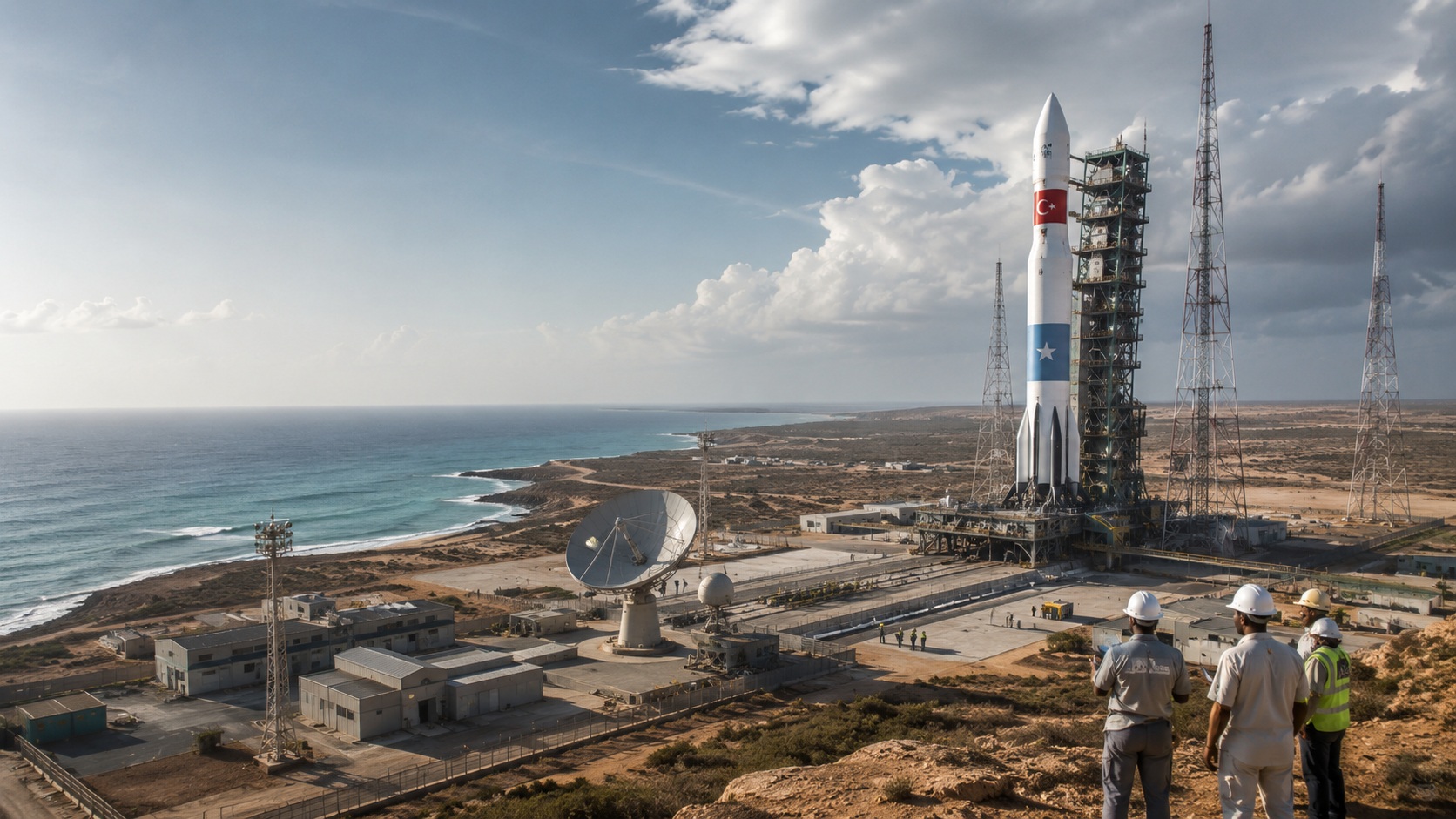
Turkey’s decision to build a spaceport in Somalia should not be viewed simply as a story about rockets, satellites or the race into orbit. It is a story about geography, sovereignty, technology and power, and about how two countries are attempting to turn a long political relationship into strategic infrastructure.
Ankara’s decision to develop the facility reflects a broader ambition to secure independent access to space while deepening its relationship with Somalia. For Mogadishu, the project offers the prospect of investment, technical expertise, infrastructure and a place in an industry that remains dominated by a small group of technologically advanced countries.
But the more interesting question is not whether Turkey wants to launch rockets from Somalia.
It is why Somalia was chosen, what Turkey gains from the arrangement, and what Somalia can realistically secure in return.
That is where the story becomes much bigger than a spaceport.
Why Somalia?
The answer begins with geography.
Somalia sits close to the equator and possesses one of Africa’s longest coastlines. For a country seeking to develop an independent launch capability, those characteristics are extremely valuable.
Launching near the equator can provide a natural advantage because the Earth’s rotation gives rockets additional velocity. A coastal launch site also allows certain launch trajectories to pass over open water, reducing some of the safety and logistical challenges associated with launching from densely populated areas.
For Turkey, Somalia therefore offers something that cannot easily be manufactured through diplomacy or investment elsewhere.
It offers location.
But geography alone does not explain the decision.
Turkey has spent more than a decade building a substantial relationship with Somalia through development assistance, defence cooperation, education, infrastructure and commercial activity. Ankara has also established a significant military training presence in Mogadishu.
The spaceport therefore does not appear in isolation.
It is another layer in a relationship that has gradually expanded from humanitarian engagement into security, diplomacy, energy and now advanced technology.
Where is the project?
The planned facility is being developed on Somalia’s Indian Ocean coast near Warsheikh, north of Mogadishu.
The location is strategically significant because it combines relative proximity to the capital with access to the Indian Ocean.
The project has reportedly involved a large tract of land allocated for the development, together with supporting infrastructure.
That immediately raises a sensitive question: who owns the spaceport?
The answer requires a distinction between sovereignty, land-use rights and operational control.
There is no sound basis for simply saying that Turkey owns Somali territory. Publicly available information instead indicates that land has been allocated to Turkey under bilateral arrangements for the construction and operation of the project.
Those distinctions matter.
A foreign government can receive long-term rights to develop or operate infrastructure without becoming the sovereign owner of the territory on which that infrastructure stands.
For Somalia, however, the practical question is still important.
Who controls access?
Who controls the launch schedule?
Who controls the technology?
Who receives the revenue?
And what happens to the infrastructure if the agreement eventually expires?
Those questions will matter more than the name written on a property document.
Who controls the infrastructure?
Turkey’s public statements make clear that the spaceport is closely connected to Ankara’s national space ambitions.
The project is being developed as part of Turkey’s effort to establish independent access to space and reduce dependence on foreign launch facilities.
That makes the facility fundamentally strategic from the Turkish perspective.
Turkey is not simply helping Somalia develop a commercial airport with rockets.
It is building infrastructure that serves a major national objective.
This creates an unusual arrangement.
Somalia provides the territory and geographical advantage.
Turkey brings much of the capital, technology, expertise and institutional capacity.
The result is a project that can be described as a partnership, but one in which the two sides do not necessarily possess equal capabilities or bargaining power.
That imbalance should not automatically be interpreted as exploitation.
It should, however, make transparency particularly important.
What does Somalia gain?
The potential gains for Somalia are considerable.
The most immediate is infrastructure.
A functioning spaceport requires roads, electricity, communications networks, security systems, logistics facilities and highly specialised technical infrastructure.
Much of that investment could benefit the surrounding economy.
The second potential benefit is employment.
Somalia has a large young population but limited opportunities in high-skilled industries. A space programme could create demand for engineers, software specialists, technicians, telecommunications professionals and scientists.
The third benefit may be even more important: knowledge.
If Somali universities and technical institutions become involved, the project could help establish a domestic scientific ecosystem.
That would be a far more valuable legacy than the physical launchpad itself.
A generation of Somali engineers trained in satellite technology, aerospace systems and telecommunications could eventually establish companies and research institutions of their own.
The fourth benefit is strategic visibility.
Somalia has frequently been viewed internationally through the lens of conflict, humanitarian emergencies and insecurity.
A space programme changes that narrative.
It signals that Somalia can participate in advanced technological industries rather than remaining merely a recipient of international assistance.
Turkey’s real prize is strategic autonomy
For Ankara, the project fits neatly into a much larger national strategy.
Turkey has spent years investing in domestic defence and aerospace capabilities. Its drone industry has expanded rapidly, while its missile, satellite and aerospace programmes have become increasingly ambitious.
Independent launch capability would complete an important part of that technological chain.
Producing a satellite is one thing.
Having the ability to launch it without depending on another country is something entirely different.
That is why the Somalia project matters.
A launch facility is not merely an industrial asset. It is an instrument of strategic autonomy.
Countries that control launch capabilities possess greater freedom in determining when and how they put satellites and other payloads into orbit.
For Turkey, that means greater independence from foreign launch providers and greater control over an increasingly important technological domain.
The military question
The spaceport also raises unavoidable questions about defence.
Space technology and military technology are closely connected.
The same advances in propulsion, guidance, communications, materials and launch systems can have both civilian and defence applications.
There has been reporting suggesting that the Somali facility could have a role in testing long-range missile technology in addition to space launches.
Such claims should be treated carefully because Turkey has publicly emphasised the facility’s role in its space programme.
Still, the possibility of dual-use infrastructure cannot simply be ignored.
A remote coastal location offers advantages for controlled testing as well as civilian launches.
That does not automatically make the project a military base.
But it does mean regional governments and foreign powers are likely to examine the facility through both civilian and strategic lenses.
Somalia’s coastline is the bigger story
The spaceport becomes even more significant when placed against Somalia’s wider geopolitical importance.
The country occupies a remarkable position along the Indian Ocean and near the Gulf of Aden, one of the world’s most important maritime corridors.
That geography has attracted competing interests from regional and global powers.
Turkey is only one of several external actors seeking influence in the Horn of Africa.
The United Arab Emirates has major commercial and port interests in the region. Egypt closely watches developments involving Somalia and Ethiopia. Saudi Arabia has long-standing interests in Red Sea security. The United States maintains counterterrorism and security interests in the region.
Against this background, a Turkish spaceport is not merely a technology project.
It adds another strategic asset to a relationship that already includes defence and diplomacy.
The energy connection
Turkey’s interests in Somalia also extend beneath the Indian Ocean.
Ankara has pursued energy cooperation with Mogadishu, including offshore oil and gas exploration.
That is significant because it demonstrates that Turkey’s engagement with Somalia is becoming increasingly multidimensional.
The relationship now touches several strategic areas:
Security.
Energy.
Maritime interests.
Infrastructure.
Technology.
Space.
Viewed individually, each project can appear relatively straightforward.
Viewed together, they reveal a much broader Turkish strategy.
Ankara is building a long-term relationship with a country occupying one of Africa’s most strategically valuable geographical positions.
The opportunity for Somalia
For Somalia, the challenge is not whether Turkish involvement is good or bad.
The more useful question is whether Somalia can negotiate an arrangement that converts foreign investment into lasting national capacity.
That requires more than construction contracts.
Mogadishu should seek measurable commitments on training, scholarships, employment, research partnerships, technology transfer and local procurement.
Somali universities should have a defined role.
Somali engineers should be trained.
Somali companies should have opportunities to participate in supporting industries.
And the legal framework governing the facility should be sufficiently transparent for Somalis to understand what has been granted, for how long and under what conditions.
The country should not merely host a spaceport.
It should develop a space economy.
The danger of becoming a host rather than a participant
This is where Somalia’s experience with foreign investment offers an important lesson.
Large infrastructure projects can transform economies, but they can also produce limited domestic value when local participation remains low.
A facility can sit on Somali soil while its technology, management, revenue and strategic decisions remain almost entirely foreign-controlled.
That would be a missed opportunity.
The greatest value of the spaceport may not be the rockets that leave Somalia.
It may be the knowledge that remains after they leave.
If Somali scientists, engineers and entrepreneurs acquire the skills to build satellites, process Earth observation data, operate communications systems and develop aerospace technologies, the project could become a foundation for a new sector.
That would represent genuine technology transfer.
The ownership question is more complicated
The phrase “Who owns the Somalia spaceport?” sounds straightforward.
It is not.
There are at least four different questions hidden inside it.
Who owns the land?
Who financed the infrastructure?
Who operates the facility?
And who controls the technology?
Those questions can have different answers.
Somalia’s territorial sovereignty is one issue.
Turkey’s operational role is another.
The ownership of equipment and intellectual property is another.
Commercial revenues are another.
That is why the legal agreement between Ankara and Mogadishu deserves close scrutiny as more details become public.
The most important information may not be found in the headline announcement.
It will be in the fine print.
A test of Somali sovereignty
There is an irony at the centre of the project.
Somalia is partnering with Turkey partly because Ankara has become an important supporter of Somali sovereignty and territorial integrity.
Yet the country must also ensure that strategic foreign investment strengthens rather than weakens its ability to exercise that sovereignty.
That requires a confident Somali state.
A government capable of saying yes to investment while also negotiating terms that protect national interests.
A government capable of welcoming foreign technology without surrendering control over its long-term development.
That is the real test.
The African dimension
The project also carries implications beyond Somalia and Turkey.
Africa has increasingly recognised the importance of space technology.
Satellites can support agriculture, weather forecasting, environmental monitoring, telecommunications, disaster response, maritime security and national planning.
Yet much of Africa remains dependent on foreign launch providers and foreign satellite infrastructure.
A successful space facility in Somalia could eventually contribute to changing that equation.
The continent does not necessarily need dozens of competing launch facilities.
But it needs greater technological independence.
Somalia could become part of that transition.
Its geographical position gives it an opportunity that few African countries possess.
More than a rocket launch
The deepest significance of Turkey’s Somalia spaceport is therefore not the rocket.
It is the relationship behind the rocket.
Turkey sees Somalia as a strategically valuable partner and a geographically ideal location for its space ambitions.
Somalia sees Turkey as a source of investment, technology, security cooperation and international support.
Both countries have something the other wants.
That is the foundation of a potentially powerful partnership.
But partnerships become durable when benefits are visible on both sides.
For Somalia, the ultimate measure of success should not be how impressive the launchpad looks from the air.
It should be how much capability exists among Somali people five, 10 or 20 years after construction is completed.
If the project produces engineers, scientists, companies, research institutions, satellite services and new industries, Somalia will have gained something enduring.
If it produces mainly a Turkish launch facility operating on Somali soil, the strategic balance will look very different.
The real question
Turkey’s spaceport in Somalia is best understood as a meeting point between geography and ambition.
For Ankara, Somalia offers a rare strategic location from which to pursue independent access to space.
For Mogadishu, Turkey offers the capital and technical expertise needed to enter a sophisticated industry.
The opportunity is genuine.
So is the risk.
Somalia has spent years trying to reclaim control over its political and economic destiny. The spaceport offers an unusual chance to turn geography into national power.
But geography only creates opportunity.
Institutions determine who captures its value.
That is why the most important question is not whether Turkey will eventually launch a rocket from Somalia.
The important question is what Somalia will control when that rocket disappears over the Indian Ocean.
If the answer is technology, skills, infrastructure, revenue and strategic capacity, the spaceport could become a landmark in Somalia’s transformation. If the answer is simply land hosting someone else’s ambition, Somalia will have gained far less than its geography deserves.

More from Geopolitics
Egypt builds a Red Sea coalition as Ethiopia tensions rise
Egypt is aligning Horn of Africa partners around Nile security, Red Sea sovereignty, Sudan’s war and Ethiopia’s growing regional ambitions.
Tanzania turns Arusha into a global diplomatic capital
Tanzania is using parliamentary diplomacy to deepen its influence, widen partnerships and strengthen Arusha’s role in global affairs.
Abiy Ahmed begins new term as Ethiopia faces security and regional challenges
Ethiopia’s new political chapter begins with a stronger mandate, but unresolved conflicts and regional rivalries could define Abiy Ahmed’s second term.