

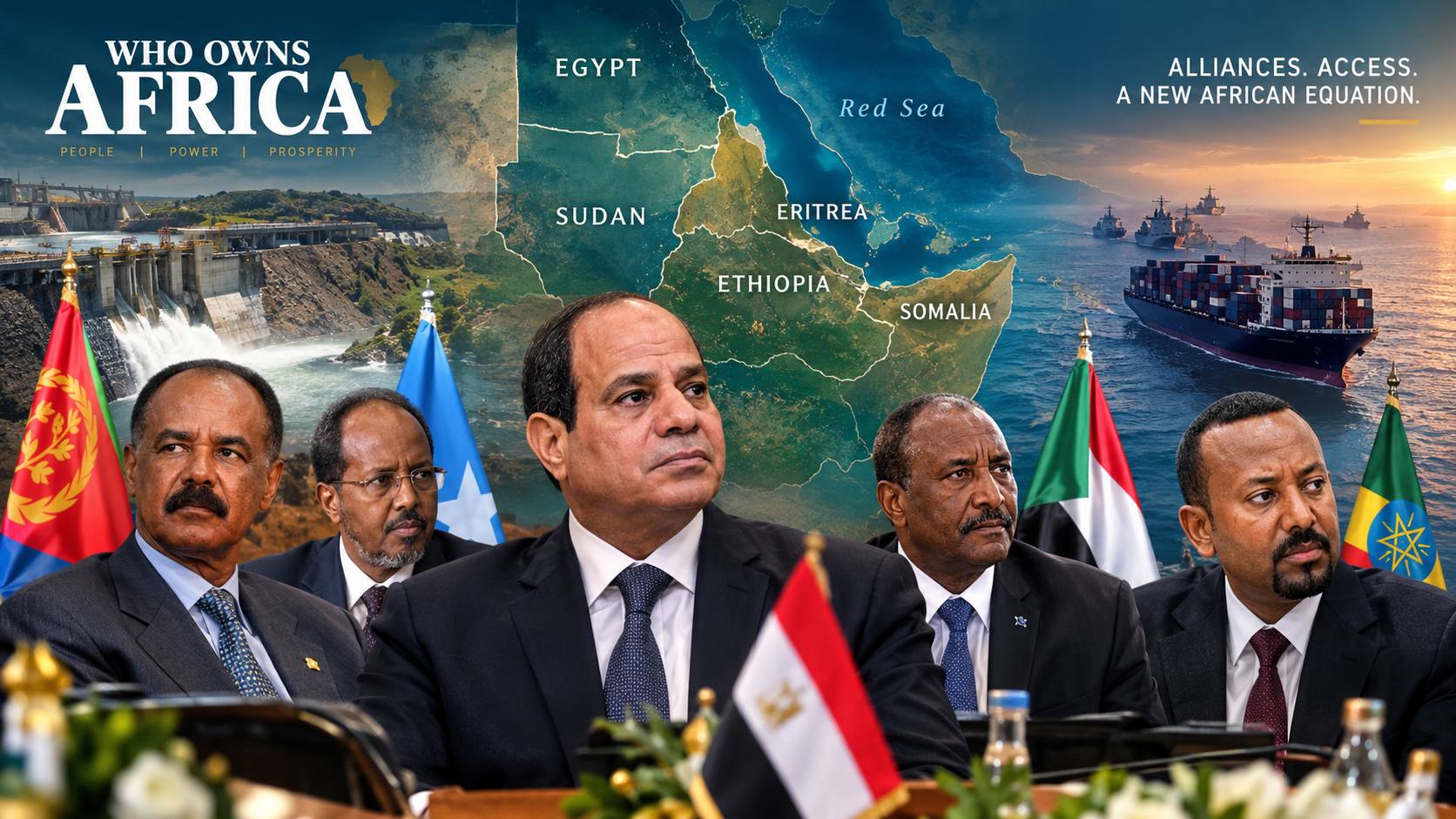
Egypt is no longer treating its confrontation with Ethiopia as a dispute over water alone. Cairo is framing the contest as part of a wider struggle over sovereignty, maritime access, regional security and the balance of power in the Horn of Africa.
That distinction matters. The four-way consultation Egypt hosted in New Alamein on Oct. 4, bringing together Eritrea, Somalia and Sudan, was officially presented as cooperation on regional challenges. But the geography tells a more revealing story. These states sit around the Red Sea and Nile systems at the heart of Africa’s competition.
The joint declaration backed Sudan’s territorial integrity, Somalia’s sovereignty, freedom of navigation and the principle that Red Sea governance belongs to littoral states. It also reaffirmed international law on transboundary rivers.
Taken together, those positions amount to more than diplomatic language. They establish the outline of a coalition.
The geography behind Egypt’s strategy
Egypt has long viewed the Nile as an existential national interest. The Grand Ethiopian Renaissance Dam transformed that concern into a prolonged strategic dispute with Addis Ababa. But Ethiopia’s renewed push for reliable access to the Red Sea has expanded the argument beyond the reservoir.
Prime Minister Abiy Ahmed has again emphasized sea access, while Ethiopia’s relations with Eritrea have deteriorated sharply. Fighting has also returned to Tigray, raising the risk of wider regional spillover.
Reuters reported this week that renewed fighting in Tigray has already killed people and triggered accusations of foreign involvement. Ethiopia has accused Egypt, Eritrea and Sudan of backing opposition forces, allegations those countries deny. The danger is that existing rivalries could turn domestic conflict into a regional contest.
For Cairo, geography is an asset. Egypt cannot dictate developments inside Ethiopia, but it can deepen relationships with neighbouring states and strengthen its position along the Red Sea. Eritrea has a long coastline, Sudan shares the Nile system, and Somalia commands a strategic coast near the Gulf of Aden.
This is the logic of the alignment.
Eritrea is no longer peripheral
Eritrea has often been treated as an isolated actor in African diplomacy. Geography is forcing its strategic value back into the calculations of major powers.
Asmara is acutely sensitive to Ethiopia’s ambitions for maritime access. Ethiopia became landlocked after Eritrea’s independence in 1993, and the question of an Ethiopian route to the sea remains politically charged. Eritrea’s Assab port is particularly sensitive because any arrangement that appears to weaken Eritrean sovereignty could alter the southern Red Sea balance.
For Egypt, Eritrea provides depth close to Ethiopia and a voice inside the Red Sea system. That does not mean Cairo controls Asmara. Both governments simply have reasons to resist arrangements that could give Ethiopia greater regional leverage.
Somalia adds another layer
Somalia brings a different calculation. Cairo’s declaration strongly backed Somalia’s territorial integrity and rejected recognition or support for Somaliland.
That position cannot be separated from the Red Sea map. Somaliland’s coastline has attracted international attention because of its location along the Gulf of Aden. Ethiopia has also pursued maritime access arrangements involving Somaliland, making the issue part of the broader contest over ports and corridors.
Egypt’s support for Somalia therefore serves two purposes. It reinforces a principle of territorial sovereignty, and it pushes back against arrangements that Cairo believes could redraw the strategic map without the consent of existing states.
The issue is also about precedent. If ports and maritime rights can be reshaped through security deals, other coastal states have reason to worry.
Sudan is the critical piece
Sudan may be the most consequential member of Egypt’s emerging alignment because the country connects the Nile question directly to the Red Sea and the war that has devastated the state.
Egypt has consistently backed Sudan’s state institutions and rejected the creation of parallel authorities. The New Alamein declaration repeated that position and called for a Sudanese-owned political process.
Cairo’s concern is understandable. A fragmented Sudan would create a security vacuum along Egypt’s southern border while weakening the position of the Nile’s downstream states. It could also increase the influence of outside powers competing for access to ports, military facilities, gold and agricultural resources.
The Sudan war has already become an arena for competing regional interests. That makes Sudan a strategic buffer for Egypt.
Saudi Arabia completes the picture
Egypt’s relationship with Saudi Arabia adds a Gulf dimension to the emerging architecture.
The two countries have intensified political consultations and discussed cooperation in maritime connectivity, logistics, energy and Red Sea security. Their interests are not identical, but they overlap around keeping major shipping routes open and limiting destabilising competition around the Red Sea.
Saudi Arabia also has direct interests on the opposite shore. For Riyadh, the Red Sea is an economic corridor and a security frontier. For Egypt, it is also the maritime extension of the Suez Canal and a strategic flank of the Nile basin.
The convergence gives Cairo a broader network.
Seoul reveals the economic strategy
President Abdel Fattah al-Sisi’s visit to South Korea this week adds another dimension to the strategy.
The trip focuses on economic cooperation, investment, infrastructure and international issues, with meetings planned with Korean companies. It fits Egypt’s effort to position itself as a bridge between Africa, the Middle East and global supply chains.
This matters because geopolitical influence depends on economic capacity. Ports, logistics networks, energy projects and transport corridors reinforce security politics.
Egypt wants investment and strategic relevance.
The real contest is over influence
The important question is not whether Egypt has created a formal military alliance. It has not.
The significant development is the construction of overlapping political interests.
Egypt wants protection for its Nile interests. Eritrea wants sovereignty. Somalia wants territorial integrity. Sudan’s government wants survival and legitimacy. Saudi Arabia wants a secure Red Sea. All have reasons to coordinate.
Ethiopia, meanwhile, is pursuing its own strategic objective: reducing the vulnerability created by landlocked geography and asserting greater regional influence.
That makes the Horn of Africa a contest between competing visions of sovereignty and access.
Cairo’s strategy is therefore less about surrounding Ethiopia than about preventing Ethiopia from becoming the dominant power linking the Nile basin to the Red Sea.
Africa’s geopolitics is increasingly shaped by corridors rather than capitals. Water crosses borders, ships move through chokepoints, and investment follows ports, roads and energy infrastructure.
The emerging Egypt-led alignment reflects that reality.
For Who Owns Africa, the deeper story is who controls the relationships, corridors and strategic choices shaping Africa’s northeastern future.
The Nile is meeting the Red Sea. Egypt is making sure it has a seat at every table where that future is negotiated.

More from Geopolitics
Tanzania turns Arusha into a global diplomatic capital
Tanzania is using parliamentary diplomacy to deepen its influence, widen partnerships and strengthen Arusha’s role in global affairs.
Abiy Ahmed begins new term as Ethiopia faces security and regional challenges
Ethiopia’s new political chapter begins with a stronger mandate, but unresolved conflicts and regional rivalries could define Abiy Ahmed’s second term.
Who owns Africa’s critical minerals? The global race for Congo, Rwanda and Mozambique
Washington and Beijing are courting Kinshasa, Kigali and Maputo for critical minerals, but African nations still aren't setting the terms.