

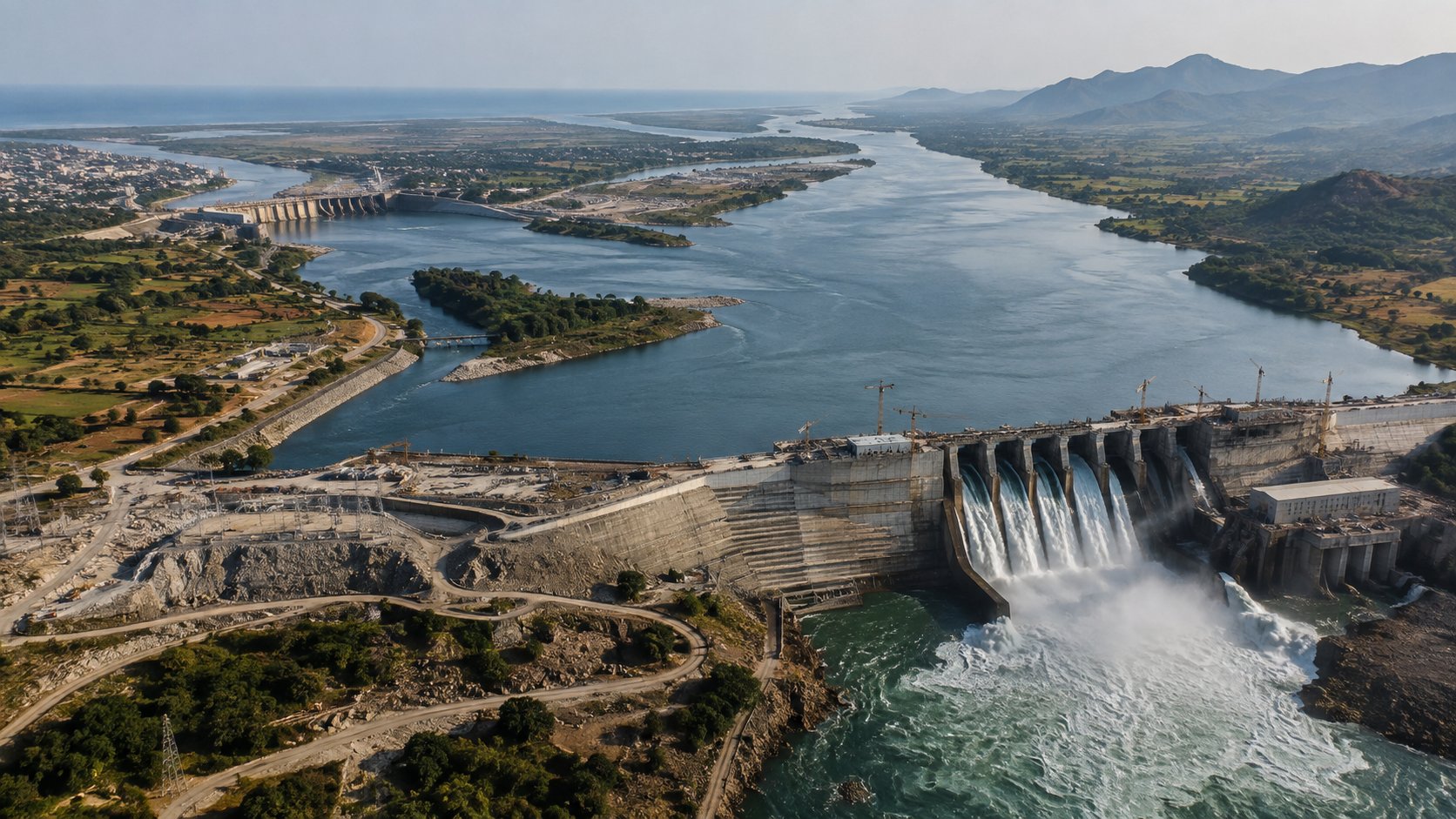
The Nile is not owned by any single country, but the ability to store, regulate and use its waters is becoming one of Africa’s most consequential sources of power, with Ethiopia controlling the continent’s largest new Nile dam while Egypt retains enormous downstream infrastructure and diplomatic influence.
The question of who controls the Nile has therefore become more complicated than the old confrontation between upstream and downstream states. Ethiopia has demonstrated that it can build and operate major infrastructure on the Blue Nile despite years of Egyptian opposition, while Egypt continues to depend overwhelmingly on the river for its freshwater needs. Sudan sits between the two, exposed to both the opportunities and risks created by the changing balance.
The dispute has been transformed by the Grand Ethiopian Renaissance Dam, or GERD, which Ethiopia inaugurated in September 2025 after more than a decade of construction and negotiations. The roughly $5 billion project has an installed generating capacity of about 5,150 megawatts according to Reuters reporting at its inauguration, making it Africa’s largest hydroelectric project. Ethiopia says the dam is primarily a development and electricity project, while Egypt has argued that its operation without a binding agreement governing droughts, releases and data sharing threatens downstream water security.
Ethiopia changes the equation
For Ethiopia, the GERD represents something larger than a power station. It is a statement that the country can develop the resources of the Blue Nile, known in Ethiopia as the Abay, to support industrialisation and electricity access.
The Ethiopian Ministry of Water and Energy says the dam is owned and operated by Ethiopian Electric Power. Its official project information puts the reservoir capacity at 74 billion cubic metres and describes the structure as a 145-metre-high concrete dam near the Sudanese border.
That ownership matters because the central issue is not simply who possesses water. It is who possesses infrastructure capable of influencing the timing of water flows.
A reservoir can store water during periods of heavy rainfall and release it later for electricity generation or other purposes. That gives the operator a degree of control over the river’s timing, although it does not mean Ethiopia owns the Nile itself or can simply determine the total annual supply reaching Egypt.
Ethiopia’s argument is that it has a sovereign right to use its natural resources for development. United Nations discussions on the dispute have recorded Ethiopia’s position that it generates a large share of the Nile’s average annual flow but has historically received little benefit from the river.
Egypt sees the issue differently.
Egypt’s downstream advantage
Egypt’s geographical position makes it one of the world’s most Nile-dependent countries. The World Bank has estimated that about 97% of Egypt’s freshwater resources come from the Nile. That dependence makes any change in upstream water management a matter of national security rather than simply an infrastructure dispute.
But Egypt is not without leverage.
For decades, Cairo has built an extensive system of dams, barrages, canals and irrigation infrastructure that allows it to manage the river once its waters enter Egyptian territory. The Aswan High Dam remains the centrepiece of that system.
Egypt’s Ministry of Water Resources and Irrigation says the High Dam has a total storage capacity of about 169 billion cubic metres at its maximum level, including storage for irrigation, flood protection and other purposes. The ministry also describes the dam as a central instrument in regulating Nile flows and protecting the country against drought and floods.
The High Dam illustrates an important distinction in the Nile dispute. Egypt has substantial control over water infrastructure inside its territory, but it cannot control the Blue Nile upstream of its borders.
Ethiopia now has a comparable strategic asset upstream.
Who financed the infrastructure?
The ownership question also has a financial dimension.
The GERD was unusual among major African infrastructure projects because Ethiopia relied heavily on domestic resources to finance construction. Ethiopian citizens and domestic institutions played a significant role in raising money, while Chinese financing was associated with turbines and electrical equipment rather than ownership of the dam itself. Historical analysis by the African Development Bank notes that Ethiopia used government securities and domestic state-owned banks to finance infrastructure, including the GERD.
The result is important geopolitically. Foreign financing can create influence, but financing does not automatically translate into ownership.
The Ethiopian government retains ownership and operational control of the GERD. China has nonetheless become an important economic partner for Ethiopia, including through infrastructure and debt relationships. Reuters reported in April that Ethiopia and China reached an agreement on debt treatment as Addis Ababa seeks to restructure its external obligations and secure future economic stability.
Egypt, meanwhile, has also been strengthening its relationship with Beijing.
Chinese President Xi Jinping visited Cairo this week, with Egypt and China agreeing to deepen cooperation in security and economic sectors. Reuters reported that Chinese investment in Egypt includes major projects in the Suez Canal Economic Zone, giving Beijing significant economic interests on both sides of the Red Sea and North African trade routes.
This means China does not have to choose a single side in the Nile dispute to become strategically important. Beijing can maintain economic relationships with both Cairo and Addis Ababa while expanding its broader African footprint.
Sudan holds a critical position
Sudan remains central to the dispute because its territory lies directly downstream from the GERD and upstream from Egypt.
For Sudan, the dam offers potential benefits, particularly in electricity generation, flood management and more predictable water flows. At the same time, the country faces risks if dam operations are conducted without adequate coordination and information sharing.
Its political instability has made a unified regional approach harder to sustain.
The 1959 Nile Waters Agreement between Egypt and Sudan remains an important part of Cairo’s legal and political position. The United Nations treaty database records the agreement as a bilateral accord signed in Cairo in November 1959.
Ethiopia was not a party to that agreement, which is one reason the treaty has never resolved the wider Nile dispute.
The disagreement is therefore partly about water and partly about the legitimacy of historical arrangements.
Climate could change the balance
The Nile dispute is becoming more difficult because the river’s future cannot be separated from climate change.
The Nile Basin Initiative says the basin is facing a warming and increasingly variable climate, with projections pointing to greater risks from drought, flooding, higher temperatures and rainfall variability. It warns that the region’s preparations for climate impacts remain inadequate.
A recent systematic review published in the Journal of Hydrology: Regional Studies found that climate projections for the Nile show mixed changes in Blue Nile flows, while emphasising the importance of adaptive governance and cooperation among countries sharing the basin.
That uncertainty may make water infrastructure more important, not less.
In a predictable climate, countries can plan around relatively stable patterns of rainfall and river flows. In a more volatile climate, reservoirs become increasingly valuable for managing extremes. But the same infrastructure can also become a source of mistrust if neighbouring states lack confidence in how it will be operated.
The foreign power equation
The Nile is increasingly part of a wider competition for influence involving China, Gulf states, Western governments and regional powers.
Foreign investors are attracted not only to dams but also to agriculture, electricity, logistics and industrial projects. These sectors are closely connected to water security.
China’s position is particularly significant because it maintains strong economic relationships with both Egypt and Ethiopia. Egypt offers access to the Suez Canal, Mediterranean trade routes and a major consumer market. Ethiopia offers a large population, a strategic position in the Horn of Africa and opportunities in energy and infrastructure.
Gulf states also have growing economic interests across the Red Sea and Horn of Africa. Their investments in ports, agriculture, logistics and energy can intersect indirectly with the politics of Nile water, even when a particular investment is not formally linked to the river.
The result is that Nile diplomacy increasingly extends beyond traditional water negotiations.
Can water become Africa’s next battleground?
Calling the Nile dispute a future water war would be premature.
The more immediate risk is prolonged political confrontation, particularly if drought coincides with high water demand and limited trust between governments.
The Nile Basin Initiative estimates that agriculture consumes more than 80% of Nile water and warns that, without greater coordination, development plans could eventually create demand equivalent to roughly 1.5 Niles by 2050.
That makes efficiency as important as ownership.
Egypt needs to reduce pressure on its limited freshwater resources. Ethiopia needs to demonstrate that hydropower development can coexist with predictable downstream flows. Sudan needs stable institutions capable of protecting its interests. And the wider Nile Basin needs mechanisms for sharing information and managing droughts.
So who controls the Nile?
The answer is neither Egypt nor Ethiopia.
Ethiopia now controls the most strategically important new piece of Nile infrastructure upstream, while Egypt retains extensive downstream storage, irrigation and water-management infrastructure. Neither country controls the entire river.
What Ethiopia has changed is the balance of power.
The GERD has shown that Egypt’s historic diplomatic influence cannot by itself prevent major upstream development. At the same time, Egypt’s dependence on the Nile means Cairo is unlikely to accept an arrangement that leaves it exposed to decisions made entirely upstream.
The contest is therefore moving from a struggle over who has the right to use the Nile toward a more practical question: who has the power to manage risk when water becomes scarce?
That question will determine the next phase of the Nile dispute.
For Ethiopia, the GERD has delivered a new source of electricity and national leverage. For Egypt, it has created a new strategic reality that must be managed rather than reversed. For Sudan and the other Nile Basin states, the stakes are even broader.
The river may belong to no single nation. But in the coming decades, the countries that control the infrastructure, information and institutions surrounding the Nile will have the greatest influence over its future.

More from Geopolitics
Why Turkey is building a spaceport in Somalia
Turkey’s spaceport in Somalia is about more than rockets, giving Ankara strategic reach while testing how much sovereignty Mogadishu can leverage.
Egypt builds a Red Sea coalition as Ethiopia tensions rise
Egypt is aligning Horn of Africa partners around Nile security, Red Sea sovereignty, Sudan’s war and Ethiopia’s growing regional ambitions.
Tanzania turns Arusha into a global diplomatic capital
Tanzania is using parliamentary diplomacy to deepen its influence, widen partnerships and strengthen Arusha’s role in global affairs.