

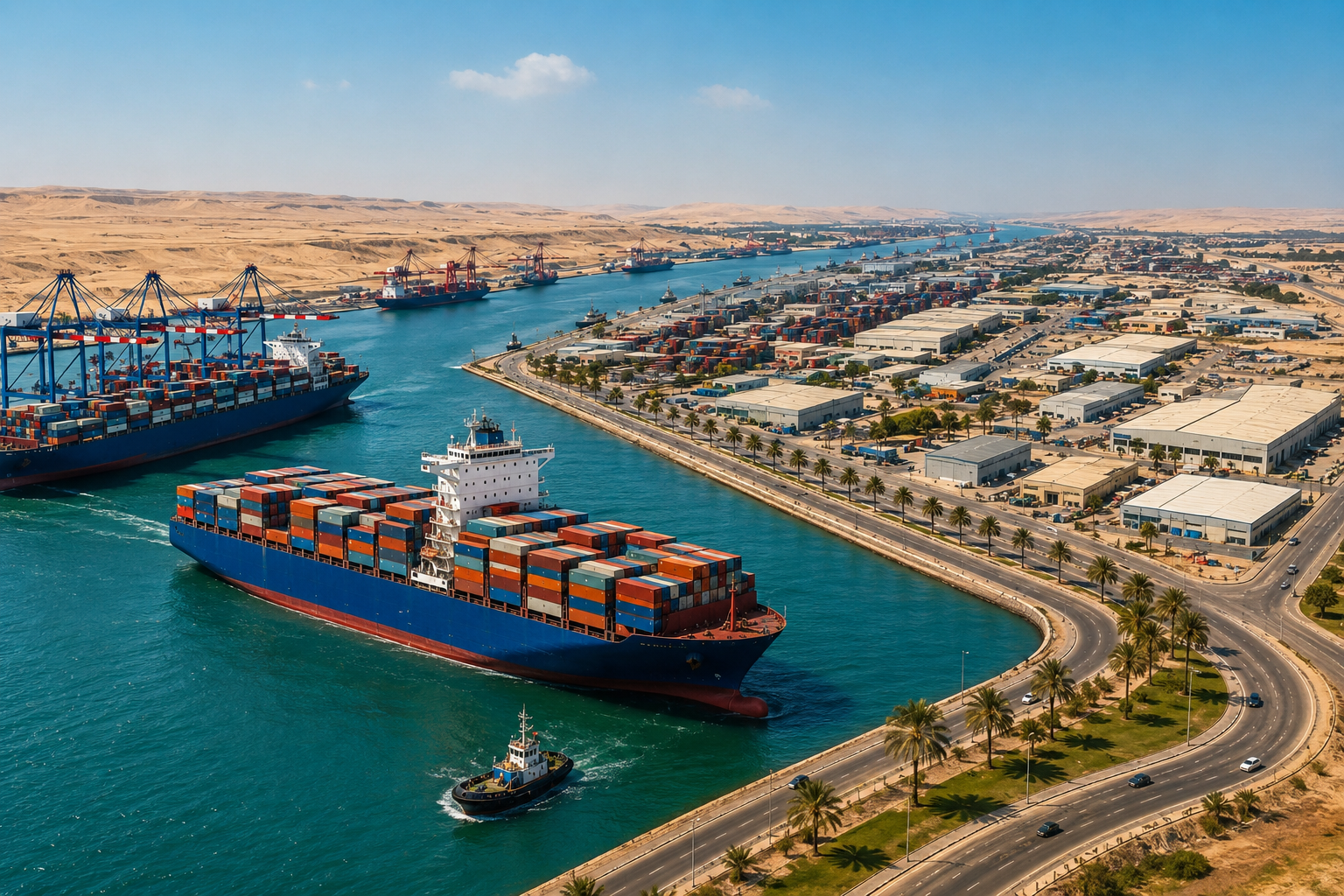
China does not own the Suez Canal, but its growing presence around the waterway is giving Chinese companies a significant commercial foothold in one of the world’s most strategically important trade corridors.
Through industrial parks, container terminals, logistics facilities and manufacturing projects, Chinese companies have built an increasingly integrated position linking Asian supply chains with Egyptian and African markets.
The expansion is gaining fresh attention as Chinese President Xi Jinping visits Egypt and Beijing seeks deeper economic and strategic ties across the Middle East and Africa.
The canal is still Egyptian
The distinction between ownership and influence is important. The Suez Canal remains under Egyptian control, operated by the Suez Canal Authority, while the surrounding Suez Canal Economic Zone, or SCZONE, is administered by an Egyptian state authority. China has not acquired the canal itself.
What Beijing has done is build a network of commercial interests around the waterway. Those interests stretch from the northern entrance at Port Said to the southern gateway at Ain Sokhna, with Chinese investment also concentrated in manufacturing, warehousing and industrial development.
This model gives Chinese businesses access to infrastructure positioned directly on one of the world’s busiest maritime routes without requiring ownership of the canal. For companies that manufacture goods for export, the attraction is straightforward: factories can be located close to ports, products can move into international shipping networks quickly, and Egypt offers access to markets in Africa, the Middle East and Europe.
Egypt, for its part, has actively encouraged the model as it seeks foreign currency, industrial investment, jobs and export capacity.
TEDA is the industrial anchor
The most visible Chinese presence is the China-Egypt TEDA Suez Economic and Trade Cooperation Zone in Ain Sokhna.
Developed by China-based TEDA, the industrial zone has become a major platform for Chinese manufacturing and logistics companies operating inside the SCZONE. Egyptian authorities said in 2025 that more than 200 Chinese companies were operating in the wider TEDA industrial zone, with investments exceeding $3 billion and more than 70,000 jobs created.
The figures have continued to grow. Chinese sources reported that by the end of June 2026, more than 200 companies had established operations in the TEDA zone, attracting more than $4.7 billion in investment and generating cumulative sales of more than $7.3 billion.
The figures vary depending on whether authorities are counting contracted investments, completed investments, the wider industrial zone or individual projects. That makes it difficult to produce a single definitive figure for China’s total investment around Suez. But the direction is clear: Chinese capital and Chinese manufacturing capacity are expanding.
The zone itself is not simply a collection of factories. It combines industrial facilities with logistics, storage, distribution and supporting services, creating an ecosystem designed to keep production and export activity close to the port.
Factories are moving closer to the port
Recent deals show how quickly this ecosystem is expanding.
In December 2025, Egypt announced three industrial contracts inside the TEDA Egypt zone worth about $1.15 billion. The projects involved China’s Xin Feng Ming Group, Chaoyang Langma Tire and Tongling Jieya Biotechnology.
Other projects have targeted electronics, home appliances, chemicals and industrial components. A project involving Hisense and Egyptian company FBB Tech, for example, was launched in the Sokhna industrial zone with an investment of $38 million and planned annual production of one million units.
In January 2026, China’s state-owned China National Chemical Engineering Company signed a $34 million project to manufacture equipment, steel structures and piping used in sodium carbonate production plants. The facility is planned for a 100,000-square-metre site in the Sokhna Industrial Zone.
These investments matter because they move China’s relationship with Egypt beyond importing finished goods. They create production capacity inside Egypt, potentially allowing companies to serve regional markets from an Egyptian base.
Chinese shipping interests
China’s footprint also reaches directly into port operations.
COSCO Shipping Ports, part of China’s state-owned shipping group, has held a 20% stake in the Suez Canal Container Terminal at East Port Said since 2007, according to a U.S. intelligence assessment. The terminal sits at the northern entrance to the canal and is strategically positioned for container transshipment.
At the southern end, COSCO is also part of the consortium behind the Red Sea Container Terminal at Ain Sokhna. The terminal’s commercial operations officially began in January 2026 under a consortium involving Hutchison Ports, CMA CGM and COSCO Shipping.
COSCO’s involvement in Sokhna was structured around a 30-year operating concession, with the company taking a 25% stake in the terminal project. The planned facility has a capacity of about 1.7 million twenty-foot equivalent units, or TEUs.
That creates an important geographic connection. Chinese-linked commercial interests are present near both ends of the Suez Canal, while the industrial base sits close to the southern gateway.
Hutchison adds another link
Hutchison Ports, a Hong Kong-based global port operator, is another major Chinese-linked player in Egypt’s maritime infrastructure.
The company is part of the consortium operating the new Sokhna terminal alongside COSCO and France’s CMA CGM. Hutchison has also had a long-standing presence in Egyptian ports, including container operations on the Mediterranean.
The result is not Chinese control of Egypt’s port system. Rather, it is a network in which Chinese and Chinese-linked companies hold stakes, concessions or operating roles alongside Egyptian, European and Gulf investors.
That distinction is central to understanding China’s Suez strategy.
How much Chinese money is involved?
There is no single number that captures China’s financial footprint in Egypt.
Egypt’s investment authority said in November 2025 that more than 2,000 Chinese companies were operating in Egypt and that Chinese investments exceeded $8 billion.
Another Egyptian government summary put Chinese investment in the TEDA zone alone at more than $3.3 billion, while broader estimates of Chinese participation across Egypt have also risen as new projects are announced.
The SCZONE provides another measure of the concentration. In November 2025, its chairman said the economic zone had attracted about $11.6 billion in investment over the previous three and a half years, with roughly half coming from China.
Those figures should not be interpreted as China owning half of the economic zone. They refer to investment attracted into projects located within the zone.
The distinction is crucial because the SCZONE contains investments from many countries, while land, strategic infrastructure and the canal itself remain under Egyptian authority.
Who benefits financially?
For China, the commercial logic is access.
Chinese manufacturers can use Egypt as a production base close to shipping routes connecting Asia, Europe and Africa. Locating factories near ports can lower transport costs and shorten supply chains. It can also provide a platform for companies seeking to export from Egypt rather than shipping every finished product directly from China.
For Egypt, the benefits are investment, employment, industrial capacity and export potential. The government is attempting to transform the Suez corridor from a route through which ships merely pass into an economic platform where goods are manufactured, stored, processed and redistributed.
The financial benefits also extend to Egyptian logistics companies, ports, contractors and workers.
But the relationship is not one-sided. Egypt remains a major importer from China. Bilateral trade reached about $20.8 billion in 2025, according to Egyptian government figures, with Chinese imports accounting for the overwhelming majority of the trade value.
That imbalance means Egypt’s challenge is not simply attracting Chinese capital. It is also turning Chinese investment into higher-value production and exports.
The Africa opportunity
This is where the Suez story becomes an African story.
Egypt sits at the intersection of the Mediterranean, the Red Sea and the African continent. For Chinese companies, an Egyptian manufacturing base can potentially serve markets beyond Egypt itself.
The country’s proximity to East and North African markets gives manufacturers a logistical advantage, particularly when production is integrated with port facilities.
Egypt is also positioning itself as a regional manufacturing hub. In 2026, Chinese companies continued to explore investments in heavy industry, clean energy and other sectors. In August, Egyptian officials said a leading Chinese aluminium group was considering an industrial complex in the SCZONE worth up to $2 billion.
If such projects proceed, the economic relationship would become more deeply embedded in Egypt’s industrial infrastructure.
Influence without ownership
China’s growing role raises a broader geopolitical question: how much influence can Beijing gain without owning the strategic asset itself?
The answer may lie in infrastructure networks rather than outright ownership.
A company does not need to own the Suez Canal to benefit from its traffic. A manufacturer does not need to control a port to depend on it. A shipping company does not need to own the waterway to hold a stake in terminals positioned at its entrances.
That is the significance of China’s expanding Suez footprint.
Chinese interests are becoming embedded across several layers of the corridor, from industrial land and factories to logistics services and port terminals. Egypt remains the sovereign decision-maker, but Chinese companies increasingly have a commercial stake in how efficiently goods move through the corridor.
Egypt’s balancing act
Cairo has strong reasons to welcome Chinese investment while avoiding dependence on any single foreign power.
Egypt has long maintained close relations with the United States, Europe and Gulf states while deepening cooperation with China and other emerging powers. Its strategy is increasingly one of diversification.
For Beijing, Egypt offers something particularly valuable: geography.
The Suez Canal remains a critical link between the Indian Ocean and Mediterranean shipping routes. Despite disruptions caused by regional conflict and attacks affecting Red Sea shipping, the strategic importance of the corridor remains intact. Egypt itself has suffered a sharp decline in canal revenues during periods of disruption.
For China, the opportunity is therefore not simply about today’s shipping volumes. It is about establishing a long-term commercial position around a corridor that connects three major economic regions.
So, who owns Egypt’s gateway?
The simplest answer is Egypt.
The Suez Canal is Egyptian. The SCZONE is Egyptian-administered. The land and national strategic infrastructure remain subject to Egyptian authority.
But ownership is only part of the story.
Chinese companies now occupy an increasingly important position in the economic machinery surrounding the canal. TEDA anchors a large industrial cluster at Sokhna. COSCO has interests at strategic container terminals. Chinese manufacturers are building factories, while new investors are considering increasingly capital-intensive projects.
Egypt’s objective is to turn geography into industrial growth. China’s objective is to turn industrial investment into access to markets.
The outcome could make Egypt one of China’s most important production and logistics platforms linking Asia to Africa.

More from Geopolitics
Why Turkey is building a spaceport in Somalia
Turkey’s spaceport in Somalia is about more than rockets, giving Ankara strategic reach while testing how much sovereignty Mogadishu can leverage.
Egypt builds a Red Sea coalition as Ethiopia tensions rise
Egypt is aligning Horn of Africa partners around Nile security, Red Sea sovereignty, Sudan’s war and Ethiopia’s growing regional ambitions.
Tanzania turns Arusha into a global diplomatic capital
Tanzania is using parliamentary diplomacy to deepen its influence, widen partnerships and strengthen Arusha’s role in global affairs.