

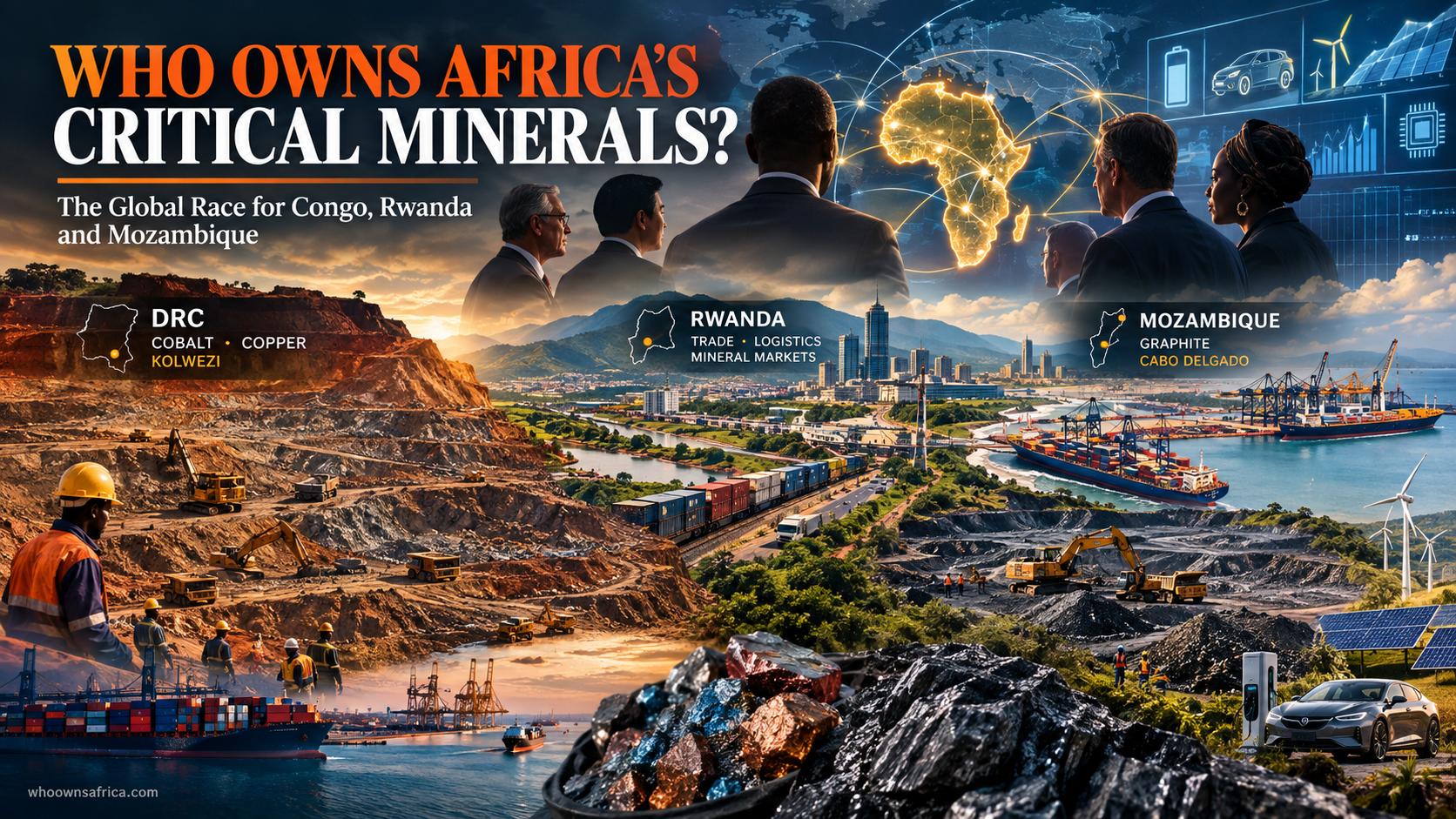
There is a particular kind of colonial déjà vu settling over Central and Southern Africa this year, dressed up in the language of partnership, supply chains and clean energy. From the cobalt pits of Kolwezi to the graphite fields of Cabo Delgado, the world’s most powerful governments and their state-linked capital have converged on a simple, uncomfortable truth: the twenty-first century’s energy transition cannot happen without African rock, and everyone wants a claim to it before their rivals do.
What makes this moment different from the extractive scrambles of the past is not the appetite. Empires have always wanted what lies beneath African soil, from rubber to gold to oil. What has changed is the packaging. Washington calls it a strategic partnership. Beijing calls it geoscience cooperation. Mining executives call it de-risking supply chains. Congolese, Rwandan and Mozambican officials, when they are being candid, call it something closer to leverage, the only kind their treasuries have left after decades of debt, conflict and underinvestment. The minerals are the same. The vocabulary has simply caught up with the times.
The Numbers That Explain Everything
Start with the geology, because it explains the diplomacy. The Democratic Republic of Congo holds somewhere close to seventy percent of the planet’s cobalt reserves and produces roughly the same share of annual global supply, a mineral without which the modern electric vehicle battery does not function. Add copper, of which Congo is now the world’s second largest producer after Chile, along with meaningful deposits of lithium, tantalum and germanium, and it becomes clear why the country sits at the centre of every serious conversation about the next industrial era.
Rwanda, by contrast, produces relatively little of its own. Its significance lies elsewhere, as a transit and processing corridor for minerals that frequently originate across its border in eastern Congo, particularly coltan, the ore refined into tantalum used in nearly every mobile phone and laptop on the planet. Mozambique brings a different asset entirely: graphite, the unglamorous but indispensable material used in electric vehicle battery anodes, of which the country is the world’s third largest producer, alongside natural gas reserves in the Rovuma Basin large enough to reorder East Africa’s energy map for a generation.
Put these three countries on a single map and the outline of a new global supply chain appears almost too neatly, extraction in one place, transit and rough processing in another, downstream ambition from Washington and Beijing layered over both.
Congo’s Minerals-for-Security Bargain
The clearest expression of this new arrangement is Congo’s so-called minerals-for-security formula, a bargain struck openly and without much diplomatic subtlety. Facing the collapse of his eastern provinces to the Rwandan-backed M23 rebel movement in 2025, after the group’s stunning capture of Goma and Bukavu, President Félix Tshisekedi offered something no African leader in recent memory has offered so explicitly: preferential access to his country’s mineral wealth in direct exchange for American security backing and diplomatic pressure on Kigali.
It worked, at least on paper. December’s Washington Accord and the accompanying Strategic Partnership Agreement gave American firms priority access to Congo’s Strategic Asset Reserve projects, an arrangement designed as much to box out Chinese capital as to attract American capital. Since then, the deals have arrived in quick succession. Virtus Minerals, a California firm founded by former military and intelligence officials and backed heavily by the Trump administration, moved to acquire control of the Étoile and Mutoshi copper-cobalt operations from the troubled Dubai-based miner Chemaf, in what its backers describe as the first meaningful American return to Congolese mining in over a decade. Weeks later, the Orion Critical Mineral Consortium, a partnership between a private equity fund and the US International Development Finance Corporation, signed a memorandum with commodities giant Glencore to acquire a forty percent stake in the Mutanda and Kamoto copper and cobalt operations, some of the largest in the country.
Kinshasa, for its part, has not put all its faith in Washington. In January it handed American officials a vetted shortlist of forty-four state-linked mining and processing assets open to investment, spanning manganese, lithium, gold and coltan concessions. It was a calculated signal, not an act of exclusive loyalty. Congo needs capital wherever it can find it, and its officials understand perfectly well that playing Washington and Beijing against one another is worth more to the treasury than picking a side.
Where China Still Holds the Cards
It would be a mistake to read any of this as China’s retreat from the continent. Roughly eighty percent of Congo’s cobalt output still moves through Chinese-controlled mining and refining operations, a position built over two decades of patient investment that no single American deal, however well publicised, is going to unwind quickly. The imbalance is even starker in processing. China does not merely mine graphite and cobalt; it dominates the conversion of raw ore into the battery-grade material that manufacturers actually need, a chokehold that Western firms have spent years trying and largely failing to break.
Mozambique illustrates this dynamic with uncomfortable clarity. Even as the United States has quietly funded feasibility studies and trade missions around the country’s graphite sector, Chinese firms have kept closing deals on the ground. In August, a subsidiary of Shandong Xinsheng Minerals completed a long-delayed acquisition of seventy percent of Triton Minerals’ graphite assets in Cabo Delgado province, consolidating an already substantial Chinese footprint across the region’s undeveloped deposits. Separately, Beijing struck a wide-ranging cooperation agreement with Maputo covering not just graphite but lithium and rare earth exploration across Mozambique’s underexplored north, backed by joint geological survey platforms under the Belt and Road framework. Washington’s interest in Mozambican graphite is real. China’s presence in Mozambican graphite is already built.
Mozambique Writes Its Own Rules
If Congo’s approach has been to trade access for protection, Mozambique’s has been quieter and, in some respects, more sophisticated. In June, President Daniel Chapo signed into law a mining code that requires a free fifteen percent state stake in every mining project operating in the country and bans the export of unprocessed minerals outright. The legislation targets graphite specifically, forcing companies to build local processing capacity rather than simply shipping raw ore abroad for value to be captured elsewhere, most often in China.
It is a modest but meaningful assertion of sovereignty, arriving precisely as both superpowers intensify their courtship. Whether it holds under commercial pressure remains to be seen; state equity requirements have a way of softening once the capital needed to build a processing plant fails to materialise on schedule. But the intent is instructive. Mozambique, unlike some of its neighbours, appears to understand that the leverage created by great power competition has a shelf life, and that laws passed today are worth more than promises extracted during a moment of maximum foreign interest.
The War That Minerals Paid For
None of this can be separated from the human cost sitting underneath the spreadsheets. The conflict in eastern Congo that gave rise to the Washington Accord was not an abstract geopolitical contest. It was, and largely remains, a war fought over territory that happens to sit atop extraordinary mineral wealth. The M23 rebellion, widely understood by UN investigators and Western governments alike to receive backing from Rwanda despite Kigali’s denials, seized Goma and Bukavu in early 2025 and, according to regional analysts, shipped on the order of one hundred and twenty tonnes of Congolese coltan into Rwanda every month at the height of the fighting. Thousands died. Hundreds of thousands were displaced.
The peace agreement signed in Washington in June 2025, and formalised as the Washington Accord that December, ended the active fighting and secured pledges from both governments to withdraw support for armed proxies. What it conspicuously did not do, according to independent analysts and the text of the agreement itself, was resolve who actually controls the mines that M23 seized, or address the flows of Congolese minerals still moving across the Rwandan border for processing. Some of the same reporting that revealed the depth of the US-brokered negotiations also disclosed a parallel understanding under discussion, in which Congolese tin, tungsten and tantalum, minerals Kinshasa has spent years accusing Rwanda of smuggling, would instead be exported to Rwanda legitimately for processing, effectively formalising a trade relationship that Congo had previously treated as theft.
That is not peace so much as a renegotiated arrangement for extracting the same resources with less shooting attached. It may prove more durable than the war it replaced. It should not be mistaken for justice.
A Familiar Shape, A New Vocabulary
Step back far enough and the pattern becomes difficult to unsee. A resource-rich African state, weakened by conflict or debt or both, offers privileged access to its mineral wealth in exchange for external backing. Great powers, competing more with each other than acting out of any particular commitment to the country in question, supply capital, diplomatic cover or military leverage in return. The mineral moves out. The value is captured downstream, in refineries and battery factories thousands of miles from where the ore was pulled from the ground. The African government banks fees, taxes and a fragile peace. The African population, more often than not, banks considerably less.
This is not a uniquely twenty-first century story. It is the oldest story on the continent, retold with lithium-ion batteries standing in for rubber tires and semiconductor chips standing in for ivory. What is genuinely new is the intensity of the competition doing the retelling. During the Cold War, African states could occasionally extract better terms by triangulating between Washington and Moscow. Today’s triangulation, between Washington and Beijing, appears to be generating real capital commitments, actual mines changing hands, actual mining codes being rewritten. Congo’s minerals-for-security bargain, cynical as it is, has at least produced tangible American investment where years of aid rhetoric produced comparatively little. Mozambique’s new mining law, however imperfectly enforced it may prove, represents an African government using competitive pressure to legislate for itself rather than simply auction itself off.
The Risk Nobody Prices In
There is also a quieter danger in all of this that tends to get lost between the press releases and the ministerial photo opportunities: the assumption, embedded in almost every deal announced this year, that African governments will remain stable, cooperative and roughly aligned with whichever foreign partner signed the paperwork. History suggests that is a poor bet. Mining concessions in Congo have changed hands amid coups, wars and nationalisations before, and the current wave of American acquisitions sits atop a security situation in the east that a single peace agreement, however well publicised in Washington, has not fully resolved. Investors pricing in Congolese cobalt at today’s political temperature are pricing in a temperature that could shift within a single election cycle or a single resumption of hostilities.
The same caution applies to Mozambique, where the graphite boom is unfolding in provinces that have, within the last five years, experienced a violent Islamist insurgency in Cabo Delgado, the very region where much of the new graphite investment is concentrated. Balama and Ancuabe are not simply geological coordinates. They sit inside a security environment that foreign capital has often preferred to discuss in the past tense rather than the present one. A mining law requiring local processing means little if the roads, power grid and security guarantees needed to build that processing capacity are not there to match it.
None of this argues against investment. It argues against the particular kind of confidence that tends to accompany a resource rush, the sense that this time the politics will hold because the stakes are simply too large for anyone to let them fail. Stakes being large has rarely been what determines whether African conflicts end. It has, historically, been closer to the opposite.
Who Actually Owns the Wealth
So who owns Africa’s critical minerals? Legally, the answer is straightforward: the states in whose ground they sit. Commercially, the picture is far murkier and considerably less flattering to African sovereignty. Chinese capital controls the overwhelming majority of Congolese cobalt production and most of the world’s capacity to refine it into anything usable. American capital is buying its way back in through a small number of high-profile, politically backed acquisitions that remain, for now, a fraction of China’s footprint. Rwandan intermediaries, backed by a state that denies the accusation while quietly formalising the trade, continue to process minerals that did not originate within Rwanda’s own borders. Mozambique is attempting, with mixed prospects, to insist that some value stay home.
The three governments at the centre of this contest, Kinshasa, Kigali and Maputo, are not powerless in this arrangement, whatever the imagery of a scramble might suggest. They are playing a genuinely difficult hand about as well as it can be played, extracting infrastructure commitments, security guarantees and equity stakes from suitors who need what lies beneath their soil considerably more than either superpower will publicly admit. But playing a hand well is not the same as holding the winning cards. Ownership, in any meaningful economic sense, is still overwhelmingly external, concentrated in refineries in Jiangsu and boardrooms in Washington rather than in Lubumbashi, Kigali or Pemba.
The energy transition the world is racing to build cannot happen without the ground beneath Congo, Rwanda’s borderlands and Mozambique’s north. Everyone chasing that ground already knows this. The open question, the one that will define the coming decade far more than any single mining deal, is whether the countries actually holding the ground come to know it just as clearly, and act on it before the current window of competitive leverage closes.

More from Geopolitics
Who controls the Nile? Egypt vs Ethiopia
Ethiopia’s control of upstream infrastructure is reshaping Egypt’s historic influence over the Nile, creating new geopolitical stakes across Africa.
Who owns Egypt’s gateway to Africa? China’s expanding Suez footprint
China is deepening its industrial, port and logistics footprint around Suez, reshaping Egypt’s role as a gateway between Asia, Europe and Africa.
Morocco’s geopolitical gambit: How Rabat is turning its gateway to Europe into power
From Ceuta and migration to ports, trade and the 2030 World Cup, Morocco is using its geography to strengthen its hand with Europe and Africa.