

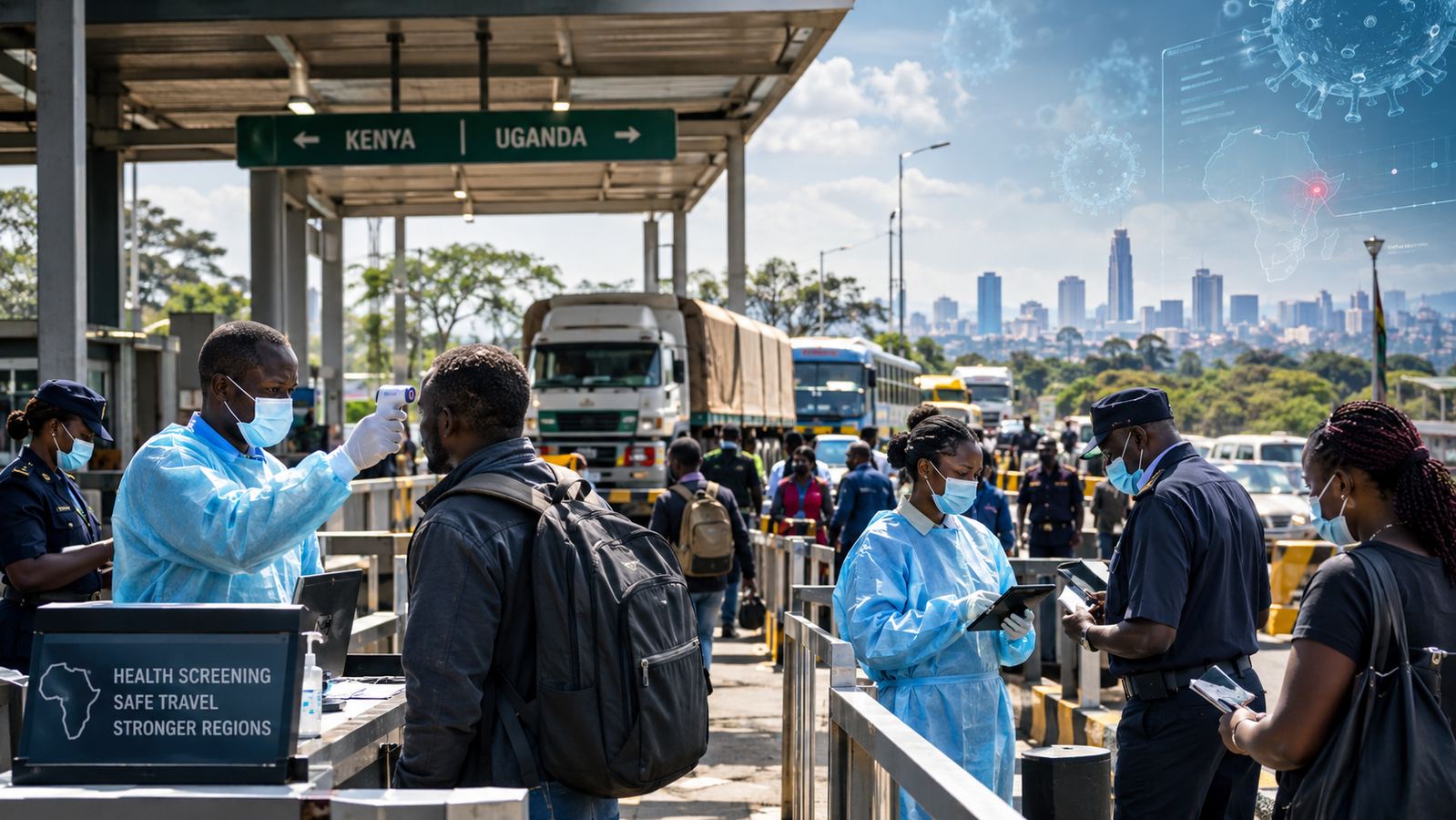
Kenya’s first imported Ebola case is more than a public health emergency. It is a warning about the limits of borders in an increasingly mobile East Africa, where disease can travel through ordinary journeys faster than governments can activate their defenses.
The Kenyan citizen at the centre of the case travelled from the Democratic Republic of Congo through Uganda before arriving in Nairobi. He later died in hospital, prompting authorities to trace contacts and intensify surveillance. Kenya has identified dozens of contacts while trying to establish the movements of passengers and crew who may have been exposed.
The immediate response is understandable. Screening is being strengthened. Contacts are being followed. Border points are receiving greater attention.
But the deeper question is uncomfortable: what exactly does a border protect when the threat is invisible, mobile and capable of crossing several jurisdictions before anyone knows that a person is infected?
That is the question Kenya and its neighbours should be asking now.
A lesson hidden in the journey
The patient’s journey matters because it illustrates the weakness of treating borders as isolated gates.
He travelled overland from Congo to Uganda and then flew to Nairobi. He passed through screening before his condition was recognised later in Kenya. That does not necessarily mean screening failed. Ebola can begin with symptoms that resemble other illnesses, while the incubation period can last between two and 21 days. People infected with Bundibugyo virus are not considered infectious before symptoms begin.
The lesson is therefore not that every traveller must be treated as a suspect.
It is that border security cannot depend on temperature checks, declarations and visual inspection alone.
A modern border health system needs intelligence, laboratories, trained personnel, interoperable surveillance and rapid communication between countries. It needs to know not only who crossed a border, but where a suspected patient came from, who they may have encountered and how quickly those people can be reached.
Kenya had already recognised this vulnerability months ago. In May, its Health Ministry said it was strengthening surveillance, laboratory testing, border health services and case management because of the regional Ebola outbreak. In June, officials specifically highlighted preparedness at Malaba, one of the country’s major crossings with Uganda.
The uncomfortable truth is that preparedness is easiest to praise before it is tested.
Now it is being tested.
East Africa cannot quarantine geography
There is a temptation during outbreaks to think in national terms.
Congo has the outbreak. Uganda is the transit country. Kenya is the destination. Each government manages its own response.
That logic is increasingly outdated.
People in East Africa do not move according to epidemiological maps. Traders cross borders. Families travel. Workers commute. Patients seek medical care. Drivers move goods between cities. Students fly home. Religious and cultural networks connect communities across national boundaries.
The same infrastructure that powers regional integration can also accelerate disease transmission.
That is not an argument against movement. Nor should Ebola become an excuse for indiscriminate travel restrictions. WHO has previously advised against blanket restrictions on travel or trade with affected countries, while stressing stronger surveillance and cross-border cooperation.
The answer is smarter mobility, not less mobility.
Nairobi is only as secure as its neighbours
Kenya has often been viewed as a regional logistics and aviation hub. Nairobi connects East Africa to the rest of the continent and beyond.
That position brings economic influence, but it also creates a particular responsibility.
An outbreak in eastern Congo is therefore not simply a Congolese problem. An outbreak moving through Uganda is not solely an Ugandan problem. And an imported case in Nairobi cannot be understood only through the lens of Kenya’s domestic health system.
The region’s security is shared.
This requires something more ambitious than emergency meetings after a case appears. East African governments need permanent mechanisms for sharing passenger information where legally appropriate, laboratory findings, contact-tracing data and outbreak intelligence.
They also need compatible protocols.
If a suspected case crosses from Congo into Uganda and later travels to Kenya, officials should not have to rebuild the patient’s epidemiological story from scratch.
The real test is trust
Ebola creates another form of vulnerability that no border wall can solve: public fear.
Rumours can move faster than viruses.
If governments provide incomplete information, citizens may fill the gap with speculation. If officials exaggerate danger, they can create panic. If they communicate too slowly, mistrust can become an obstacle to contact tracing and treatment.
Kenya therefore faces a communications challenge alongside the medical one.
Authorities must explain what is known, what remains uncertain and what citizens should actually do. They must resist both complacency and alarmism.
That balance is essential because Ebola response depends heavily on cooperation.
People must report symptoms. Families must disclose contacts. Communities must accept isolation when necessary. Health workers must have confidence in protective systems. Safe burial practices must be respected.
A fearful population can become harder to manage than a frightened government expects.
The border should become a health system
Kenya’s Ebola case should ultimately force a broader conversation about what East African border security means.
For decades, border security has largely been associated with migration, customs, terrorism, smuggling and territorial control.
Health security now belongs in the same conversation.
That means investing in permanent border laboratories, digital disease surveillance, trained port health teams and reliable isolation capacity. It means ensuring that hospitals in major transport hubs can recognise unusual infectious diseases quickly. It means rehearsing regional responses before an emergency arrives.
Kenya’s government says it has been preparing for this threat since the outbreak emerged. The current case will show whether those preparations can translate into speed, coordination and transparency when the pressure is real.
Africa’s invisible frontier
The most important lesson from Kenya’s first imported Ebola case is not that borders are failing.
It is that borders were never designed to stop everything.
They can regulate people, goods and documents. They can provide checkpoints. They can slow movement.
They cannot see a virus.
That requires another layer of security built around science, cooperation and trust.
East Africa has spent years building physical connections between its economies. The next challenge is building equally strong connections between its public health systems.
Kenya’s Ebola case is therefore a test, but it is also an opportunity.
The region can respond by treating the episode as another isolated outbreak, or it can recognise the larger reality: in a connected East Africa, health security is regional security.
The invisible frontier has already arrived. The question now is whether the region is ready to defend it.

More from Health

Does health insurance in Africa really matter?
Across the continent, insurance schemes promise protection from medical bills, yet most people still pay from their own pockets.
DR Congo Ebola: Who controls the data behind Africa’s health security?
Congo’s Ebola response is turning telecom data into a public-health tool, raising questions over ownership, sovereignty, privacy and foreign influence.
Who owns Africa’s vaccine supply chains?
As Ebola spreads in DR Congo, the outbreak underscores Africa's push to strengthen vaccine manufacturing, health infrastructure and biotechnology investment.