

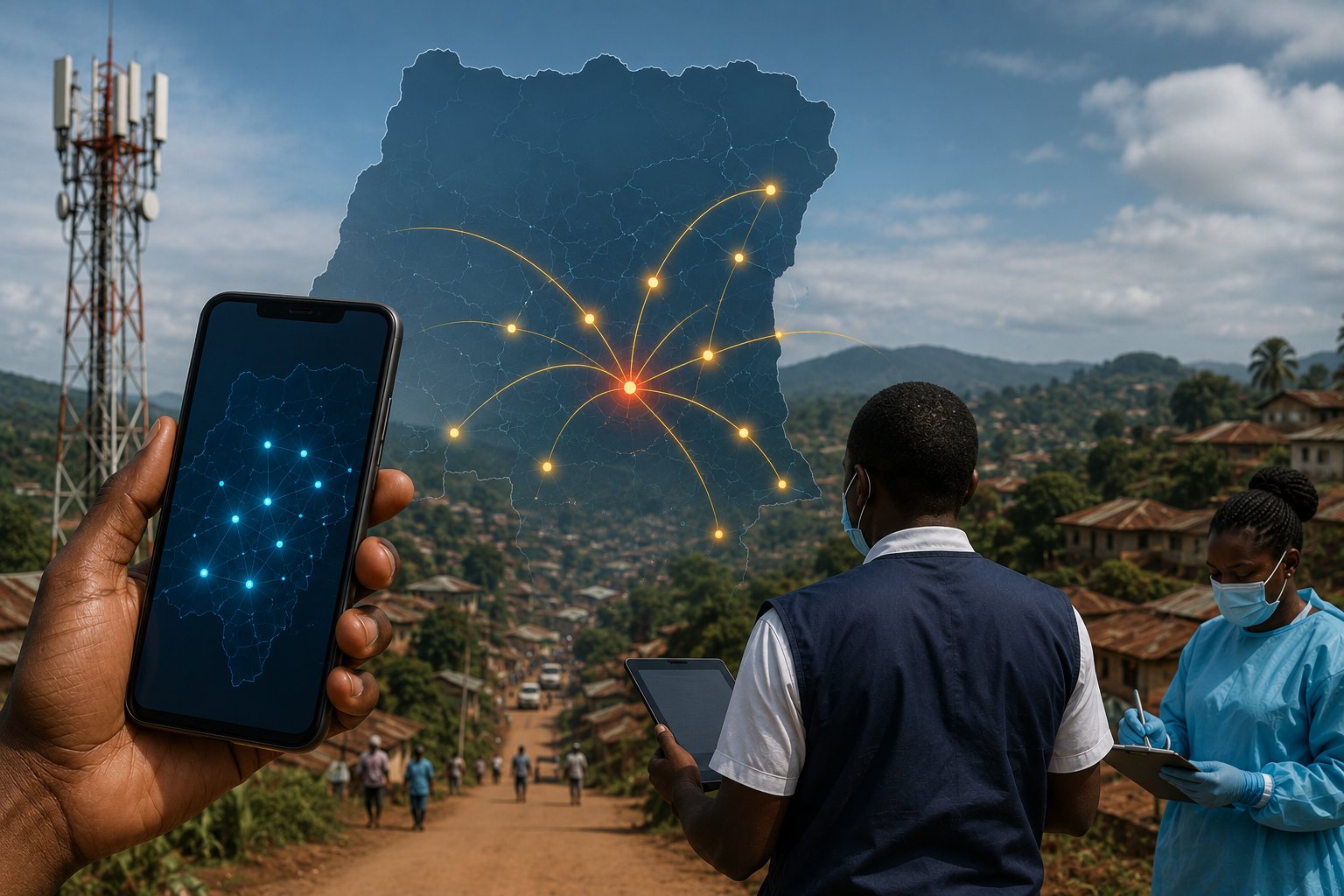
Congolese health authorities, the World Health Organization and Swedish non-profit Flowminder are using anonymized mobile-phone movement data to map population flows and identify where Ebola could spread next, turning telecommunications infrastructure into an increasingly important part of the country’s public-health response.
The technology offers health officials a new way to see movement patterns across a vast country where roads are difficult, insecurity is widespread and conventional disease surveillance can struggle to keep pace with transmission.
The development is significant not only because of what the data can reveal about the Ebola outbreak, but also because of what it says about who controls the infrastructure on which Africa’s health-security systems increasingly depend.
Reuters reported on Thursday that Flowminder is analysing anonymized mobile-phone data supplied by Vodacom Congo to understand how people move between outbreak areas and other parts of the Democratic Republic of Congo. The approach uses information generated when phones connect to mobile-network antennas, allowing researchers to estimate population movements without identifying individual subscribers.
The outbreak, caused by the Bundibugyo strain of Ebola, has become the largest Ebola outbreak ever recorded in the Democratic Republic of Congo. Reuters reported more than 6,250 infections and 3,039 deaths across six provinces as of Thursday. WHO had reported 5,794 confirmed cases and 2,786 deaths by Aug. 26, showing how rapidly the outbreak has expanded.
A new map of disease
For public-health officials, the value of mobile data is straightforward. Ebola does not respect administrative boundaries, and infections can emerge in places that have no obvious epidemiological connection on a conventional map.
People, however, create those connections every day.
A person travelling from an outbreak zone to a transport hub can potentially create a route for the virus to reach another community. By studying aggregated movement patterns, epidemiologists can identify locations that deserve stronger surveillance, additional testing capacity or preparations for possible cases.
Flowminder’s analysis initially examined movements from Bunia, Mongbwalu and Rwampara in Ituri province, areas closely associated with the beginning of the outbreak. The organisation’s June analysis found that mobile data could identify destinations receiving people from affected areas and help health officials prioritise surveillance.
Kisangani became an important example. Flowminder identified the city as a major mobility hub and warned that its connections made it important for Ebola surveillance. Shortly afterwards, cases were reported there. A later Flowminder analysis found links between Kisangani and health zones in several provinces, including areas in Maniema, Mongala, Bas-Uele and Kinshasa.
That does not mean the model predicts every outbreak location. Flowminder itself cautions that mobility is only one factor in transmission. Actual infections depend on contact patterns, behaviour, healthcare access and other conditions.
But the data can provide something traditional surveillance often lacks: an early picture of where people are going.
So who owns the data?
This is where the public-health story becomes a question of power.
The underlying mobile records are generated by telecommunications customers and held within the systems of mobile operators. In this case, Flowminder says the Ebola analysis uses anonymized Call Detail Records provided by Vodacom Congo.
The organisation says individual-level data does not leave Vodacom’s secure premises. Its published analysis is aggregated at health-zone level, and subscribers are not identified.
That distinction is important.
The public-health authorities are not receiving a list of named people travelling from one town to another. They are receiving statistical information about movement patterns.
Yet anonymization does not remove the broader ownership question.
Who has the infrastructure capable of producing the intelligence? Who decides when the data can be used? Who determines what analytical products are created? Who controls the technology, servers, algorithms and technical expertise needed to transform raw network information into policy?
In the current arrangement, a large part of that chain sits outside direct government ownership.
Telecom power
Vodacom Congo is not a small local technology company. Vodacom Group says it owns 51% of its DRC operation, while Vodafone holds a 65.1% stake in Vodacom Group. Vodacom describes its DRC business as the market leader, with about 26.1 million mobile customers.
That corporate structure matters because mobile networks are becoming more than communications infrastructure.
They are increasingly sources of economic intelligence, population statistics, humanitarian information and public-health signals.
During an epidemic, that makes telecommunications companies strategic actors in national health security.
Their networks can provide information about mobility at a scale that government agencies may find difficult or expensive to reproduce independently.
This creates a paradox. The state may have legal responsibility for protecting public health, while private companies possess some of the infrastructure needed to understand the movement of the population.
The African sovereignty question
For the Democratic Republic of Congo, the issue is particularly important because the country has enormous geographic scale but limited digital infrastructure.
The Internet Society’s 2026 country assessment lists five operational data centres in the DRC and describes domestic hosting capacity as an area with room for further development. The U.S. International Trade Administration has likewise identified limited domestic data-centre capacity as a challenge for the country’s digital economy.
This means digital sovereignty cannot simply mean passing a law saying data belongs to the country.
Sovereignty also requires infrastructure.
A government needs secure data centres, trained analysts, interoperable health-information systems, cybersecurity capabilities and institutions capable of managing sensitive information without relying indefinitely on outside organisations.
Otherwise, the country may have legal authority over health data while remaining dependent on foreign companies and international organisations for the practical ability to use it.
The foreign partner dilemma
Flowminder’s role illustrates another layer of the question.
The Swedish non-profit brings specialist expertise in processing mobility data. WHO brings epidemiological expertise and international coordination. Funding for the Flowminder DRC programme has included support from the King Baudouin Foundation, William and Flora Hewlett Foundation, Britain’s Foreign, Commonwealth and Development Office and Gavi, according to Flowminder.
There is a strong argument for such partnerships.
During a fast-moving epidemic, governments should use whatever credible expertise can help save lives. Building every capability from scratch during an emergency would be unrealistic.
But emergency partnerships can also create long-term dependencies.
If foreign organisations repeatedly provide the analytical capacity, international donors finance the work and multinational companies control key infrastructure, African governments risk becoming consumers of health intelligence rather than owners of the systems that produce it.
That distinction could become increasingly important as artificial intelligence, satellite imagery, digital identity systems and mobile analytics become central to public policy.
Privacy cannot be secondary
The health-security argument also has to confront privacy.
Mobile-phone metadata can reveal patterns of human behaviour even when names are removed. If improperly handled, telecommunications information can become a powerful surveillance tool.
The DRC’s telecommunications framework includes protections for privacy and personal data. Articles 126 to 133 of the country’s 2020 telecommunications and ICT legislation address privacy and the protection of personal data, including confidentiality of communications.
The Ebola programme’s use of aggregated and anonymized information is therefore an important safeguard.
But transparency should go further.
Communities should know what information is being used, for what purpose, who can access the resulting analysis and how long information is retained. Clear rules should distinguish legitimate epidemic surveillance from broader population monitoring.
Public trust is itself a health-security asset.
If people believe that seeking medical care or carrying a mobile phone could expose their movements to authorities, they may become less willing to cooperate with health workers.
Who should control Africa’s health intelligence?
The lesson from the Ebola response may not be that telecommunications companies should be removed from public-health operations.
It may be that African governments need stronger bargaining power over the digital infrastructure they already depend on.
A sustainable model would allow telecom operators to contribute anonymized information while governments retain meaningful control over public-health priorities, governance standards and the resulting intelligence.
African universities and public institutions could also play a larger role in analysing mobility data. Instead of importing expertise only during emergencies, governments could invest in permanent epidemiological data teams capable of working alongside telecom operators and international organisations.
That would transform the relationship from dependency to partnership.
A test of digital sovereignty
The Ebola outbreak is therefore testing more than the DRC’s ability to contain a dangerous virus.
It is testing whether African states can exercise sovereignty in an economy where information is increasingly generated and controlled by private digital networks.
The immediate objective is clear: find where Ebola could travel before the virus gets there.
The longer-term question is harder.
If mobile-phone data can help determine where vaccines, surveillance teams and laboratories should go, then that data has strategic value. If the analytical systems can identify population movements across national borders, they have geopolitical value as well.
The DRC does not necessarily need to own every telecom tower, software platform or analytical company. But it does need the capacity to set the rules, protect citizens, audit systems and develop its own expertise.
The future of African health security may depend not only on who manufactures vaccines or runs hospitals, but also on who controls the information infrastructure that tells governments where the next outbreak could emerge.
For Who Owns Africa, that is the central question behind Congo’s mobile-data experiment. The technology may help save lives today. But the ownership of the digital systems powering it will help determine who has power over Africa’s health intelligence tomorrow.

More from Health
Zambia draws a line on data and still secures $1.5 billion from Washington
Zambia's health deal with Washington shows how African states can demand development finance while protecting data, resources and negotiating sovereignty.
Ebola reaches Kenya: Is America’s retreat from Africa making the crisis worse?
Kenya's Ebola case exposes how weakened global solidarity, shrinking health diplomacy and Africa's interconnected borders can turn local outbreaks into regional emergencies.
Kenya’s new invisible front: Ebola puts East Africa’s borders under pressure
Kenya’s first imported Ebola case exposes the limits of border screening and challenges East Africa to rethink health security, mobility and preparedness.