

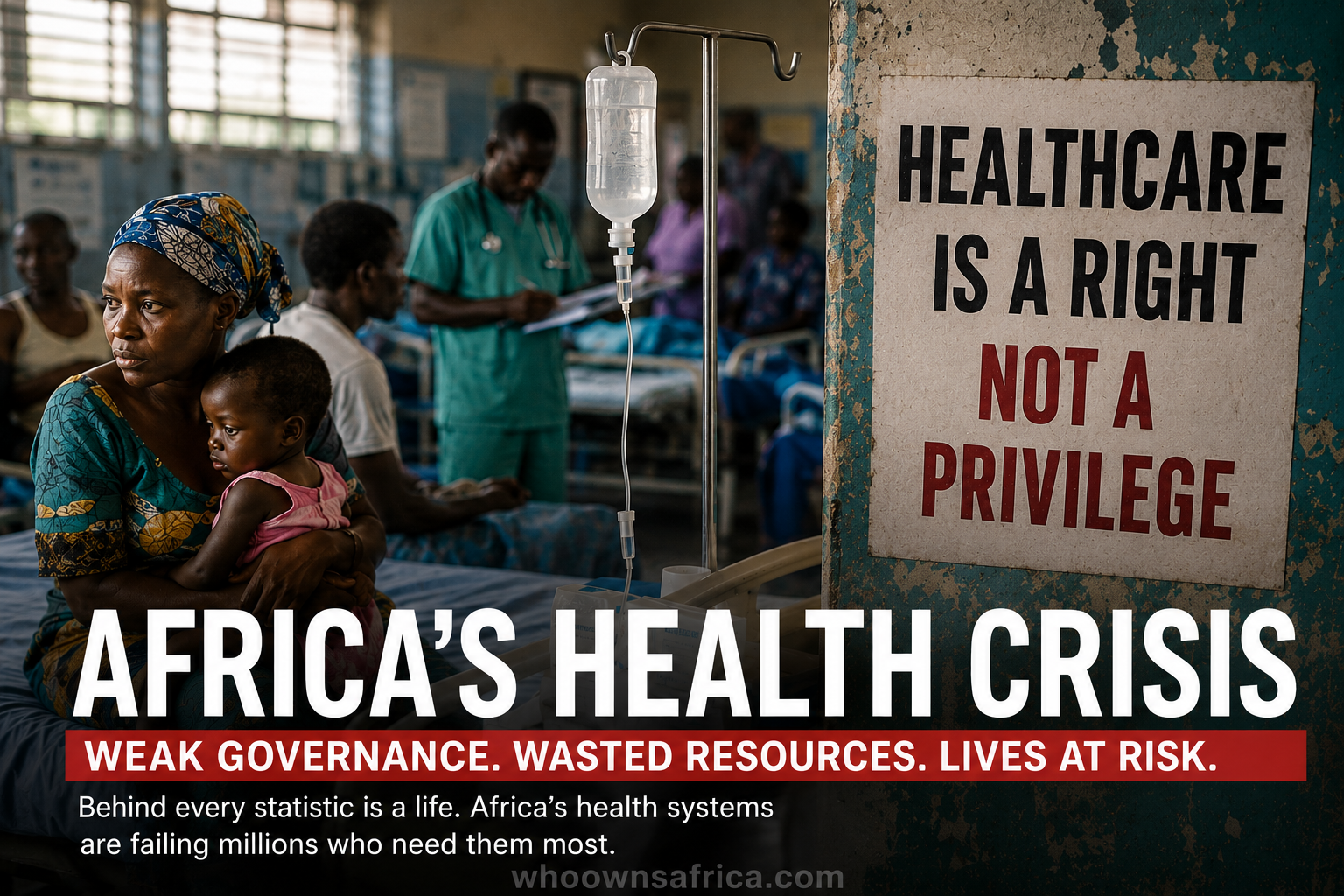
Weak institutions, inefficient spending and a growing healthcare workforce exodus are leaving African health systems vulnerable despite billions of dollars in domestic and international support.
Africa’s healthcare crisis is increasingly exposing a problem that money alone cannot solve: weak governance.
Across the continent, recurring disease outbreaks, shortages of medicines and equipment, overstretched hospitals and protests by healthcare workers are revealing persistent weaknesses in the way health systems are funded, managed and held accountable.
From Ebola outbreaks in Central and East Africa to industrial action by doctors and nurses in Kenya, Nigeria and Zimbabwe, the pressures are widespread.
The challenge is becoming more urgent as African populations grow and governments face competing demands for scarce public resources.
For countries that have received billions of dollars in international health assistance over decades, the question is no longer simply whether more money is needed.
It is whether existing resources are being converted into functioning hospitals, adequately staffed facilities and reliable healthcare for ordinary citizens.
Funding is only part of the problem
Africa’s health systems remain chronically underfunded.
Many countries have failed to meet the Abuja Declaration target of allocating at least 15% of national budgets to healthcare.
But funding shortfalls do not fully explain why hospitals can lack essential medicines and equipment even when budgets have been approved.
Audits and independent reviews cited in the source material point to recurring problems including delayed disbursement of funds, procurement irregularities and underutilisation of allocated budgets.
The consequences are often visible at the frontline.
Healthcare workers report outdated equipment, shortages of basic medicines and infrastructure projects delayed by administrative bottlenecks.
That points to a broader problem: the effectiveness of health spending depends not only on how much governments allocate, but on how those resources are managed.
A cycle of crisis and response
Disease outbreaks repeatedly expose these weaknesses.
Emergency responses can mobilise international expertise, funding and logistics, but the improvements often prove difficult to sustain once the immediate threat has passed.
The World Health Organization and the Africa Centres for Disease Control and Prevention remain important in coordinating responses to health emergencies.
Yet rural clinics can return to chronic shortages, laboratories can remain under-equipped and disease surveillance systems can continue to operate below the capacity needed to detect threats early.
This creates a recurring pattern: emergency intervention followed by a return to structural vulnerability.
For patients, the consequences extend well beyond outbreaks.
In many rural and underserved areas, people must travel long distances to reach healthcare facilities that may themselves lack medicines, equipment or sufficient staff.
A system that is constantly responding to emergencies has less capacity to prevent them.
International aid fills gaps but creates dependencies
International organisations have played a major role in improving healthcare across Africa.
The World Bank, Global Fund to Fight AIDS, Tuberculosis and Malaria, and Gavi, the Vaccine Alliance, have supported programmes addressing HIV, tuberculosis, malaria and vaccine-preventable diseases.
Those programmes have delivered important gains.
But reliance on external financing can create another vulnerability.
When governments depend heavily on donors to fill domestic funding gaps, long-term health planning can become tied to external priorities. In some cases, donor-funded programmes focus heavily on individual diseases rather than the wider infrastructure required to sustain healthcare delivery.
The result can be a system that performs well in selected areas while remaining vulnerable elsewhere.
A successful vaccination campaign, for example, cannot compensate for a shortage of doctors, laboratories or functioning primary healthcare facilities.
Healthcare workers are becoming a pressure point
Few indicators reveal the strain on public health systems more clearly than the growing dissatisfaction among healthcare workers.
Doctors and nurses in Kenya have staged repeated strikes over pay, working conditions and delayed salaries. Similar disputes have occurred in Nigeria, while Zimbabwe’s health sector has faced prolonged industrial action.
The disputes are often presented as labour conflicts.
But the underlying grievances point to wider systemic weaknesses.
Healthcare workers report chronic understaffing, inadequate equipment and difficult working conditions. Years of responding to the COVID-19 pandemic and other health emergencies have also increased pressure on frontline staff.
Burnout and declining morale can further weaken already stretched services.
Then there is migration.
Skilled doctors and nurses are increasingly seeking better-paid opportunities in Europe, North America and the Middle East.
The loss of trained professionals creates a difficult cycle. Fewer workers mean greater pressure on those who remain, which can make working conditions worse and encourage more professionals to leave.
COVID-19 exposed the preparedness gap
The COVID-19 pandemic provided one of the clearest tests of Africa’s health infrastructure in decades.
Many governments introduced public health measures quickly, but the pandemic exposed shortages in critical care capacity, oxygen supplies, personal protective equipment and other essential resources.
Intensive care units remain limited in many countries, particularly outside major urban centres.
Since the pandemic, governments and regional institutions have promoted stronger surveillance systems, expanded laboratory capacity and improved emergency response planning.
The weakness is implementation.
Preparedness plans require sustained funding, trained personnel and functioning institutions. Without those foundations, strategies can remain largely theoretical.
The next health emergency will test whether the lessons of COVID-19 have translated into permanent improvements.
Political choices shape health outcomes
At the centre of the crisis is a political question: what do governments choose to prioritise?
African governments face pressure to finance infrastructure, security, debt obligations and other national priorities.
But persistent underinvestment in healthcare can carry significant economic costs of its own.
Weak governance can compound the problem.
Limited transparency and ineffective institutions can undermine public spending, while opaque procurement systems can contribute to inflated costs and delays in delivering medical supplies.
When citizens lose confidence in public healthcare, those who can afford it may turn to private providers.
Those who cannot are left with fewer alternatives.
That creates a two-tier system in which access to quality care increasingly depends on income and location.
Africa’s progress is uneven
The continent’s health crisis should not be treated as uniform.
Some countries have made substantial progress in expanding healthcare access.
Rwanda has invested in community-based healthcare and insurance coverage. Ghana’s National Health Insurance Scheme has expanded access to services, while South Africa has relatively advanced healthcare infrastructure despite persistent challenges.
But progress varies sharply between countries and within them.
Rural communities and conflict-affected areas often face the greatest shortages of healthcare workers, equipment and financing.
The differences suggest that solutions must be tailored to national and local circumstances rather than imposed through a single continental model.
Following the money
Where health money goes matters as much as how much is available.
A substantial share of health financing is directed towards disease-specific programmes, particularly HIV, malaria and tuberculosis.
Those programmes have produced measurable results, but broader needs such as primary healthcare, workforce development and maintenance of existing facilities can receive less attention.
Hospital construction illustrates the problem.
New facilities are highly visible and can become attractive political projects. But buildings alone do not provide healthcare.
Hospitals require doctors, nurses, medicines, equipment, electricity, maintenance and long-term operating budgets.
Without those resources, expensive facilities can remain underused.
Administrative delays create another drain on public resources, with funds sometimes becoming trapped in complex bureaucratic systems before reaching frontline services.
Greater transparency over health budgets and procurement is therefore central to improving outcomes.
The cost is ultimately paid by patients
The consequences of these failures are measured not only in budgets and strikes, but in human lives.
Patients face long waiting times, shortages of essential medicines and high out-of-pocket costs.
For low-income households, medical expenses can push families into financial hardship.
Delays in diagnosis and treatment can also turn preventable illnesses into life-threatening conditions.
Healthcare workers face their own risks, working long hours in stressful environments and, during outbreaks, sometimes without adequate protection.
The cumulative effect is a system that struggles to provide reliable care when people need it most.
A chance to rebuild
The decline is not irreversible.
The African Union and Africa Centres for Disease Control and Prevention are pursuing initiatives aimed at improving regional coordination and strengthening local capacity.
African countries are also exploring domestic production of vaccines, medicines and medical supplies, while digital health technologies could help expand access and improve efficiency.
But none of these measures will succeed without sustained political commitment.
Building resilient health systems requires governments to look beyond emergency responses and invest consistently in primary care, healthcare workers, laboratories, supply chains and public health infrastructure.
It also requires stronger oversight of how health budgets are allocated and spent.
Conclusion
Africa’s healthcare crisis is often described as a shortage of money.
The evidence presented in this analysis suggests a more complicated picture.
Funding matters, but governance determines how effectively that funding reaches patients.
Weak institutions, procurement problems, workforce shortages, dependence on external financing and inconsistent political commitment can undermine even well-funded programmes.
The choice facing African governments is therefore broader than whether to increase health budgets.
They must decide whether healthcare will be treated as a long-term investment in economic and social stability, rather than a sector that receives urgent attention only when the next crisis arrives.
For millions of Africans, that distinction could determine whether the continent remains trapped in a cycle of emergency response or builds health systems capable of preventing, absorbing and recovering from future shocks.

More from Health

Does health insurance in Africa really matter?
Across the continent, insurance schemes promise protection from medical bills, yet most people still pay from their own pockets.
DR Congo Ebola: Who controls the data behind Africa’s health security?
Congo’s Ebola response is turning telecom data into a public-health tool, raising questions over ownership, sovereignty, privacy and foreign influence.
Who owns Africa’s vaccine supply chains?
As Ebola spreads in DR Congo, the outbreak underscores Africa's push to strengthen vaccine manufacturing, health infrastructure and biotechnology investment.