


Ask a market trader in Lagos, a boda boda rider in Nairobi, or a teacher in Lusaka whether they have health insurance, and the answer, more often than not, is a shrug followed by a story about a bill they paid in cash they didn’t really have. That single exchange captures the real state of health financing across Africa better than any government white paper. Insurance exists on paper in most countries. It exists in practice for a minority. And the gap between those two facts is where this commentary lives.
The question in the headline is not rhetorical. It is asked in policy circles, in parliaments, and increasingly in households that have watched a single hospital admission wipe out months of savings. Does health insurance in Africa really matter? The honest answer is yes, urgently, but not in the way the glossy program launches suggest. It matters because of what happens when it is absent, not because of what it currently delivers.
A continent still paying cash for its own survival
Across sub-Saharan Africa, insurance coverage remains startlingly thin. Research pooling demographic and health survey data from 23 countries found overall coverage sitting at roughly 11 percent among women and 14 percent among men in urban areas. Rural coverage tends to be lower still. That statistic alone should reframe how the continent talks about healthcare financing. It is not a system with gaps. It is, for most people, no system at all.
Nigeria illustrates the pattern starkly. Despite a national scheme that has existed in one form or another since 1999, enrolment has hovered for years around a fraction of the population. Even after the country’s most consequential health financing reform in decades, the National Health Insurance Authority Act of 2022, out-of-pocket payments still make up an estimated roughly 71 to 76 percent of total health expenditure, meaning the majority of Nigerians remain financially exposed every time illness strikes. Enrolment has grown, reaching 22.03 million people by July 2026, a 35 percent year-on-year increase, but set against a population north of 220 million, that growth still leaves most citizens outside the system.
This is not a uniquely Nigerian story. It is the regional norm, with a handful of exceptions that prove how much political will actually matters.
The exceptions that prove reform is possible
Rwanda is the country most often cited when African policymakers want to prove universal coverage is achievable without Western-scale budgets. Its community-based health insurance model, built on modest, income-adjusted premiums pooled at the village level, has been credited with steep declines in preventable child deaths and has become something of a policy pilgrimage site for health ministries elsewhere on the continent.
Ghana offers a similar, if less dramatic, lesson. Its National Health Insurance Scheme has pushed coverage into the 40 to 50 percent range in parts of the country, with out-of-pocket spending falling to around a quarter of total health costs, backed by sustained public investment running into the hundreds of millions of dollars annually. Kenya’s social insurance overhaul has leaned on technology, expanding telemedicine access to stretch limited resources further into underserved counties.
What these examples share is not a single financing model. Rwanda relies on community pooling. Ghana leans on a national levy. Kenya is experimenting with digital rails to cut administrative friction. What they share is sustained political commitment measured in years, not electoral cycles, and a willingness to subsidise the poorest rather than assume the market will eventually reach them.
Why the market alone will not close this gap
There is a temptation, common among finance ministries courting foreign investment, to treat health insurance as a market that simply needs more private capital and better distribution. The regional insurance industry is indeed growing. Analysts project Africa’s broader insurance market climbing from roughly 88.5 billion dollars in 2026 to nearly 160 billion dollars by 2035, driven by urbanisation, rising incomes, and mobile-first premium collection reaching customers who never had a bank branch nearby. Microinsurance products are spreading among informal-sector workers in East Africa, and bancassurance partnerships are pulling underserved rural municipalities into formal coverage for the first time.
None of that growth, however, is arriving primarily as health cover for the poor. It is concentrated in life insurance, motor cover, and increasingly sophisticated products for the emerging middle class in Lagos, Nairobi, and Johannesburg. Health insurance remains a smaller, harder segment to sell profitably, because the people who need it most are precisely the people insurers find least profitable to enrol: informal workers with irregular incomes, rural households far from accredited facilities, and populations with higher underlying disease burdens.
A purely commercial approach to health insurance in Africa will always underserve the poor, because insurance economics punish exactly the people universal health coverage is supposed to protect.
Closing that gap requires subsidy, cross-subsidy, or state-backed pooling, not just better sales channels.
South Africa’s cautionary tale of ambition without consensus
No country better illustrates how contested this issue becomes once real money and real interests are on the table than South Africa. Its National Health Insurance Act, signed into law in 2024, aims to eventually fold the country’s fragmented system, a well-resourced private medical scheme sector serving a wealthier minority alongside an overstretched public system serving everyone else, into a single public fund.
The intent is admirable: end a two-tier arrangement where roughly 15 percent of the population, covered by private medical schemes, consumes a disproportionate share of the country’s health spending and its specialist doctors, while the majority relies on public hospitals that are chronically underfunded and understaffed. Public sector out-of-pocket costs have been kept relatively low at around 15 percent of expenditure, a genuine achievement, but access and quality remain deeply unequal between those two systems.
The politics, however, have been brutal. Private insurers, medical associations, and opposition parties have challenged the law’s constitutionality and financing model, arguing the public system cannot absorb the administrative and clinical burden of universal enrolment without years of preparatory investment first. Implementation timelines have already slipped, and the fight over South Africa’s NHI is likely to run for years yet. It is a useful reminder that even a relatively wealthy, industrialised African economy with strong institutions finds universal health financing reform politically punishing. Poorer, less institutionally robust countries face an even steeper climb.
The informal economy problem nobody has solved
Roughly eight in ten workers across sub-Saharan Africa operate in the informal economy, according to labour estimates that have held roughly steady for years. They sell vegetables, drive motorcycles, braid hair, repair phones, and trade across borders. None of that income shows up neatly on a payroll that an insurer or tax authority can tap for automatic premium deductions.
Every national scheme on the continent, from Nigeria’s Group Individual and Family Social Health Insurance Programme to Kenya’s revamped social health fund, has built a separate track specifically to try to capture these workers, and every one of those tracks has struggled with the same problem: voluntary enrolment among people who must choose, month to month, between a premium and rent. When money is tight, health insurance is the bill that gets deferred, because the cost of skipping it is invisible until the day it isn’t.
Digital premium collection, paid through mobile money in small, frequent instalments rather than one intimidating annual sum, is one of the more promising fixes under active study. Early evidence suggests it lowers the psychological and logistical barrier to enrolment, though a rigorous review of its actual impact on coverage and retention rates across the region is still being finalised by researchers this year. The honest position, for now, is cautious optimism rather than proof of concept.
What happens to families without cover
Statistics can flatten the human weight of this gap. A market trader in Lagos who skips her child’s medical check-up because it costs half a week’s sales is not an outlier; she is the median experience for hundreds of millions of households across the continent. A single hospital admission, an unplanned caesarean section, a diagnosis that requires ongoing medication, any of these can consume savings built over years in a matter of days.
This is what health economists mean when they talk about catastrophic health expenditure, and it is the real argument for why insurance matters, more than any abstract commitment to universal coverage as a policy slogan. Insurance is not primarily about making healthcare free. It is about converting an unpredictable, potentially ruinous cost into a small, predictable one. A family that pays a modest premium every month is protected from the kind of shock that pushes households back into poverty after they had only just climbed out.
Without that protection, illness becomes one of the leading informal taxes on the African poor, arriving without warning and collected without mercy.
The uncomfortable question of who actually pays
Behind almost every African health financing success story sits a quieter truth: donor money still underwrites a meaningful share of the continent’s health systems, from vaccine programmes to maternal health clinics to the technical advisers who help design national insurance schemes in the first place. That dependency is shrinking as aid budgets in donor capitals face their own domestic pressures, and African governments are increasingly, if reluctantly, being forced to ask what happens when that support recedes further.
This is not an argument against donor partnership, which has saved lives and built genuine institutional capacity. It is an argument for treating domestic resource mobilisation, taxation, national insurance levies, and disciplined public spending, as the only durable foundation for universal coverage. The World Health Organization has long recommended that countries direct roughly 5 percent of gross domestic product toward health; most African economies still fall well short of that benchmark, with Nigeria’s health spending sitting closer to 3.8 percent of GDP. Insurance schemes built on premiums alone, without a strong tax-funded backbone subsidising the poorest enrollees, tend to stall exactly where they are needed most.
The private sector has a role here too, and it is not a purely cynical one. Employer-sponsored group insurance, on-site workplace clinics, and corporate partnerships with NGOs have measurably cut sick days and improved productivity in cities like Lagos, offering a template that could be extended further into the informal economy through cooperatives and trade associations rather than individual employers alone.
The politics behind the policy
It would be naive to treat health insurance reform purely as a technical financing question. It is deeply political. Mandating insurance, as Nigeria’s 2022 Act attempts to do, means confronting employers who resent new payroll obligations, informal workers who distrust a state they associate with extraction rather than service, and healthcare providers who must be accredited, paid promptly, and held to standards many currently fall short of.
Lagos State’s decision to make coverage compulsory for all residents, not just formal employees, and the federal legislature’s move to compile and sanction non-compliant companies, show enforcement finally catching up to ambition in at least one part of Nigeria. Whether that model travels to less wealthy, less administratively capable states is an open question, and probably the one that will determine whether the national reform succeeds or simply adds another underfunded acronym to the pile.
There is also a quieter political tension worth naming: governments that spend on health insurance subsidies are choosing not to spend that money elsewhere, in electoral cycles where visible infrastructure often wins more votes than invisible financial protection. Rwanda and Ghana sustained their reforms across changes in leadership. That continuity, more than any specific design feature, may be the hardest thing for other countries to replicate.
What would actually move the needle
None of this means the situation is hopeless, or that policymakers are short of workable ideas. Several practical shifts, already visible in pockets of the continent, deserve to be scaled rather than reinvented.
First, subsidised premiums for the poorest and informally employed need to stop being an afterthought bolted onto formal-sector schemes and become the primary design target from the outset, funded through general taxation or earmarked levies rather than voluntary contributions that predictably collapse under financial stress. Second, digital enrolment and mobile money premium collection should be treated as core infrastructure, not a pilot programme, given how effectively they have already lowered friction where they have been properly funded and integrated with national identity systems. Third, accreditation and prompt payment of healthcare providers matter more than headline enrolment numbers, because an insurance card that cannot be used at a nearby, functioning clinic is worth little to the family holding it.
Finally, and perhaps most importantly, political continuity has to survive changes in government. Rwanda and Ghana’s progress was not the product of a single visionary minister but of institutions and budgets that outlasted individual administrations. Countries that treat health financing reform as a multi-decade national commitment, rather than a signature policy for one electoral term, are the ones most likely to be cited as success stories a decade from now.
So, does it really matter?
Strip away the acronyms, the enrolment targets, and the investor presentations, and the answer becomes simple. Health insurance matters in Africa not because it currently works well across the continent, because for the most part it does not, but because its absence is measurably, personally costly to the people least able to absorb that cost.
The countries making genuine progress, Rwanda through community pooling, Ghana through sustained public financing, Kenya through digital reach, share a refusal to treat insurance as a product to be sold rather than a protection to be guaranteed. The countries still struggling, Nigeria chief among them despite a bold legal framework, are discovering that passing a law is the easy part; building the trust, enforcement, and subsidy architecture to make that law real for an informal trader or a rural farmer is the work that actually determines outcomes.
Until that work is done at scale, the answer to whether health insurance really matters in Africa will keep being written not in policy documents but in the quiet arithmetic of households deciding, illness by illness, what they can afford to treat and what they will have to hope simply goes away. That arithmetic, repeated across hundreds of millions of kitchen tables from Dakar to Dar es Salaam, is the real measure of whether a continent’s health financing reforms are working, far more than any enrolment figure announced at a policy conference.
For now, the most honest thing that can be said is that Africa has proven, in isolated but genuine cases, that universal health coverage is achievable within its own means. What remains unproven, at continental scale, is the political stamina to finish what a handful of countries have started.
This is a commentary piece. The views expressed reflect analysis of publicly available health financing data and reporting from across the African insurance and health policy landscape.

More from Health
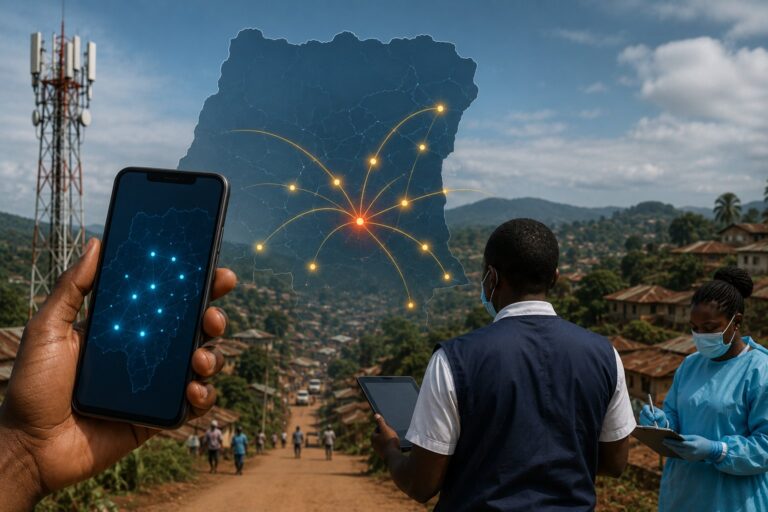
DR Congo Ebola: Who controls the data behind Africa’s health security?
Congo’s Ebola response is turning telecom data into a public-health tool, raising questions over ownership, sovereignty, privacy and foreign influence.
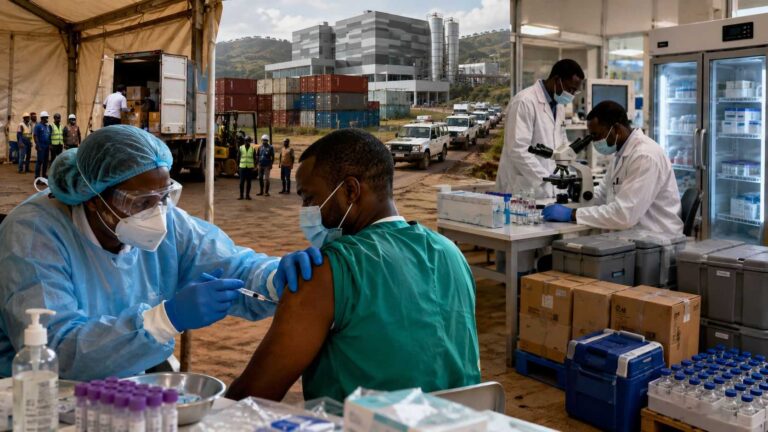
Who owns Africa’s vaccine supply chains?
As Ebola spreads in DR Congo, the outbreak underscores Africa's push to strengthen vaccine manufacturing, health infrastructure and biotechnology investment.