

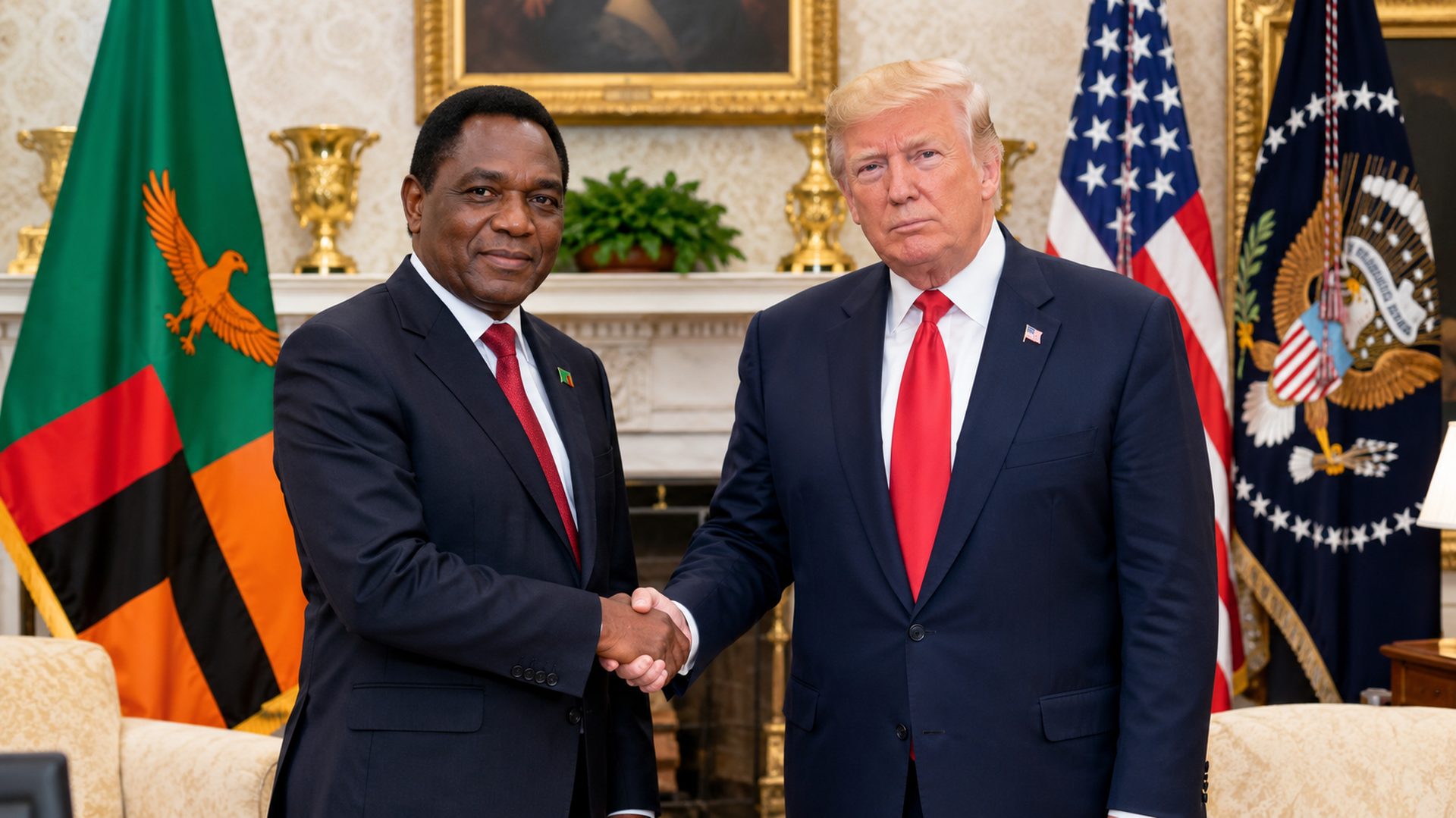
Zambia’s decision to move ahead with a $1.5 billion United States health agreement is not simply a story about aid arriving after months of diplomatic friction. It is a revealing example of an African government discovering that saying no can sometimes be as valuable as saying yes.
That distinction matters.
The agreement is expected to provide $1.5 billion in US health funding over five years, as part of a broader $3.6 billion health commitment involving Zambia and the United States. The revised arrangement follows months of disagreement over health data, biological specimens, intellectual property and other provisions. Zambian officials say the controversial requirements concerning individual patient data and specimen sharing have been removed.
The important story, however, is not the size of the cheque.
It is the negotiation that came before it.
The price of saying no
For years, much of Africa’s development relationship with wealthy countries has been built around a familiar imbalance. Capital comes from outside. Expertise comes from outside. Technology comes from outside. The conditions often follow.
That model is changing, slowly.
Zambia’s negotiations with Washington suggest that African governments are becoming more conscious of the less visible assets sitting inside their institutions. Data is one of them.
A health record may look like an administrative document. At national scale, it becomes something much more significant.
It can reveal disease patterns, population movements, treatment outcomes, genetic information and the effectiveness of health interventions. Disease surveillance systems can also generate biological material that becomes valuable to researchers developing diagnostics, vaccines and medicines.
That creates a difficult question.
If foreign money helps build the system that generates the information, does that give the foreign financier ownership of the information?
Zambia’s answer appears to be no.
That is a small sentence with enormous implications.
Data is becoming sovereignty
The old language of sovereignty was built around land, borders, armies and natural resources.
The new language is increasingly digital.
Who owns a citizen’s medical information? Who can transfer it across borders? Who can combine it with other datasets? Who can commercialise discoveries produced from biological material? Who receives the benefits when research based on African samples becomes a profitable medicine?
These questions are no longer theoretical.
Zambia’s dispute brought them into the centre of a negotiation involving billions of dollars.
The final agreement, according to Zambian officials, will not require the country to send biological specimens to the United States, while concerns over individual patient data have been removed. The government also says it pushed for clearer provisions on intellectual property, benefit sharing and scientific capacity.
That is precisely why the episode deserves more attention than it has received.
Aid is no longer just aid
Washington’s evolving approach to African health financing is part of a much larger transformation in US engagement with the continent.
The era of large programmes administered primarily through traditional aid structures is giving way to bilateral arrangements that place greater emphasis on national governments taking responsibility for health systems and eventually increasing domestic financing.
That transition can make sense.
African countries should ultimately finance more of their own healthcare. External support should strengthen institutions rather than create permanent dependency.
But there is a danger when financial assistance becomes a vehicle for securing advantages in unrelated strategic areas.
Earlier in the year, Zambia publicly objected to what it described as an attempt to connect health assistance with negotiations over critical minerals. Reuters reported at the time that Lusaka wanted the health and minerals discussions treated separately.
That issue exposes another uncomfortable reality.
Copper sits behind the conversation
Zambia is not an ordinary aid recipient.
It is one of Africa’s major copper producers and sits at the centre of a strategic minerals contest involving the United States, China and European powers.
Copper is indispensable to electricity networks, renewable energy infrastructure, transport and industrial technology. Zambia’s mineral wealth therefore gives the country importance far beyond its borders.
That creates opportunities, but also pressure.
When a country possesses something powerful, external partners naturally want access to it.
The question for Lusaka is how to convert that interest into national advantage without exchanging one form of dependency for another.
This is where the health agreement becomes interesting.
If health financing can be negotiated independently from mineral access, Zambia has demonstrated that strategic relationships do not necessarily have to become package deals.
That principle could matter well beyond Zambia.
Africa should negotiate the whole equation
There is a tendency to discuss African countries as though they are competing for assistance from richer nations.
That perspective is increasingly outdated.
African states possess markets, minerals, data, young populations, agricultural potential, strategic geography and political influence. The negotiation is therefore not simply about what Africa receives.
It should also be about what Africa contributes and what it retains.
Zambia’s experience offers a useful template.
Take the money.
Take the medical expertise.
Take the training.
Take the technology.
But establish clearly who controls national data, who owns intellectual property, where biological samples can travel and how citizens benefit when research generates commercial value.
That is not hostility toward foreign partners.
It is the foundation of a serious partnership.
The unanswered questions remain
The revised agreement is a diplomatic success for Zambia, but it should not be treated as the end of the debate.
One important issue is transparency.
Zambian officials have said the final memorandum will not be made public before signing.
That creates an obvious problem.
If sovereignty is the principle being defended, citizens should be able to understand the agreement made in their name.
Parliamentarians, civil society organisations, health professionals and data protection specialists should be able to examine the final terms and assess whether the safeguards described by government are actually enforceable.
Another question concerns sustainability.
Zambian officials say the US contribution will form part of a broader five-year health commitment and that Zambia will increase its own financing as the country moves toward greater self-reliance.
That may ultimately be more important than the headline figure.
A $1.5 billion injection can expand programmes.
It cannot, by itself, build a permanently independent health system.
The real victory is the precedent
Zambia should not be romanticised as though it has suddenly rewritten the rules of international development.
It has not.
Nor should Washington be portrayed as an enemy simply because its original proposals generated resistance.
The more interesting interpretation is that both sides eventually recognised the value of compromise.
Washington still gets a major health partnership.
Zambia still receives substantial financial support.
And the Zambian government says provisions it regarded as unacceptable have been removed.
That is what negotiation is supposed to achieve.
For Africa, the broader lesson is even more important.
The continent does not need to reject foreign capital, American partnerships or international assistance to defend sovereignty.
It needs the confidence to negotiate them.
Who owns Africa’s data?
This may become one of the defining questions of the next decade.
Africa’s resources are no longer limited to what can be dug out of the ground.
The continent is producing enormous quantities of digital information through hospitals, mobile networks, financial systems, universities, governments and businesses.
That information will have economic value.
The countries that control the rules surrounding it will have power.
Zambia’s negotiations with Washington therefore represent something bigger than one health agreement. They show that African sovereignty is entering a new phase, one in which control over information may become as consequential as control over copper.
The lesson for other governments is straightforward.
Do not confuse partnership with surrender.
Do not confuse funding with ownership.
And do not assume that accepting assistance means accepting every condition attached to it.
Zambia has shown that an African government can challenge the terms, protect what it considers strategically important and still reach an agreement.
For WHO OWNS AFRICA, that is the deeper story.
The future of African sovereignty may not be decided only in mines, presidential palaces or military headquarters.
Increasingly, it may be decided inside databases.
And the countries that understand that early will have a much stronger hand when the next negotiation begins.

More from Health

Ebola reaches Kenya: Is America’s retreat from Africa making the crisis worse?
Kenya's Ebola case exposes how weakened global solidarity, shrinking health diplomacy and Africa's interconnected borders can turn local outbreaks into regional emergencies.

Kenya’s new invisible front: Ebola puts East Africa’s borders under pressure
Kenya’s first imported Ebola case exposes the limits of border screening and challenges East Africa to rethink health security, mobility and preparedness.

Does health insurance in Africa really matter?
Across the continent, insurance schemes promise protection from medical bills, yet most people still pay from their own pockets.