

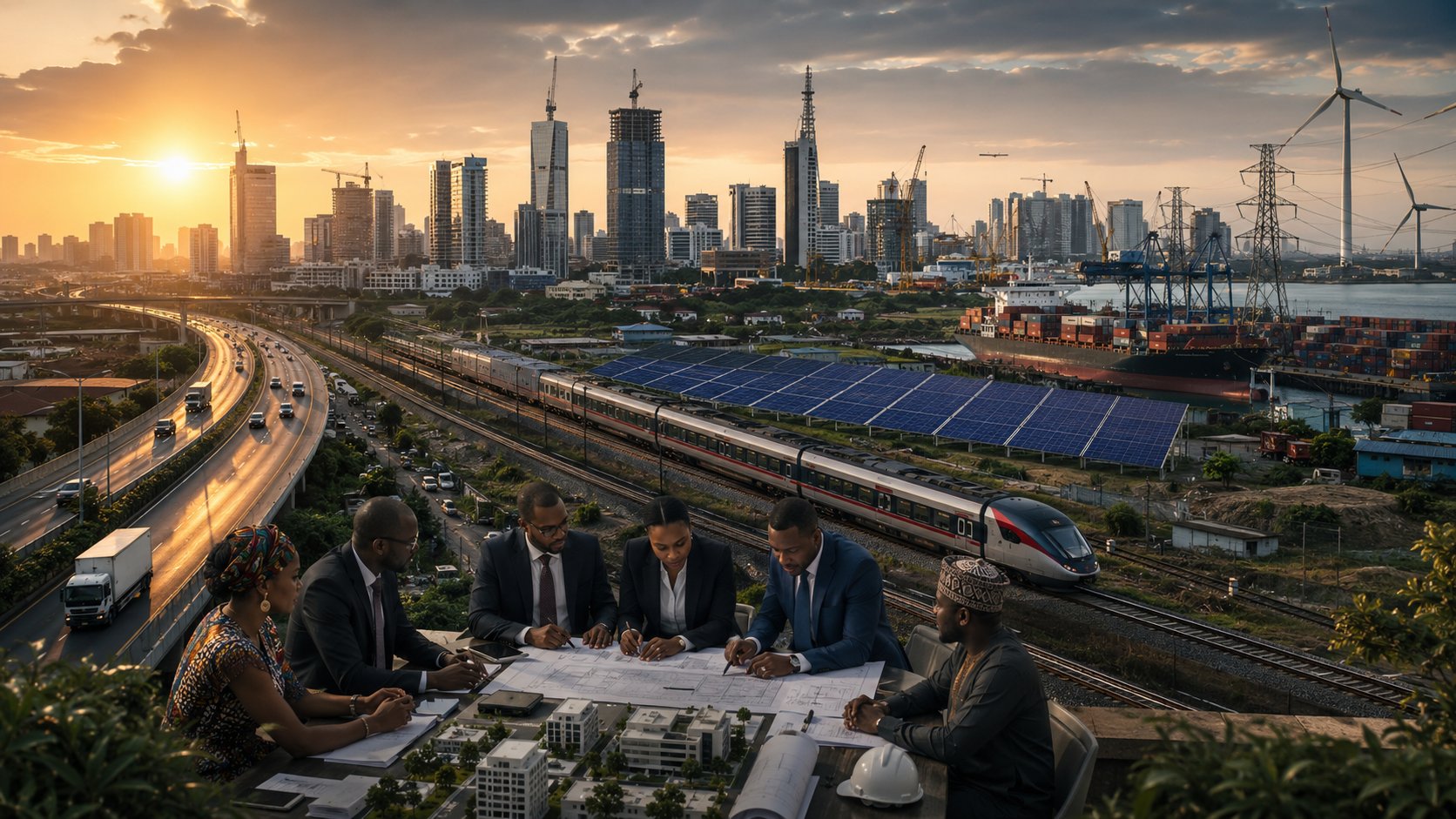
Africa’s infrastructure investment story is entering a new phase, with institutional investors increasingly being drawn into the financing of roads, energy systems, transport networks and digital infrastructure that will shape the continent’s economic future.
The launch of a $150 million Infrastructure Climate-Resilient Fund in Nigeria by AFC Capital Partners is one of the latest signs of that shift. The fund is designed to mobilise domestic institutional capital for climate-resilient infrastructure and forms part of a broader $750 million pan-African initiative that aims to unlock as much as $3.7 billion in total project financing.
The scale of the opportunity
The Nigerian fund arrives as Africa faces a huge infrastructure financing gap. A joint OECD and African Union assessment estimates that African countries would need to invest an average of $155 billion a year in infrastructure through 2040 to bring infrastructure development closer to levels seen in comparable economies. Such an increase could more than double Africa’s GDP by 2040 and add an estimated $2.83 trillion to the continent’s economy.
The requirement covers far more than traditional public works. Africa needs new electricity generation and transmission, roads and railways, ports and logistics facilities, water infrastructure, industrial zones and digital networks. The continent also needs to upgrade existing infrastructure so that it can cope with climate risks. That combination of economic growth, urbanisation, industrialisation and climate pressure is creating one of the largest long-term infrastructure investment opportunities in emerging markets.
Nigeria offers a model
Nigeria provides a useful starting point because of both the size of its economy and the scale of its infrastructure needs. AFC Capital Partners, the asset-management arm of Africa Finance Corporation, launched the Nigerian fund after receiving regulatory approval from the Securities and Exchange Commission. The vehicle is structured as a closed-end investment fund intended to bring long-term domestic institutional money into critical infrastructure. Transport and renewable energy have been identified as priority areas for the first investments, with the fund targeting its first investment before the end of the year once it reaches its initial close.
The structure is significant because it puts African institutional investors closer to the centre of the infrastructure financing equation. Pension funds, insurance companies and sovereign wealth funds have pools of capital that can be invested over long periods, making them potentially well suited to infrastructure assets that require substantial upfront investment but can generate income over decades. The challenge is creating investment structures that provide adequate returns while managing political, currency, regulatory and project risks.
Who will own the next infrastructure boom?
That financing question leads to a larger ownership question. Who will actually own Africa’s next generation of infrastructure? Governments are likely to remain important owners and regulators of strategic assets, but the ownership structure around individual projects is becoming more diverse. Infrastructure funds, pension funds, private investors, sovereign wealth funds, development institutions and international financial groups can all participate in the same project, with different levels of ownership and risk.
For Africa, the implications are considerable. Domestic institutional investment could allow a greater share of African savings to be channelled into African infrastructure, potentially keeping more investment income within local economies and strengthening domestic capital markets. Foreign capital, meanwhile, can provide financing capacity, expertise and access to international markets that may not otherwise be available. The emerging model is therefore less about choosing between domestic and international investors and more about determining how the two can work together while ensuring that strategic assets create lasting value for African economies.
Climate resilience becomes investable
Climate change is also changing the definition of good infrastructure. A road that is profitable but repeatedly damaged by flooding is a weaker investment than one designed to withstand extreme weather. A power project that depends on a water source vulnerable to drought faces a different risk profile from a diversified renewable-energy system. Investors are increasingly being asked to consider these factors before committing capital, rather than treating climate resilience as an issue that can be addressed after construction.
AFC’s fund has been built around that approach. The broader Infrastructure Climate-Resilient Fund is designed to incorporate climate considerations throughout the lifecycle of infrastructure assets, while the Green Climate Fund provides first-loss capital and technical assistance intended to reduce investment risks and attract additional private financing. The broader vehicle is expected to develop a diversified portfolio of 10 to 12 infrastructure projects across Africa.
Energy could lead the race
Energy is likely to remain one of the most attractive areas for infrastructure investors because electricity shortages continue to constrain businesses and households across much of Africa. The opportunity extends beyond building power plants. Investors can participate in generation, transmission, distribution, storage and decentralised systems such as mini-grids. Renewable energy is particularly important because many African countries have abundant solar, wind, geothermal and hydro resources, while governments and investors are under increasing pressure to reduce the climate impact of economic growth.
The wider economic effect could be significant. Reliable electricity lowers production costs, improves the competitiveness of manufacturers and allows businesses to operate more consistently. It also supports digital services, financial technology and modern urban economies. As African countries industrialise and demand for electricity increases, investment in generation will need to be matched by investment in the networks that move electricity from where it is produced to where it is consumed.
Transport is becoming a regional opportunity
Transport infrastructure offers another major opportunity, particularly as African countries seek to increase trade under the African Continental Free Trade Area. The most valuable projects may not be isolated roads or bridges but connected corridors linking farms, mines, factories, cities, border crossings and ports. Better infrastructure can reduce the time and cost of moving goods, making it easier for companies to manufacture in one country and sell across several others.
This changes how investors should look at transport assets. A railway can generate value through freight charges, but its wider economic impact can also increase demand for warehouses, logistics parks, industrial facilities and port services along the route. The same principle applies to roads and border infrastructure. The strongest projects may be those that connect multiple parts of the economy and generate several sources of commercial activity rather than relying on a single revenue stream.
Digital infrastructure joins the boom
Africa’s infrastructure story is no longer limited to physical assets. Fibre networks, mobile towers, data centres, cloud infrastructure and digital payment systems are becoming essential parts of the continent’s economic infrastructure. Businesses increasingly depend on reliable connectivity, while banks and fintech companies need secure networks to process transactions and provide services across borders.
This creates another ownership race. Digital infrastructure can generate recurring revenues and benefit from the continent’s expanding digital economy, but it also carries strategic importance. Whoever controls the networks through which information and financial transactions move can influence the development of entire markets. For investors, this makes digital infrastructure increasingly attractive. For governments, it makes regulation, competition and national strategic interests increasingly important.
The financing model is changing
The biggest obstacle to infrastructure investment is not necessarily a shortage of capital. It is risk. Large projects often require years of development before construction begins and may take decades to generate returns. Currency movements, changing regulations, political uncertainty and weak project preparation can make investors cautious, particularly when projects depend on government contracts or regulated tariffs.
This is where blended finance can make a difference. Development institutions can absorb some of the initial risk through guarantees, concessional capital or first-loss structures, allowing commercial investors to enter projects that might otherwise appear too risky. The AFC fund reflects this approach, combining institutional investment with catalytic support designed to attract additional private capital. The broader fund has already attracted commitments including $253 million from the Green Climate Fund and $52.48 million from the European Investment Bank.
Domestic capital could change ownership
Africa has an important advantage in this emerging investment cycle: its own institutional savings. Pension funds and insurers hold substantial pools of long-term capital, but only a portion is currently directed toward infrastructure. Unlocking more of that capital could create a stronger connection between African savings and African development.
That could also change the ownership story. Instead of infrastructure being financed predominantly through government borrowing or foreign development assistance, African pension funds and investment vehicles could become significant shareholders in airports, power projects, transport corridors, data centres and other productive assets. Such a shift would not eliminate foreign investment, but it could give domestic investors a larger role in determining how infrastructure is financed and who benefits from its returns.
The next race is about control
The infrastructure opportunity is therefore much bigger than the headline figures suggest. Africa needs hundreds of billions of dollars of new investment, but the real strategic competition will be over the assets that this capital creates. Roads determine connectivity. Ports determine access to trade. Energy systems determine industrial capacity. Digital networks determine how economies communicate and transact.
The launch of the Nigerian infrastructure fund shows how that competition is beginning to take shape. The fund is not large enough to solve Nigeria’s infrastructure deficit, let alone Africa’s, but its structure points toward a broader model in which domestic institutional investors, development institutions and private capital work together to finance long-term assets. AFC Capital Partners says its parent, Africa Finance Corporation, has deployed more than $20 billion across 36 African countries, giving the group an established platform from which to scale this model.
For Who Owns Africa, the key question is therefore not simply where the next $150 billion will come from. It is who will own and control the infrastructure that billions of dollars will build. The answer will increasingly be found in the investment funds, pension schemes, sovereign wealth funds, development institutions and private companies positioning themselves today. Africa’s next infrastructure boom could reshape not only how the continent connects and produces, but also who controls the assets at the heart of its next economic transformation.

More from Infrastructure
Who owns Dar es Salaam? Tanzania’s port boom creates a new land battle
Dar es Salaam's port capacity arrived four years early, and now Temeke residents want to know who owns the boom.

Who is winning the race to own Africa’s infrastructure?
China remains influential, but Gulf investors, Western capital and African institutions are reshaping who finances and controls critical infrastructure.

Who is building Uganda? Inside the $242 million Citibank infrastructure deal
Inside Uganda’s $242 million Citibank-backed road project, the contractors, financiers and regional trade interests shaping eastern Africa’s infrastructure future.