

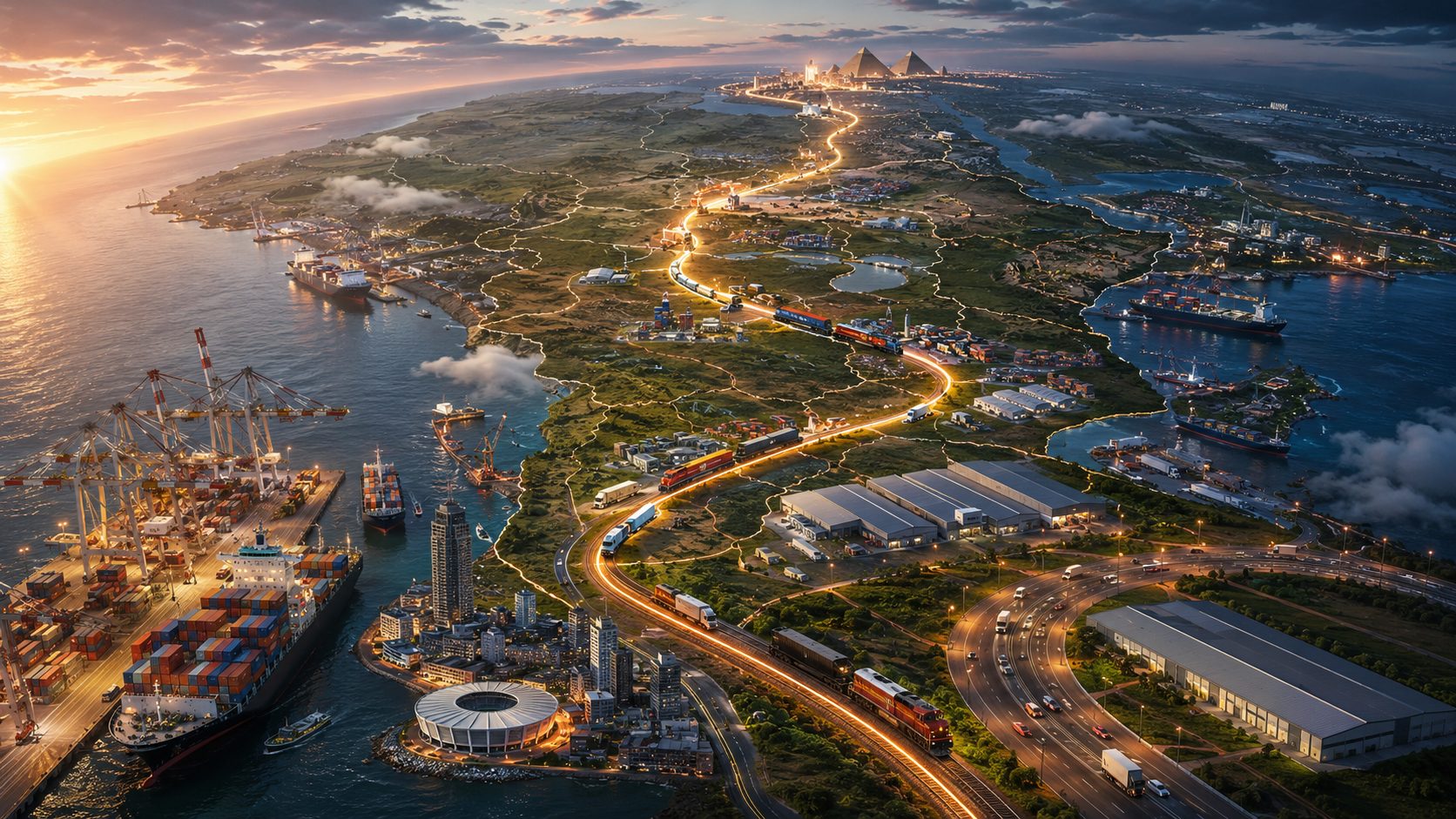
The idea of a trade route running from Cape Town to Cairo has existed for generations, but the business opportunity is becoming harder to ignore. Across southern, central and eastern Africa, governments, development banks and private investors are building or upgrading roads, railways, ports, border crossings and logistics hubs that could eventually create a more connected north-south trading system.
The question for investors is no longer simply whether Africa can connect its two economic poles. It is who will own the infrastructure, operate the networks and capture the value created by the traffic flowing through them.
A corridor, not a single project
The Cape-to-Cairo corridor is best understood as a collection of overlapping infrastructure ambitions rather than one concession or one railway.
At its southern end, South Africa has some of the continent’s most developed ports, railways and logistics infrastructure. Further north, the North-South Multimodal Transport Corridor connects major markets in southern Africa, including South Africa, Zambia and Zimbabwe, while providing routes to the Democratic Republic of Congo and other landlocked economies.
The African Development Bank has described the North-South corridor as a programme involving roads and border crossings connecting Lusaka, Harare, Johannesburg and Durban. The programme has a reported budget of about $2.12 billion, with financing coming through a COMESA-led special purpose vehicle and public-private partnerships for individual components.
At the northern end, Egypt is positioning itself as a gateway into Africa from the Mediterranean. In 2026, the country was advancing a roughly 10,000-km Cairo-to-Cape Town highway concept intended to strengthen road connectivity across the continent.
The resulting corridor is therefore less a straight line than a chain of infrastructure assets.
And every link has an owner.
South Africa controls the southern gateway
For South Africa, the biggest strategic assets are its ports and rail network.
The country’s state-owned Transnet controls critical freight infrastructure, including the country’s major commercial ports and freight railway network. Durban is particularly important because it provides a maritime gateway for South Africa and neighbouring landlocked economies.
The ownership question becomes more complicated as South Africa opens parts of its freight railway system to private operators.
That shift could create an entirely new class of African infrastructure investors.
Reuters reported this month that South African rail services company Traxtion is investing 3.4 billion rand, about $210 million, in additional rail capacity, including 46 locomotives and 920 wagons. The company is betting on reforms that increasingly allow private operators into freight networks across the region.
That matters for the Cape-to-Cairo story because rail ownership does not necessarily mean owning the track.
The future model could involve governments retaining infrastructure while private companies own locomotives, wagons, terminals and logistics services.
The result would be a more fragmented but potentially more competitive freight market.
Durban is more than a port
If the corridor succeeds, Durban could become one of its most important southern anchors.
The port already serves South Africa’s industrial heartland and provides access to neighbouring countries. Around the port sits an ecosystem of trucking companies, freight forwarders, warehouses, container depots, rail operators and manufacturers.
This is where the ownership story becomes larger than the infrastructure itself.
A company does not have to own a port to profit from a trade corridor. It can own the warehouse beside it, operate the inland container terminal, finance trucks, provide customs technology or manage the cargo.
The most valuable businesses could ultimately sit one step away from the physical infrastructure.
Zambia is a critical middle link
For the corridor to become commercially meaningful, landlocked countries must be able to move goods cheaply and reliably.
Zambia is therefore strategically important.
Its copper and other mineral exports require efficient connections to ports. The North-South corridor already provides an important route towards Durban, while alternative routes through Angola, Tanzania and Mozambique are creating competition for mineral cargo.
This competition could determine which corridors attract private investment.
The companies that secure long-term concessions, operate rail fleets and build logistics hubs may become as important as the governments that own the roads.
The development of the Kazungula Bridge between Zambia and Botswana offers a useful example of how individual infrastructure projects can alter regional trade patterns. The African Development Bank says the bridge was designed to strengthen regional integration and trade across southern Africa.
Egypt wants the northern gateway
At the other end of the continent, Egypt brings a very different strategic asset: the Suez Canal.
The canal already sits at one of the world’s most important maritime trade chokepoints. But Egypt’s ambitions extend beyond shipping.
The government has been investing heavily in roads, railways, ports and logistics infrastructure designed to connect industrial zones with domestic and international markets.
The Cairo-Alexandria railway is one example. A World Bank-backed trade logistics programme is modernising the approximately 370-km railway corridor, with recent signalling packages valued at about $666.7 million.
Egypt is also developing a high-speed rail network linking Ain Sokhna, Cairo, Alexandria and Marsa Matrouh, adding another layer to the country’s transport transformation.
For the Cape-to-Cairo concept, the significance is clear. Egypt is attempting to become not simply the end of an African road, but a logistics platform connecting African production with Mediterranean and global markets.
The private sector wants the terminals
Ports may attract the most visible investment, but terminals could become the real battleground.
Global port operators and logistics companies increasingly use concessions and long-term operating agreements to establish positions in African trade.
The model is attractive because governments can retain ownership of strategic infrastructure while private operators provide capital, technology and management expertise.
Egypt’s Suez Canal Economic Zone is particularly important in this respect. Industrial parks, ports, warehouses and manufacturing facilities are being developed around strategic transport links.
The same pattern is emerging elsewhere.
Private investors are increasingly interested in inland logistics parks, dry ports and container terminals because these assets capture revenue after cargo leaves the port.
For an investor, owning a warehouse at a major junction can be more attractive than owning hundreds of kilometres of road.
Finance may determine ownership
The biggest question may ultimately be who finances the corridor.
Africa’s infrastructure requirements are too large for governments to fund alone. Development banks therefore play a critical role in preparing projects and attracting private capital.
The African Development Bank has financed projects aimed at improving regional connectivity and has supported private-sector investment in transport infrastructure. Its Egypt strategy also includes support for regional integration and studies linked to the Nile navigation corridor between Lake Victoria and the Mediterranean.
South African institutions also have an important role.
The Development Bank of Southern Africa, commercial banks and infrastructure funds can provide capital for projects that governments alone cannot finance.
International development institutions, including the World Bank and European development financiers, can reduce project risk through guarantees and long-term lending.
The structure of that financing matters.
A government may build the road, a development bank may finance it, a private company may operate the terminal and an investment fund may own the logistics warehouse.
Who, then, owns the corridor?
The answer could be all of them.
Gulf, Chinese and European capital
The next contest will be between different pools of international capital.
Chinese companies have already established a major presence in African infrastructure, particularly in rail, roads, ports and industrial projects.
European development institutions remain important sources of long-term infrastructure finance.
Gulf investors, meanwhile, are increasingly interested in African ports, logistics, energy and industrial zones.
Egypt has become an especially important market for Gulf capital because of its geographic position and large domestic market.
The ownership map is therefore unlikely to be dominated by one foreign power.
Instead, Africa’s emerging corridor economy could produce a complicated mix of African governments, regional companies, Gulf investors, European institutions, Chinese contractors and global logistics operators.
The industrial prize
The biggest economic opportunity may not be transportation.
It could be manufacturing.
A functioning north-south corridor would allow factories to source components from different African markets and distribute finished products across the continent.
Industrial parks along the route could attract food processors, automotive suppliers, mining equipment manufacturers, pharmaceutical companies and consumer goods producers.
That would shift the corridor from a road for moving commodities into a platform for creating value.
Egypt already sees industrialisation and private-sector development as priorities, while South Africa has a large industrial base and sophisticated financial markets.
Between them lie markets rich in minerals, agriculture and increasingly urban consumers.
The commercial logic is powerful.
The ownership battle is only beginning
The Cape-to-Cairo dream will face serious obstacles.
Border delays, different customs systems, weak rail links, political risk and inconsistent regulation can make a theoretical corridor much less efficient in practice.
Infrastructure can also be built without producing enough cargo to justify the investment.
That is why the most successful investors are likely to be those that understand the entire logistics chain rather than individual assets.
The winners may own ports and railways, but they could also own data platforms, trucking fleets, warehouses, customs systems and industrial estates.
The corridor will therefore be measured not only in kilometres of asphalt and rail track, but in the number of businesses able to move goods across borders quickly and cheaply.
Who will own Cape-to-Cairo?
The most important ownership story in Africa may not be about a single company taking control of a single mega-project.
It may be about hundreds of strategic positions being accumulated along the route.
Transnet and South African private rail operators could shape the southern gateway. Regional governments will retain ownership of major roads and border infrastructure. Egypt will control critical northern transport assets. Global port operators may operate terminals. Banks and development institutions will finance projects. Logistics companies will control warehouses, trucks and distribution centres.
And investors will compete for the assets sitting between them.
If the corridor becomes a functioning trade network, the biggest winners may not be the companies with the longest railway concessions or the largest ports.
They will be the companies positioned at the points where African trade changes hands.
For Who Owns Africa, that is the question worth following: not simply who builds Cape-to-Cairo, but who owns the gateways, bottlenecks and businesses that make the corridor profitable.
The map of African infrastructure is being redrawn.
The ownership map is next.

More from Infrastructure
Who owns Dar es Salaam? Tanzania’s port boom creates a new land battle
Dar es Salaam's port capacity arrived four years early, and now Temeke residents want to know who owns the boom.

Who is winning the race to own Africa’s infrastructure?
China remains influential, but Gulf investors, Western capital and African institutions are reshaping who finances and controls critical infrastructure.
Africa’s next infrastructure boom: Where the $150 billion opportunity is emerging
Institutional investors are targeting Africa’s growing infrastructure needs, creating new opportunities across energy, transport, logistics, digital networks and urban development.