

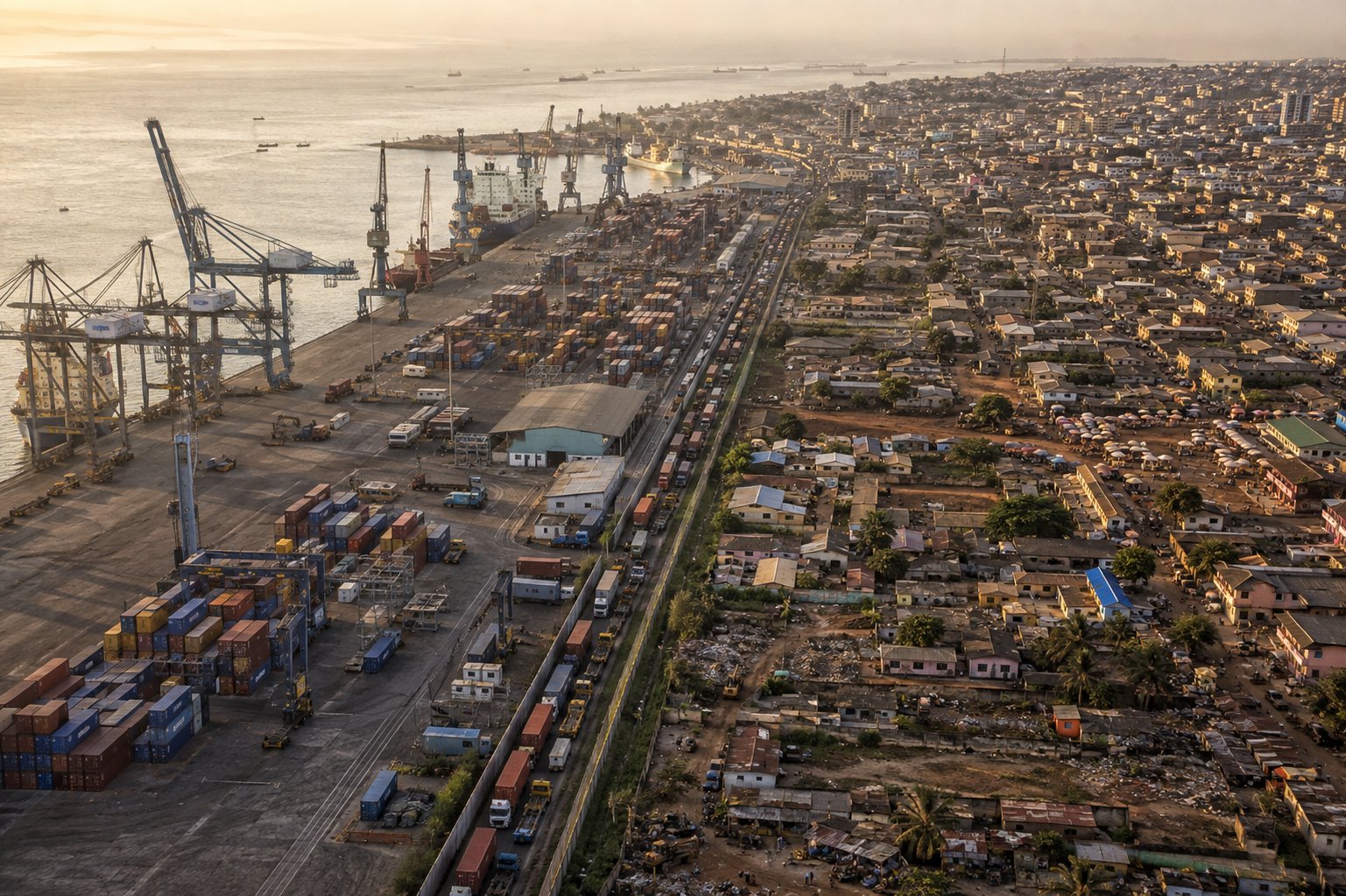
A cargo boom at Dar es Salaam Port has pushed local officials to consider setting aside ten wards in Temeke Municipality for port related business, a proposal that has opened a political fight over who controls some of the most valuable urban land in East Africa.
The port, which handles more than 90 percent of Tanzania’s cargo traffic, has grown faster than planners expected. That growth is now colliding with a densely populated district that officials say has become inseparable from the port’s supply chain, and with residents and opposition politicians who fear they will pay the price for that success.
A capacity milestone, four years early
Temeke District Commissioner Sixtus Mapunda said this week that cargo volumes at the port had already reached a level authorities had not expected to see until 2030. The threshold was crossed in June 2026, he said, a jump officials link to recent upgrades at the port and to wider improvements across Tanzania’s freight network, including new berths and rail links between the port and inland terminals, as logistics analysts have noted in recent months.
Mapunda said the acceleration means Temeke, the district that hosts the port itself, must plan quickly for warehouses, container yards and factories tied to the port economy. He said roughly half of all cargo leaving the port is destined for export, while the remainder stays inside Tanzania. Of that domestic share, he said, 90 percent is consumed in Dar es Salaam, and 70 percent of that stays in Temeke specifically.
“Temeke forms an economic hub,” Mapunda said, arguing that the district’s proximity to the port makes it central to any citywide land use plan.
Ten wards, one economic argument
To manage that growth, Mapunda said, the municipality has identified ten wards it considers strategically placed to host port related operations without overwhelming the port itself with cargo traffic.
Keko, Azimio, Buza, Sandari, Kilakala, Mtoni, Makangarawe, Temeke, Miburani and Yombo Vituka.
Mapunda insisted the plan is not an eviction order. He described it instead as an economic opportunity, comparing port proximity to farmland that should benefit those who live nearby. Residents with plots suited to container storage or light manufacturing, he said, could attract investors and profit directly from the port’s expansion rather than being displaced by it.
“We are not relocating citizens, we will provide guidance on how best to utilise these areas,” he said, urging residents of the ten wards to prepare for what he called a shared success.
The precedent of Kurasini
Officials have repeatedly pointed to Kurasini, the Temeke ward that already hosts the port itself, as a model for what they hope will happen elsewhere in the district. Kurasini shifted over the past decade from a residential neighbourhood into a zone of port extensions, container depots and logistics firms, a transition documented in environmental impact assessments tied to the port’s expansion.
Mapunda cited Kurasini as evidence that residents can benefit from handing land to investors rather than resisting change, saying some landholders there converted plots into profitable commercial operations. Critics, however, note that Kurasini’s transformation also displaced long standing residents and reshaped an entire ward’s character, a history that fuels current anxieties in the ten wards now under discussion.
Opposition sounds the alarm
The opposition ACT-Wazalendo party moved quickly to challenge the plan. In a statement issued on September 3, the party warned that Temeke residents could face displacement to make way for inland container depots, and said it would resist any effort to redraw ward boundaries or move residents for dry port activity.
ACT-Wazalendo’s regional secretary, Felix Kamugisha, urged the district commissioner to pause the plan and instead direct new cargo traffic toward the Kwala Dry Port in neighbouring Coast Region. The party said it was prepared to organise peaceful protests if the government pressed ahead, and it backed a separate proposal from its shadow transport minister to freeze new depot permits inside the city.
“The port is a friend. The port does not move, but we human beings can move,” Mapunda said in comments that opposition leaders seized on as evidence of the district’s true intentions.
Why Kwala has not settled the argument
Kwala Dry Port, commissioned by President Samia Suluhu Hassan in July 2025, was built precisely to relieve pressure on Dar es Salaam’s port. Connected to the Standard Gauge Railway, the facility was designed to handle roughly 300,000 containers a year, about 30 percent of the volume passing through the city port, and sits within a wider industrial park intended to draw investment away from the congested coastline.
Mapunda argued that geography alone does not settle the debate. Routing cargo far from the city, he said, raises transport costs for traders and consumers who ultimately need goods delivered inside Dar es Salaam. He said it would make little economic sense to send cargo to Kwala or further inland only for finished goods to return to factories in Temeke. The Tanzania Ports Authority has continued to describe Kwala as a decongestion tool for the capital rather than a full replacement for port-adjacent activity in Temeke.
A plan without a map
What has unsettled residents most is not the concept but the absence of detail. Mapunda has not published a map identifying the exact boundaries of the ten wards, set a timeline for implementation, named investors, or outlined a formal land acquisition, consultation or compensation process, according to reporting by The Chanzo.
The uncertainty sits atop an already strained system. Temeke’s municipal director has said roughly 70 percent of Dar es Salaam’s 114 inland container depots operate within the district, a concentration that has produced long lorry queues, road damage and safety concerns near schools in residential neighbourhoods. City authorities ordered a crackdown on trucks parked in road reserves in August, a move truck owners said only highlighted the shortage of designated staging space rather than solving it.
Part of a wider pattern
The Temeke dispute is unfolding against a backdrop of recurring land conflicts across Dar es Salaam. In March, the government halted planned evictions of traders at Coco Beach after public objections, with the Prime Minister assuring the public the site was not being sold to a private developer.
In Kinondoni, residents and informal workers have objected to fencing at the Biafra Grounds, a long used public space, as commercial development moves forward under a claim of ownership by the ruling party. And in Temeke itself, dozens of families in Mbagala Rangi Tatu faced demolition notices last year tied to a proposed bus terminal, a dispute that reached the courts after the council argued the land was public property.
None of these earlier cases prove that a formal displacement programme is planned for the new ten wards. But they explain why residents, traders and opposition figures are asking pointed questions about consultation and compensation before any plan advances.
What happens next
For now, the ten wards remain a proposal rather than a policy. No demolition notices have been issued, and officials continue to insist that residents will be guided toward investment rather than removed from their homes. Yet the scale of what is at stake, a port that handles the bulk of Tanzania’s trade and a district of well over a million people, means the manner in which authorities resolve the standoff is likely to shape how Dar es Salaam manages growth for years to come.
The central question raised by the dispute goes beyond zoning. As cargo volumes climb and investors circle some of the city’s most valuable land, residents of Temeke are asking a more basic question: when a boom reshapes a neighbourhood, who actually owns what comes next.

More from Infrastructure

Who is winning the race to own Africa’s infrastructure?
China remains influential, but Gulf investors, Western capital and African institutions are reshaping who finances and controls critical infrastructure.
Africa’s next infrastructure boom: Where the $150 billion opportunity is emerging
Institutional investors are targeting Africa’s growing infrastructure needs, creating new opportunities across energy, transport, logistics, digital networks and urban development.

Who is building Uganda? Inside the $242 million Citibank infrastructure deal
Inside Uganda’s $242 million Citibank-backed road project, the contractors, financiers and regional trade interests shaping eastern Africa’s infrastructure future.