

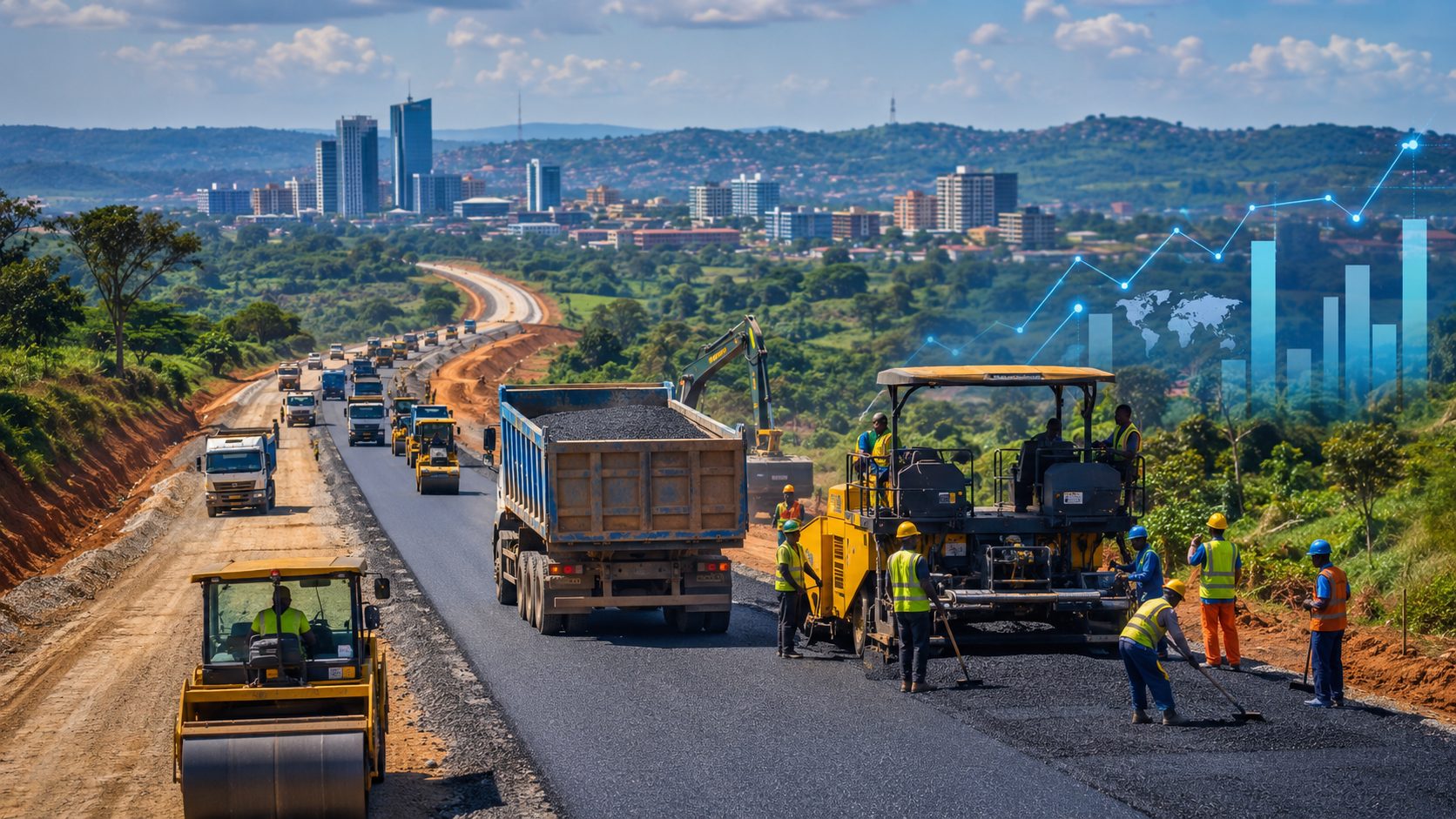
Uganda is seeking up to €207.7 million, about $242.5 million, from Citibank and other financial institutions to finance a major road project in eastern Uganda, but behind the headline borrowing is a more complicated story about Chinese construction capital, African risk insurance, public debt and the future of regional trade.
The project covers the 127-kilometre Jinja-Mbulamuti-Kamuli-Bukungu road and another 10 kilometres of roads in Jinja City. Once completed, the government says the corridor will improve transport in the Busoga sub-region and create an alternative north-south route connecting communities and markets beyond the traditional road network.
For Who Owns Africa, however, the bigger question is not simply whether Uganda needs another paved road.
It is who controls the money, who gets the construction contract, who carries the financial risk and who ultimately benefits from the infrastructure.
The road at the centre
The Jinja-Mbulamuti-Kamuli-Bukungu corridor has been discussed for years as a strategic transport link in eastern Uganda.
The project is designed to upgrade the existing gravel road to paved Class II standard, including drainage structures, bridges and other ancillary works. The National Planning Authority identifies the road as an eastern Uganda project intended to reduce transport costs and travel times while connecting productive agricultural areas to markets.
The Bukungu end is particularly important.
Government documents describe it as a gateway towards districts including Amolatar, Kaberamaido, Soroti, Nakasongola and Kayunga. That gives the road significance beyond the immediate Jinja and Kamuli corridor.
Jinja is already one of Uganda’s major industrial and commercial centres. Improving its connection to the north and east could strengthen the movement of agricultural produce, manufactured goods and consumer products.
The road could also give traders an alternative to heavily used routes around Kampala.
The money has changed
The financing story is almost as important as the road itself.
In October 2025, Uganda’s Parliament authorised the government to borrow up to €230.45 million from Citi Bank for the project. The revised proposal is about €22.68 million lower, following negotiations involving the Ministry of Finance, the Ministry of Works and Transport, Citibank and the African Trade and Investment Development Insurance agency, or ATIDI.
The revised package is structured in two main parts.
Citibank is expected to provide about €179.26 million, including insurance, for the works. A further €28.51 million commercial facility is intended to cover land compensation and construction supervision, including the owner’s engineer.
The change was partly triggered by a shift in policy by China’s export credit agency Sinosure. According to Uganda’s finance ministry, Sinosure introduced a €100 million ceiling for financing non-revenue-generating or non-self-financing projects, making the previous arrangement unsuitable for a project of this size.
Uganda then went back to Citibank.
That decision says something about the changing architecture of African infrastructure finance.
Why Citibank?
Citibank is not the contractor pouring concrete or laying asphalt. Its role is financial.
That distinction matters.
The bank’s position is that of arranger and lender, bringing together financing that allows Uganda to proceed with a project that might otherwise struggle to attract commercial capital.
This is part of a wider pattern in which international banks increasingly sit between African governments and infrastructure companies, structuring transactions around export-credit agencies, insurers and other financial institutions.
Citibank’s role in Uganda is not new.
In 2024, the bank arranged financing for the 97-kilometre Lusalira-Nkonge-Lumegere-Ssembabule road. That package involved Citi as coordinating mandated lead arranger and lender, with support from ATIDI and the Development Bank of Southern Africa, while Absa Bank Mauritius participated in the syndicate.
Citibank has also been selected to mobilise financing for Uganda’s much larger €2.7 billion Standard Gauge Railway project linking Kampala to the Kenyan border at Malaba.
For Citi, Uganda is therefore becoming more than a single road transaction.
It is part of a broader infrastructure financing relationship.
The Chinese contractor question
Perhaps the most interesting ownership angle is on the construction side.
Ugandan parliamentary and media records indicate that the civil works contract, valued at roughly 649.6 billion Ugandan shillings, was signed with PowerChina International Group Limited in March 2023. The contract covers the design and construction of the 127-kilometre road and the 10 kilometres of Jinja City roads.
That means the question of which contractor might win the project is, in practical terms, already different from a conventional future tender story.
The contractor has already been identified in the existing contract.
The critical issue now is whether the revised financing package enables that contract to move from paperwork into substantial construction.
Uganda’s government said in January that the civil works contract had been signed and preparatory activities were under way, while compensation of people affected by the project was progressing.
The financing delay has nevertheless become a central feature of the project’s history.
Why PowerChina matters
PowerChina is one of China’s major state-owned engineering groups, with businesses spanning power, water, transport and civil construction. Its international subsidiary, PowerChina International Group Limited, has previously been involved in major infrastructure activity in Uganda.
The company’s presence in Uganda is therefore broader than this road.
PowerChina and its affiliates have been involved in major energy infrastructure, including work associated with the Karuma hydropower project and transmission infrastructure.
That creates an important Who Owns Africa question.
When Uganda borrows internationally to pay for infrastructure designed or built by a foreign contractor, the ownership of the physical road remains with the Ugandan state. But significant portions of the economic value generated by the transaction can flow across borders through construction contracts, imported equipment, engineering services, insurance premiums, financing costs and debt repayment.
The road may be Ugandan.
The money moving around it is international.
Who carries the debt?
Ultimately, the borrower is the Government of Uganda.
That means the public sector carries the repayment obligation.
The distinction between a commercial bank lending to a government and a private investor building a project with its own capital is critical. If the road generates economic activity but no dedicated revenue stream, repayment depends largely on the government’s broader fiscal capacity rather than tolls or project revenues.
Uganda is already facing pressure on that capacity.
The IMF has projected that Uganda’s debt-to-GDP ratio will rise to 55.5% in the fiscal year that began in July and approach 60% by 2030/31. The Fund has also warned of a high debt-service burden. Fitch has similarly pointed to rising public debt and high interest costs as constraints on Uganda’s sovereign rating.
That does not make the road a bad investment.
Infrastructure can create economic returns that are not captured directly through tolls. Lower transport costs can improve farm incomes, expand markets, increase land values and attract industrial investment.
But the government must still repay the loan.
The regional trade opportunity
The strongest argument for the project is its potential economic geography.
Jinja sits on a major corridor connecting Uganda to Kenya and the wider East African trading system. A better road towards Kamuli and Bukungu could open alternative routes for goods moving between northern and eastern Uganda and the country’s industrial heartland.
The impact could extend towards Tanzania and the Democratic Republic of Congo through Uganda’s wider road network.
Uganda’s economy depends heavily on regional trade, while Kenya remains a crucial gateway for Ugandan imports and exports through the port of Mombasa.
Any road that reduces bottlenecks on Uganda’s internal network can therefore have an effect beyond the districts immediately surrounding the project.
For the DRC, where Uganda has been expanding commercial and infrastructure links, better domestic connectivity could eventually support movements towards western border corridors.
But these benefits will depend on more than asphalt.
Border efficiency, customs systems, vehicle standards, security and road maintenance will determine whether a new corridor actually becomes a competitive trade route.
The hidden cost of infrastructure
There is another side to the project.
Uganda’s Parliament has repeatedly questioned the country’s borrowing and the slow implementation of some infrastructure projects.
The Jinja-Mbulamuti-Kamuli-Bukungu road is particularly notable because the construction contract dates back to 2023, while financing arrangements have continued to evolve.
Every year of delay can increase costs.
Contractors remain mobilised or unable to fully deploy resources. Land compensation can become more expensive. Designs can require revisions. Inflation can push up construction inputs.
And governments can end up paying financing costs before infrastructure begins producing its economic benefits.
That is why the latest €207.7 million proposal is more than another borrowing request.
It is a test of whether Uganda can connect financial closure to actual delivery.
Who owns the opportunity?
The answer is fragmented.
Uganda owns the public infrastructure and assumes the sovereign borrowing obligation.
Citibank sits at the centre of the financing structure.
ATIDI provides an important layer of risk protection.
PowerChina is positioned on the construction side.
Ugandan businesses and workers are expected to benefit from construction activity and, eventually, improved connectivity.
Farmers, manufacturers, transporters and traders are the intended long-term beneficiaries.
But lenders, insurers, engineering companies and contractors also participate in the economic chain created by the project.
That is the real ownership story.
Africa’s infrastructure boom is rarely owned by one company or one country. It is assembled through networks of governments, banks, insurers, contractors, export-credit agencies and international suppliers.
Uganda’s infrastructure bet
Uganda is betting that the economic return from better roads will outweigh the financial cost of borrowing.
That bet is becoming increasingly important as the government pursues several major infrastructure projects at the same time, including roads, airports and the Standard Gauge Railway.
The Citibank deal shows how that infrastructure model is evolving.
Chinese construction companies remain important players, but the financing does not necessarily come directly from Chinese policy banks. International commercial banks such as Citibank can arrange the capital, while African institutions such as ATIDI provide insurance and risk support.
The result is a more complicated financial map.
For Uganda, the immediate priority is straightforward: secure the money, complete compensation, mobilise the contractor and finally build the road.
For investors and companies watching Africa, the bigger lesson is different.
The next phase of Africa’s infrastructure story will not be defined only by who builds the roads. It will be defined by who finances them, who insures them, who supplies them, who collects the returns and who remains responsible when the bills come due.
The Jinja-Mbulamuti-Kamuli-Bukungu project puts all of those questions on one road.
And, for Uganda, the journey has taken more than a decade to reach this point.

More from Infrastructure
Who owns Dar es Salaam? Tanzania’s port boom creates a new land battle
Dar es Salaam's port capacity arrived four years early, and now Temeke residents want to know who owns the boom.

Who is winning the race to own Africa’s infrastructure?
China remains influential, but Gulf investors, Western capital and African institutions are reshaping who finances and controls critical infrastructure.
Africa’s next infrastructure boom: Where the $150 billion opportunity is emerging
Institutional investors are targeting Africa’s growing infrastructure needs, creating new opportunities across energy, transport, logistics, digital networks and urban development.