

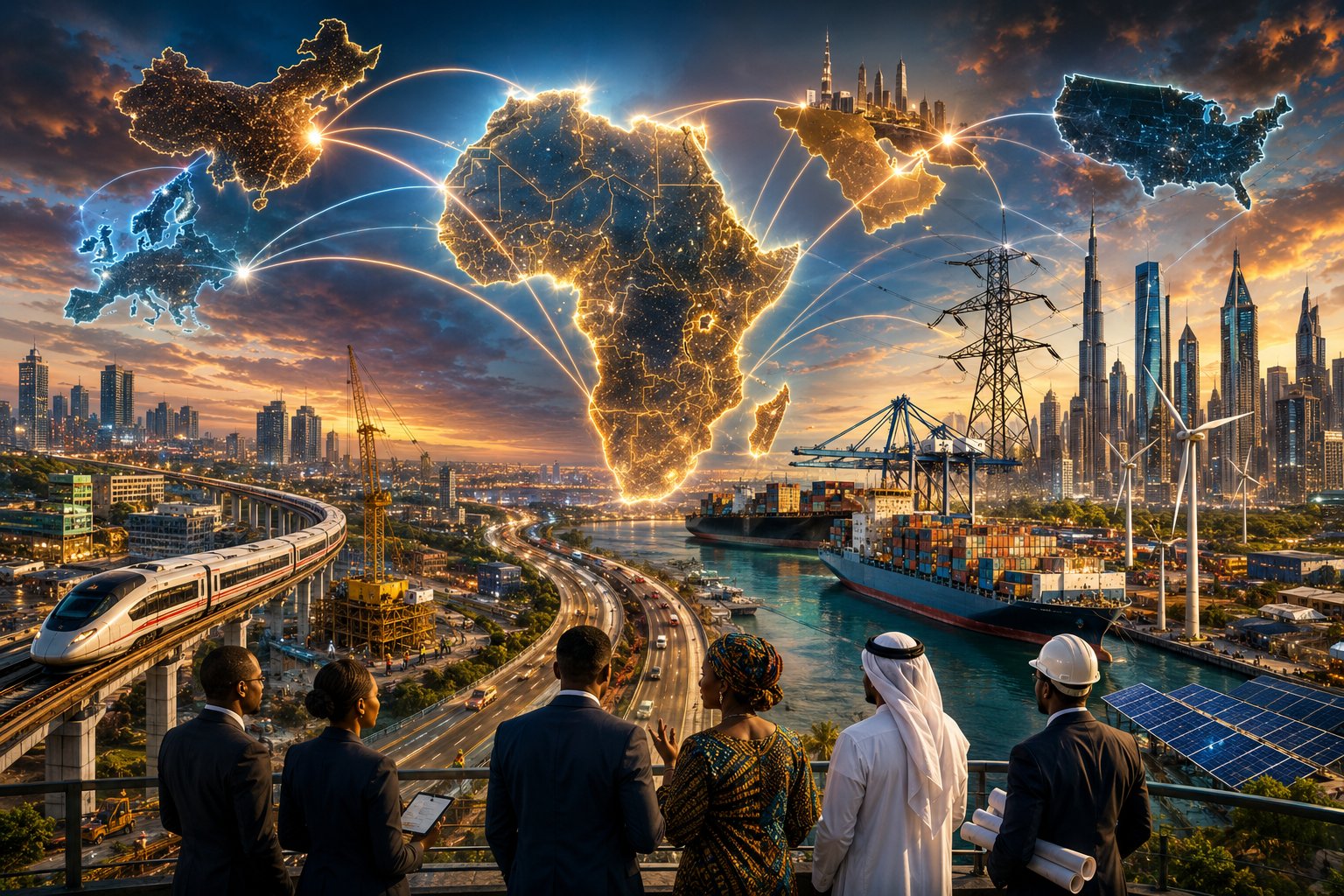
Africa’s infrastructure race is entering a new phase, with China no longer the only outside power building at scale as Gulf investors expand rapidly, Western capital searches for strategic opportunities and African institutions push to mobilise the continent’s own trillions.
The contest is no longer simply about who can finance a railway, build a port or construct a power plant. It is increasingly about who controls the networks through which Africa will trade, move energy, transmit data and connect its cities over the next several decades.
The shift matters because Africa needs enormous investment in roads, railways, electricity, ports, water, telecommunications and digital infrastructure. At the same time, the financing environment is changing. Traditional development assistance is under pressure, Chinese sovereign lending has become more selective and governments are increasingly turning to private capital and public-private partnerships.
That is creating an opening for new players.
The result is a more fragmented infrastructure market in which Beijing remains a formidable force, Gulf states are becoming major owners and financiers, European institutions retain deep influence, the United States is concentrating on strategic sectors and African investors are seeking a larger share of the assets being built on their own continent.
The question for the coming decade may therefore not be whether China will own Africa’s infrastructure.
It may be whether anyone can.
China still has the network
China enters this new phase with one major advantage: it has spent decades building relationships, contractors, supply chains and physical infrastructure across Africa.
Chinese companies have been involved in major rail, road, power, telecommunications and port projects across the continent. The Belt and Road Initiative helped establish Chinese construction companies and financiers as familiar partners for African governments seeking large projects.
But the model is changing.
Chinese policy banks are no longer extending sovereign loans at the pace seen during the first decade of the Belt and Road era. African governments facing high debt burdens have also become more cautious about borrowing for projects that do not generate sufficient revenue.
That has not removed China from the market. Instead, it has pushed Chinese companies toward commercially viable projects, smaller investments, industrial facilities, renewable energy and projects tied to trade and supply chains.
China’s presence in African maritime infrastructure illustrates the evolution. Analysts say Chinese companies and institutions have become deeply embedded in port development, logistics and maritime networks, giving Beijing influence beyond individual construction contracts.
The strategic significance is considerable.
Ports connect directly to railways, industrial zones, mines and agricultural supply chains. Whoever operates or finances several parts of that chain can gain influence over trade flows without formally owning an entire corridor.
China therefore remains difficult to displace.
Its advantage is not simply money. It is the combination of engineering capacity, construction companies, equipment manufacturers, lenders and long-standing government relationships.
The Gulf is moving faster
If China’s strength is scale and experience, the Gulf’s advantage is capital.
The United Arab Emirates and Saudi Arabia have emerged as increasingly important investors across African infrastructure, particularly in ports, logistics, energy, agriculture, mining and industrial development.
Their approach differs from the traditional development-finance model. Gulf investors often look for commercially strategic assets that can generate long-term returns while supporting broader trade and supply-chain objectives.
Ports are particularly attractive.
The Gulf’s own economic transformation has made logistics, shipping, airports, renewable energy and global trade central to its development strategy. African markets offer opportunities to export that expertise while securing access to fast-growing consumer markets and strategic commodities.
Recent reporting has highlighted the growing role of Gulf capital in addressing Africa’s infrastructure financing shortfall, as Chinese and Western funding become more selective.
The UAE has been especially aggressive.
Its companies and sovereign-linked investors have pursued interests in African ports, energy projects, mining and agriculture. The country’s growing economic presence has also made Dubai an important financial gateway for African businesses and investors.
This gives Gulf investors a distinctive position.
They can finance infrastructure while also connecting African assets to Middle Eastern logistics networks, shipping companies, commodity traders and investment funds.
Ports are the new prize
The competition becomes clearest at Africa’s ports.
A modern port is no longer simply a place where ships load and unload containers. It can anchor industrial parks, warehouses, railways, roads, data infrastructure and energy projects.
That makes ports strategic infrastructure.
China has developed or supported port projects across the continent. Gulf-linked companies are also expanding their presence, particularly around the Red Sea, East Africa and North Africa.
The competition is partly commercial, but geography gives it a geopolitical dimension.
The Red Sea connects the Indian Ocean with Europe through the Suez Canal. East African ports provide gateways into some of the world’s fastest-growing markets and connect landlocked economies to international trade.
Control over logistics infrastructure can therefore influence where commodities move, where factories are built and which countries become regional trading hubs.
For African governments, this competition can be useful.
More bidders can mean better terms.
But it also creates a challenge. A government that awards control of a strategically important asset for decades must consider not only the immediate financial package but also the long-term implications for national sovereignty, competition and economic resilience.
Europe still has deep roots
Europe is not leaving the African infrastructure race.
European governments, development banks and private investors retain major relationships across the continent, particularly in energy, transport, telecommunications, climate finance and urban infrastructure.
European institutions have traditionally placed greater emphasis on environmental standards, governance, transparency and social safeguards than some other infrastructure financiers.
That can make European projects slower to structure.
It can also make them attractive to governments seeking diversified financing and stronger institutional standards.
The European Union has sought to mobilise major investment through its Global Gateway strategy, which aims to provide an alternative to China’s infrastructure model by supporting digital, climate, transport, health and energy projects.
But Europe faces a basic problem.
Its capital is often fragmented among national governments, European institutions, development banks and private investors. Decision-making can therefore be slower than the relatively direct state-backed approach associated with China or the commercially aggressive model increasingly associated with Gulf investors.
In infrastructure, speed matters.
A government that needs a power plant or railway financed today may prefer a partner capable of moving quickly, even if another financier offers stronger governance conditions.
America is choosing strategic infrastructure
The United States has historically played a smaller direct role in African physical infrastructure than China.
Washington’s influence has instead been stronger in finance, technology, security and private investment.
That could change in selected sectors, but not necessarily through a return to the old model of financing large numbers of government-owned roads and railways.
The emerging American approach is more strategic.
Critical minerals, energy security, telecommunications, digital infrastructure and supply-chain diversification are increasingly important to U.S. policy toward Africa.
The logic is straightforward.
Africa contains large reserves of minerals needed for batteries, renewable-energy technologies and advanced manufacturing. Countries such as the Democratic Republic of Congo and Zambia are therefore becoming important to global competition over supply chains.
Infrastructure is essential to unlocking those resources.
A mine without reliable electricity, roads, railways and export corridors is economically constrained.
That makes infrastructure a form of industrial policy.
Africa’s own capital may be the biggest story
The most important competitor to foreign capital, however, may ultimately be African capital.
Africa has substantial pools of domestic savings. The challenge has been converting those savings into long-term investment in infrastructure.
The African Finance Corporation’s 2026 infrastructure report says African capital pools now exceed $4 trillion, including more than $1 trillion in pension and life assets. At the same time, official development assistance fell sharply in 2025.
That changes the conversation.
African pension funds, insurance companies, banks, sovereign wealth funds and private-equity firms could become much more important owners of infrastructure assets.
The African Development Bank is also seeking to mobilise more private capital and strengthen domestic financing mechanisms. Its support for infrastructure funds and initiatives to recycle existing public assets reflect an effort to make African infrastructure more investable.
The African Union-backed New African Financial Architecture for Development is pushing in the same direction, with proposals aimed at mobilising domestic savings, strengthening guarantees and deepening local capital markets.
This could eventually change the ownership equation.
Instead of an African government choosing between a Chinese company, a Gulf investor or a European development bank, the preferred structure could increasingly be a consortium in which African pension funds and infrastructure funds hold significant equity alongside international investors.
That would keep more returns within Africa.
Ownership is becoming more complicated
The word “own” is itself becoming harder to define.
Infrastructure ownership can mean direct equity ownership. It can mean a long-term concession to operate a port. It can mean financing a project. It can mean supplying the technology. It can mean controlling logistics around an asset.
A Chinese company may build a railway without owning it.
A Gulf investor may acquire a concession to operate a port.
A European institution may provide guarantees that make a private project possible.
An African pension fund may own part of the infrastructure company.
An American technology firm may provide the digital systems that make the network function.
All five can therefore have influence over the same infrastructure without any one of them owning the entire asset.
This is why the next phase of Africa’s infrastructure competition will be less visible than the construction boom of the past two decades.
The battle will increasingly take place through concessions, equity stakes, project finance, data centres, power-purchase agreements, logistics contracts and industrial supply chains.
Energy may decide the race
If ports are the visible face of the competition, electricity is likely to be its foundation.
Africa’s industrialisation depends on reliable and affordable power. Demand is expected to increase as populations grow, cities expand and industries such as manufacturing, mining and data processing become more electricity intensive.
This creates opportunities for Chinese companies, Gulf investors, European institutions, American firms and African developers.
The Gulf has shown particular interest in renewable energy. Gulf investors announced $60 billion across 83 African projects in one widely cited dataset, with most of the investment originating from the UAE and Saudi Arabia and much of it directed toward hydrogen and renewable energy.
Digital infrastructure is also becoming part of the energy equation.
Data centres require large amounts of electricity, while artificial intelligence is increasing demand for computing capacity.
MTN, Africa’s largest telecoms operator, said this month it was developing AI-enabled data centres in South Africa and Nigeria through a joint venture with a UAE-backed partner. The first phase is planned at 150 megawatts, illustrating how African companies and Gulf capital are increasingly combining their strengths.
That model could become increasingly common.
Africa has more bargaining power
The most important change may be that African governments have more choices.
Twenty years ago, a government seeking a major railway or power project might have had relatively few credible financing options.
Today, it can potentially approach China, Gulf investors, European institutions, U.S. investors, multilateral lenders and African funds.
That does not eliminate the risks.
Governments still need to negotiate contracts carefully, protect public interests and ensure infrastructure generates economic value rather than simply adding debt.
But competition among financiers gives African states an opportunity to demand better terms.
The strongest governments will use that competition to diversify.
Instead of allowing one foreign partner to dominate an entire infrastructure ecosystem, they can separate projects and financing sources.
One partner can build the railway.
Another can operate the port.
An African pension fund can provide equity.
A development bank can provide guarantees.
A private investor can finance the power plant.
That approach reduces dependence on any single external power.
So who is winning?
China remains the strongest player in terms of accumulated infrastructure experience, construction capacity and the breadth of its physical footprint.
The Gulf, however, may be the fastest-growing force in strategic infrastructure ownership and investment.
Europe remains important because of its financial institutions, regulatory influence and long-standing economic ties.
The United States is likely to remain more selective, concentrating on infrastructure linked to technology, critical minerals, energy and strategic supply chains.
But the long-term winner could be Africa itself.
That will depend on whether African governments and institutions can turn domestic savings into infrastructure ownership and whether they can negotiate foreign investment without surrendering excessive control over strategic assets.
The African Development Bank’s push to mobilise domestic capital reflects that wider shift. The institution has said it wants to increase infrastructure financing not only through its own lending but by leveraging its resources to attract other investors.
The race, then, is not simply China versus the Gulf versus the West.
It is a contest over who will finance, build, operate and ultimately benefit from the infrastructure that will shape Africa’s economic geography.
China built much of the foundation.
The Gulf is moving aggressively into ownership and logistics.
Europe and America are defending strategic interests.
African capital is beginning to realise that it cannot remain a spectator.
For Who Owns Africa, that may be the central question of the next infrastructure cycle: will Africa merely host the world’s capital, or will Africans increasingly own the systems that connect their own continent to the global economy?

More from Infrastructure
Who owns Dar es Salaam? Tanzania’s port boom creates a new land battle
Dar es Salaam's port capacity arrived four years early, and now Temeke residents want to know who owns the boom.
Africa’s next infrastructure boom: Where the $150 billion opportunity is emerging
Institutional investors are targeting Africa’s growing infrastructure needs, creating new opportunities across energy, transport, logistics, digital networks and urban development.

Who is building Uganda? Inside the $242 million Citibank infrastructure deal
Inside Uganda’s $242 million Citibank-backed road project, the contractors, financiers and regional trade interests shaping eastern Africa’s infrastructure future.