

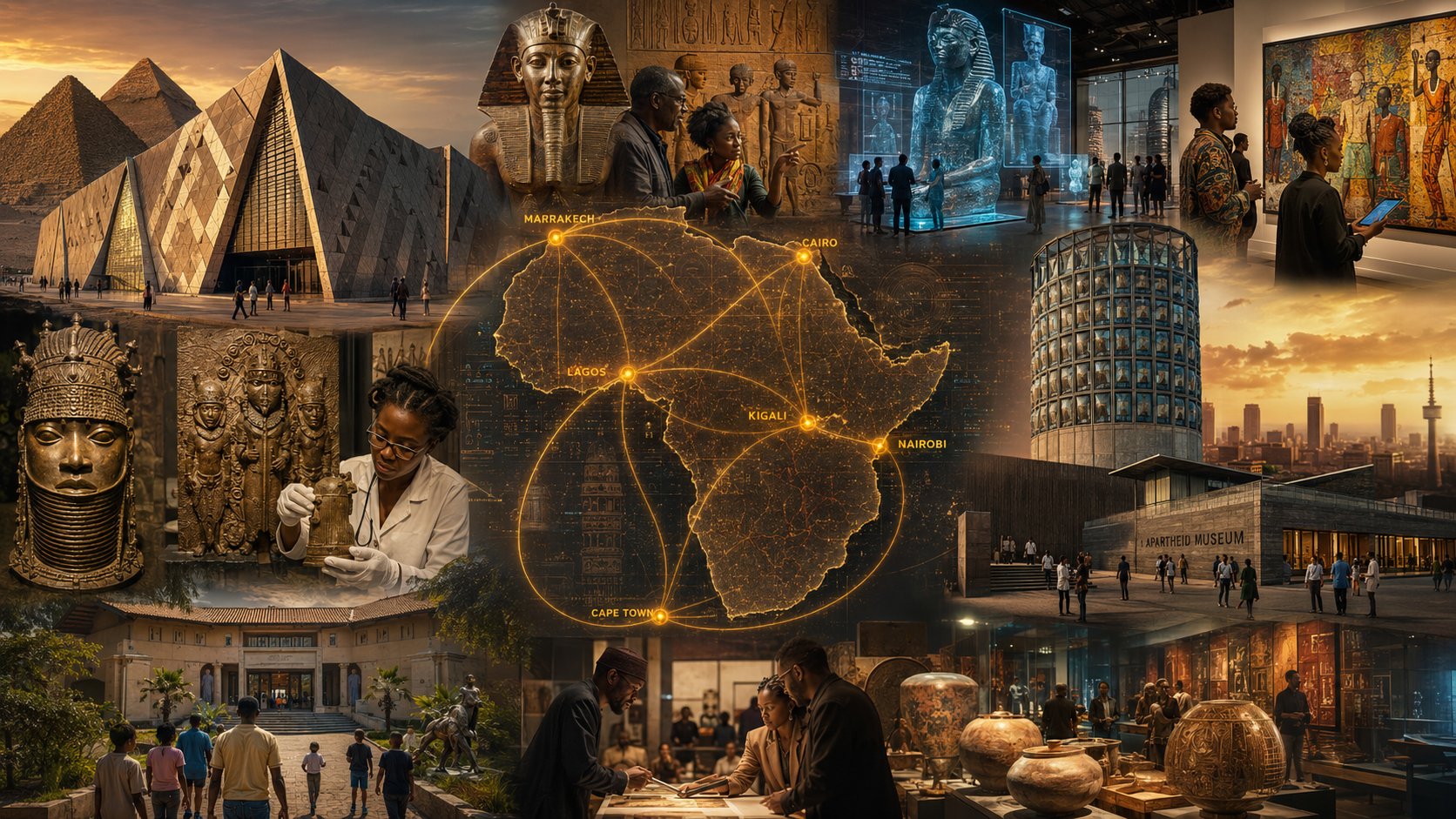
Africa’s museums are entering a defining period, and 2026 may be remembered as the year the continent began moving from preserving its history to actively controlling the way that history is presented, interpreted and valued.
For generations, the African museum was often portrayed as a quiet institution filled with objects from a distant past. That image is increasingly outdated. Across the continent, museums are becoming places where ancient civilisations, colonialism, independence, genocide, contemporary art, technology, tourism and the politics of restitution collide.
The transformation is particularly visible in Egypt, where the Grand Egyptian Museum has emerged as one of the most ambitious cultural projects in the world. It is equally visible in Nigeria, where the return of Benin Bronzes has intensified questions about ownership, custodianship and whether the institutions receiving returned heritage have the resources to protect it.
In South Africa, museums continue to confront apartheid and the country’s difficult political history, while in Kenya and Ethiopia, national museums remain important gateways into archaeology, human evolution, natural history and cultural identity.
The result is a museum landscape that is increasingly difficult to define with a single formula.
Some institutions are enormous. Others occupy modest buildings but carry extraordinary historical weight. Some are designed around ancient objects. Others preserve memory through photographs, oral testimony and personal belongings. Increasingly, museums are also becoming economic assets, attracting international visitors, supporting creative industries and helping cities build cultural identities.
For this Who Owns Africa ranking, the question is therefore not simply which museum has the most famous artefacts.
The ranking considers six broad factors: historical and cultural significance, quality and depth of collections, ability to tell an African story, international influence, visitor and tourism potential, and relevance to the future of museums on the continent.
The ranking is editorial rather than an official industry league table. It is intended to provoke discussion about what makes a museum important in Africa in 2026.
The ranking
| Rank | Museum | City | Country | Why it stands out |
|---|---|---|---|---|
| 1 | Grand Egyptian Museum | Cairo | Egypt | Scale, archaeology and global tourism potential |
| 2 | Apartheid Museum | Johannesburg | South Africa | Powerful modern African historical storytelling |
| 3 | Robben Island Museum | Cape Town | South Africa | Global symbol of resistance and political memory |
| 4 | Zeitz MOCAA | Cape Town | South Africa | Major platform for contemporary African art |
| 5 | National Museum of Egyptian Civilization | Cairo | Egypt | Broad presentation of Egypt across millennia |
| 6 | The Egyptian Museum | Cairo | Egypt | Historic archaeological importance and collections |
| 7 | Bardo National Museum | Tunis | Tunisia | Exceptional Mediterranean and Roman heritage |
| 8 | District Six Museum | Cape Town | South Africa | Community memory and apartheid history |
| 9 | Kigali Genocide Memorial | Kigali | Rwanda | Memory, education and reconciliation |
| 10 | Museum of West African Art | Benin City | Nigeria | New-generation institution linked to restitution |
| 11 | MACAAL | Marrakech | Morocco | Contemporary African art and cultural tourism |
| 12 | National Museum of Ethiopia | Addis Ababa | Ethiopia | Human evolution and Ethiopian heritage |
| 13 | Nairobi National Museum | Nairobi | Kenya | Natural history, archaeology and Kenyan identity |
| 14 | Luxor Museum | Luxor | Egypt | Exceptional location and curated ancient heritage |
| 15 | Constitution Hill | Johannesburg | South Africa | Human rights, political history and democracy |
| 16 | Nigerian National Museum | Lagos | Nigeria | National archaeological and ethnographic heritage |
| 17 | Karen Blixen Museum | Nairobi | Kenya | Literature, colonial history and tourism |
| 18 | Iziko South African Museum | Cape Town | South Africa | Natural history and scientific collections |
| 19 | Musée Yves Saint Laurent | Marrakech | Morocco | Fashion, design and Marrakech’s global cultural profile |
| 20 | Nike Centre for Art and Culture | Lagos | Nigeria | Contemporary Nigerian creativity and artistic education |
1. Grand Egyptian Museum, Egypt
The Grand Egyptian Museum takes the number one position because it represents perhaps the clearest example of Africa building a cultural institution with global ambitions.
Situated close to the Giza pyramids, the museum has been designed to accommodate one of the world’s most important archaeological collections. Its significance is amplified by its location. Few museums can place visitors within sight of monuments that have defined human civilisation for thousands of years.
The museum’s enormous scale and emphasis on ancient Egyptian heritage make it a potential tourism powerhouse for Egypt. Its opening has also reinforced Cairo’s position as one of the world’s major destinations for archaeological tourism.
But the real importance of GEM goes beyond tourism.
It demonstrates how a major African country can invest in a museum not simply as a preservation facility but as a national cultural statement. In an era when African countries are increasingly seeking greater authority over their heritage, the institution carries considerable symbolic weight.
That is why GEM sits at number one.
2. Apartheid Museum, South Africa
The Apartheid Museum does not depend on ancient treasure to make an impact. Its strength is storytelling.
Opened in Johannesburg in 2001, the museum documents the rise and fall of apartheid through photographs, film, documents, artefacts and personal histories. The museum describes itself as the pre-eminent institution dealing with 20th-century South Africa and the apartheid story.
Its architecture and exhibitions are designed to confront visitors rather than simply entertain them.
That approach is increasingly important across Africa, where younger generations are demanding more honest accounts of colonialism, racial discrimination, political violence and state power.
The Apartheid Museum therefore earns second place because it demonstrates how a museum can become a national classroom and a place of moral reflection.
3. Robben Island Museum, South Africa
Robben Island carries a historical weight that few museums can reproduce.
The island became internationally known as the place where Nelson Mandela and other anti-apartheid activists were imprisoned. Today, the Robben Island Museum manages the site as a national estate and World Heritage Site, with a mandate covering conservation, education, research and responsible tourism.
Its most powerful exhibit is the island itself.
Visitors encounter prison buildings, landscapes and spaces associated with decades of political repression. The physical environment turns historical information into an experience.
That makes Robben Island one of Africa’s most powerful institutions of memory and gives it a well-deserved third place.
4. Zeitz MOCAA, South Africa
Zeitz MOCAA represents another side of Africa’s museum revolution.
The Cape Town institution is dedicated to contemporary art from Africa and its diaspora and occupies a dramatically transformed historic grain silo at the V&A Waterfront. The museum describes itself as the world’s largest museum dedicated to contemporary art from Africa and its diaspora.
Its importance is cultural as much as architectural.
For decades, international museum systems often treated African art through historical, anthropological or colonial collections. Zeitz MOCAA helped create a major platform in Africa where contemporary African artists could be presented as participants in global modernity.
Its continued investment in African and South African audiences is also notable. From September 2026, the museum introduced discounted admission for South African and African citizens and a weekly Africa Wednesday programme offering free access to African citizens.
That balance between international visibility and local accessibility will be critical to its future.
5. National Museum of Egyptian Civilization
The National Museum of Egyptian Civilization offers something different from the Grand Egyptian Museum.
Its ambition is to present Egyptian civilisation across different historical periods rather than concentrating primarily on the pharaonic world.
That broader approach matters because Egypt’s history did not stop with the pyramids.
The museum provides a framework for understanding the evolution of Egyptian society through thousands of years, linking ancient traditions with later periods and modern identity.
Its location in Cairo also places it within a wider network of archaeological and cultural institutions that make the Egyptian capital one of Africa’s most important museum cities.
6. The Egyptian Museum
The Egyptian Museum in central Cairo remains one of the continent’s great cultural landmarks.
Its importance cannot be measured simply by comparing it with newer institutions.
For more than a century, it has shaped the international understanding of ancient Egypt and helped establish Cairo as a global centre for Egyptology.
GEM may represent the future, but the Egyptian Museum represents the history of modern museum-making in Egypt.
The two institutions can therefore complement one another rather than compete.
7. Bardo National Museum, Tunisia
The Bardo National Museum in Tunis earns its place through the extraordinary depth of Tunisia’s archaeological history.
Its collections reveal the layers of civilisation that shaped North Africa, including Phoenician, Roman, Byzantine and Islamic influences.
The museum is particularly associated with its Roman mosaics, which demonstrate the artistic sophistication of ancient North Africa.
Its importance also lies in geography. Tunisia has historically served as a bridge between Africa and the Mediterranean, and the Bardo helps tell that interconnected story.
8. District Six Museum, South Africa
District Six Museum proves that a museum does not need an enormous collection to become historically powerful.
The institution preserves the memory of a Cape Town community destroyed by forced removals under apartheid.
Its strength comes from personal histories, photographs, maps and community memory.
The museum illustrates an increasingly important principle in African museology: heritage is not necessarily confined to objects.
Sometimes the most valuable historical evidence is the memory of people who experienced events themselves.
9. Kigali Genocide Memorial, Rwanda
The Kigali Genocide Memorial occupies a difficult but essential place in Africa’s museum landscape.
It commemorates victims of the 1994 genocide against the Tutsi and provides educational material about the genocide, its causes and its consequences.
The institution demonstrates how museums and memorials can participate in national healing.
Its importance extends beyond Rwanda. Across the world, societies confronting mass violence are asking how memory should be preserved without allowing history to become either propaganda or forgotten trauma.
Kigali provides one of Africa’s most consequential answers.
10. Museum of West African Art, Nigeria
The Museum of West African Art, or MOWAA, is among the institutions most closely associated with the next chapter of Nigerian cultural infrastructure.
Its emergence in Benin City is particularly significant because the city is historically associated with the Benin Kingdom and the extraordinary artistic tradition represented by the Benin Bronzes.
The museum’s relevance has increased as artefacts taken during Britain’s 1897 invasion of Benin have begun returning to Nigeria.
Reuters reported in February 2026 that while Benin Bronzes were returning from European collections, the traditional craft that produced them was struggling in Benin City itself.
That creates a powerful contradiction.
Objects can return home, but heritage cannot truly be restored if the knowledge and craftsmanship surrounding it disappear.
MOWAA therefore represents more than a museum. It is part of a much larger attempt to rebuild the ecosystem around West African cultural heritage.
11. MACAAL, Morocco
The Museum of African Contemporary Art Al Maaden has helped strengthen Marrakech’s position within the contemporary African art world.
Its focus on contemporary African artists challenges the idea that African museums should primarily preserve ancient or colonial-era collections.
The museum instead places modern African creativity at the centre.
That makes it particularly relevant to a continent where artists increasingly address migration, climate change, technology, gender, urbanisation and identity.
12. National Museum of Ethiopia
The National Museum of Ethiopia holds an extraordinary position in the global story of human evolution.
Its association with Lucy, the famous Australopithecus fossil, has made it an essential destination for visitors interested in humanity’s origins.
But Ethiopia’s museum story is larger than Lucy.
The institution provides access to archaeological, cultural and historical material from a country with one of Africa’s deepest recorded civilisational histories.
It therefore connects science, archaeology and national identity in a distinctive way.
13. Nairobi National Museum, Kenya
Nairobi National Museum remains one of East Africa’s most important cultural institutions.
Its collections span archaeology, palaeontology, ethnography, art and natural history, offering visitors a broad introduction to Kenya’s heritage.
Its importance is strengthened by Kenya’s extraordinary archaeological record and biodiversity.
For Nairobi, the museum is also a major cultural anchor at a time when the city is increasingly positioning itself as an international business, technology and tourism centre.
The museum’s future will depend partly on whether it can attract younger Kenyan audiences while maintaining the research and conservation work that gives its collections lasting value.
14. Luxor Museum, Egypt
Luxor Museum benefits from one of the world’s greatest archaeological settings.
Located in a city surrounded by ancient temples and tombs, it provides visitors with a carefully presented collection without the overwhelming scale of some larger institutions.
Its greatest strength is context.
A visitor can move from the museum to the temples and archaeological landscapes of Luxor and experience Egyptian history as a connected physical environment.
15. Constitution Hill, South Africa
Constitution Hill combines history, memory and contemporary democracy.
The Johannesburg site was once a prison complex associated with political repression. Today, it is connected to South Africa’s constitutional order and human rights culture.
Its importance lies in that connection.
Visitors are asked to consider not only what happened under apartheid but also what institutions were created to prevent such abuses from being repeated.
16. Nigerian National Museum, Lagos
The Nigerian National Museum remains an important gateway into one of Africa’s most culturally diverse societies.
Its archaeological and ethnographic collections reflect the country’s many peoples and historical traditions.
Nigeria’s rapidly expanding creative economy gives institutions such as the national museum an opportunity to connect heritage with contemporary culture.
The challenge is infrastructure, funding and audience development.
Nigeria has the scale and cultural richness to support some of Africa’s most influential museums. The next step is matching that potential with sustained institutional investment.
17. Karen Blixen Museum, Kenya
The Karen Blixen Museum occupies a distinctive position in Nairobi’s tourism landscape.
It preserves the former home associated with Danish author Karen Blixen, whose writings about Kenya made the country familiar to international readers.
The museum also presents a more complicated challenge.
Colonial-era museums and historic homes cannot simply reproduce romanticised narratives. They must increasingly place personal stories within the larger realities of colonialism.
That tension makes the site historically relevant in contemporary Kenya.
18. Iziko South African Museum
The Iziko South African Museum is particularly important for natural history and science.
Its collections include fossils, zoological specimens and cultural material, making it an institution where human history and the natural environment intersect.
In an era of climate change and biodiversity loss, natural-history museums may become increasingly important.
They can help explain how ecosystems developed, how species changed and why environmental conservation matters.
19. Musée Yves Saint Laurent Marrakech
The Musée Yves Saint Laurent Marrakech expands the definition of what an African museum can represent.
Its focus is fashion and design, centred on the relationship between Yves Saint Laurent and Marrakech.
Its importance lies partly in the city’s emergence as an international cultural destination.
The museum connects fashion, architecture, tourism and creative industries, demonstrating how cultural institutions can contribute to the identity and economy of a modern African city.
20. Nike Centre for Art and Culture, Nigeria
The Nike Centre for Art and Culture closes this ranking but remains an important example of grassroots cultural entrepreneurship.
Associated with Nigerian artist and cultural advocate Nike Davies-Okundaye, the centre promotes Nigerian art, traditional crafts, textiles and artistic education.
Its importance lies in the relationship between art and skills.
A museum or cultural centre can preserve an object, but institutions that teach people how traditional artistic practices are created may preserve something even more valuable: knowledge.
That is especially important at a time when traditional craft industries across Africa face pressure from rising costs, changing consumer habits and younger generations moving into other professions.
WHY IT MATTERS
Africa’s museum debate is no longer only about what is inside the building. It is increasingly about who owns the objects, who tells the story, who benefits from tourism and whether local communities have meaningful control over their heritage.
The return of African artefacts from European museums has made those questions impossible to ignore.
In Nigeria, for example, the debate over the Benin Bronzes has moved from whether objects should return to more complicated questions about custody, conservation and future display.
Reuters reported that Nigeria’s National Commission for Museums and Monuments was authorised to retrieve and conserve returned Benin Bronzes, while the Oba of Benin was recognised as their owner and custodian under a 2023 decree. Plans for a Benin Royal Museum have also formed part of the wider effort.
This is where 2026 becomes significant.
Restitution is not simply about bringing an object across a border.
A successful return requires conservation laboratories, trained professionals, climate-controlled storage, cataloguing systems, insurance, research and public education.
In other words, restitution can force investment in African museum infrastructure.
The museum becomes an economic asset
There is another reason museums matter.
Tourism.
Africa has some of the world’s most extraordinary archaeological and cultural resources, yet the economic value generated from those resources remains uneven.
A major museum can change the equation.
Visitors do not spend money only on tickets. They pay for hotels, transport, restaurants, guides, flights, crafts and entertainment.
The Grand Egyptian Museum is perhaps the clearest illustration of this potential.
Egypt has positioned the museum within a wider strategy to strengthen its tourism offering around the Giza plateau and Cairo.
If successful, the model could encourage other African governments to regard museums not simply as government-funded cultural obligations but as long-term economic infrastructure.
The danger, however, is commercialisation without substance.
A museum should not become a shopping centre with historical objects attached.
Its credibility will ultimately depend on scholarship, conservation and the quality of its interpretation.
Technology changes the experience
The museum of the future will also be increasingly digital.
Artificial intelligence, augmented reality, digital archives and multilingual guides could allow visitors to interact with collections in ways that were difficult to imagine a generation ago.
For Africa, the opportunity is particularly large.
A student in Kisumu could potentially explore a digitised collection in Cairo. A researcher in Lagos could access archival material from Cape Town. A visitor in Nairobi could examine objects from another African country before travelling there.
Digitisation can also help museums preserve fragile collections and reach audiences beyond their physical buildings.
But technology should support history, not replace it.
The strongest museums will be those that combine sophisticated technology with trusted scholarship and human interpretation.
Africa’s museums need African audiences
Perhaps the biggest test for the continent’s museums is not international recognition.
It is local relevance.
A museum that attracts thousands of foreign tourists but few local schoolchildren has only partly fulfilled its mission.
Museums need to become places where young Africans see themselves reflected.
That means exhibitions in accessible languages, affordable admission, school partnerships, youth programmes, digital content and exhibitions that connect historical events with contemporary life.
Zeitz MOCAA’s 2026 changes are instructive. The museum’s discounted rates for South African and African citizens and its Africa Wednesday initiative show how a globally recognised institution can also think about local access.
The question for other museums is whether similar models can be developed.
The continent’s cultural competition
Africa’s leading cities are increasingly competing not only for tourists and investment but also for cultural influence.
Cairo has GEM.
Cape Town has Zeitz MOCAA, Robben Island and an extensive museum network.
Johannesburg has the Apartheid Museum and Constitution Hill.
Marrakech has built a powerful cultural tourism ecosystem.
Nairobi has national museums, galleries and a rapidly expanding creative economy.
Lagos and Benin City have the potential to become major hubs for Nigerian and West African art.
This competition could be healthy.
It can encourage governments and private investors to fund better museums, train professionals and create stronger cultural districts.
But it could also deepen inequality if funding concentrates only in a handful of major cities.
Africa needs both flagship institutions and smaller community museums.
The two should not be viewed as competing models.
What 2026 could change
If 2026 is remembered as a turning point, the defining change will probably not be a single exhibition.
It will be the growing confidence with which African institutions assert ownership over their narratives.
For decades, some of Africa’s most important objects were displayed outside the continent.
Now, restitution is forcing museums, governments and traditional authorities to confront a different question: what happens when those objects come home?
Nigeria’s experience with the Benin Bronzes shows how complicated that process can be. At the same time that objects are returning, Reuters has reported concerns about the decline of the traditional bronze-casting industry in Benin City itself.
That should be a warning.
Returning objects is essential, but preserving the knowledge around those objects is equally important.
Africa’s museum renaissance will therefore be measured not only by new buildings and visitor numbers but by whether the continent can sustain the people, skills and institutions needed to protect its heritage.
The verdict
The Grand Egyptian Museum deserves the number one position in this ranking because it combines extraordinary heritage with unprecedented scale and global tourism potential.
But the wider lesson from the top 20 is more important than the ranking itself.
There is no single African museum model.
There are museums of ancient civilisation, museums of political memory, museums of contemporary art, museums of natural history, memorials, historic homes and community cultural centres.
Together, they form a much bigger story.
Africa is not simply rediscovering its past.
It is renegotiating who has the authority to explain that past.
That is why 2026 matters.
The museums now emerging or reinventing themselves are operating in a world where restitution is accelerating, technology is transforming access, tourism is becoming more experience-driven and younger Africans are demanding more ownership of the stories told about their continent.
The institutions that succeed will be those that understand that a museum is not a warehouse.
It is a conversation.
And increasingly, Africa wants to lead that conversation.

More from Magazine

Seychelles’ Aldabra giant tortoise population hits 180,000
Seychelles’ Aldabra tortoise recovery offers a powerful lesson in conservation, patience and why protecting ecosystems can matter beyond borders.

Who owns South Africa’s fuel infrastructure?
South Africa’s fuel shock exposes the hidden ownership, infrastructure and corporate power shaping prices paid by consumers and industry.

How Aliko Dangote is turning Africa’s biggest refinery into a $47 billion public company
Nigeria's SEC has cleared a $1.6 billion share sale for Dangote's refinery, setting up Africa's largest-ever stock market listing.