

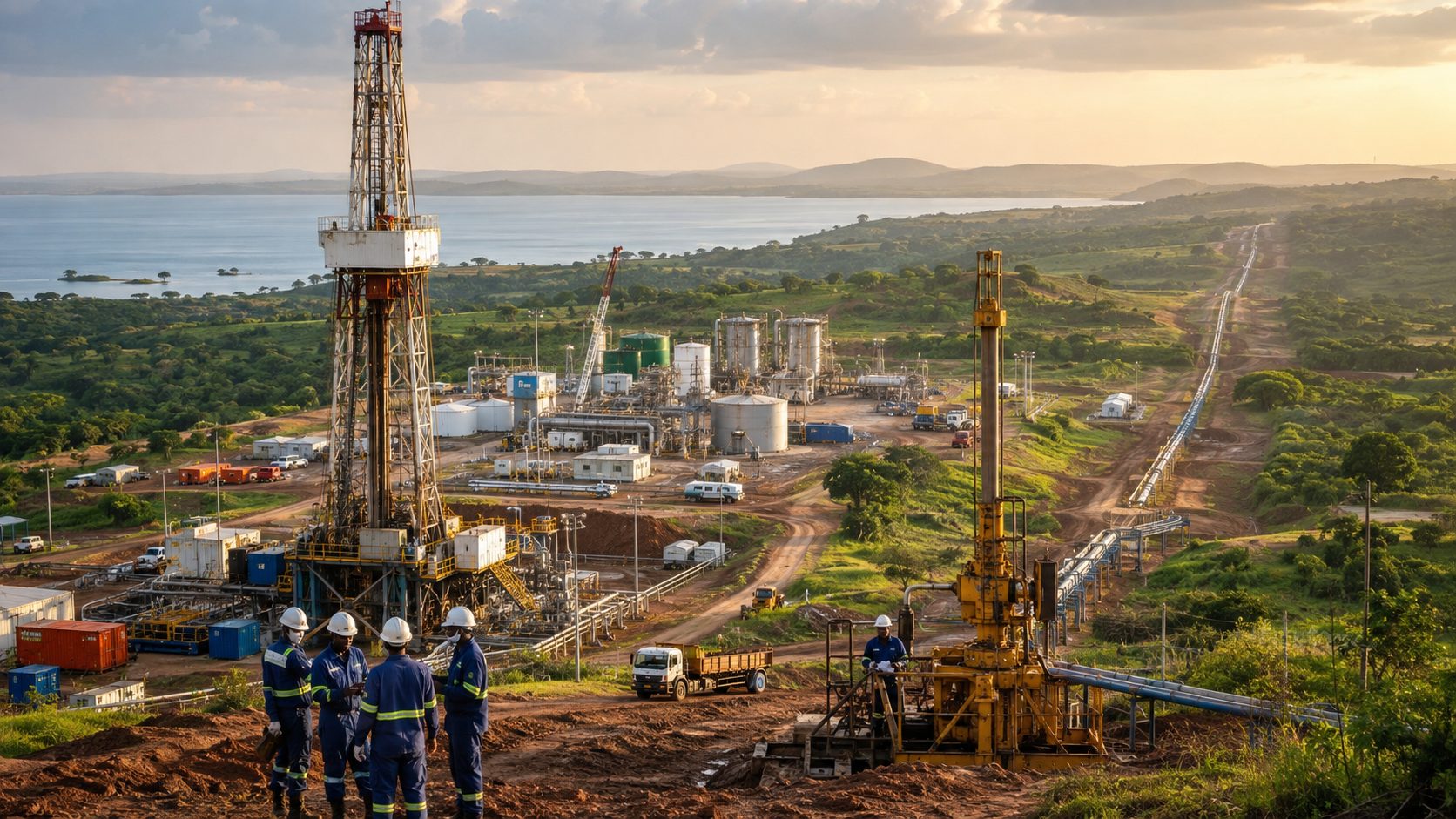
After nearly two decades of waiting, Uganda is finally approaching the moment when its oil wealth begins generating commercial returns.
The country is preparing for its first commercial oil production in 2026, with the Tilenga and Kingfisher projects moving toward completion alongside the East African Crude Oil Pipeline, known as EACOP.
The scale of the opportunity is significant.
Uganda has discovered billions of barrels of oil in the Lake Albert region. The projects are expected to attract around $10 billion in development and infrastructure investment, creating opportunities for international oil companies, the Ugandan government, local businesses, banks and investors.
But one question matters more than the size of the investment.
Who will actually make money from Uganda’s oil boom?
The answer involves much more than the companies drilling the wells.
Uganda’s first oil is finally getting closer
Uganda discovered commercial quantities of oil in 2006. Since then, the country has spent years negotiating agreements, developing infrastructure and building the regulatory framework needed to start production.
Most of the country’s oil resources are concentrated in the Albertine Graben in western Uganda, around Lake Albert.
The Petroleum Authority of Uganda estimates that the country has about 6.5 billion barrels of oil in place, with a significant portion considered recoverable. (pau.go.ug)
Two major projects will lead Uganda’s first oil production: Tilenga and Kingfisher.
Tilenga is operated by TotalEnergies, while CNOOC operates Kingfisher.
Together, the projects are expected to reach around 230,000 barrels of oil per day at peak production. (totalenergies.ug)
But producing the oil is only half the challenge.
Uganda is landlocked, so it needs a route to international markets.
That is where EACOP comes in.
Who owns Uganda’s oil projects?
The ownership structure determines who gets a direct share of the profits.
In the Tilenga project, TotalEnergies holds 56.67%, CNOOC Uganda holds 28.33%, while Uganda National Oil Company, or UNOC, holds 15% on behalf of the Ugandan government. (unoc.co.ug)
Kingfisher has the same ownership structure.
The difference is that CNOOC operates Kingfisher, while TotalEnergies operates Tilenga.
This means the two international oil companies have major financial interests in Uganda’s emerging oil industry.
Uganda also has a direct commercial stake through UNOC.
That gives the government a share of production rather than relying only on taxes and royalties.
TotalEnergies is the biggest corporate player
Among the companies involved, TotalEnergies has the largest position.
The French energy company operates Tilenga and holds the largest participating interest in both Tilenga and Kingfisher.
Its influence extends beyond the oil fields.
TotalEnergies also owns 62% of EACOP, the pipeline that will transport Uganda’s crude oil to the Tanzanian coast. (eacop.com)
This gives TotalEnergies exposure to both the production and transportation sides of Uganda’s oil business.
The company can potentially earn from its share of crude production while also benefiting from its investment in the pipeline.
However, its actual returns will depend on factors such as oil prices, production levels, costs, taxes and the terms of Uganda’s petroleum agreements.
CNOOC has a major stake in the oil boom
China’s CNOOC is another major player.
The company operates the Kingfisher project and holds a 28.33% interest in both Kingfisher and Tilenga.
CNOOC also owns 8% of EACOP. (eacop.com)
Kingfisher is expected to produce about 40,000 barrels per day at peak production. (unoc.co.ug)
For CNOOC, Uganda provides access to a new oil-producing region with long-term production potential.
For Uganda, the partnership brings international capital, technology and technical expertise.
How will Uganda make money from oil?
Uganda’s biggest opportunity is not simply selling crude.
The government has several ways to earn from the industry.
The first is through UNOC’s 15% interests in Tilenga and Kingfisher.
The second is through EACOP, where UNOC owns 15%.
The third is through petroleum taxes, royalties and other government revenues.
Together, these sources could create a substantial new income stream for the government.
For the 2026/27 financial year, Uganda has projected about Sh2.2 trillion in oil revenues, according to government budget figures reported by Uganda Broadcasting Corporation. (ubc.go.ug)
President Yoweri Museveni has also said Uganda could receive around $1.5 billion a year as its share of oil revenue once production becomes established. (web.parliament.go.ug)
The actual figure will change depending on production and global oil prices.
Still, the potential is large enough to affect Uganda’s public finances for years.
EACOP is the key to Uganda’s oil exports
Uganda’s crude cannot simply leave the country by sea.
It must first travel from the Lake Albert region to the coast.
EACOP provides that connection.
The 1,443-kilometre pipeline will transport crude from Kabaale in western Uganda to the Chongoleani Peninsula near Tanga in Tanzania. (eacop.com)
The pipeline is designed specifically for Uganda’s crude, which requires heating to remain fluid during transportation.
EACOP therefore represents one of the largest pieces of infrastructure linked to Uganda’s oil boom.
Its ownership is divided between four shareholders:
- TotalEnergies: 62%
- UNOC: 15%
- TPDC: 15%
- CNOOC: 8%
EACOP will generate revenue by charging for transporting crude through the pipeline.
That creates another business around every barrel of Uganda’s oil.
Why Tanzania will also benefit
Uganda’s oil boom is also becoming a Tanzanian economic opportunity.
Tanzania owns 15% of EACOP through TPDC.
The country will host the final section of the pipeline and the export facilities at Tanga. (eacop.com)
That gives Tanzania an opportunity to earn from the pipeline itself.
It can also benefit from employment, logistics, construction, services and other economic activity created by the project.
The result is a cross-border energy corridor linking Uganda’s oil fields to the Indian Ocean.
Ugandan companies could be major winners
The biggest economic opportunity may not belong to the oil companies.
It could belong to businesses supplying them.
Oil production requires thousands of goods and services.
Companies are needed for:
- Engineering
- Transport
- Construction
- Security
- Catering
- Accommodation
- Equipment supply
- Maintenance
- Technology
- Logistics
- Professional services
Uganda expects local companies to capture a significant portion of this spending.
Government estimates suggest Ugandan businesses could receive around 28% of approximately $15 billion in oil-sector development and construction investment through goods, services and works. (petroleum.go.ug)
That would represent a potential market worth billions of dollars.
It also explains why local content could become one of the most important parts of Uganda’s oil strategy.
A Ugandan company does not need to own an oil field to benefit.
It needs to become good enough to supply the industry.
Banks and investors are also in the game
Oil projects require enormous amounts of financing.
That creates opportunities for banks and financial institutions.
EACOP’s financing has involved regional and international institutions, including Afreximbank, Standard Bank, Stanbic Bank Uganda and KCB Bank Uganda. (eacop.com)
Financial institutions can earn from loans, guarantees, foreign exchange, transaction services and other financial products.
The wider economy could also benefit from increased demand for insurance, investment management and corporate finance.
Uganda’s oil boom is therefore creating a financial ecosystem around the physical oil infrastructure.
Will Uganda keep enough of the money?
This is where the story becomes more complicated.
A $10 billion investment does not mean $10 billion will go directly into Ugandan pockets.
Large oil projects require imported equipment, international contractors, specialised technology and foreign financing.
The challenge is ensuring that enough economic value remains inside Uganda.
That means building local companies capable of handling more complex work.
It also means investing oil revenues in sectors that can continue generating growth after oil production declines.
If Uganda uses oil money to strengthen manufacturing, agriculture, technology, infrastructure and human capital, the benefits could extend far beyond the petroleum sector.
Uganda’s refinery could create another opportunity
Uganda also plans to develop a 60,000-barrel-per-day refinery at Kabaale.
The refinery is intended to process crude into petroleum products for Uganda and regional markets.
That could allow Uganda to capture more value from its petroleum resources instead of exporting crude while importing refined fuel.
A successful refinery could create additional opportunities in manufacturing, storage, transportation and distribution.
But it will also require significant investment and careful management.
The economics will have to make sense.
The environmental debate will continue
Uganda’s oil boom has also generated environmental and social concerns.
Tilenga is being developed around Lake Albert, an area with communities, farmland and sensitive ecosystems.
EACOP crosses Uganda and Tanzania, requiring land acquisition along its route.
Project developers say they have implemented environmental and social safeguards, compensation programmes and community engagement measures.
Environmental groups have raised concerns about land rights, biodiversity and the climate impact of developing a major new fossil-fuel project.
The debate is unlikely to disappear once Uganda starts producing oil.
The government will have to demonstrate that economic development can coexist with environmental protection.
Can Uganda avoid the resource curse?
This is perhaps the biggest question surrounding Uganda oil.
Natural resources can transform economies.
But they can also create problems when revenues are poorly managed.
Uganda has an opportunity to learn from other African oil producers.
The country could use petroleum revenues to build roads, electricity infrastructure, schools, hospitals and industrial capacity.
It could also save part of the revenue for future generations.
The objective should be simple:
Use temporary oil wealth to build permanent economic assets.
If Uganda succeeds, oil could help accelerate economic diversification.
If it fails, the country could become heavily dependent on a commodity whose price and production levels it does not control.
Who will really make money from Uganda’s oil boom?
The answer is becoming clearer as production approaches.
TotalEnergies is positioned to be the largest corporate beneficiary through its interests in Tilenga, Kingfisher and EACOP.
CNOOC has a major position through Kingfisher, its interests in Tilenga and its EACOP stake.
Uganda stands to benefit through UNOC’s ownership interests, taxes, royalties and other petroleum revenues.
Tanzania will benefit from its EACOP ownership and the economic activity surrounding the export corridor.
Banks and investors can earn from financing the infrastructure.
Ugandan businesses have an opportunity to capture billions of dollars in contracts and services.
But there is another group whose interests matter most.
Ugandan citizens.
The real success of Uganda’s oil boom will not be measured by how much crude is extracted.
It will be measured by what the country does with the money.
The real oil boom begins after first oil
The first barrel will be historic.
But it will only mark the beginning.
Uganda’s upstream projects and EACOP are moving closer to completion. The infrastructure being built today could support oil production for decades.
The opportunity is therefore much bigger than a single commodity.
Uganda can use oil to strengthen its industrial base, develop local businesses, improve infrastructure and create new opportunities for future generations.
But that outcome is not guaranteed.
The country will need strong institutions, transparent revenue management, competitive local businesses and disciplined public investment.
Uganda has spent nearly 20 years waiting for its oil boom. The next 20 years will determine whether that oil becomes a source of lasting wealth or simply another missed opportunity.
For the companies involved, the first barrel represents a commercial milestone.
For Uganda, it represents something much bigger.
It is a test of whether Africa’s natural resources can finally be converted into broad-based economic prosperity.

More from Magazine
How Aliko Dangote is turning Africa’s biggest refinery into a $47 billion public company
Nigeria's SEC has cleared a $1.6 billion share sale for Dangote's refinery, setting up Africa's largest-ever stock market listing.

Inside Ethiopia’s $12.5 billion bet to build Africa’s next aviation hub
Ethiopia’s massive Bishoftu airport aims to transform Ethiopian Airlines into Africa’s dominant aviation hub while attracting global investment and technology.

Who owns Africa’s mobile future? The battle behind MVNOs
Africa's mobile industry is entering a new ownership contest as MVNOs, fintechs and satellites challenge traditional telecom giants.