

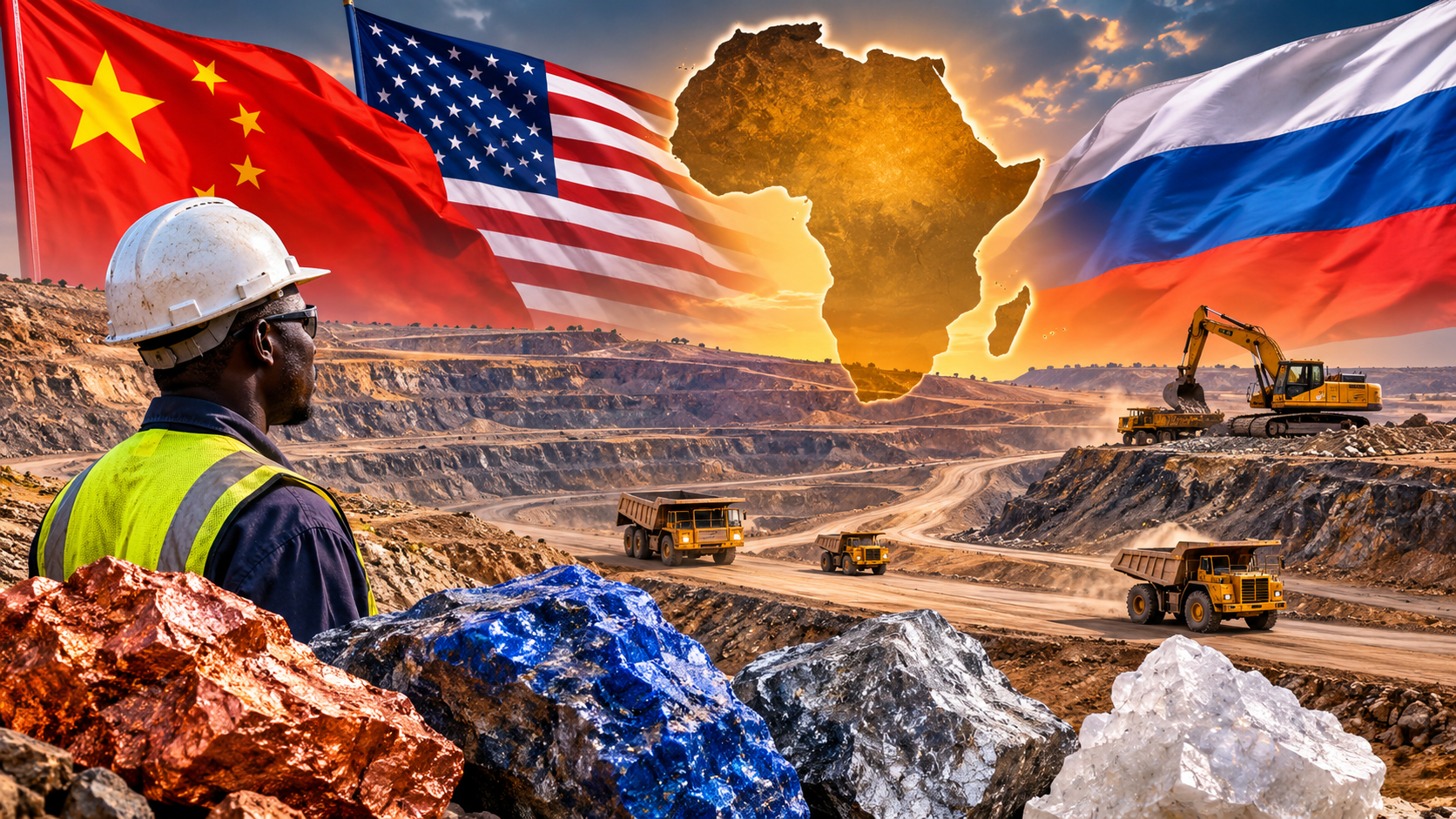
Africa is becoming one of the most strategically important territories in the global struggle for economic and technological power. Beneath its soil lie minerals essential to electric vehicles, advanced electronics, renewable energy, military technology and the industries expected to shape the next century. China has spent years establishing a formidable position in this sector.
The United States is accelerating efforts to secure alternative supply chains, while Russia is pursuing its own strategic interests through mining, political relationships and resource diplomacy. Yet the most important question is not which foreign power will win access to Africa’s minerals. It is whether African countries can transform their geological wealth into lasting economic power before another generation of resources leaves the continent with limited industrial benefits.
The new geopolitical importance of Africa’s mineral wealth
The global competition for critical minerals is no longer simply a mining industry issue. It has become a question of national security, technological independence and international economic influence.
Cobalt, lithium, copper, graphite, manganese, nickel and rare earth elements are increasingly important to industries ranging from electric vehicle manufacturing to renewable energy infrastructure. They are also essential components of batteries, advanced electronics and certain defence technologies.
Africa occupies an unusually important position in this emerging economic landscape.
According to the International Energy Agency’s Global Critical Minerals Outlook 2025, the Democratic Republic of Congo accounts for approximately 70% of global mined cobalt production. The continent also has substantial manganese, platinum-group metals, graphite and copper resources.
South Africa remains a major global supplier of platinum-group metals and manganese, while Zambia and the DRC form an important part of the world’s copper and cobalt supply chains.
Zimbabwe, Namibia, Mali and Ghana have also attracted attention because of their lithium potential and broader mineral resources.
However, possessing mineral deposits does not automatically translate into economic power. The countries that control processing, technology, financing, transportation and manufacturing frequently capture a disproportionate share of the value generated by these resources.
This distinction explains why Washington, Beijing and Moscow increasingly view African mining as a strategic priority.
China’s early investment advantage
China’s position in Africa’s critical minerals industry is built on something more substantial than diplomatic agreements or political declarations. It rests on years of investment, established commercial relationships and an extensive industrial presence.
Chinese companies have acquired stakes in major mining operations, financed infrastructure and developed processing facilities across several African countries.
The Democratic Republic of Congo provides perhaps the clearest example.
Companies such as CMOC Group and Zijin Mining have established significant interests in the country’s copper and cobalt industries. Chinese entities have also been involved in major mining operations through partnerships with international companies and the Congolese state-owned mining company Gécamines.
The advantage is not simply the ownership of mining concessions. Chinese companies have developed relationships across multiple stages of the mineral supply chain, including extraction, refining, logistics and international trading.
This integration gives Chinese businesses considerable influence over how minerals move from African mines into global manufacturing industries.
Zimbabwe offers another example of China’s expanding influence.
Chinese investors have entered the country’s lithium industry, including projects involving processing facilities intended to move some activities beyond the export of raw ore.
The strategic advantage is clear: China is not merely interested in obtaining African minerals. It wants to maintain access to the materials needed by its industrial economy.
That distinction helps explain why Chinese mining investments have continued to attract attention as Western governments attempt to diversify their mineral supply chains.
However, Chinese involvement should not be treated as a single uniform model. Some projects bring capital, infrastructure and employment, while others raise questions about transparency, environmental protection, local procurement and the distribution of profits.
The important question for African governments is whether individual agreements deliver competitive long-term benefits rather than simply increase extraction.
America’s attempt to challenge China’s dominance
For Washington, Africa’s mineral resources have acquired renewed strategic importance as the United States seeks to reduce its dependence on supply chains dominated by China.
The American approach increasingly combines diplomatic agreements, development finance, private-sector investment and infrastructure development.
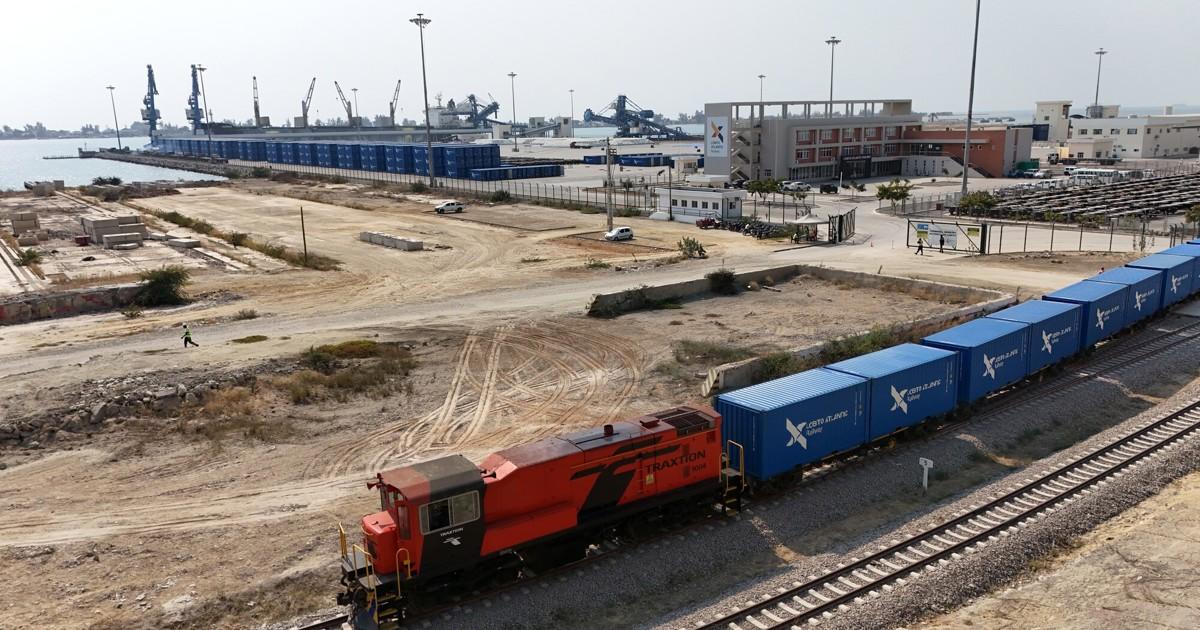
One of its most important initiatives is the Lobito Corridor.
The corridor connects Angola’s Atlantic port of Lobito to mining regions in the Democratic Republic of Congo and Zambia. Its development is intended to provide an alternative export route for copper and other minerals while encouraging investment in regional transport infrastructure.
The significance extends beyond transportation.
For decades, African mineral producers have operated within export systems that frequently connect mining areas to international markets without generating sufficiently integrated industrial development along the way.
Alternative transport infrastructure could strengthen African countries’ negotiating positions by giving them more choices over where and how their resources are exported.
American involvement has also moved into direct commercial and diplomatic arrangements.
In December 2025, the United States and the DRC signed a strategic partnership agreement focused on economic cooperation, critical minerals and infrastructure.
The partnership provides a framework for American investment and preferential access opportunities involving strategic mineral assets. It also addresses infrastructure, local value creation and the development of more transparent supply chains.
A notable commercial development followed in 2026, when US-based Virtus Minerals acquired Chemaf’s Congolese copper and cobalt mining assets.
However, the transaction also illustrates the risks associated with geopolitical competition.
A Reuters investigation published in April 2026 questioned claims about the mining experience and operational assets of Virtus’s subsidiary, ROK Metals. The reporting raised concerns about whether adequate due diligence had been conducted.
The episode is an important reminder that a project does not become commercially credible simply because it advances a government’s strategic objectives.
American participation could introduce additional capital, technology and competition into African mining. But Washington must demonstrate that its commercial commitments can translate into operational projects rather than remain diplomatic ambitions.
For African governments, the opportunity lies in using competition between foreign investors to negotiate better financing arrangements, infrastructure commitments and local industrial participation.
Russia’s strategic interest in African resources
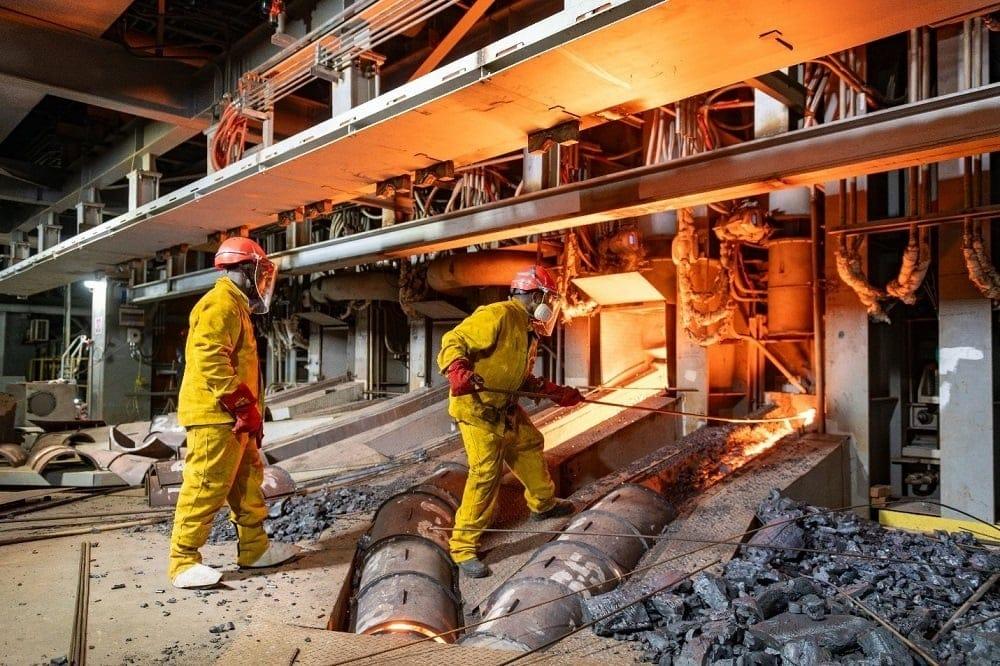
Russia’s position in Africa’s mineral competition is different from China’s extensive industrial footprint and America’s growing infrastructure and investment strategy.
Moscow has traditionally relied on political relationships, security cooperation, energy partnerships and selected mining interests to maintain its presence across the continent.
Its mining interests include gold, diamonds, uranium, platinum-group metals and other strategic resources.
Countries such as the Central African Republic, Sudan, Zimbabwe and Madagascar have featured in discussions of Russian commercial and political engagement in the mining sector.
Russian-linked companies and networks have also attracted international scrutiny over the relationship between resource extraction, security arrangements and political influence.
The Central African Republic illustrates the complicated nature of this approach.
Russian security involvement has developed alongside commercial interests in the country’s natural resources, particularly gold and diamonds. This relationship has attracted criticism and questions about transparency, accountability and the distribution of economic benefits.
Nevertheless, Russia should not be regarded as an industrial competitor on the same scale as China in African mineral processing.
Its influence is more selective and often linked to particular countries, political relationships and resource opportunities.
The distinction matters because the competition for African minerals is not taking place on equal commercial terms.
China has established substantial manufacturing and processing capabilities. The United States brings financial markets, technological partnerships and diplomatic influence. Russia seeks strategic access through a narrower combination of commercial and political relationships.
African governments must understand these differences rather than treat all foreign investment proposals as equivalent.
The real struggle is over ownership and processing
The most important dimension of Africa’s critical minerals competition is not necessarily who extracts the resources. It is who controls the activities that transform them into higher-value industrial products.
Mining is only one part of the mineral economy.
A mineral extracted from the ground may pass through several stages before becoming a component in a battery, electric vehicle, electronic device or industrial machine.
These stages include concentration, refining, chemical processing, component manufacturing, distribution and technology development.
Each stage creates opportunities for employment, investment, taxation and industrial development.
Yet Africa remains underrepresented in many of these activities.
An OECD assessment published in 2026 found that approximately 24% of African critical mineral exports were raw materials and 72% were semi-processed products. This means that fully processed products represented only a small proportion of exports.
The International Energy Agency has similarly highlighted the concentration of refining capacity, particularly in China.
This creates an uncomfortable economic contradiction.
African countries supply materials essential to some of the world’s most advanced industries, but much of the processing and manufacturing associated with those industries takes place elsewhere.
The consequences extend beyond lost corporate profits.
When processing facilities are located outside Africa, the continent also loses opportunities to develop engineering expertise, industrial supply chains, specialised employment and technological capabilities.
In other words, the economic cost is not limited to the difference between the price of raw ore and the price of refined minerals.
It includes the industrial knowledge and future productive capacity that remain outside African economies.
This is where the competition between foreign powers could become particularly consequential.
If China, America or another international investor develops processing facilities in Africa, the arrangement could provide substantial benefits. But those benefits depend on whether African countries participate meaningfully in ownership, management, technology transfer and industrial development.
A processing plant owned entirely by foreign interests, importing most of its specialised equipment and exporting nearly all its output, does not automatically create a strong domestic industrial ecosystem.
The challenge is to move beyond the simple presence of factories towards deeper economic participation.
Who actually captures the profits?
The question of mineral ownership is often more complicated than identifying the country where a mine is located.
A mining concession may be granted by an African government, operated by a foreign company and financed through international banks or investment funds.
The mineral may then be sold to a trading company, processed in another country and incorporated into products manufactured somewhere else.
At every stage, different participants capture different economic rewards.
African governments may collect royalties, corporate taxes and licence fees. Local workers receive wages, while domestic businesses may benefit from contracts and services.
Foreign investors receive returns on capital and may control operational decisions. International processors and manufacturers capture additional margins further along the supply chain.
The distribution depends on the ownership structure, taxation arrangements, production costs, market prices and bargaining power of the participants.
This is why mineral production figures alone provide an incomplete picture of economic success.
A country can become a major global producer without developing a correspondingly strong domestic manufacturing industry.
The DRC’s cobalt industry demonstrates the contradiction particularly clearly. Its position as the world’s leading mined cobalt producer has not automatically translated into control over the global battery manufacturing industry.
The same issue applies to manganese in South Africa and Gabon, and copper in Zambia.
For African governments, the central question should therefore be how much domestic economic value is generated by each mineral project, not simply how much ore is extracted.
The Lobito Corridor and Africa’s bargaining power
Infrastructure could become one of the most important instruments through which African countries reshape their position in the global minerals economy.
The Lobito Corridor is significant because it offers the possibility of connecting mineral-producing regions to an alternative Atlantic export route.
For Zambia and the DRC, diversified transport infrastructure could reduce dependence on established export routes and strengthen access to international markets.
But the corridor’s significance should not be exaggerated.
A railway does not automatically produce industrialisation. Nor does an alternative port guarantee that African countries will capture a larger share of mineral profits.
The benefits depend on what happens around the infrastructure.
Can local companies supply equipment and services? Will industrial zones develop along the route? Can electricity infrastructure support mineral processing? Will smaller businesses gain access to commercial opportunities?
These questions are more important than the political symbolism of an internationally funded railway.
The corridor should therefore be evaluated as an industrial development opportunity, not simply a transport project designed to move minerals towards foreign markets.
Africa’s biggest weakness is fragmentation
The competition for critical minerals presents African governments with an opportunity to improve their international bargaining positions.
However, the continent’s fragmented approach remains a major obstacle.
Countries frequently negotiate mining agreements independently, even when their resources form part of the same regional industrial system.
This weakens their collective bargaining power and makes it harder to develop processing industries that require large, reliable supplies of minerals, affordable electricity and access to substantial markets.
The African Continental Free Trade Area offers an important framework for addressing this challenge.
Regional cooperation could allow countries to specialise in different stages of mineral production rather than competing to establish identical facilities independently.
For example, the DRC and Zambia could deepen cooperation around copper and battery-related industries, while South Africa could contribute established industrial expertise and manufacturing capacity.
Similarly, countries producing lithium, graphite and manganese could explore regional partnerships in chemical processing, research and industrial supply chains.
However, regional cooperation requires more than political agreements.
Governments must coordinate regulations, infrastructure investments, customs procedures, electricity supply and industrial policies.
Without these foundations, ambitious beneficiation strategies risk becoming expensive political announcements.
The policy choices that will determine Africa’s future
African governments need to move beyond the assumption that restricting mineral exports is sufficient to create domestic industries.
Export restrictions, processing requirements and local ownership policies can improve bargaining power, but they can also create unintended consequences.
If governments impose restrictions before establishing competitive processing capacity, investors may delay projects, production may decline and informal trading may increase.
Research by the OECD and the UK Government highlights the importance of electricity, transport infrastructure, affordable financing, technical skills and regulatory stability in determining whether mineral processing investments are commercially viable.
These are not minor administrative considerations. They are the foundations of industrial competitiveness.
There are several priorities African governments should consider.
First, improve transparency in mining agreements. Citizens should be able to understand who owns major concessions, what governments receive in return and how public revenues are distributed.
Second, negotiate meaningful local participation. Mining agreements should encourage domestic procurement, workforce development, technology transfer and opportunities for African businesses.
Third, invest in electricity and infrastructure. Processing minerals requires reliable energy supplies, industrial facilities and efficient transportation systems.
Fourth, strengthen regional industrial cooperation. African countries should develop complementary manufacturing and processing capabilities instead of pursuing fragmented national strategies.
Finally, strengthen environmental and labour protections. Economic development cannot be sustainable if communities experience environmental destruction, unsafe working conditions or inadequate compensation.
These measures would help African countries negotiate from a position of greater strength, regardless of whether their investment partners come from China, America, Russia, Europe or the Middle East.
A competition Africa cannot afford to lose
The competition between China, America and Russia is likely to remain an important feature of African geopolitics for decades.
Demand for minerals will continue to be shaped by technological innovation, energy security, industrial development and defence requirements. However, individual mineral markets will experience different cycles, and not every anticipated investment or processing project will become commercially successful.
This creates both an opportunity and a warning for Africa.
The opportunity is that international competition gives African governments more potential partners, financing options and diplomatic leverage than they might otherwise have.
The warning is that geopolitical attention does not automatically translate into economic development.
Foreign powers ultimately pursue their own national and commercial interests. China wants reliable industrial supply chains. The United States wants greater supply-chain security and reduced dependence on strategic competitors. Russia seeks commercial opportunities and geopolitical influence.
None of these objectives should be confused with an automatic commitment to Africa’s industrial transformation.
African governments must therefore define their own priorities before negotiating with external partners.
The continent needs more than mining agreements. It needs industrial strategies capable of turning natural resources into productive economies.
The real measure of success will not be the number of foreign companies operating African mines, the value of minerals exported or the number of diplomatic agreements signed.
It will be the number of processing facilities built, African companies developed, skilled workers employed, technologies transferred and manufacturing industries established.
There is a fundamental difference between being a supplier of the materials that power the global economy and becoming an industrial participant in that economy.
For too long, Africa has occupied the former position.
The contest for critical minerals presents an opportunity to change that relationship. But the opportunity will not last indefinitely, and the decisions made today will influence the continent’s economic position for generations.
China, America and Russia may be competing for Africa’s underground wealth. Africa’s more important challenge is to ensure that the economic future created by that wealth is not decided elsewhere.
Who Owns Africa examines the people, companies, governments and institutions shaping Africa’s economic and political future.

More from Mining
Africa could power the green revolution, but will Africans own it?
Africa's renewable energy boom and mineral wealth could reshape global industries, but ownership, financing and value capture will determine who truly benefits.
Africa has the minerals. But who controls the money?
Kenya's Mrima Hill mineral project exposes a deeper African challenge: attracting foreign investment while retaining ownership, industrial value and economic benefits.
Tata Chemicals Exit: Who will control Kenya’s lake Magadi Soda Ash Wealth?
Kenya ordered Tata Chemicals out of Lake Magadi, reviving debate over foreign ownership and who truly benefits from Africa's minerals.