

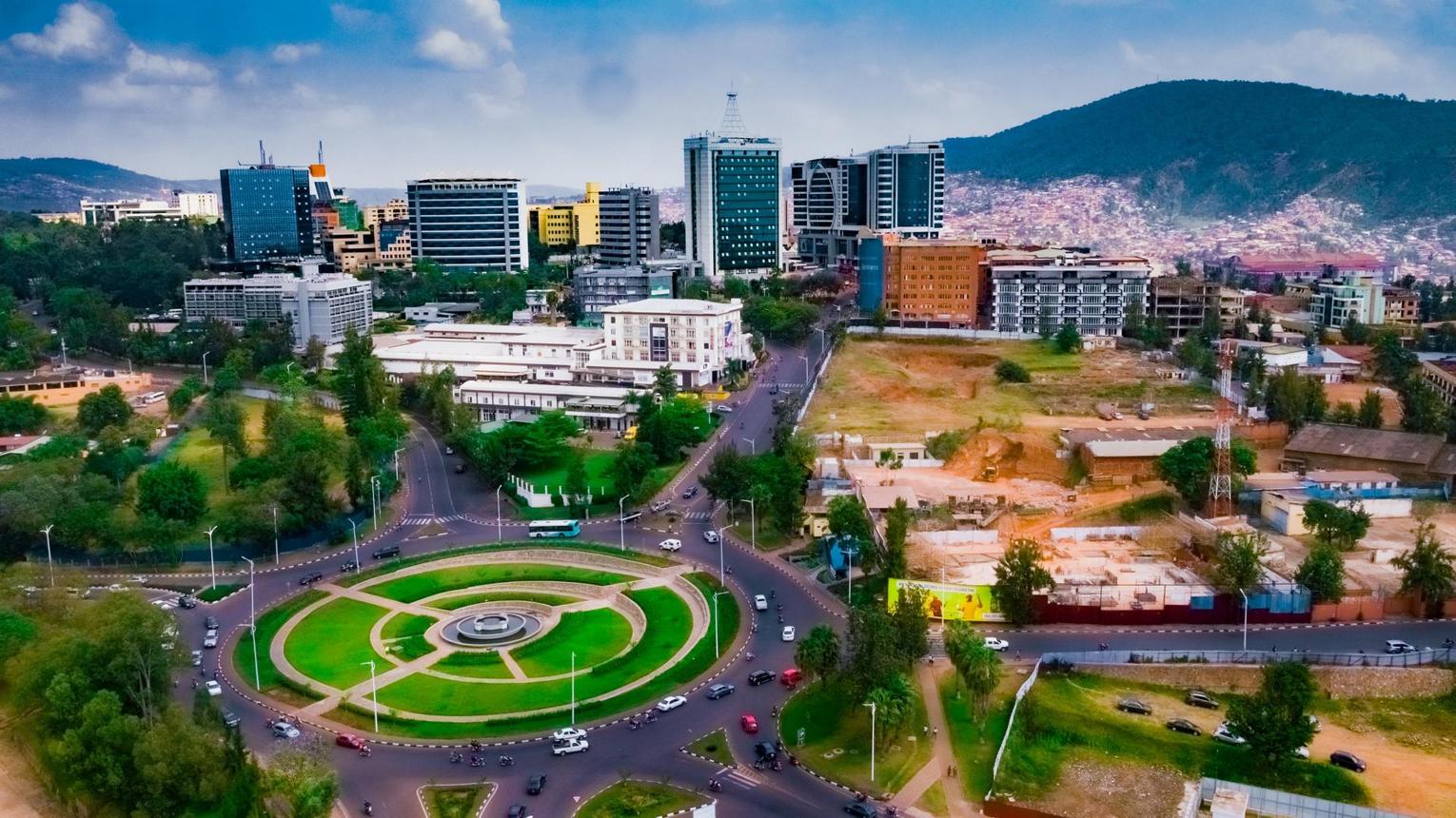
Kigali’s changing skyline tells a story of ambition, but the more consequential transformation is happening behind the buildings, where land rights, investment capital, corporate structures and government planning determine who controls the city’s most valuable assets. Rwanda’s capital is attracting developers, institutional investors and international businesses, yet the question of who ultimately owns its emerging property wealth is considerably more complicated than the names displayed on construction sites.
The distinction matters. A company can finance a development without owning the underlying land. An investor can control a property through shares in a locally registered company, while a bank may hold a mortgage over the asset. A government-backed institution can facilitate a project without being its ultimate commercial owner.
Kigali’s real estate expansion is therefore not simply a construction story. It is an examination of how economic power is distributed in one of Africa’s most ambitious urban development experiments.
Kigali’s transformation is creating a new investment economy
For years, Rwanda has treated urban development as an important component of its broader economic transformation strategy. Kigali occupies a central position in that ambition.
The capital is expected to accommodate growing demand for residential housing, commercial offices, hospitality, retail facilities and modern infrastructure as Rwanda expands its services, technology, tourism and financial sectors.
The government’s development vision has also encouraged the emergence of planned urban districts designed to attract international businesses, skilled professionals and institutional capital.
This has created an investment environment in which property is increasingly connected to other economic sectors.
A modern office building, for example, is not merely a collection of commercial units. It depends on transport infrastructure, reliable electricity, telecommunications, financial services and a sufficient concentration of businesses capable of paying commercial rents.
Similarly, premium residential developments depend on the expansion of Rwanda’s professional workforce, diplomatic community, international business population and higher-income households.
The commercial opportunity is real, but it also creates an important question: is the market expanding because ordinary Rwandans can afford better housing, or because developers are responding primarily to demand from wealthier buyers and institutions?
The difference will determine the social and economic consequences of Kigali’s property boom.
Who actually owns land in Rwanda?
Understanding Kigali’s property market begins with Rwanda’s land ownership framework.
Unlike jurisdictions where land ownership is commonly understood through unrestricted freehold rights, Rwanda operates a structured land tenure system in which long-term leases play a central role.
The Land Law, Law No. 27/2021 of June 10, 2021, establishes the legal framework governing land ownership, registration and transfers.
It recognises different categories of land rights, including freehold, emphyteutic leases and land concessions.
Under this framework, qualifying landholders can obtain long-term land rights, with emphyteutic leases generally extending for periods of up to 99 years, subject to the applicable legal requirements.
The distinction becomes particularly important when foreign investors enter the market.
Article 16 of the 2021 Land Law provides that foreigners can obtain emphyteutic leases and land concessions for investment purposes. Freehold ownership by foreigners is subject to exceptional legal provisions.
The National Land Authority’s guidance also explains that foreign individuals and companies with foreign shareholding have specific rights concerning residential property and investment land.
This means international investors can participate in Kigali’s real estate economy, but the legal structure of their land rights must be understood before assessing what they actually own.
A foreign-backed development company may control a valuable property through a registered land lease, a concession or an ownership interest in a local corporate entity. Those arrangements are not necessarily equivalent to unrestricted ownership of the land.
The distinction is fundamental to understanding the market.
The corporate structures behind the buildings
One of the least understood aspects of Kigali’s property market is the relationship between developers, investors, financing institutions and registered property companies.
Large developments frequently involve several separate entities.
A developer may establish a special-purpose company to hold a project. Investors contribute equity, banks provide debt financing, contractors deliver construction and property managers operate the completed development.
The registered company may hold the property rights, while its shareholders exercise economic influence through their ownership interests.
This structure allows investment risks and financial obligations to be separated between different participants.
It also means that identifying the developer’s name is not enough to establish who ultimately owns a building.
The relevant questions include who owns the project company, who financed its acquisition, whether the property is mortgaged, who controls its board and whether beneficial ownership is disclosed.
Rwanda has established formal business registration and land registration systems, but public information about individual development companies does not always provide a complete picture of their ultimate beneficial ownership.
For researchers and investors, this creates an important distinction between registered ownership and economic control.
A comprehensive assessment of Kigali’s property market therefore requires company-level investigation rather than simply counting prominent buildings.
Kigali Heights reveals how ownership can change
One transaction offers a particularly useful illustration of how international and domestic capital interact in Kigali’s property market.
Kigali Heights, a major commercial and retail complex near the Kigali Convention Centre, was developed through the involvement of Fusion Capital Group, an investment firm with Kenyan and British ownership interests.
The development was completed in 2016 and became an established commercial destination, accommodating retail businesses, restaurants and other commercial tenants.
In October 2024, the complex was acquired by Yyussa Company Limited, a Rwandan real estate firm led by Yusuf Kalinganire.
The transaction was reported at approximately $31.8 million.
According to the announcement published by Kigali Heights, Fusion Capital had led the financing and development of the property. Its representatives described the transaction as a transition from an initial structure in which local investors held a 5% stake to one in which local ownership reached 100%.
The transaction is significant for several reasons.
First, it demonstrates that international capital can participate in developing major commercial assets without necessarily remaining their permanent owner.
Second, it shows how domestic investors can acquire established properties after the initial development risks have been absorbed.
Third, it illustrates the potential for local companies to accumulate ownership of income-producing commercial assets rather than remaining confined to smaller property investments.
However, one transaction should not be interpreted as evidence that the entire Kigali property market is undergoing the same ownership transition.
It is a notable example, not a comprehensive measure of market-wide ownership.
Institutional investors are changing the scale of development
The next stage of Kigali’s transformation involves investment structures that extend beyond traditional property developers.
A particularly important example is Kigali Innovation City, a planned mixed-use development in Rwanda’s Kigali Special Economic Zone.
The project involves the Rwandan government, the Rwanda Development Board and Africa50, a pan-African infrastructure investment platform.
The development covers approximately 61 hectares and is designed to accommodate universities, technology companies, research facilities, commercial offices, residential accommodation, hotels and retail infrastructure.
In May 2024, Africa50 and the Rwandan government formalised an implementation agreement intended to accelerate the development.
The Arab Bank for Economic Development in Africa, known as BADEA, is supporting the project through financing for initial shared infrastructure.
Africa50 describes its role as a project development, finance and equity partner. Its published project information estimates the total development cost at approximately $300 million.
The significance of this arrangement goes beyond the size of the investment.
It demonstrates how institutional investors can participate in urban development through project structuring, equity participation, infrastructure financing and partnerships with governments.
The government, meanwhile, contributes strategic planning, public infrastructure and the policy environment required to make the development commercially viable.
These roles should not be confused with one another.
A government partnership does not automatically mean that the state owns every commercial building within a development. Equally, an institutional investor’s involvement does not establish that it owns the entire project.
The actual distribution of ownership depends on the project’s legal agreements, corporate structure and financing arrangements.
For Kigali, the growing use of such partnerships could become an important model for attracting larger pools of long-term capital.
The financing behind Kigali’s property boom
Real estate development is capital-intensive.
Land acquisition, architectural design, construction materials, labour, utilities and infrastructure require substantial funding before a project begins generating income.
Kigali’s developers operate within a financing environment that combines domestic banking, private equity, international investment and development finance.
Commercial banks provide loans to property companies and eligible homebuyers. Equity investors contribute capital in exchange for ownership interests and potential returns. Development finance institutions can provide longer-term financing for projects that might otherwise struggle to secure suitable commercial funding.
The Development Bank of Rwanda has also played an important role in expanding housing finance.
One notable initiative is the Rwanda Housing Finance Project, commonly associated with the Gira Iwawe programme.
Supported by the World Bank and implemented through the Development Bank of Rwanda, the initiative was designed to expand access to longer-term housing finance and strengthen the domestic mortgage market.
A 2024 research paper by the Rwanda Bankers Association described mortgage products under the programme with interest rates of 11% and 13% for specified income categories, with repayment periods extending up to 20 years.
These financing arrangements matter because a property market cannot expand sustainably through construction alone.
Developers need buyers who can afford completed homes, while households need mortgages that reflect their income levels and ability to repay.
Without affordable long-term finance, the market risks becoming increasingly dependent on wealthy cash buyers, corporate tenants and institutional purchasers.
That may support premium developments, but it does not necessarily resolve the country’s wider housing shortage.
The uncomfortable economics of Kigali’s housing market
Kigali’s property boom is occurring alongside a substantial housing affordability challenge.
Research published by the Centre for Affordable Housing Finance in Africa in its 2024 Housing Finance Yearbook estimated that Kigali required at least 22,000 additional housing units annually.
However, the research estimated that only around 3,000 residential units were being supplied to the formal Kigali housing market annually over the decade to 2023.
The difference illustrates the scale of the challenge.
Demand is not concentrated exclusively among affluent households. It includes workers, young professionals, families, small-business owners and people moving to the capital in search of employment.
Yet formal residential development often faces high construction costs, expensive imported materials and limited access to affordable financing.
These pressures influence the types of properties developers choose to construct.
Premium apartments and commercial developments can offer stronger potential returns, particularly when investors anticipate demand from international businesses and higher-income customers.
Affordable housing, by contrast, often requires lower development margins, cheaper construction methods, infrastructure support and financing arrangements that allow households to purchase or rent at manageable prices.
The market can therefore experience rapid investment growth without producing enough housing for the majority of residents.
This is one of the most important contradictions in Kigali’s urban transformation.
A city can become more attractive to investors while becoming increasingly difficult for ordinary workers to afford.
Who benefits from rising property values?
Rising property values can generate wealth for several groups.
Landholders may benefit from higher valuations. Developers can earn returns from completed projects. Banks receive interest income from mortgages and commercial loans. Investors may receive dividends, rental income or capital gains.
Construction companies, architects, engineers, suppliers and property managers also participate in the expanding market.
However, the benefits are not automatically distributed across the wider population.
Households that own appreciating property may accumulate wealth, while renters face the possibility of higher housing costs.
Small businesses can benefit from improved commercial infrastructure but may also struggle with increasing rents in attractive locations.
Landowners in areas targeted for infrastructure development may experience rising land values, although the actual benefit depends on their legal rights, planning restrictions and ability to transact.
The government also has an economic interest in successful urban development through taxation, employment, infrastructure utilisation and wider economic activity.
The policy challenge is to ensure that property investment contributes to broader economic development rather than simply increasing the value of a limited number of assets.
The risk of building a city for investors
Kigali’s urban planning ambitions are closely connected to Rwanda’s efforts to attract international businesses and strengthen its position as a regional economic centre.
The strategy has advantages.
Modern commercial districts can attract financial services, technology companies, tourism operators and international institutions. New infrastructure can improve productivity and encourage investment in other sectors.
But there is a potential weakness in relying too heavily on premium real estate as an indicator of economic progress.
Buildings do not automatically create productive economies.
An office complex needs tenants. A shopping centre needs consumers with purchasing power. Luxury apartments need a sustainable market of residents willing and able to pay.
If construction expands faster than underlying economic demand, developers can face vacancies, debt-servicing difficulties and pressure on property valuations.
Kigali must therefore balance the attraction of international capital with the development of a domestic economy capable of supporting the assets being built.
That requires job creation, higher household incomes, affordable credit and a more productive private sector.
The broader argument is explored in our analysis, Rwanda wants to triple its economy by 2035. Can its growth model deliver?.
What investors should examine before entering Kigali
For prospective investors, Rwanda offers a structured investment environment and a real opportunity to participate in a growing urban economy.
However, the attractiveness of a particular property cannot be established through location or projected appreciation alone.
Investors need to examine the underlying land rights, the legal identity of the property-owning company, the shareholder structure, outstanding mortgages, planning approvals and the terms of any development agreements.
Foreign investors must pay particular attention to the requirements governing land rights and investment approvals.
The distinction between a residential lease, an investment-related land lease and a land concession can have significant legal and commercial consequences.
Currency exposure also matters. Investors earning rental income in Rwandan francs but financing projects in foreign currencies may face exchange-rate risks.
Interest rates, construction costs, occupancy levels, rental demand and exit opportunities should all form part of a realistic assessment.
Kigali’s investment potential is better understood through its underlying economics than through promotional claims about the city’s future.
The ownership question Kigali cannot avoid
Kigali’s transformation is an important example of how African cities can use coordinated planning, domestic entrepreneurship and international investment to attract capital and modernise infrastructure.
The involvement of Africa50, BADEA, domestic property companies and international developers demonstrates the diversity of financial interests shaping the city’s development.
The acquisition of Kigali Heights also illustrates that ownership can evolve, with local investors gaining control of assets initially developed with international capital.
Yet the broader ownership picture remains difficult to quantify. Publicly available information does not establish a comprehensive breakdown of beneficial ownership across Kigali’s residential, commercial and institutional property markets.
That information matters.
Who controls the largest property companies? Which institutions hold the most valuable commercial assets? How much capital is domestic, and how much comes from abroad? How are project debts distributed? What proportion of new housing is affordable to ordinary Rwandan households?
These are not merely questions for property researchers. They concern the distribution of economic power in Rwanda’s changing capital.
Ultimately, Kigali’s success should not be measured only by the height of its buildings, the value of its property transactions or the number of international investors it attracts.
It should also be measured by whether Rwandans can participate meaningfully in the ownership of the assets being created, whether businesses can grow around the new infrastructure and whether the city’s expanding housing supply reflects the needs of its population.
The most important question is therefore not simply who owns Kigali today.
It is who will own the economic value created by Kigali tomorrow, and whether that wealth will become a foundation for wider prosperity or remain concentrated among those who already control the capital, land and development opportunities.
For a city aspiring to become one of Africa’s leading business destinations, that distinction may prove more consequential than any new addition to its skyline.

More from Ownership

Who owns Africa’s biggest companies? The 50 corporate giants controlling African markets
From banking and telecommunications to mining and manufacturing, Africa's corporate ownership reveals who controls capital, markets and economic influence.
Inside the $1.2 trillion opportunity in African company acquisitions
Foreign investors, private equity firms and multinational corporations are reshaping ownership of African businesses, infrastructure and strategic economic assets.